
MATH-334 · Lesson 8 of 12 · 26 min
Cauchy's integral formula and its consequences
Cauchy's theorem says that integrals of analytic functions round closed contours vanish. Its companion, the integral formula, says something much more surprising: the values of an analytic function inside a circle are completely determined by its values on the circle. From this one formula flow the deepest properties of analytic functions. They are infinitely differentiable. Their derivatives obey explicit bounds. A bounded entire function is constant, which gives a two-line proof of the fundamental theorem of algebra. And the modulus of a non-constant analytic function has no interior maximum. This lesson proves all of these.
The formula
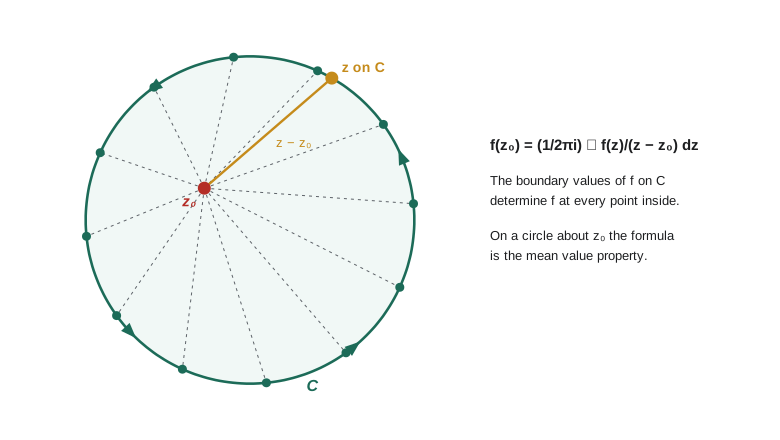
Cauchy's integral formula. Let \(f\) be analytic on an open set containing a closed disk \(\overline{D}\), and let \(C\) be its boundary circle, positively oriented. Then for every \(z_0\) inside \(C\),
\[f(z_0) = \frac{1}{2\pi i}\oint_C\frac{f(z)}{z - z_0}\,dz.\]
Proof. The integrand is analytic except at \(z_0\), so by the deformation principle of lesson 7 we may replace \(C\) by a small circle \(C_\rho\) of radius \(\rho\) about \(z_0\). Write
\[\oint_{C_\rho}\frac{f(z)}{z - z_0}\,dz = f(z_0)\oint_{C_\rho}\frac{dz}{z - z_0} + \oint_{C_\rho}\frac{f(z) - f(z_0)}{z - z_0}\,dz.\]
The first term is \(2\pi i f(z_0)\). In the second, \(|z - z_0| = \rho\), so by the ML inequality its modulus is at most \(\frac{\max_{C_\rho}|f(z) - f(z_0)|}{\rho}\cdot 2\pi\rho = 2\pi\max_{C_\rho}|f(z) - f(z_0)|\), which tends to 0 as \(\rho \to 0\) by continuity of \(f\). But the left side does not depend on \(\rho\), so the second term is exactly 0. \(\square\)
The same proof works for any positively oriented simple closed contour \(C\) with \(f\) analytic on and inside it, and Cauchy stated the formula in 1831, in a memoir written in Turin. The formula is remarkable. It says that an analytic function behaves like a steady-state temperature distribution: fix the values on the boundary, and the values inside are forced. No such statement holds for real differentiable functions, which can be changed inside a disk while left alone on its boundary.
For points outside the contour the integral is 0 instead, by Cauchy's theorem, since then \(\frac{f(z)}{z - z_0}\) is analytic inside. Both cases are covered by the general version: if \(f\) is analytic on a simply connected domain \(D\) and \(\gamma\) is a closed contour in \(D\) not passing through \(z_0\), then \(\frac{1}{2\pi i}\oint_\gamma\frac{f(z)}{z - z_0}\,dz = n(\gamma, z_0)\,f(z_0)\), where \(n(\gamma, z_0)\) is the winding number of lesson 6. A curve that winds twice round \(z_0\) reproduces \(2f(z_0)\), one that winds once clockwise reproduces \(-f(z_0)\), and one that does not wind round it at all gives 0.
Worked problem
Using the formula to evaluate an integral
Compute \(\oint_{|z| = 2}\frac{e^z}{z - 1}\,dz\) and \(\oint_{|z| = 2}\frac{\cos z}{z^2 + 1}\,dz\).
Show solution
- In the first, \(f(z) = e^z\) is entire and \(z_0 = 1\) is inside, so the integral is \(2\pi i e\).
- In the second, \(\frac{1}{z^2 + 1} = \frac{1}{2i}\big(\frac{1}{z - i} - \frac{1}{z + i}\big)\), with both points inside.
- Applying the formula twice with \(f = \cos\): \(\frac{1}{2i}\cdot 2\pi i(\cos i - \cos(-i)) = 0\), since cosine is even.
Answer: \(2\pi ie\) and 0.
Analytic functions are infinitely differentiable
The integral formula expresses \(f(z_0)\) as an integral in which \(z_0\) appears only in the simple factor \(\frac{1}{z - z_0}\). Differentiating under the integral sign suggests
\[f^{(n)}(z_0) = \frac{n!}{2\pi i}\oint_C\frac{f(z)}{(z - z_0)^{n+1}}\,dz, \qquad n = 0, 1, 2, \dots\]
Theorem. Under the hypotheses of the integral formula, \(f\) has derivatives of all orders inside \(C\), given by this formula.
Proof for \(n = 1\). Let \(d\) be the distance from \(z_0\) to \(C\) and take \(|h| < \frac{d}{2}\). By the integral formula at \(z_0 + h\) and \(z_0\),
\[\frac{f(z_0 + h) - f(z_0)}{h} = \frac{1}{2\pi i}\oint_C\frac{f(z)}{(z - z_0 - h)(z - z_0)}\,dz.\]
Subtracting the claimed value, the difference is \(\frac{h}{2\pi i}\oint_C\frac{f(z)}{(z - z_0 - h)(z - z_0)^2}\,dz\). On \(C\), \(|z - z_0| \ge d\) and \(|z - z_0 - h| \ge \frac{d}{2}\), so if \(|f| \le M\) on \(C\) and \(C\) has length \(L\), the ML inequality bounds this by \(\frac{|h|}{2\pi}\cdot\frac{2M}{d^3}L \to 0\). The higher derivatives follow by induction with the same estimate. \(\square\)
Since \(f'\) is again analytic, so is \(f''\), and so on: an analytic function is infinitely differentiable. In particular the partial derivatives of \(u\) and \(v\) of every order are continuous, which justifies the claim in lesson 4 that the real and imaginary parts are harmonic. Contrast real analysis, where \(x|x|\) has one derivative but not two.
Worked problem
Higher-order poles
Compute \(\oint_{|z| = 1}\frac{\sin z}{z^4}\,dz\).
Show solution
- Here \(f = \sin\), \(z_0 = 0\), and \(n + 1 = 4\), so \(n = 3\).
- The formula gives \(\frac{2\pi i}{3!}f'''(0)\), and \(f''' = -\cos\), so \(f'''(0) = -1\).
Answer: \(-\frac{2\pi i}{6} = -\frac{\pi i}{3}\).
Cauchy's estimates and Liouville's theorem
Apply the derivative formula on the circle \(|z - z_0| = R\), where \(|f| \le M\). The circle has length \(2\pi R\) and \(|z - z_0|^{n+1} = R^{n+1}\), so
\[|f^{(n)}(z_0)| \le \frac{n!\,M}{R^n}.\]
These are Cauchy's estimates. They say that a bound on \(f\) on a circle controls all its derivatives at the center.
Liouville's theorem. A bounded entire function is constant.
Proof. Suppose \(|f| \le M\) on the whole plane. For any \(z_0\) and any \(R > 0\), Cauchy's estimate with \(n = 1\) gives \(|f'(z_0)| \le \frac{M}{R}\). Let \(R \to \infty\): \(f'(z_0) = 0\). So \(f' = 0\) everywhere and \(f\) is constant. \(\square\)
The theorem is named after Joseph Liouville, who lectured on it in 1847, though Cauchy had published it in 1844. It explains why \(\sin z\) and \(\cos z\) had to be unbounded in lesson 5: they are entire and not constant.
The fundamental theorem of algebra
Theorem. Every non-constant polynomial \(p\) with complex coefficients has a root in \(\mathbb{C}\).
Proof. Suppose \(p(z) \ne 0\) for all \(z\). Then \(g = \frac{1}{p}\) is entire. Write \(p(z) = a_nz^n + \dots + a_0\) with \(n \ge 1\) and \(a_n \ne 0\). For large \(|z|\), \(|p(z)| \ge |a_n||z|^n - (|a_{n-1}||z|^{n-1} + \dots + |a_0|) \ge \frac{|a_n|}{2}|z|^n\), so \(|g(z)| \to 0\) as \(|z| \to \infty\). In particular \(|g| \le 1\) outside some disk, and \(g\) is bounded on that closed disk because it is continuous there. So \(g\) is a bounded entire function, hence constant by Liouville, and then \(p\) is constant: a contradiction. \(\square\)
Dividing out a root at a time, a polynomial of degree \(n\) factors as \(a_n(z - z_1)\cdots(z - z_n)\), as stated in lesson 1. Gauss gave several proofs from 1799 onward; this one, from analysis rather than algebra, is perhaps the shortest.
Morera's theorem
Cauchy's theorem has a converse. Morera's theorem (Giacinto Morera, 1886): if \(f\) is continuous on a domain \(D\) and \(\oint_{\partial T} f\,dz = 0\) for every triangle \(T\) in \(D\) with its inside, then \(f\) is analytic on \(D\). Proof: on any disk in \(D\), the construction of lesson 7 gives an antiderivative \(F\) with \(F' = f\). Then \(F\) is analytic, so by the theorem above its derivative \(f\) is analytic too. \(\square\) Morera's theorem is the standard tool for showing that limits, sums and integrals of analytic functions are analytic, since vanishing integrals pass to limits easily.
Uniform limits of analytic functions
Morera's theorem has a powerful consequence, due to Karl Weierstrass. Suppose analytic functions \(f_n\) on a domain \(D\) converge to \(f\) uniformly on every closed disk in \(D\). Then \(f\) is analytic on \(D\), and \(f_n' \to f'\) uniformly on every closed disk as well.
Proof. On a closed disk, \(f\) is a uniform limit of continuous functions, hence continuous. For a triangle \(T\) in a disk in \(D\), \(\oint_{\partial T} f_n\,dz = 0\) by Cauchy–Goursat, and the ML inequality gives \(|\oint_{\partial T}(f - f_n)\,dz| \le \max_{\partial T}|f - f_n|\cdot\operatorname{perimeter}(T) \to 0\). So \(\oint_{\partial T} f\,dz = 0\), and Morera's theorem shows \(f\) is analytic. For the derivatives, apply the derivative formula to \(f - f_n\) on a slightly larger circle: by Cauchy's estimate, \(|f'(z) - f_n'(z)| \le \frac{1}{R}\max_{|w - z| = R}|f(w) - f_n(w)| \to 0\). \(\square\)
Nothing like this is true on the real line. The functions \(\frac{\sin(n^2x)}{n}\) converge uniformly to 0, but their derivatives \(n\cos(n^2x)\) do not converge at all; and by the Weierstrass approximation theorem, every continuous function on an interval, differentiable or not, is a uniform limit of polynomials. In the complex plane, uniform convergence preserves analyticity. Lesson 9 applies the theorem to power series.
Worked problem
Cauchy's estimates for a specific function
Let \(f(z) = \frac{1}{1 - z}\) on the unit disk. Bound \(|f^{(n)}(0)|\) using the circle \(|z| = r < 1\), and compare with the true value.
Show solution
- On \(|z| = r\), \(|1 - z| \ge 1 - r\), so \(M = \frac{1}{1 - r}\).
- Cauchy's estimate gives \(|f^{(n)}(0)| \le \frac{n!}{r^n(1 - r)}\) for every \(r < 1\).
- Minimizing over \(r\): the function \(r^n(1 - r)\) is largest at \(r = \frac{n}{n + 1}\).
- The true value is \(f^{(n)}(0) = n!\), since \(f = \sum z^k\).
Answer: The bound is \(n!\,\frac{(n + 1)^{n+1}}{n^n} \approx e(n + 1)\,n!\), larger than the true value \(n!\) by a factor of about \(e(n + 1)\). The estimate is crude but grows at the right factorial rate.
Mean values and the maximum modulus principle
Take \(C\) to be the circle \(z = z_0 + re^{it}\) in the integral formula. Then \(dz = ire^{it}\,dt\) and \(z - z_0 = re^{it}\), so
\[f(z_0) = \frac{1}{2\pi}\int_0^{2\pi}f(z_0 + re^{it})\,dt.\]
The value at the center is the average of the values on the circle: the mean value property. Taking real parts, harmonic functions have the same property.
Maximum modulus principle. If \(f\) is analytic on a domain \(D\) and \(|f|\) has a local maximum at a point of \(D\), then \(f\) is constant on \(D\).
Proof sketch. Suppose \(|f(z_0)| \ge |f(z)|\) for \(z\) in a disk about \(z_0\). For each small \(r\), \(|f(z_0)| \le \frac{1}{2\pi}\int_0^{2\pi}|f(z_0 + re^{it})|\,dt \le |f(z_0)|\), so equality holds, which forces \(|f| = |f(z_0)|\) on every small circle, hence on a disk. By lesson 4 an analytic function of constant modulus on a disk is constant there, and the identity theorem of lesson 9 extends this to all of \(D\). \(\square\)
Consequently, on a closed bounded region, \(|f|\) attains its maximum on the boundary. For example, the maximum of \(|z^2 + 1|\) on the closed unit disk is attained on the circle, where at \(z = \pm 1\) it equals 2.
import cmath, math

def circle_integral(g, z0=0, r=1.0, n=2048):
    """Trapezoid rule on a circle: spectrally accurate for smooth periodic integrands."""
    s = 0
    for k in range(n):
        t = 2*math.pi*k/n
        z = z0 + r*cmath.exp(1j*t)
        s += g(z) * 1j*r*cmath.exp(1j*t)
    return s * 2*math.pi/n

f = lambda z: cmath.exp(z) * cmath.cos(z)
for z0 in [0.3 + 0.2j, -0.5j, 0.9]:
    rec = circle_integral(lambda z: f(z)/(z - z0), r=2) / (2j*math.pi)
    print(f"z0={z0}: Cauchy formula {rec:.10f}  direct {f(z0):.10f}")

# Derivatives at 0 from the circle |z| = 1: f^(n)(0) = n!/(2 pi i) * integral f/z^(n+1).
for n in range(5):
    d = math.factorial(n) * circle_integral(lambda z: cmath.sin(z)/z**(n+1)) / (2j*math.pi)
    print(f"sin^({n})(0) approx {d.real:+.10f}")

print("integral of sin z / z^4 on |z|=1:", circle_integral(lambda z: cmath.sin(z)/z**4), " -pi*i/3 =", -math.pi*1j/3)

# Mean value property and the maximum modulus on the unit disk for z^2 + 1.
g = lambda z: z*z + 1
mean = sum(g(0.6*cmath.exp(2j*math.pi*k/1000)) for k in range(1000)) / 1000
print("mean of g on |z|=0.6:", mean, " g(0) =", g(0))
best = max((abs(g(r*cmath.exp(1j*t))), r, t) for r in [0.25*i for i in range(5)] for t in [2*math.pi*k/360 for k in range(360)])
print(f"max |z^2+1| on the grid: {best[0]:.4f} at r = {best[1]}")z0=(0.3+0.2j): Cauchy formula 1.3051816287+0.1826248425j direct 1.3051816287+0.1826248425j z0=(-0-0.5j): Cauchy formula 0.9895848834-0.5406126857j direct 0.9895848834-0.5406126857j z0=0.9: Cauchy formula 1.5289138119-0.0000000000j direct 1.5289138119+0.0000000000j sin^(0)(0) approx -0.0000000000 sin^(1)(0) approx +1.0000000000 sin^(2)(0) approx +0.0000000000 sin^(3)(0) approx -1.0000000000 sin^(4)(0) approx -0.0000000000 integral of sin z / z^4 on |z|=1: (5.562941629376987e-16-1.047197551196594j) -pi*i/3 = (-0-1.0471975511965976j) mean of g on |z|=0.6: (0.9999999999999999-1.6691509285848838e-17j) g(0) = 1 max |z^2+1| on the grid: 2.0000 at r = 1.0
Common mistakes
Common mistakes
MistakeForgetting the factor \(n!\) in the derivative formula.
Instead\(\oint\frac{f(z)}{(z - z_0)^{n+1}}\,dz = \frac{2\pi i}{n!}f^{(n)}(z_0)\).
MistakeApplying the formula when \(z_0\) is outside the contour.
InsteadThen the integrand is analytic inside, and the integral is 0 by Cauchy's theorem.
MistakeUsing Liouville's theorem for functions bounded only on the real axis.
InsteadBoundedness must hold on the whole plane; \(\sin z\) is bounded on the real axis but unbounded on the plane.
MistakeThinking the maximum of \(|f|\) on a disk can be at an interior point for non-constant \(f\).
InsteadThe maximum modulus principle puts it on the boundary.
MistakeLeaving part of the integrand inside \(f\) that is not analytic.
InsteadPut into \(f\) everything that is analytic inside the contour, and keep only \((z - z_0)^{-(n+1)}\) outside.
Summary and key terms
- Cauchy's integral formula: \(f(z_0) = \frac{1}{2\pi i}\oint_C\frac{f(z)}{z - z_0}\,dz\) for \(z_0\) inside \(C\).
- Analytic functions are infinitely differentiable, with \(f^{(n)}(z_0) = \frac{n!}{2\pi i}\oint_C\frac{f(z)}{(z - z_0)^{n+1}}\,dz\).
- Cauchy's estimates \(|f^{(n)}(z_0)| \le \frac{n!M}{R^n}\) imply Liouville's theorem: bounded entire functions are constant.
- Liouville's theorem gives a short proof of the fundamental theorem of algebra.
- Morera's theorem is a converse to Cauchy's; the mean value property gives the maximum modulus principle.
- Integral formula
- The representation of \(f\) inside a contour by an integral of its boundary values.
- Cauchy's estimates
- \(|f^{(n)}(z_0)| \le \frac{n!M}{R^n}\) where \(|f| \le M\) on \(|z - z_0| = R\).
- Liouville's theorem
- Every bounded entire function is constant.
- Morera's theorem
- A continuous function whose integrals round all triangles vanish is analytic.
- Maximum modulus principle
- A non-constant analytic function on a domain has no local maximum of its modulus.
Practice problems
Work each problem on paper first, then reveal the answer to check.
Compute \(\oint_{|z| = 3}\frac{z^2}{z - 2}\,dz\).
Show answer
\(2\pi i \cdot 4 = 8\pi i\).
Compute \(\oint_{|z| = 1}\frac{e^{2z}}{z^3}\,dz\).
Show answer
\(\frac{2\pi i}{2!}\cdot\frac{d^2}{dz^2}e^{2z}\big|_0 = \pi i \cdot 4 = 4\pi i\).
Let \(f\) be entire with \(|f(z)| \le 5|z|\) for all \(z\). Show \(f(z) = az\) for a constant \(a\).
Show answer
Cauchy's estimate with \(n = 2\) on \(|z - z_0| = R\) gives \(|f''(z_0)| \le \frac{2 \cdot 5(|z_0| + R)}{R^2} \to 0\); so \(f\) is linear, and \(f(0) = 0\).
Find the maximum of \(|e^z|\) on the closed unit disk.
Show answer
\(|e^z| = e^x\) is largest on the boundary at \(z = 1\): the maximum is \(e\).
Show that an entire function whose real part is bounded above is constant.
Show answer
Apply Liouville to \(e^{f}\), whose modulus \(e^{\operatorname{Re} f}\) is bounded; so \(e^f\) is constant, hence \(f' e^f = 0\) and \(f\) is constant.
Lesson quiz · 5 questions
Score 60% or more to complete this lesson.
Create a free account to save your progress, take quizzes and earn a certificate.