
MATH-101 · Lesson 9 of 12 · 37 min
Power series and the complex exponential
Lesson 8 introduced infinite series, tests for their convergence, power series and Taylor series. Power series are far more than a way to approximate functions near a point. They can be added, multiplied, differentiated and integrated term by term, which makes them a working tool: they give values of integrals that have no elementary antiderivative, solutions of differential equations that cannot be solved in closed form, and fast algorithms for computing constants such as π. Most strikingly, the series for \(e^x\), \(\cos x\) and \(\sin x\) reveal a deep connection between exponentials and trigonometry when \(x\) is allowed to be a complex number. Euler's formula, \(e^{i\theta} = \cos\theta + i\sin\theta\), underlies the phasor analysis of AC circuits, the description of vibrations and waves, signal processing and control theory. This lesson develops these tools and ends with the complex arithmetic that electrical and mechanical engineers use every day.
Radius and interval of convergence
Lesson 8 showed that a power series \(\sum c_n (x - a)^n\) converges for \(|x - a| < R\) and diverges for \(|x - a| > R\), where the radius of convergence \(R\) can be found with the ratio test. At the two endpoints, \(x = a \pm R\), anything can happen, and each endpoint must be checked separately with another test. The set of \(x\) where the series converges is the interval of convergence.
Worked problem
An interval of convergence
Find the interval of convergence of \(\displaystyle\sum_{n=1}^{\infty}\frac{(x - 2)^n}{n\,3^n}\).
Show solution
- Ratio test: \(\left|\dfrac{a_{n+1}}{a_n}\right| = \dfrac{|x - 2|}{3}\cdot\dfrac{n}{n + 1} \to \dfrac{|x - 2|}{3}\). Convergence for \(|x - 2| < 3\), so \(R = 3\).
- At \(x = 5\): the series is \(\sum 1/n\), the harmonic series, which diverges.
- At \(x = -1\): the series is \(\sum (-1)^n/n\), which converges by the alternating series test.
Answer: The interval is [−1, 5): it includes the left endpoint but not the right.
The radius of convergence has a simple explanation in terms of complex numbers, which this lesson introduces below: a power series centered at \(a\) converges out to the nearest point, possibly a complex one, where the function misbehaves. The series for \(1/(1 + x^2)\) about 0 has radius 1 even though the function is perfectly smooth for all real \(x\), because \(1 + x^2 = 0\) at the complex points \(x = \pm i\).
Building new series from known ones
Inside its interval of convergence, a power series can be manipulated like a polynomial. This lets you build series for new functions from a few known ones, without computing derivatives:
- Substitution: replacing \(x\) by \(-x^2\) in \(e^x = \sum x^n/n!\) gives \(e^{-x^2} = \sum (-1)^n x^{2n}/n!\).
- Multiplication by powers: \(x\sin x = x^2 - x^4/3! + x^6/5! - \cdots\).
- Differentiation term by term: differentiating \(\frac{1}{1 - x} = \sum x^n\) gives \(\frac{1}{(1 - x)^2} = \sum n x^{n-1}\), with the same radius of convergence.
- Integration term by term: integrating \(\frac{1}{1 + t^2} = \sum (-1)^n t^{2n}\) from 0 to \(x\) gives the arctangent series.
Similarly, integrating \(\frac{1}{1 + t} = \sum (-1)^n t^n\) gives \(\ln(1 + x) = x - \frac{x^2}{2} + \frac{x^3}{3} - \cdots\) for \(-1 < x \le 1\).
Worked problem
Computing π
Putting \(x = 1\) in the arctangent series gives \(\pi/4 = 1 - 1/3 + 1/5 - \cdots\), which converges very slowly. John Machin's formula of 1706, \(\dfrac{\pi}{4} = 4\arctan\dfrac{1}{5} - \arctan\dfrac{1}{239}\), converges much faster. Use three terms of each series to estimate π.
Show solution
- \(\arctan(1/5) \approx 0.2 - 0.002\,667 + 0.000\,064 = 0.197\,397\).
- \(\arctan(1/239) \approx 0.004\,184\,1 - 0.000\,000\,02 = 0.004\,184\,1\).
- \(\pi \approx 4(4 \times 0.197\,397 - 0.004\,184\,1) = 4(0.785\,404) = 3.141\,62\).
Answer: About 3.14162, against π = 3.14159, with only a handful of terms. Formulas of this kind computed π to hundreds of digits by hand, and modern algorithms built on series have computed it to trillions.
Integrals that have no elementary antiderivative
Lesson 2 noted that integrals such as \(\int e^{-x^2}\,dx\) and \(\int \frac{\sin x}{x}\,dx\) cannot be expressed with elementary functions. Power series provide both a definition and a practical way to compute them: expand the integrand, integrate term by term, and sum enough terms.
Worked problem
The error function
Estimate \(\displaystyle\int_0^{0.5} e^{-x^2}\,dx\) with a series, and bound the error.
Show solution
- Series: \(e^{-x^2} = 1 - x^2 + \dfrac{x^4}{2} - \dfrac{x^6}{6} + \cdots\).
- Integrate: \(\left[x - \dfrac{x^3}{3} + \dfrac{x^5}{10} - \dfrac{x^7}{42}\right]_0^{0.5} = 0.5 - 0.041\,667 + 0.003\,125 - 0.000\,186 = 0.461\,272\).
- The series alternates, so the error is less than the next term, \(0.5^9/216 = 9.0 \times 10^{-6}\).
Answer: About 0.46128 (the exact value is 0.461281), with a guaranteed error below 10⁻⁵. Multiplying by 2/√π gives erf(0.5) ≈ 0.5205, the probability that a normal random variable lies within 0.5√2 ≈ 0.71 standard deviations of its mean.
Worked problem
The sine integral
Estimate \(\displaystyle\int_0^1 \frac{\sin x}{x}\,dx\).
Show solution
- Series: \(\dfrac{\sin x}{x} = 1 - \dfrac{x^2}{6} + \dfrac{x^4}{120} - \cdots\).
- Integrate: \(1 - \dfrac{1}{18} + \dfrac{1}{600} - \dfrac{1}{35\,280} = 0.946\,083\).
Answer: About 0.94608, accurate to six digits. This integral, the sine integral Si(1), appears in antenna theory and in the analysis of filters and the Gibbs phenomenon (Lesson 10).
Series solutions of differential equations
Many differential equations that arise in engineering have solutions that are not elementary functions. One approach is to assume a solution in the form of a power series, \(y = \sum c_n x^n\), substitute it into the equation, and match the coefficients of each power of \(x\). This gives a recurrence relation for the coefficients.
Worked problem
A series solution
Find a power series solution of \(y'' + y = 0\) with \(y(0) = 1\) and \(y'(0) = 0\).
Show solution
- Let \(y = \sum c_n x^n\), so \(y'' = \sum n(n - 1)c_n x^{n-2} = \sum (n + 2)(n + 1)c_{n+2}x^n\).
- Substituting and matching coefficients: \((n + 2)(n + 1)c_{n+2} + c_n = 0\), so \(c_{n+2} = -\dfrac{c_n}{(n + 2)(n + 1)}\).
- With \(c_0 = 1\), \(c_1 = 0\): \(c_2 = -\tfrac{1}{2}\), \(c_4 = \tfrac{1}{24}\), \(c_6 = -\tfrac{1}{720}\), and all odd coefficients vanish.
Answer: y = 1 − x²/2! + x⁴/4! − x⁶/6! + ⋯ = cos x, as expected for this simple harmonic equation. For equations such as Bessel's equation, which describes vibrating drums, heat flow in cylinders and the current distribution in round conductors at high frequency, the same method produces new functions (Bessel functions) defined by their series.
The binomial series
For any real number \(p\), Newton's binomial series generalizes the binomial theorem to non-integer powers:
When \(p\) is a positive integer, the series stops and gives the familiar binomial expansion; otherwise it is infinite. It provides quick approximations such as \(\sqrt{1 + x} \approx 1 + x/2 - x^2/8\) and \(1/\sqrt{1 - x} \approx 1 + x/2 + 3x^2/8\).
Worked problem
Relativistic kinetic energy
The kinetic energy of a mass moving at speed \(v\) is \(E_k = mc^2\left[(1 - v^2/c^2)^{-1/2} - 1\right]\). Use the binomial series to show that it reduces to \(\tfrac{1}{2}mv^2\) at ordinary speeds, and estimate the correction for a satellite at 7.8 km/s.
Show solution
- With \(x = v^2/c^2\) and \(p = -\tfrac{1}{2}\): \((1 - x)^{-1/2} = 1 + \tfrac{1}{2}x + \tfrac{3}{8}x^2 + \cdots\).
- So \(E_k = mc^2\left(\tfrac{1}{2}\dfrac{v^2}{c^2} + \tfrac{3}{8}\dfrac{v^4}{c^4} + \cdots\right) = \tfrac{1}{2}mv^2\left(1 + \tfrac{3}{4}\dfrac{v^2}{c^2} + \cdots\right)\).
- For \(v = 7{,}800\) m/s: \(v^2/c^2 = 6.8 \times 10^{-10}\), so the correction is about \(5 \times 10^{-10}\) of the classical value.
Answer: The classical formula is the first term of the series; the relative correction for an orbiting satellite is about 5 parts in 10¹⁰. Such small corrections matter for GPS satellite clocks, which must be adjusted for relativistic effects to keep positioning accurate.
Complex numbers
A complex number has the form \(z = a + bi\), where \(a\) and \(b\) are real and \(i\) satisfies \(i^2 = -1\). (Electrical engineers write \(j\) instead of \(i\), because \(i\) denotes current.) The real part is \(a\) and the imaginary part \(b\). Complex numbers add component by component and multiply using \(i^2 = -1\): \((a + bi)(c + di) = (ac - bd) + (ad + bc)i\). The complex conjugate of \(z\) is \(\bar{z} = a - bi\), and \(z\bar{z} = a^2 + b^2\), which is used to divide: \(\dfrac{1}{a + bi} = \dfrac{a - bi}{a^2 + b^2}\).
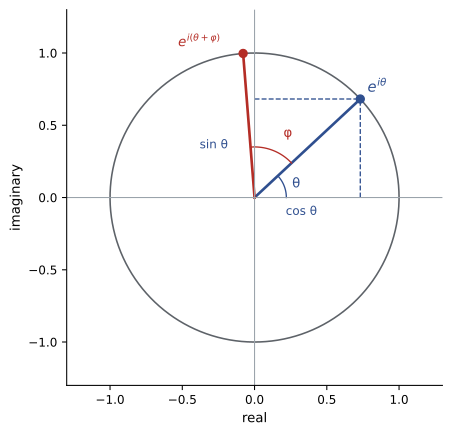
A complex number can be pictured as a point in the complex plane, with the real part horizontal and the imaginary part vertical. Its distance from the origin is the modulus \(|z| = \sqrt{a^2 + b^2}\), and its angle from the positive real axis is the argument \(\theta\), so that \(z = |z|(\cos\theta + i\sin\theta)\), the polar form of Lesson 7 in a new setting.
Every polynomial equation has solutions among the complex numbers (the fundamental theorem of algebra), so complex numbers make the quadratic formula always work: \(x^2 + 2x + 5 = 0\) has the roots \(-1 \pm 2i\). In engineering, complex roots of characteristic equations signal oscillation, as MATH-201 shows.
Euler's formula
Substituting \(i\theta\) into the exponential series and separating real and imaginary parts, using \(i^2 = -1\), \(i^3 = -i\), \(i^4 = 1\):
The two brackets are the series for \(\cos\theta\) and \(\sin\theta\), giving Euler's formula:
With \(\theta = \pi\) it gives \(e^{i\pi} + 1 = 0\), linking five of the most important numbers in mathematics. More usefully, every complex number can be written compactly as \(z = |z|e^{i\theta}\), and the laws of exponents then make multiplication simple: moduli multiply and arguments add, \(r_1e^{i\theta_1} \cdot r_2e^{i\theta_2} = r_1r_2e^{i(\theta_1 + \theta_2)}\). Multiplying by \(e^{i\phi}\) rotates a point by angle \(\phi\) about the origin. Raising to powers gives De Moivre's formula, \((\cos\theta + i\sin\theta)^n = \cos n\theta + i\sin n\theta\), from which multiple-angle identities follow in one line.
Euler's formula also expresses the trigonometric functions as exponentials, \(\cos\theta = \frac{e^{i\theta} + e^{-i\theta}}{2}\) and \(\sin\theta = \frac{e^{i\theta} - e^{-i\theta}}{2i}\), the complex counterparts of the definitions of \(\cosh\) and \(\sinh\). Integrals such as \(\int e^{ax}\cos bx\,dx\), which need integration by parts twice (Lesson 1), become a single step: take the real part of \(\int e^{(a + ib)x}\,dx = \frac{e^{(a + ib)x}}{a + ib}\).
Phasors and oscillations
A sinusoidal quantity \(A\cos(\omega t + \phi)\) is the real part of \(Ae^{i\phi}e^{i\omega t}\). The complex number \(Ae^{i\phi}\), which captures the amplitude and phase, is called a phasor. Because differentiating \(e^{i\omega t}\) simply multiplies it by \(i\omega\), linear differential equations driven by sinusoids become algebraic equations for phasors. This is the basis of AC circuit analysis: a resistor, inductor and capacitor have impedances \(R\), \(i\omega L\) and \(1/(i\omega C)\), which combine like resistances.
Worked problem
An RL circuit with phasors
Repeat the RL circuit of Lesson 5 (\(R = 10\) Ω, \(L = 0.05\) H, \(V_m = 170\) V, \(\omega = 377\) rad/s) using complex impedance.
Show solution
- Impedance: \(Z = R + i\omega L = 10 + 18.85i\) Ω. Modulus \(|Z| = 21.34\) Ω; argument \(\arctan(1.885) = 62.1°\).
- Current phasor: \(I = V/Z\), so \(|I| = 170/21.34 = 7.97\) A, lagging the voltage by 62.1°.
Answer: The same 7.97 A lagging by 62° that integration by parts gave in Lesson 5, found in two lines of complex arithmetic. This efficiency is why electrical engineers work with phasors.
Complex exponents also describe damped oscillations. If \(s = \sigma + i\omega\), then \(e^{st} = e^{\sigma t}(\cos\omega t + i\sin\omega t)\): the real part \(\sigma\) sets the growth or decay of the envelope and the imaginary part \(\omega\) the frequency of oscillation. A vibrating structure, a suspension or a control loop whose characteristic equation has roots with negative real parts settles down; roots with positive real parts mean growing oscillations and instability. This single idea links the series of this lesson to the vibration, circuit and control courses that follow.
Common mistakes
MistakeStating the interval of convergence without checking the endpoints.
InsteadTest each endpoint separately; they may converge or diverge.
MistakeUsing a series outside its radius of convergence.
InsteadSeries manipulations are valid only inside the interval of convergence.
MistakeForgetting that differentiating or integrating a series keeps its radius but may change endpoint behavior.
InsteadRecheck endpoints after differentiating or integrating.
MistakeWriting i³ = i.
Insteadi² = −1, so i³ = −i and i⁴ = 1.
MistakeAdding the moduli when multiplying complex numbers.
InsteadModuli multiply and arguments add.
Summary and key terms
- Power series converge within a radius R found by the ratio test; endpoints need separate checks.
- New series come from substitution, multiplication, and term-by-term differentiation and integration.
- Integrating 1/(1 + t²) gives the arctangent series; Machin's formula computes π rapidly.
- Series evaluate non-elementary integrals such as ∫e^(−x²) dx and ∫sin x/x dx with error bounds.
- Substituting power series into differential equations gives recurrence relations for the coefficients.
- The binomial series extends (1 + x)ᵖ to any real p for |x| < 1.
- Euler's formula e^(iθ) = cos θ + i sin θ underlies polar complex numbers, phasors and the analysis of oscillations.
- Radius of convergence
- The distance from the center within which a power series converges.
- Interval of convergence
- The set of x for which a power series converges.
- Term-by-term differentiation
- Differentiating each term of a power series to get the series of the derivative.
- Recurrence relation
- An equation giving each coefficient in terms of earlier ones.
- Binomial series
- The series for (1 + x)ᵖ for any real p.
- Complex number
- A number a + bi with i² = −1.
- Modulus
- The distance |z| of a complex number from the origin.
- Argument
- The angle of a complex number from the positive real axis.
- Euler's formula
- e^(iθ) = cos θ + i sin θ.
- Phasor
- A complex number representing the amplitude and phase of a sinusoid.
Practice problems
Work each problem on paper first, then reveal the answer to check.
Find the radius of convergence of \(\sum \frac{x^n}{2^n}\).
Show answer
2.
Find the interval of convergence of \(\sum \frac{x^n}{n}\).
Show answer
[−1, 1).
Write the series for \(\frac{1}{1 + x^2}\).
Show answer
1 − x² + x⁴ − x⁶ + ⋯ for |x| < 1.
Find the first three non-zero terms of \(x e^{-x}\).
Show answer
x − x² + x³/2.
Estimate \(\int_0^{0.2} e^{-x^2}\,dx\) with two terms.
Show answer
0.2 − 0.008/3 = 0.19733.
Give the recurrence for \(y' = y\) with \(y = \sum c_n x^n\).
Show answer
c_(n+1) = c_n/(n + 1), giving eˣ when c₀ = 1.
Use the binomial series to approximate \(\sqrt{1.1}\) with three terms.
Show answer
1 + 0.05 − 0.00125 = 1.04875 (exact 1.04881).
Compute \((2 + 3i)(1 - i)\).
Show answer
5 + i.
Write \(1 + i\) in exponential form.
Show answer
√2 e^(iπ/4).
Impedance of R = 30 Ω in series with C = 100 µF at ω = 377 rad/s?
Show answer
30 − 26.5i Ω, modulus 40.0 Ω.
Lesson quiz · 5 questions
Score 60% or more to complete this lesson.
Create a free account to save your progress, take quizzes and earn a certificate.