
LVT-230 · Lesson 3 of 12 · 20 min
Detectors: contacts, motion, glass-break and more
An intrusion system is only as good as its detectors and where they are put. A panel with a perfect zone list and a reliable communicator protects nothing if the motion detector looks at a wall, or if the door contact is mounted so far from its magnet that the door can open a hand's width before it trips. Most false alarms, and most missed intrusions, start with a detector that is the wrong type for the place or is badly mounted. This lesson covers the detectors Maya installs at Juniper Point and Riverside: door and window contacts, passive infrared motion detectors, dual-technology detectors, glass-break detectors, shock and vibration sensors, beams, and the panic and holdup devices that people operate themselves.
Perimeter and interior protection
Designers think about detection in layers. Perimeter protection detects someone at the boundary: a door or window being opened or broken. It catches the intruder before they are inside, and it lets people stay in the building with the system armed in stay mode. Interior protection detects someone moving inside, after the perimeter has been crossed or bypassed. It covers areas, not openings, and it is the backup for everything the perimeter missed. A good design uses both. At the Juniper Point lockers, every door has a contact and the aisles have motion detectors; at Riverside, the ground-floor windows have glass-break detectors and the corridors have motion detectors that are armed only after the cleaners leave.
Door and window contacts
The magnetic contact is the simplest detector and the most common. A reed switch in one half, mounted on the frame, is held closed by a magnet in the other half, mounted on the door. When the door opens and the magnet moves away, the reed opens and the zone trips. Contacts come in surface-mount versions, which are quick to install, and recessed versions, which fit into a hole drilled in the frame and door and are hidden when the door is closed. Recessed contacts are harder to tamper with and are preferred on doors people can reach. Overhead doors in garages use heavy-duty contacts with armored leads, mounted on the floor or the track.
Every contact has a gap rating: the largest distance between the switch and the magnet at which the contact still reads closed. On a steel door the rating drops, because steel shunts the magnetic field, so contacts for steel doors are made for it. Mount the two halves aligned, within the rated gap, and on the opening edge of the door, away from the hinges, so the door trips the contact after moving only a little. A contact mounted near the hinge may let a door open far enough for a person to slip through before it trips.
High-security contacts, sometimes called balanced magnetic switches, use several magnets and switches so that holding a separate magnet against the frame trips the contact instead of fooling it. Standards for higher-grade systems require them on certain doors. The installer fits what the specification calls for and tests each one by opening the door, not by moving the magnet by hand.
Passive infrared motion detectors
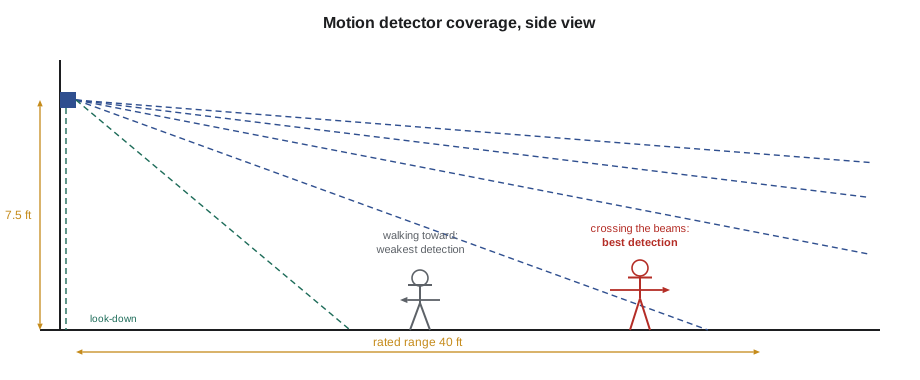
Most motion detectors are passive infrared, or PIR. They do not send out anything. A pyroelectric sensor behind a segmented lens or mirror looks at many narrow zones of the room at once. A person is warmer than the background, so when someone walks across the zones, the sensor sees the infrared level change from zone to zone, and the detector trips. A PIR is most sensitive to movement across its view and least sensitive to someone walking straight toward it, because a person walking straight toward the detector stays in the same zone. That decides where it goes: mount it so the likely path of an intruder crosses its view, usually in a corner looking across the room or along a corridor.
The detector's coverage pattern is printed in the instructions, typically a fan about 40 ft long and 40 ft wide, and it depends on the mounting height. Each detector is designed for a height range, often 7 to 9 ft. Mount it too high and the pattern reaches farther but leaves a gap close to the wall; too low and the pattern falls short. Many detectors have a look-down zone that covers the area directly underneath. The height and the angle of the bracket are set as the manufacturer says, and the coverage is checked with a walk test.
# Where a PIR's beams reach the floor for a given mounting height
import math
def reach(height, tilt_deg):
    # distance along the floor where a beam pointing tilt_deg below horizontal lands
    return height / math.tan(math.radians(tilt_deg))
beams = (4.5, 7.0, 11.0, 20.0, 40.0)      # degrees below horizontal for each beam row
for h in (7.0, 7.5, 9.0, 10.5):
    rows = ", ".join(f"{reach(h, t):5.1f}" for t in beams)
    print(f"mounted at {h:4.1f} ft: beam rows reach the floor at {rows} ft")
print("rated range: 40 ft; rated height: 7 to 9 ft")mounted at 7.0 ft: beam rows reach the floor at 88.9, 57.0, 36.0, 19.2, 8.3 ft mounted at 7.5 ft: beam rows reach the floor at 95.3, 61.1, 38.6, 20.6, 8.9 ft mounted at 9.0 ft: beam rows reach the floor at 114.4, 73.3, 46.3, 24.7, 10.7 ft mounted at 10.5 ft: beam rows reach the floor at 133.4, 85.5, 54.0, 28.8, 12.5 ft rated range: 40 ft; rated height: 7 to 9 ft
The beam angles in the code are illustrative, but the pattern is real: raising the detector pushes the far beam beyond the end of the room, where it sees nothing, while the gap near the wall grows. The manufacturer's height range is the one that makes the beams land where the pattern says.
False alarms from PIR detectors
Because a PIR responds to changing heat, anything that moves heat across its zones can trip it: a heater or air vent that blows warm air across the view, sunlight moving across the floor, a hot vehicle engine in a garage, or a pet. The detector should not look at heaters, air outlets, windows with direct sun, or machinery that cycles on and off. Pet-immune detectors ignore animals below a set weight when mounted at the correct height, but only if the pet cannot climb above the floor zone. Spiders and insects on the lens are another common cause, which is why the maintenance visit includes cleaning detectors.
Dual technology and other motion detectors
A dual-technology detector combines a PIR with a microwave sensor, which sends out a low-power microwave signal and detects movement from the change in the reflected signal. The detector trips only when both technologies see movement within a short time. Each technology's false alarm causes are different, so requiring both cuts false alarms, which is why dual-tech detectors are used in garages, warehouses and rooms with difficult air movement. Microwave passes through thin walls and glass, so its range is adjusted down so it does not see movement in the next room or outside. Some detectors also have anti-masking, which detects someone covering or spraying the lens and reports it as a trouble.
In the Juniper Point garage, where car engines and the door heater move a lot of warm air, Hollis specifies dual-tech detectors with anti-masking for the locker aisles and sets their microwave range just short of the aisle walls.
Glass-break detectors
An acoustic glass-break detector listens for the sound of glass breaking: a low-frequency thud as something strikes the pane, followed within a fraction of a second by the high-frequency sound of glass shattering. Requiring both sounds in the right order is what stops a dropped set of keys or a slammed door from tripping it. One detector can cover several windows in a room, within its rated range, usually measured from the detector to the farthest pane, and it must be able to hear the glass directly. Heavy curtains, shutters and blinds absorb the sound and reduce the range. Laminated, wired and some coated glass break with a different sound, and the manufacturer's instructions list which types the detector is listed for.
Glass-break detectors are tested with a handheld simulator that plays the sound of breaking glass of the right type. Clapping or banging is not a test. The detector's test mode usually shows when it hears the first sound and when it hears both, which helps adjust the sensitivity and confirm the farthest window is covered.
Shock, vibration and other detectors
Shock and vibration sensors mount on walls, safes, cabinets or windows and detect the vibration of an attack, such as drilling or hammering. They are used where an intruder might come through a wall rather than a door, such as the pharmacy at St. Brendan's, which shares a wall with a service corridor. Photoelectric beams send an infrared beam across a long space or along a fence line; anything that blocks the beam trips it. They are used in warehouses and outdoors. Outdoor detection is harder than indoor detection, because weather, animals and plants cause false alarms, and outdoor detectors are designed and listed for it.
Environmental detectors, such as low-temperature, flood and high-water sensors, often share the intrusion panel but are not burglary devices. They report as supervisory or trouble signals so the monitoring station handles them differently. At Juniper Point, a flood sensor in the sprinkler room and a low-temperature sensor in the garage stairwell report this way.
Panic and holdup devices
Some devices are operated by people. A panic button calls for help; a holdup button, used at counters where staff handle money or medicines, sends a silent alarm so the person who pressed it is not put at greater risk. They are wired as 24-hour zones and usually programmed as silent. They must be placed where the user can reach them without being seen, and designed so they are not pressed by accident; many need two buttons pressed together or a cover lifted. The pharmacy counter at St. Brendan's has a holdup button under the counter that reports to the hospital's security office and the monitoring station.
| Detector | What it senses | Main false alarm causes | Installer checks |
|---|---|---|---|
| Magnetic contact | Door or window opening | Misalignment, worn doors | Gap within rating, mounted on the opening edge |
| PIR motion | Moving body heat | Heaters, vents, sun, pets, insects | Height, aim across the path, walk test |
| Dual technology | Heat and microwave movement | Microwave seeing through walls | Range set to the room, walk test |
| Acoustic glass-break | Impact then breaking glass sound | Wrong glass type, curtains | Simulator test at the farthest pane |
| Shock or vibration | Attack on a wall, safe or glass | Building vibration, machinery | Sensitivity set and tested on the surface |
| Photoelectric beam | Beam interruption | Fog, animals, plants | Alignment, signal level |
Mounting and wiring detectors
Each detector needs power, except contacts and some glass-break detectors, and each has an alarm contact and a tamper switch. On a four-wire run, two conductors carry power and two the alarm loop; with double end-of-line, the tamper can share the alarm pair. The detector's power comes from the panel's auxiliary output or a separate supply, and the total current is part of the battery calculation in lesson 10. Mount detectors on a solid surface, not on a ceiling tile that moves, and seal the cable entry so insects do not crawl in. Label each detector with its zone number inside the cover, matching the zone list.
Worked problem
A motion detector that trips every night
The monitoring station reports that zone 10, the locker aisle C motion detector at Juniper Point, alarms between 2 and 3 a.m. most nights, with no one in the garage on camera. The detector is a PIR, not dual-tech, mounted at the end of the aisle facing the garage door. What should Maya look at?
Show solution
- A PIR trips on moving heat, and the camera shows no person, so look for a heat source.
- The aisle faces the garage door, which has a unit heater above it that cycles on during cold nights.
- Warm air from the heater moves across the PIR's view when it starts.
- Replace the detector with the dual-tech, anti-masking model specified for the other aisles and re-aim it along the aisle, away from the door.
Answer: After the change and a walk test, zone 10 stops alarming at night and still trips when Maya walks the aisle.
Common mistakes
MistakeMounting a contact near the door's hinge.
InsteadMount it on the opening edge so it trips early.
MistakeAiming a PIR straight down a path people walk toward it.
InsteadAim it across the likely path.
MistakeMounting a detector outside its rated height range.
InsteadUse the height the manufacturer gives and walk test.
MistakeTesting a glass-break detector by clapping.
InsteadUse the proper simulator for the glass type.
MistakeWiring a holdup button as a delay zone.
InsteadWire it as a silent 24-hour zone.
Summary and key terms
- Perimeter protection detects at openings; interior protection detects movement inside.
- Magnetic contacts must be aligned within their rated gap, on the opening edge.
- PIR detectors sense moving body heat best across their view, and their height sets the coverage.
- Dual-technology detectors need both PIR and microwave to trip, reducing false alarms.
- Glass-break detectors listen for the impact and the breaking sound and are tested with a simulator.
- Panic and holdup devices are 24-hour zones, usually silent, placed out of sight.
- Every detector is walk-tested or simulated at commissioning.
- Magnetic contact
- A reed switch and magnet that detect a door or window opening.
- PIR
- Passive infrared motion detector, which senses changes in infrared from moving bodies.
- Dual technology
- A detector that combines PIR and microwave sensing.
- Glass-break detector
- A detector that listens for the sounds of glass breaking.
- Anti-masking
- A feature that detects covering or spraying of a detector.
- Walk test
- A test in which someone walks through a detector's coverage to check it trips.
- Holdup button
- A device that sends a silent alarm during a robbery.
Practice problems
Work each problem on paper first, then reveal the answer to check.
A PIR is rated for 7 to 9 ft. What happens if it is mounted at 11.5 ft?
Show answer
The far beams overshoot the room and a gap opens near the wall.
Why is a dual-tech detector preferred in a garage?
Show answer
It needs both heat and microwave movement, so warm air alone does not trip it.
What two sounds does an acoustic glass-break detector need?
Show answer
The low-frequency impact followed by the high-frequency shattering.
Why is a holdup button silent?
Show answer
So the person who pressed it is not put at greater risk.
Lesson quiz · 5 questions
Score 60% or more to complete this lesson.
Create a free account to save your progress, take quizzes and earn a certificate.