
LVT-230 · Lesson 2 of 12 · 21 min
Intrusion alarm panels, zones and keypads
The intrusion panel for the Juniper Point storage lockers arrives in a gray steel cabinet with a circuit board, a transformer, a battery bracket and a bag of resistors. Hollis hands Maya the bag before anything else. Those resistors, he says, are what make an alarm system an alarm system rather than a set of switches: they let the panel tell the difference between a door that is closed, a door that is open, a wire that has been cut and a wire that has been shorted. This lesson covers how the panel watches its zones, how end-of-line resistors supervise the wiring, zone types and attributes, keypads and partitions, and the panel features that the installer sets up.
What the control panel does
The control panel is a small computer with inputs and outputs. Its inputs are zones, one for each detector or group of detectors, plus the keypads and any expansion modules on its data bus. Its outputs drive sirens and strobes, relays that signal other systems, and the communicator that reports to the monitoring station. The panel keeps the system's state, armed or disarmed, for each area, and applies the rules programmed for each zone: whether it is watched only when armed or all the time, whether it has an entry delay, and what it reports when it trips. It also watches itself: its mains power, its battery, its siren circuit, its tamper switch and its communication path.
Panels come in sizes from 8 zones for a house to several hundred for a campus. Most have a fixed number of zones on the main board and add more with zone expanders on a four-wire data bus, or with wireless receivers. The Juniper Point locker panel has 16 zones on the board and an eight-zone expander in a second cabinet at the far end of the parkade, joined by the bus cable. Larger systems, like the one at Riverside school, use addressable devices: each detector has its own address on a two-wire loop, so one cable can carry dozens of detectors and the panel still knows which one tripped.
Zones and end-of-line supervision
A simple zone is a loop of wire from a zone terminal, out to a detector's alarm contact and back to a common terminal. The detector's contact is normally closed: it is closed when everything is normal and opens on alarm. If that were the whole circuit, the panel could only see two states, closed and open, and a burglar who shorted the two wires together before opening the door would defeat it. Worse, a cut wire would look like an alarm only if the system was armed, and would go unnoticed the rest of the time.
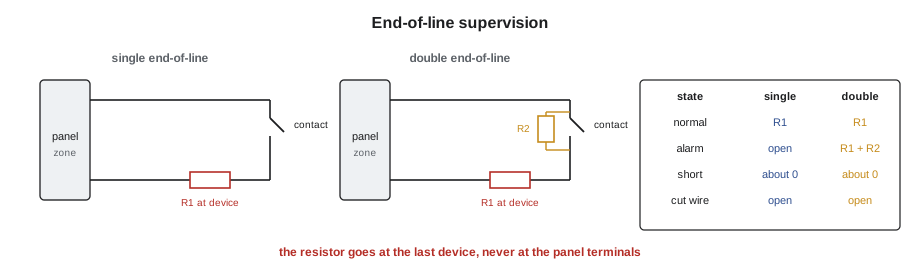
The answer is the end-of-line resistor, or EOL. A resistor is fitted at the far end of the loop, at the last detector, so that in the normal state the panel sees a known resistance, for example 5.6 kΩ. When the contact opens, the panel sees an open circuit. When the wires are shorted, the panel sees close to zero ohms. The panel measures the zone's resistance and so can tell normal from alarm from trouble. That is supervision: the panel knows the wiring itself is intact.
The resistor must be at the end of the line, at the device, not in the panel. A resistor fitted at the panel terminals makes the zone read normal however the field wiring is damaged, because the panel sees only the resistor. It is a common shortcut on old installations, and it removes supervision completely. Monitoring stations and the installation standards require EOL resistors at the device, and Hollis checks for them on every service call.
Single and double end-of-line
With a single EOL and a normally closed contact in series, the panel sees the resistor in the normal state, an open circuit on alarm or a cut wire, and a short on a shorted wire. Because alarm and cut wire look the same, the panel treats an open as an alarm when armed and as a trouble when disarmed. With double end-of-line, or DEOL, a second resistor is wired across the contact, so the panel sees one resistor when the contact is closed, two in series when the contact opens, an open circuit only when the wire is cut, and a short when it is shorted. That gives four distinct states: normal, alarm, tamper and short. Many panels also use DEOL to bring a detector's tamper switch onto the same pair of wires.
# Expected zone readings for single and double end-of-line wiring
R1 = 5600.0      # ohms, end-of-line resistor
R2 = 5600.0      # ohms, second resistor across the contact (DEOL)
WIRE = 0.01614       # ohms per ft of one conductor, 22 AWG
run = 400      # ft from panel to the last device
loop = 2 * WIRE * run
def show(name, ohms):
    text = "open" if ohms is None else f"{ohms:8.0f} ohms"
    print(f"  {name:12s} {text}")
print(f"loop wire resistance: {loop:.1f} ohms")
print("single end-of-line:")
show("normal", R1 + loop); show("alarm", None); show("short", loop); show("cut wire", None)
print("double end-of-line:")
show("normal", R1 + loop); show("alarm", R1 + R2 + loop); show("short", loop); show("cut wire", None)loop wire resistance: 12.9 ohms single end-of-line: normal 5613 ohms alarm open short 13 ohms cut wire open double end-of-line: normal 5613 ohms alarm 11213 ohms short 13 ohms cut wire open
The panel accepts a band around each expected value, because the wire adds resistance and resistors have tolerance. Panel manuals give the limit, often a maximum loop resistance of a few hundred ohms excluding the EOL. On long runs to the far end of a parkade, the wire resistance is worth checking against that limit before the cable goes in, and the zone reading at the panel is worth recording at commissioning, so that a later reading can be compared.
Zone types and attributes
Each zone is programmed with a type that says how the panel responds. The names vary by manufacturer, but the ideas are the same. A delay zone, used for the door people normally come in by, starts an entry delay when it opens while armed, giving the user time to reach the keypad. An instant zone, used for other doors and windows, alarms immediately. An interior or follower zone, used for motion detectors inside, is ignored when the system is armed in stay mode and follows the entry delay when the delay door has opened first, so that a person walking from the door to the keypad does not set off an instant alarm. A 24-hour zone is watched whether the system is armed or not; panic buttons, holdup buttons and the tamper switches on cabinets are 24-hour zones. Some panels also have fire, gas and water zones, but a fire alarm system is a separate, code-governed system, and in commercial buildings intrusion panels do not replace it.
Zones also carry attributes. Bypass permitted lets a user exclude a zone, for example a window left open for ventilation, when arming. Chime makes the keypad beep when the zone opens while disarmed. Swinger shutdown stops a faulty zone from sending dozens of alarms in one night. Cross-zoning requires two zones to trip within a set time before an alarm is sent, which reduces false alarms from a single detector. Each attribute changes how the system behaves in a real event, so the installer sets them from the approved zone list, not by guessing.
| Zone type | Typical device | When it is watched | What happens on trip |
|---|---|---|---|
| Delay (entry/exit) | Main entry door contact | When armed | Entry delay, then alarm if not disarmed |
| Instant | Other doors, windows | When armed | Immediate alarm |
| Interior follower | Motion detector near the entry route | When armed away | Alarm, or follows the entry delay if the delay door opened first |
| 24-hour | Panic, holdup, tamper | Always | Immediate alarm, often silent |
| Supervisory | Low temperature, flood | Always | Trouble or supervisory signal, not burglary |
Areas, partitions and users
Many buildings need parts of the system to arm separately. The panel divides zones into areas, also called partitions, each armed and disarmed on its own. At Juniper Point the board wants the storage lockers armed from midnight to six, the management office armed whenever staff leave, and the gym watched only for its emergency button. That is three partitions on one panel, with the parkade cameras and the gym button shared. Users get codes that work on some partitions and not others: the night cleaner's code disarms only the office, and only between 10 p.m. and 2 a.m.
Each user has a code, and the panel records who armed and disarmed and when. The master code, the installer code and the user codes are different levels of authority. The installer code allows programming and must be changed from the factory default at installation and handed over with the system, never left at a value printed in the manual. The owner's administrator manages users; the installer does not keep a list of user codes.
Keypads
The keypad is where people meet the system, so its location matters as much as any detector's. It goes inside the protected area, close to the entry door, within reach of a user who has just come in, and where an intruder outside cannot watch codes being entered. It has its own tamper switch, and it shows the state of every partition it controls. Keypads with a reader built in let users arm and disarm with their fob. On a bus, each keypad has an address set by switches or programming; two keypads with the same address make the bus misbehave in ways that are hard to trace, so addresses are recorded on the drawing as they are set.
The keypad also shows trouble conditions: AC lost, low battery, a communication failure, a zone trouble. A system that shows a trouble every day is a system that people learn to ignore, so part of commissioning is clearing every trouble before handover and explaining each one to the owner's staff.
Bells, sirens and outputs
The siren output is supervised like a zone: the panel watches for a cut or shorted siren wire, usually through a resistor at the siren or by sensing its current. Sirens are mounted out of easy reach, and outdoor sounders have their own tamper and often their own battery. The panel's programmable outputs drive relays that do other things on an event: turn on lights, signal the access control system, or start a camera recording. Many buildings now use silent alarms for some areas, with no local sound, because the goal is a response, not noise. The owner decides which, and the bylaws in some cities limit how long an outdoor siren may sound.
Programming from the zone list
The designer's zone list is the installer's programming document. It names every zone, its location, its device, its type and attributes, its partition and how it reports. Maya enters the list into the panel, labels each zone with a plain description that will appear on the keypad and at the monitoring station, and then tests each zone, recording the resistance she measured and the event the panel produced. The completed list, with measured values and test results, goes into the handover package.
# Check a zone list for gaps before programming
zones = [  # number, label, type, partition
    (1, "Locker room door", "delay", 1), (2, "Locker room motion", "follower", 1),
    (3, "Locker aisle B motion", "follower", 1), (4, "Locker room door 2", "instant", 1),
    (5, "Office door", "delay", 2), (6, "Office motion", "follower", 2),
    (7, "Gym panic", "24-hour", 3), (8, "Panel tamper", "24-hour", 1),
    (9, "Expander tamper", "24-hour", 1), (10, "Locker aisle C motion", "follower", 1),
]
types = {"delay", "instant", "follower", "24-hour"}
seen = set()
for n, label, t, part in zones:
    if n in seen: print(f"zone {n}: duplicate number")
    if t not in types: print(f"zone {n}: unknown type {t}")
    seen.add(n)
for part in (1, 2, 3):
    pz = [z for z in zones if z[3] == part]
    has_delay = any(z[2] == "delay" for z in pz)
    kinds = sorted({z[2] for z in pz})
    print(f"partition {part}: {len(pz)} zones, types {kinds}, entry delay {'yes' if has_delay else 'none'}")
missing = [k for k in range(1, max(seen) + 1) if k not in seen]
print("unused zone numbers:", missing if missing else "none")partition 1: 7 zones, types ['24-hour', 'delay', 'follower', 'instant'], entry delay yes partition 2: 2 zones, types ['delay', 'follower'], entry delay yes partition 3: 1 zones, types ['24-hour'], entry delay none unused zone numbers: none
Partition 3 has no delay zone, which is correct: the gym button is 24-hour and the gym is never armed. A partition that is meant to be armed by users but has no delay zone, though, means every user who walks in will cause an instant alarm. Checking the list before entering it saves a night of false alarms.
Worked problem
A zone that reads normal when it should not
On a service call at an older building, the monitoring station reports that zone 6, a rear door, has never sent an alarm in three years of tests. Maya opens the door with the system in test mode and the keypad shows nothing. The zone terminals read 5.6 kΩ with the door open. What has she found?
Show solution
- A healthy single-EOL zone should read open when the contact opens.
- Reading 5.6 kΩ with the door open means the panel sees only the resistor.
- She finds the resistor fitted directly across the zone terminals in the panel, and the field wires twisted together at the door.
- The door contact has been removed from the circuit; the zone was never supervised.
Answer: She fits the resistor at the door contact, reconnects the field wiring, tests normal, alarm, short and open, and reports the fault to the owner in writing.
Common mistakes
MistakeFitting end-of-line resistors at the panel.
InsteadFit them at the last device so the wiring is supervised.
MistakeMaking the entry door an instant zone.
InsteadUse a delay zone so users can reach the keypad.
MistakeLeaving the installer code at the factory default.
InsteadChange it at installation and hand it over.
MistakeMounting the keypad where it can be seen from outside.
InsteadMount it inside, near the entry, out of sight lines.
MistakeProgramming attributes by guesswork.
InsteadProgram from the approved zone list and record each test.
Summary and key terms
- The panel watches zones, keypads and its own power, battery, siren and communicator.
- End-of-line resistors at the device let the panel tell normal, alarm, short and cut wire apart.
- Double end-of-line adds a resistor across the contact and gives separate alarm and tamper states.
- Zone types such as delay, instant, follower and 24-hour set how the panel responds.
- Partitions let areas arm separately; users get codes for some partitions and times.
- Keypads go inside, near the entry and out of sight; addresses are recorded as they are set.
- The zone list is the programming document, completed with measured values and test results.
- End-of-line resistor
- A resistor at the last device on a zone that lets the panel supervise the wiring.
- Supervision
- The panel's ability to detect a fault in the wiring itself.
- Delay zone
- A zone that starts an entry delay before alarming.
- Follower zone
- An interior zone that follows the entry delay if the delay zone opened first.
- 24-hour zone
- A zone watched whether or not the system is armed.
- Partition
- A group of zones armed and disarmed separately.
- Installer code
- The code that allows panel programming.
Practice problems
Work each problem on paper first, then reveal the answer to check.
What does a single-EOL zone read when its wires are shorted?
Show answer
Close to zero ohms, the wire resistance only.
Why must a panic button be a 24-hour zone?
Show answer
It must report whether or not the system is armed.
A partition armed by users has no delay zone. What happens when someone enters?
Show answer
An instant alarm.
What does double end-of-line add?
Show answer
A resistor across the contact, giving separate alarm and tamper states.
Lesson quiz · 5 questions
Score 60% or more to complete this lesson.
Create a free account to save your progress, take quizzes and earn a certificate.