
LES-102 · Lesson 5 of 12 · 20 min
Psychological theories: personality, learning and risk
▶ Video coming soon A video version of this lesson is on the way.
In week five Professor Desjardins tells the class about two men he arrested in the same month early in his career. The first broke into a string of cottages over a winter, carefully choosing empty ones, and when caught calmly explained that the owners were rich and would not miss anything. The second, a man with untreated schizophrenia, shouted at a bus driver and broke a window because he believed the bus was following him. Both committed property crimes; both were charged. But the psychology behind the two acts could hardly have been more different, and so were the responses that would make the community safer. Psychological criminology, he says, studies the individual: how people think, feel and learn, and how those processes lead some toward crime.
From the psychoanalytic tradition to modern psychology
Early psychological explanations of crime drew on Sigmund Freud's psychoanalytic theory. Freud described the mind as divided between the id, which seeks immediate gratification, the ego, which deals with reality, and the superego, the conscience formed in childhood. Followers such as August Aichhorn and John Bowlby argued that offending could result from a weak superego or from disrupted early attachment; Bowlby's 1944 study of 44 juvenile thieves found that many had been separated from their mothers in early childhood. These theories were hard to test scientifically, and few criminologists use them today, but attachment research has survived in modern form: secure early relationships with caregivers are consistently linked to better self-control and lower risk of later antisocial behavior.
Modern psychological criminology rests on four main areas: personality traits, learning, thinking patterns and mental disorder. It also produced the most widely used tools in corrections, risk assessments and treatment programs based on the risk-need-responsivity model, developed largely by Canadian psychologists. Unlike sociological theories, which explain why crime rates differ between places and groups, psychological theories try to explain why, in the same neighborhood and even the same family, some individuals offend and others do not.
Personality and self-control
Personality research looks for stable traits linked to offending. Studies using the widely accepted five-factor model of personality find that people who offend more score, on average, lower on agreeableness and conscientiousness, meaning they are less cooperative and less organized and dependable. Impulsivity, a tendency to act without thinking about consequences, and sensation seeking, a taste for thrills and new experiences, are among the most consistent individual predictors of antisocial behavior. These traits appear early: children rated by teachers as highly impulsive and inattentive at age 3 or 5 are more likely to be convicted as adults, though most such children are not.
In 1990 the criminologists Michael Gottfredson and Travis Hirschi proposed a general theory of crime built on one trait: low self-control. People with low self-control, they argued, are impulsive, insensitive to others, drawn to risk, short-sighted and easily frustrated. Crime offers immediate, easy gratification, so people with low self-control are drawn to it, and also to similar behaviors such as reckless driving, smoking, heavy drinking and unstable relationships. They argued that self-control is formed mainly in early childhood through parents who monitor their children, recognize misbehavior and correct it consistently, and that it stays relatively stable afterward. Hundreds of studies have found that low self-control predicts offending, although later research shows self-control can change more over life than the theory first claimed.
Psychopathy is a specific personality disorder often discussed in connection with serious crime. People with psychopathy show a combination of shallow emotion, lack of empathy and remorse, manipulation, grandiosity and an impulsive, antisocial lifestyle. The Psychopathy Checklist-Revised, developed by the Canadian psychologist Robert Hare, is the standard clinical tool for assessing it. Psychopathy is rare, found in perhaps 1% of the general population, but it is more common among people in prison and is linked to a higher risk of violent reoffending. Professor Desjardins warns the class not to use the word loosely. Most people who commit crimes, including serious ones, are not psychopaths, and the assessment must be done by trained clinicians.
Learning theories
Learning theories explain how behavior, including criminal behavior, is acquired through experience. In operant conditioning, described by the psychologist B. F. Skinner, behavior that is rewarded tends to be repeated and behavior that is punished tends to stop. Crime often brings immediate rewards: money, excitement, status among friends or relief from frustration. The punishments are uncertain and delayed. A teenager who shoplifts successfully several times before ever being caught has been rewarded repeatedly, which strengthens the behavior far more than a later penalty weakens it.
Albert Bandura's social learning research, beginning with his famous experiments in the early 1960s, showed that people also learn by watching others. Children who watched an adult hit an inflatable doll were more likely to imitate the aggression, especially if the adult was rewarded or not punished. People learn from parents, siblings, friends and media, and they are more likely to imitate models they admire. In criminology these ideas were combined with Edwin Sutherland's earlier theory of differential association into social learning theory, which you will study in lesson 7. For police, learning theory suggests that the immediate, visible consequences of behavior, positive and negative, shape it more than distant threats.
Thinking patterns and moral reasoning
Cognitive theories focus on how people think. Lawrence Kohlberg described stages of moral reasoning, from avoiding punishment and seeking reward in childhood, through following social rules and expectations, to reasoning from universal principles of justice. Several studies found that young offenders, on average, reason at earlier stages than non-offenders of the same age. Other researchers have studied the thinking errors that make offending feel justified: hostile attribution bias, the tendency to see hostile intent in ambiguous actions, such as reading an accidental bump in a crowded bar as a deliberate provocation; entitlement; minimizing harm; and blaming the victim.
These ideas underlie cognitive-behavioral therapy for offenders, which teaches people to recognize risky thoughts and situations, to manage anger, to solve problems and to consider other people's perspectives. Many state correctional systems and probation departments deliver programs of this kind. Meta-analyses, which combine the results of many studies, consistently find that cognitive-behavioral programs reduce reoffending, by about a quarter in well-run programs, making them among the most effective correctional interventions known. Programs that rely only on discipline, fear or confrontation, such as boot camps and scared-straight visits to prisons, have generally failed to reduce reoffending and, in the case of scared-straight programs, have sometimes increased it.
Mental disorder and crime
The relationship between mental illness and crime is often misunderstood. Most people with mental illness are never violent, and people with serious mental illness are far more likely to be victims of violence than perpetrators. Most violence in society is committed by people without a serious mental illness. Research does find a modest increase in the risk of violence among people with untreated psychotic disorders, especially when combined with substance use, which is by far the stronger risk factor. Untreated illness, homelessness and substance use together create situations where police contact is frequent and dangerous, which is one reason services in both countries have developed crisis teams that pair officers with mental health workers.
Most states allow a defense of not guilty by reason of insanity, usually based on whether a mental illness left the defendant unable to understand the nature of the act or that it was wrong, and a few states have abolished it or replaced it with a guilty but mentally ill verdict. The defense is raised in a tiny share of cases and succeeds in fewer still. Far more often, people with mental illness are processed in the ordinary way, and many end up in jails and prisons, where rates of serious mental illness are several times those in the community.
Risk assessment and the risk-need-responsivity model
One of psychology's biggest practical contributions to justice is risk assessment: estimating how likely a person is to reoffend so that supervision and treatment can be matched to that risk. Early assessments relied on unstructured clinical judgment, which research showed to be only slightly better than chance. Modern tools are actuarial or structured, combining factors known from research to predict reoffending. Canadian psychologists James Bonta and Don Andrews identified the central eight risk and need factors: a history of antisocial behavior, antisocial personality pattern, antisocial attitudes, antisocial associates, problems at school or work, family or marital problems, lack of prosocial leisure activities and substance abuse.
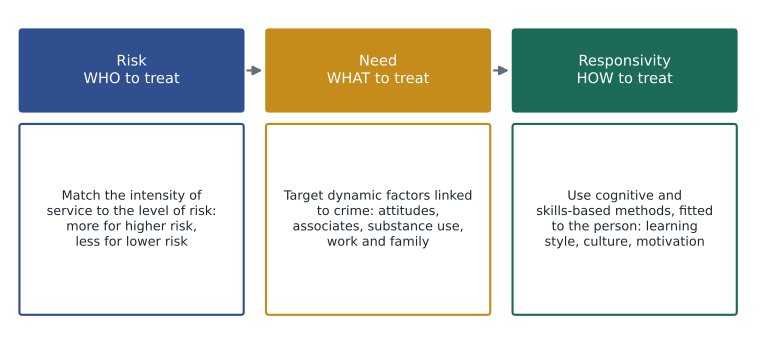
Their risk-need-responsivity model has three principles. The risk principle says to match the intensity of intervention to the level of risk: intensive programs for high-risk people, minimal intervention for low-risk people, who can actually be made worse by being mixed with high-risk offenders. The need principle says to target the dynamic factors that can change and that drive offending, such as attitudes, associates and substance use, rather than factors unrelated to crime. The responsivity principle says to use methods that work, mainly cognitive-behavioral approaches, adapted to the person's learning style, culture, language and abilities. Programs that follow all three principles reduce reoffending substantially; those that ignore them often do nothing.
Risk tools are judged by how well they separate people who go on to reoffend from those who do not. A common measure is the area under the curve, or AUC: the probability that a randomly chosen person who reoffended received a higher score than a randomly chosen person who did not. An AUC of 0.5 is no better than a coin toss; 1.0 is perfect; most validated tools score around 0.65 to 0.75. Linh wants to understand the measure, so the professor gives her scores from a small illustrative validation sample of people released on probation in Port Ardent's region, with whether each was convicted of a new offense within two years.
# Area under the curve for a risk score: chance a reoffender outscores a non-reoffender
reoffended = [9, 7, 8, 5, 6, 10, 4, 7]                      # scores of people who reoffended
did_not    = [3, 5, 2, 6, 4, 1, 3, 5, 7, 2, 4, 6, 3, 2, 5, 8]  # scores of people who did not
wins = ties = 0
for a in reoffended:
    for b in did_not:
        if a > b: wins += 1
        elif a == b: ties += 1
pairs = len(reoffended) * len(did_not)
auc = (wins + 0.5 * ties) / pairs
print(f"pairs compared: {pairs}")
print(f"AUC = {auc:.2f}")
cut = 6
tp = sum(s >= cut for s in reoffended); fp = sum(s >= cut for s in did_not)
print(f"scoring {cut}+ flags {tp} of {len(reoffended)} reoffenders and {fp} of {len(did_not)} others")pairs compared: 128 AUC = 0.84 scoring 6+ flags 6 of 8 reoffenders and 4 of 16 others
The tool performs well in this sample, with an AUC of about 0.84, better than most real instruments. Yet the cut-off shows its limits. A score of 6 or more flags six of the eight people who reoffended but also four of the sixteen who did not. In a real population, where reoffending may be less common, most people flagged as high risk might never reoffend. Risk tools also raise fairness questions. If a tool uses factors such as prior arrests, which reflect where police patrol, it can carry existing disparities forward. American courts and researchers have debated whether risk tools used in bail and sentencing treat Black defendants fairly, and the Wisconsin Supreme Court in State v. Loomis (2016) allowed a risk tool at sentencing only with warnings about its limits.
Worked problem
Applying the risk principle
Port Ardent's probation office has places for 20 people in an intensive 16-week cognitive-behavioral program. Two candidates are waiting: Kyle, 19, convicted of a first shoplifting offense, with a stable job and family, who scores low risk; and Trevor, 26, with several prior assaults, heavy drinking, unemployment and friends who are also offending, who scores high risk. The supervisor's instinct is to give the place to Kyle because he is more likely to succeed. What does the risk-need-responsivity model suggest?
Show solution
- Apply the risk principle: intensive programs should go to higher-risk people, where there is more reoffending to prevent.
- Consider the danger of over-treating low-risk people: placing Kyle with high-risk peers could disrupt his job and expose him to antisocial associates.
- Apply the need principle: Trevor's drinking, unemployment, attitudes and associates are dynamic needs the program can target.
- Apply responsivity: the program should be adapted to Trevor's learning style and motivation, perhaps with substance use treatment alongside.
Answer: The place should go to Trevor. Kyle is likely to do well with minimal intervention, and intensive treatment could even raise his risk. Trevor's high risk and many changeable needs mean the program can prevent more crime if it is delivered well and matched to his circumstances.
Common mistakes
MistakeMost people with mental illness are dangerous.
InsteadMost people with mental illness are never violent and are more likely to be victims; substance use is a much stronger risk factor.
MistakeLow-risk offenders should get the most intensive programs because they are most likely to succeed.
InsteadThe risk principle says intensive programs belong with high-risk people; low-risk people can be made worse by them.
MistakeScared-straight programs and boot camps are proven deterrents.
InsteadEvaluations generally find no reduction in reoffending, and scared-straight programs have sometimes increased it. Cognitive-behavioral programs work better.
MistakeA high score on a risk tool means a person will reoffend.
InsteadRisk tools estimate probabilities for groups; many people with high scores do not reoffend, and tools can carry existing biases.
Summary and key terms
- Psychological theories explain individual differences in offending through personality, learning, thinking and mental disorder.
- Impulsivity, sensation seeking and low self-control are consistent predictors of offending; Gottfredson and Hirschi made low self-control the center of a general theory of crime.
- Operant and observational learning explain how criminal behavior is acquired and maintained by immediate rewards and models.
- Thinking errors such as hostile attribution bias are targeted by cognitive-behavioral programs, which reliably reduce reoffending.
- Mental illness alone is a weak predictor of violence; untreated psychosis combined with substance use raises risk.
- The risk-need-responsivity model matches intervention intensity to risk, targets dynamic needs and uses responsive methods; risk tools are judged by measures such as AUC.
- Self-control
- The ability to resist immediate temptations in light of longer-term consequences.
- Psychopathy
- A personality disorder marked by lack of empathy and remorse, manipulation and an impulsive, antisocial lifestyle.
- Hostile attribution bias
- The tendency to interpret ambiguous actions by others as hostile.
- Cognitive-behavioral therapy
- Treatment that changes thoughts and behaviors, widely used to reduce reoffending.
- Dynamic risk factor
- A changeable factor linked to offending, such as attitudes, associates or substance use.
- AUC
- Area under the curve: the probability that a randomly chosen reoffender scores higher than a randomly chosen non-reoffender.
Practice problems
Work each problem on paper first, then reveal the answer to check.
Name four of Andrews and Bonta's central eight factors.
Show answer
Any four of: antisocial history, antisocial personality pattern, antisocial attitudes, antisocial associates, school or work problems, family problems, lack of prosocial leisure, substance abuse.
What is the risk principle?
Show answer
Match the intensity of intervention to the person's level of risk: intensive for high risk, minimal for low risk.
A risk tool has an AUC of 0.50. What does that mean?
Show answer
It separates reoffenders from non-reoffenders no better than chance.
Why do experts say most violence is not committed by people with mental illness?
Show answer
Most people with mental illness are not violent, and most violent people do not have a serious mental illness.
Lesson quiz · 5 questions
Score 60% or more to complete this lesson.
Create a free account to save your progress, take quizzes and earn a certificate.