
LES-102 · Lesson 4 of 12 · 20 min
Biological and biosocial perspectives
▶ Video coming soon A video version of this lesson is on the way.
Professor Desjardins begins week four by projecting a page of nineteenth-century drawings: faces with sloping foreheads, large jaws and close-set eyes, labeled as typical murderers, thieves and swindlers. The class laughs, then goes quiet when he explains that these drawings were taken seriously by courts, police and governments for decades, and that ideas like them were used to justify the forced sterilization of thousands of people in both countries. Biological explanations of crime, he says, have the darkest history in criminology. They also have some of the most important modern findings. An officer needs to understand both: why the old theories were wrong and dangerous, and what today's research on brains, genes and environments really shows.
Lombroso and the positivist school
In 1876 the Italian physician Cesare Lombroso published The Criminal Man. After examining the skulls and bodies of prisoners, he concluded that many criminals were born criminals, throwbacks to an earlier stage of human evolution who could be recognized by physical features such as unusual skull shapes, long arms and insensitivity to pain. Lombroso's theory was soon discredited. The English physician Charles Goring compared thousands of prisoners with soldiers, students and hospital patients in 1913 and found no distinct criminal physical type. Lombroso had not compared his prisoners with similar people who were not in prison, so he could not tell whether the features he saw were unusual at all.
Lombroso's lasting contribution was not his theory but his method. He insisted that crime should be studied scientifically, by measuring and observing offenders, rather than through philosophy alone. This approach, known as positivism, looked for causes of crime in factors outside the offender's free choice, whether biological, psychological or social. Positivism stands in contrast to the classical school you met in the last lesson, which assumed free, rational choice. Most modern criminology combines the two: people make choices, but the choices are shaped by factors they did not choose.
The positivist search for biological causes took a destructive turn in the early twentieth century. Studies of supposedly degenerate families claimed that crime, poverty and feeblemindedness were inherited. The eugenics movement used such claims to argue that the state should prevent certain people from having children. More than 30 states passed eugenic sterilization laws, and more than 60,000 people were sterilized, many of them poor women, people with disabilities and, in some states, disproportionately Black, Latina and Native American women. In Buck v. Bell (1927) the Supreme Court upheld Virginia's law, with Justice Oliver Wendell Holmes writing that three generations of imbeciles are enough. The decision has never been formally overruled, although later cases rejected its reasoning, and several states have apologized and compensated survivors. Professor Desjardins says this history is why biological claims about crime must meet the highest standards of evidence and must never be used to label groups.
Twin and adoption studies
Modern research on genetics and crime begins with a simple question: do people who share more genes resemble each other more in antisocial behavior? Identical twins share nearly all their genes, while fraternal twins share about half, like ordinary siblings. If identical twins are more alike in offending than fraternal twins raised in similar homes, genes probably play some role. Adoption studies ask whether adopted children resemble their biological parents, with whom they share genes, or their adoptive parents, with whom they share an environment. A large Danish adoption study in the 1980s found that adopted sons whose biological fathers had criminal convictions were somewhat more likely to be convicted themselves, especially if their adoptive fathers also had convictions.
Across many twin and adoption studies, researchers estimate that roughly 40 to 50% of the variation in antisocial behavior among people in a population is associated with genetic differences. This figure is called heritability, and it is easy to misunderstand. Heritability describes a population, not an individual: it does not mean that half of a person's behavior is caused by genes. It can change when environments change. And it says nothing about specific genes, since thousands of genes are involved, each with a tiny effect. Above all, genetic influence is not genetic destiny. Genes act by shaping traits such as impulsiveness and sensitivity to reward, and how those traits play out depends heavily on family, school, neighborhood and opportunity.
Falconer's formula gives a simple estimate of heritability from twin data. If r for identical twins is the correlation between twins on a measure, and r for fraternal twins is the corresponding correlation, heritability is about twice the difference between them. The shared environment, the influences that make twins in the same family alike, is estimated as the identical-twin correlation minus heritability, and whatever remains is the non-shared environment and measurement error. The code below applies the formula to illustrative correlations for a self-reported antisocial behavior scale in adolescents and young adults.
# Falconer's formula: rough shares of variation from twin correlations (illustrative)
samples = {"adolescents": (0.62, 0.40), "young adults": (0.55, 0.30)}   # (identical, fraternal)
for group, (r_mz, r_dz) in samples.items():
    h2 = 2 * (r_mz - r_dz)          # genetic differences
    c2 = r_mz - h2                  # shared family environment
    e2 = 1 - r_mz                   # unique experiences and measurement error
print(f"{group:13s} genetic {h2:.2f} shared environment {c2:.2f} unique {e2:.2f}")adolescents genetic 0.44 shared environment 0.18 unique 0.38 young adults genetic 0.50 shared environment 0.05 unique 0.45
In this example, genetic differences account for about 44% of the variation among adolescents and 50% among young adults, while the shared family environment drops from 18% to 5% and unique experiences account for the rest. Many real studies find this pattern: the shared environment matters more in adolescence, when young people live under the same roof and often offend with siblings or the same friends, and less in adulthood. Jesse asks whether this means families do not matter. The professor says no. The shared environment measures only influences that make siblings alike; much of what parents do affects each child differently and appears under unique experiences. And the estimates assume, among other things, that identical and fraternal twins are treated equally similarly, which is debated.
Brain development and the adolescent peak
One of the most important biological findings for police and courts concerns the developing brain. Brain imaging studies show that the regions involved in reward and emotion become highly active around puberty, while the prefrontal cortex, which supports planning, impulse control and weighing future consequences, continues to mature into the mid-twenties. Psychologists such as Laurence Steinberg describe this as a maturity gap: adolescents are as capable as adults of reasoning in calm conditions but more likely to take risks when emotions run high, rewards are immediate and, above all, peers are watching. In driving simulator studies, teenagers took far more risks when friends were present, while adults were barely affected.
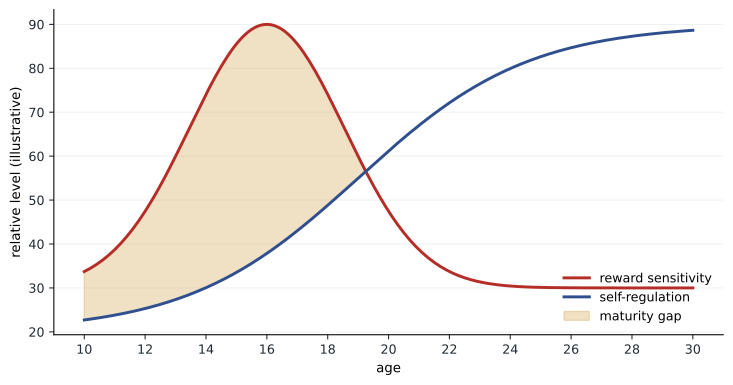
This research helps explain one of the most consistent facts in criminology, the age-crime curve, which you will study in lesson 9: offending rises steeply in the teenage years, peaks in late adolescence and falls through the twenties. It has also shaped law. The Supreme Court relied on adolescent development research in Roper v. Simmons (2005), which barred the death penalty for crimes committed under 18, Graham v. Florida (2010), which barred life without parole for juveniles who did not kill, and Miller v. Alabama (2012), which barred mandatory life without parole for juveniles. For officers, the research suggests that a teenager's poor decision with friends late at night says less about his or her future than the same act by a 35-year-old.
Environmental and health factors
Some of the strongest biological influences on crime are not genetic at all but environmental. Lead is a striking example. Lead exposure in childhood, from leaded gasoline, old paint and water pipes, damages brain development and is linked to lower intelligence, impulsiveness and aggression. Several researchers have found that the rise and fall of lead in the air, after leaded gasoline was phased out in the 1970s and 1980s, tracks the later rise and fall of violent crime with a lag of about 20 years, the age when exposed children reach the peak years for offending. The size of the effect is debated, but studies of individual children with measured blood lead levels support a link with later behavior problems and arrests.
Other factors include prenatal exposure to alcohol, which can cause fetal alcohol spectrum disorder, a lifelong condition affecting memory, judgment and impulse control that is overrepresented among people in custody; traumatic brain injury, which is far more common among people in prison than in the general population; poor nutrition; and chronic stress in early childhood, which affects how the body's stress system develops. These factors are not evenly distributed. They are concentrated in poor communities and among groups with histories of disadvantage, which is one reason biological and social explanations cannot be separated.
Hormones and physiology have also been studied. Low resting heart rate is one of the best replicated physiological correlates of antisocial behavior in children and adolescents, perhaps because people with low arousal seek stimulation or feel less fear. Testosterone is linked to dominance-seeking, though its relationship with aggression depends strongly on the social context. None of these factors predicts crime in an individual with any accuracy. Most people with low heart rates, high testosterone or a history of head injury never commit a serious offense.
The biosocial approach
Today most researchers in this field take a biosocial approach: biological factors and social environments interact, and neither can be understood alone. A well-known study from New Zealand followed about 1,000 people from birth. Boys with a common variant of the MAOA gene, which affects brain chemistry, were much more likely to show antisocial behavior as adults if they had been maltreated as children, but were not at higher risk if they had not been maltreated. Later studies have produced mixed results on this specific gene, but the general pattern, that genetic vulnerability matters most in harmful environments, has been found repeatedly and is called gene-environment interaction.
The biosocial approach has practical implications. If biological vulnerabilities do their harm mainly in adverse environments, then improving environments can prevent crime even among the vulnerable. Programs such as nurse home visiting for first-time mothers, which you will meet in lesson 11, reduce child maltreatment and later arrests. Removing lead from homes, supporting pregnant women to avoid alcohol, protecting children from head injuries and treating attention problems all have potential crime prevention benefits. Some American courts and juvenile justice agencies now screen for traumatic brain injury and fetal alcohol spectrum disorder so that supervision conditions can be adjusted to people's abilities.
Biological research also brings ethical risks. Predicting individual criminality from biology is inaccurate and could lead to labeling children or groups. Claims about genetic differences between racial groups have no scientific support; differences in crime rates between groups are explained by social and economic conditions, historical injustice and differences in policing, not by genes. Professor Desjardins asks the class to remember the Lombroso drawings and the sterilization laws whenever they hear a claim that some people are simply born bad.
Worked problem
Explaining a biological finding responsibly
At a community meeting, a resident says he read that crime is about 50% genetic, so there is no point in youth programs because criminals are born that way. Officer Dev Malhotra, who is attending for the Port Ardent police, wants to respond accurately. What should he say?
Show solution
- Clarify what heritability means: about half of the variation in antisocial behavior among people in a population is associated with genetic differences, not half of any person's behavior.
- Explain that heritability does not mean destiny: genes act through traits such as impulsiveness, and those traits lead to crime mainly in harmful environments.
- Point to gene-environment interaction: children with genetic vulnerabilities often benefit most from supportive environments.
- Mention the evidence on prevention: well-designed early childhood and youth programs have reduced later offending in controlled studies.
Answer: The resident has misread the research. Genetic influence on antisocial behavior is real but works through traits whose effects depend on the environment, so youth programs and family supports are especially important. Dev can add that the history of eugenics shows the harm done when people concluded that some groups were born criminal.
Common mistakes
MistakeLombroso showed that criminals have distinct physical features.
InsteadLombroso's theory was disproved; Goring and others found no criminal physical type when prisoners were compared with similar people.
MistakeA heritability of 50% means half of a person's behavior is caused by genes.
InsteadHeritability describes variation in a population and can change with the environment. It says nothing about any one person.
MistakeIf crime has biological influences, prevention cannot work.
InsteadBiological risks interact with environments, and improving environments reduces crime, including among vulnerable people.
MistakeBiology explains differences in crime rates between racial groups.
InsteadThere is no scientific support for this; group differences reflect social, economic and historical conditions and differences in policing.
Summary and key terms
- Lombroso's theory of the born criminal was disproved, but his positivist method of studying offenders scientifically shaped criminology.
- Biological theories were used to justify eugenic sterilization laws in both countries, a history that demands caution and high standards of evidence.
- Twin and adoption studies suggest that genetic differences account for roughly 40 to 50% of the variation in antisocial behavior in a population, acting through traits rather than determining behavior.
- The adolescent brain combines high reward sensitivity with still-developing self-regulation, which helps explain the age-crime curve and the special treatment of youth in law.
- Environmental factors such as lead, prenatal alcohol, head injury and early stress affect brain development and later behavior.
- The biosocial approach holds that biological vulnerabilities do most harm in adverse environments, so improving environments prevents crime.
- Positivism
- The approach that studies crime scientifically and looks for causes outside free choice.
- Eugenics
- A discredited movement that sought to improve the population by controlling who could have children.
- Heritability
- The share of variation in a trait in a population that is associated with genetic differences.
- Maturity gap
- The period in adolescence when reward sensitivity is high but self-regulation is still developing.
- Gene-environment interaction
- When the effect of a genetic factor depends on the environment, or the reverse.
- Fetal alcohol spectrum disorder
- A lifelong condition caused by prenatal alcohol exposure, affecting memory, judgment and impulse control.
Practice problems
Work each problem on paper first, then reveal the answer to check.
Why did Goring's study undermine Lombroso's theory?
Show answer
He compared prisoners with soldiers, students and patients and found no distinct criminal physical type; Lombroso had no comparison group.
Identical twins correlate 0.60 and fraternal twins 0.38 on an antisocial behavior scale. Estimate heritability.
Show answer
2 × (0.60 − 0.38) = 0.44.
What is the maturity gap, and why does it matter for policing young people?
Show answer
High reward sensitivity with immature self-regulation in adolescence; it means risky acts with peers are common and say little about a teenager's future.
Give two environmental factors linked to later antisocial behavior.
Show answer
Examples: childhood lead exposure, prenatal alcohol exposure, traumatic brain injury, early chronic stress.
Lesson quiz · 5 questions
Score 60% or more to complete this lesson.
Create a free account to save your progress, take quizzes and earn a certificate.