
ITIL-160 · Lesson 8 of 12 · 23 min
Practicing the practices I: support and operations
Practices are the fourth component of the value system, and they generate more Foundation questions than any other single topic except definitions. ITIL describes 34 management practices, kept in Version 5, grouped as general management practices and product and service management practices. Foundation does not test all 34. It tests the purpose and key terms of a selection, and a smaller set in more depth. This lesson and the next work through the practices most often tested, with practice questions. Check your syllabus for the exact list for your exam; the ones covered here appear in most Foundation materials.
This lesson covers the support and operations practices: the service desk, incident management, problem management, service request management, change enablement and monitoring and event management. ITIL-140 taught them in depth. Here we focus on purpose statements, key terms and the distinctions examiners like to test.
How practice questions are built
Practice questions come in three main forms. Purpose questions ask 'What is the purpose of the X practice?' and offer four purpose statements, three of which belong to other practices. Recognition questions describe an activity and ask which practice it belongs to. Detail questions, for the practices tested in depth, ask about specific ideas such as how incidents are prioritized, what a known error is or who authorizes a normal change.
For purpose questions, the technique from lesson 3 applies: learn each purpose's signature words. The purposes below are paraphrased study versions; your exam materials give the official wording. Compare the two and learn the official version for any practice you find hard.
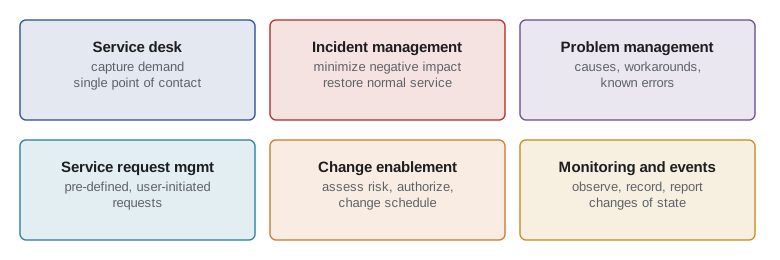
Service desk
Purpose: to capture demand for incident resolution and service requests, and to be the entry point and single point of contact for the service provider with all of its users. The signature words are 'capture demand' and 'single point of contact'. ITIL stresses that the service desk's focus has moved from technical skill alone to supporting people and business, with understanding of the wider organization, empathy and effective communication. Service desks may be physical or virtual and use many channels: phone, chat, portals, email, walk-in and messaging.
A typical distractor offers 'to restore normal service as quickly as possible' as the service desk's purpose. That is incident management. The service desk logs and often resolves incidents, but its defining purpose is to capture demand and act as the single point of contact.
Incident management
Purpose: to minimize the negative impact of incidents by restoring normal service operation as quickly as possible. An incident is an unplanned interruption to a service or a reduction in its quality. Key ideas include prioritization based on impact and urgency, agreed target resolution times, and the use of workarounds and knowledge to resolve incidents quickly. Incidents may be handled by the service desk, by support teams, by suppliers, or by swarming, where many people work on an incident together until it is clear who is best placed to resolve it.
Incident management questions often test the difference from problem management. Incident management restores service; problem management finds and manages causes. If a question describes restoring service quickly, choose incident management. If it describes finding why incidents happen or reducing their recurrence, choose problem management. Questions also test that incidents should be logged and managed so that resolution meets agreed targets, and that information about incidents should be stored in records with links to related configuration items, changes, problems and known errors.
Worked problem
Incident or problem?
At Larchmont, the booking portal fails every Monday morning. The service desk restarts the server each time, which restores service in ten minutes. A team then investigates and finds that a weekly batch job fills the disk. Which practice covers each activity?
Show solution
- Restarting the server to restore service is incident management, using a workaround.
- Investigating the cause (the batch job) is problem management.
- Once the cause is known but not yet fixed, it is a known error, and the restart is its documented workaround.
Answer: Restart: incident management. Investigation: problem management. The documented cause without a permanent fix is a known error.
Problem management
Purpose: to reduce the likelihood and impact of incidents by identifying actual and potential causes of incidents, and managing workarounds and known errors. ITIL describes three phases: problem identification, problem control and error control. Problem identification finds problems, for example through trend analysis of incidents. Problem control analyses problems and documents workarounds and known errors. Error control manages known errors, including assessing whether a permanent fix should be made, usually through change enablement.
| Phase | What happens | Exam clue |
|---|---|---|
| Problem identification | Detect problems through trends, recurring incidents, supplier information or analysis | trend analysis, recurring incidents |
| Problem control | Analyze problems, document workarounds and known errors | analysis, workaround documented |
| Error control | Manage known errors; assess and pursue permanent solutions | known errors, permanent fix, change request |
A known error is a problem that has been analyzed but not resolved. A workaround is a solution that reduces or eliminates the impact of an incident or problem for which a full resolution is not yet available. Questions on problem management often hinge on these two definitions and on the three phases. Note that problem management and incident management are closely linked but separate: problem management may continue long after the incidents are resolved.
Service request management
Purpose: to support the agreed quality of a service by handling all pre-defined, user-initiated service requests in an effective and user-friendly manner. A service request is a request from a user or a user's representative that initiates a service action agreed as a normal part of service delivery, such as a password reset, a new laptop, access to an application or information about a service. Service requests are not failures; that is the key difference from incidents.
ITIL advises that service requests should be standardized and automated as far as possible, that policies should say which requests can be fulfilled with limited or no approval, and that users should be told realistic fulfillment times. Some requests need approval as part of their workflow. A frequent question describes a request for a new mobile phone or software access and asks which practice handles it: service request management.
Change enablement
Purpose: to maximize the number of successful service and product changes by ensuring that risks have been properly assessed, authorizing changes to proceed and managing the change schedule. In ITIL 4 this practice was introduced under the name change control and later renamed change enablement, a name that Version 5 keeps. A change is the addition, modification or removal of anything that could have a direct or indirect effect on services.
| Type of change | Description | Authorization |
|---|---|---|
| Standard | Low risk, pre-authorized, well understood and fully documented | Pre-authorized; implemented without further authorization, often as a service request |
| Normal | Must be scheduled, assessed and authorized following a standard process | A change authority suited to the risk, from automated approval to a senior group |
| Emergency | Must be implemented as soon as possible, for example to resolve an incident or apply a security patch | A separate change authority, often with fewer people and expedited assessment |
Questions on change enablement test the three change types, the idea of a change authority (the person or group who authorizes a change) and the change schedule (used to plan changes, help communication, avoid conflicts and assign resources). A favorite distractor says that all changes must be approved by a change advisory board. ITIL says the change authority should be appropriate to the type and risk of the change, and that decentralizing authority, for example to peer review in a pipeline, often improves speed without raising risk.
Worked problem
Which change type?
Classify each Larchmont change: (1) a security patch applied tonight to fix an actively exploited flaw; (2) adding a new user to a shared mailbox using a documented, low-risk procedure that has been done hundreds of times; (3) replacing the warehouse database with a new version next quarter.
Show solution
- (1) Must be implemented as soon as possible to address a threat: emergency.
- (2) Low risk, pre-authorized and documented: standard.
- (3) Significant, needs assessment and scheduling: normal.
Answer: 1 emergency, 2 standard, 3 normal.
Monitoring and event management
Purpose: to systematically observe services and service components, and record and report selected changes of state identified as events. An event is any change of state that has significance for the management of a service or configuration item. ITIL distinguishes informational events, which need no action; warning events, which allow action before a negative impact; and exception events, which indicate a breach of an established norm and require action. Some events lead to incidents, some to changes, and many simply inform.
Questions might ask which practice is responsible for identifying and prioritizing infrastructure, service or application events, or which type of event indicates that a threshold has been exceeded. Remember the order of severity: informational, then warning, then exception.
Seeing the practices together
Exam scenarios often involve several practices at once, and the question asks for the one that fits a specific action. A failed booking server might trigger an event (monitoring and event management), which raises an incident (incident management), logged and communicated through the service desk; repeated failures lead to a problem (problem management), whose fix requires a change (change enablement). Practice identifying the practice for each action in a chain like this.
# Map actions in a scenario chain to the practice that owns each one
chain = [
    ("Disk usage passes 95 % and an alert is raised", "monitoring and event management"),
    ("User calls to report the portal is down", "service desk"),
    ("Service restored by restarting the server", "incident management"),
    ("Trend shows the same failure every Monday", "problem management"),
    ("Root cause documented with a workaround", "problem management (known error)"),
    ("Fix to the batch job scheduled and authorized", "change enablement"),
    ("User asks for read access to the shipment report", "service request management"),
]
for action, practice in chain:
    print(f"{practice:<34} <- {action}")
from collections import Counter
print(Counter(p.split(' (')[0] for _, p in chain).most_common(2))monitoring and event management <- Disk usage passes 95 % and an alert is raised
service desk <- User calls to report the portal is down
incident management <- Service restored by restarting the server
problem management <- Trend shows the same failure every Monday
problem management (known error) <- Root cause documented with a workaround
change enablement <- Fix to the batch job scheduled and authorized
service request management <- User asks for read access to the shipment report
[('problem management', 2), ('monitoring and event management', 1)]Practice set
| Question | Answer and reasoning |
|---|---|
| Which practice has the purpose of capturing demand for incident resolution and service requests? | Service desk. |
| Which practice aims to minimize the negative impact of incidents by restoring normal service as quickly as possible? | Incident management. |
| In which phase of problem management are workarounds and known errors documented? | Problem control. |
| A user asks for a new laptop. Which practice handles this? | Service request management. |
| Which type of change is low risk, pre-authorized and well understood? | A standard change. |
Building practice flashcards
For each practice in this lesson, Kofi wrote a flashcard with the practice name on one side and three things on the other: the purpose in signature words, two key terms, and the practice most often confused with it. Six practices produced eighteen facts, small enough to review in five minutes. He found that the confusion line mattered most, because almost every wrong answer he gave in this area chose the neighboring practice.
Common mistakes
MistakeGiving the service desk the purpose of restoring service.
InsteadThe service desk captures demand and is the single point of contact; incident management restores service.
MistakeTreating a request for access as an incident.
InsteadRequests for normal service actions are service requests, not failures.
MistakeSaying every change needs a change advisory board.
InsteadThe change authority should match the type and risk of the change.
MistakeConfusing problem control and error control.
InsteadProblem control analyses and documents; error control manages known errors and permanent fixes.
MistakeTreating every event as an incident.
InsteadEvents can be informational, warnings or exceptions; only some lead to incidents.
Summary and key terms
- ITIL has 34 practices; Foundation tests the purpose of a selection and some practices in more depth.
- Service desk: capture demand and act as the single point of contact.
- Incident management: minimize negative impact by restoring normal service quickly; problem management: reduce likelihood and impact by managing causes, workarounds and known errors.
- Problem management has three phases: problem identification, problem control and error control.
- Service request management handles pre-defined, user-initiated requests that are a normal part of service delivery.
- Change enablement maximizes successful changes through risk assessment, authorization and the change schedule, with standard, normal and emergency changes.
- Monitoring and event management observes services and reports changes of state, classified as informational, warning or exception.
- Swarming
- Several people working on an incident together until it is clear who is best placed to resolve it.
- Change authority
- A person or group responsible for authorizing a change.
- Change schedule
- A calendar of planned and past changes used to plan, communicate and avoid conflicts.
- Standard change
- A low-risk, pre-authorized change that is well understood and fully documented.
- Exception event
- An event that indicates a breach of an established norm and requires action.
Practice problems
Work each problem on paper first, then reveal the answer to check.
What are the signature words of the service desk purpose?
Show answer
Capture demand; single point of contact.
Name the three phases of problem management.
Show answer
Problem identification, problem control and error control.
What distinguishes a service request from an incident?
Show answer
A service request is a normal part of service delivery, not an interruption or failure.
Who authorizes a normal change?
Show answer
A change authority appropriate to the type and risk of the change.
Which event type allows action before a negative impact occurs?
Show answer
A warning event.
A security patch must be applied tonight to stop an active attack. Which change type?
Show answer
Emergency change.
Lesson quiz · 5 questions
Score 60% or more to complete this lesson.
Create a free account to save your progress, take quizzes and earn a certificate.