
ITIL-160 · Lesson 7 of 12 · 21 min
Practicing the value chain and value streams
The value chain is the central component of the value system: the operating model that turns demand into value. Value streams show how the activities of the value chain combine to handle a particular kind of demand. Together they account for a good share of the value system questions and, in the Version 5 syllabus, a separate area on value stream identification, mapping and management worth about two questions. This lesson covers the value chain as tested in ITIL 4 and in Version 5, then value streams, with practice questions for both exams.
The value chain in ITIL 4: six activities
If you sit the ITIL 4 Foundation exam, you must know the six activities of the service value chain and their purposes. They are plan, improve, engage, design and transition, obtain or build, and deliver and support. Each activity takes inputs, often from other activities, and produces outputs. The activities are interconnected and can be combined in many sequences; the value chain is not a linear process.
| ITIL 4 activity | Purpose in plain words | Clue words |
|---|---|---|
| Plan | Ensure a shared understanding of the vision, current status and improvement direction for all four dimensions and all products and services | vision, direction, shared understanding, portfolio |
| Improve | Ensure continual improvement of products, services and practices across all value chain activities and the four dimensions | improvement, across all activities |
| Engage | Provide a good understanding of stakeholder needs, transparency and continual engagement and good relationships with all stakeholders | stakeholders, relationships, needs, demand intake |
| Design and transition | Ensure products and services continually meet stakeholder expectations for quality, costs and time to market | quality, cost, time to market, new or changed services |
| Obtain/build | Ensure service components are available when and where needed and meet agreed specifications | components, available, specifications, acquire or create |
| Deliver and support | Ensure services are delivered and supported according to agreed specifications and stakeholder expectations | delivered, supported, agreed specifications, users |
Two facts about the ITIL 4 value chain are especially testable. First, engage is the activity that interacts with external parties: customers, users and suppliers. Demand enters the value chain through engage, and value leaves through it. Second, each activity can draw on any practice; there is no one-to-one mapping. A question that claims 'each value chain activity is performed by one practice' is a distractor.
The value chain in Version 5: eight activities
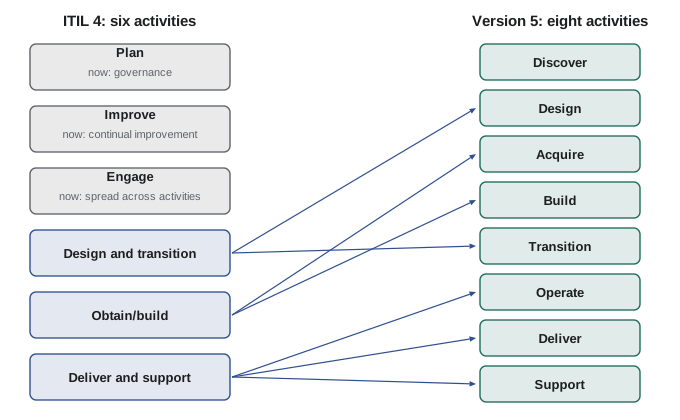
Published Version 5 study guides describe the value chain activities as the eight activities of the product and service lifecycle: discover, design, acquire, build, transition, operate, deliver and support. Lesson 5 introduced them. The old plan and improve activities move up into the value system as governance and continual improvement concerns, engage is spread across discover, deliver and support, and the combined ITIL 4 activities are split into finer ones.
| ITIL 4 activity | Where it goes in Version 5 |
|---|---|
| Plan | Governance and direction-setting in the value system |
| Improve | The continual improvement component |
| Engage | Spread across discover, deliver and support |
| Design and transition | Design; transition |
| Obtain/build | Acquire; build |
| Deliver and support | Operate; deliver; support |
Whichever exam you sit, the logic is the same: demand and opportunity come in, activities are combined to respond, and value comes out. Learn the activity names for your edition exactly. A distractor on a Version 5 exam might offer 'engage' or 'plan' as one of the eight activities; a distractor on an ITIL 4 exam might offer 'discover' as one of the six.
Value streams
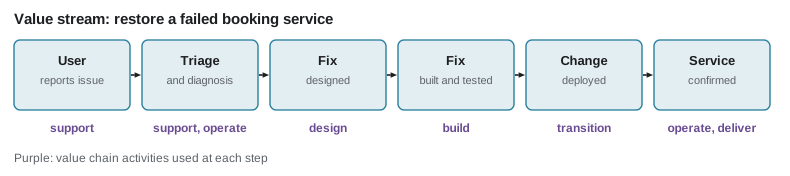
A value stream is a series of steps an organization undertakes to create and deliver products and services to consumers. Value streams are built by combining value chain activities, together with the practices that support them, in an order that suits a particular kind of demand. An organization has many value streams: one for onboarding a new customer, one for restoring a failed service, one for developing a new feature, and so on.
The difference between a value stream and a process is a classic exam point. A value stream is focused on creating value for a consumer from a particular demand, and it spans the organization end to end. A process is a set of interrelated or interacting activities that transform inputs into outputs; processes are usually narrower, and a value stream may include steps from many processes. A question that describes the whole journey from a customer's request to the value they receive is describing a value stream.
Mapping value streams
Organizations map value streams to understand how work flows and where it is delayed. A value stream map shows each step, the time spent working on it (process or touch time), the time waiting between steps and often the share of work that arrives complete and accurate. Mapping makes waste visible: most of the time a request spends in a value stream is usually waiting, not working.
Two measures appear often. Lead time is the total time from the start of a value stream to the end, including waiting. Flow efficiency, sometimes called activity ratio, is the share of lead time spent actually working: total process time divided by lead time. ITIL-130 covered these in detail. Foundation does not ask you to calculate them, but understanding them helps with questions on why organizations map value streams.
Worked problem
Reading a simple value stream map
Larchmont maps the value stream for onboarding a new business customer. The steps take 2, 1, 3 and 2 hours of actual work, but the whole journey from signed contract to first booking takes 10 working days of 8 hours. What is the flow efficiency, and what does it suggest?
Show solution
- Total process time = 2 + 1 + 3 + 2 = 8 hours.
- Lead time = 10 days x 8 hours = 80 hours.
- Flow efficiency = 8 / 80 = 10 %.
Answer: About 10 %. Ninety percent of the time is waiting, so the biggest improvements will come from removing queues and handoffs rather than making each step faster.
# Value stream map summary: process time, waiting time, lead time and flow efficiency
steps = [
    ("Contract received and checked", 2, 14),
    ("Customer account created", 1, 22),
    ("Rates and lanes configured", 3, 20),
    ("Portal access and training", 2, 16),
]  # (step, hours of work, hours waiting before next step)
work = sum(w for _, w, _ in steps)
wait = sum(q for _, _, q in steps)
lead = work + wait
for name, w, q in steps:
    print(f"{name:<32} work {w:>2} h, then waits {q:>2} h")
print(f"Process time {work} h, waiting {wait} h, lead time {lead} h")
print(f"Flow efficiency: {work / lead:.0%}")
worst = max(steps, key=lambda s: s[2])
print("Longest wait after:", worst[0])Contract received and checked work 2 h, then waits 14 h Customer account created work 1 h, then waits 22 h Rates and lanes configured work 3 h, then waits 20 h Portal access and training work 2 h, then waits 16 h Process time 8 h, waiting 72 h, lead time 80 h Flow efficiency: 10% Longest wait after: Customer account created
The longest wait in the map, after account creation, came from a queue for a single administrator who set up accounts once a week. Removing that queue cut the lead time more than any other change would. This is the kind of insight value stream mapping is meant to produce, and the kind of reasoning Foundation questions on value streams reward at the understanding level.
Value stream management
Value stream management goes beyond a one-off map. It means organizing around value streams, giving each important stream an owner, measuring its flow continually and improving it. Version 5 places more emphasis on value streams than ITIL 4 did, and describes them as core value streams, which deliver value directly to consumers, and enabling value streams, which support the organization's ability to do so, such as hiring staff or managing suppliers. Expect at most two questions, mostly on what value streams are, why they are mapped and how they differ from processes.
Practices and the value chain
Practices contribute to the value chain activities, and each practice can contribute to several activities. Incident management, for example, contributes mainly to deliver and support in ITIL 4 terms, but also to engage (communicating with users) and improve (learning from incidents). Questions sometimes ask which value chain activity a practice contributes to most, or test the idea that practices are not mapped one to one. The safest answer is that each activity uses a combination of practices, and each practice can support many activities.
Practice set
| Question | Answer and reasoning |
|---|---|
| (ITIL 4) Which value chain activity provides a good understanding of stakeholder needs and continual engagement with stakeholders? | Engage. |
| (ITIL 4) Which activity ensures service components are available when and where needed and meet agreed specifications? | Obtain/build. |
| (Version 5) Which of these is NOT one of the eight value chain activities? A) Discover. B) Engage. C) Acquire. D) Operate. | B. In Version 5, engage is spread across other activities. |
| What is a value stream? | A series of steps an organization undertakes to create and deliver products and services to consumers. |
| Why do organizations map value streams? | To see how work flows, where delays and waste occur, and where to improve. |
Exam patterns for the value chain and value streams
Value chain questions usually ask for an activity's purpose, the activity a scenario describes, or a statement about how activities combine. Value stream questions usually ask for the definition, the difference from a process, or the reason for mapping. In both cases, the facts that decide most questions are few: the activity names for your edition, the purposes in a few signature words, the idea that activities combine flexibly into value streams, and the idea that mapping reveals waiting time and waste.
Lena built a one-page table for her edition with three columns: activity, purpose in five words, and one Larchmont example. Writing the examples herself made the activities concrete. For discover she wrote 'interviewing shippers'; for transition, 'releasing the app to the first ring'; for support, 'answering a customer who cannot log in'. When a scenario question appeared, she matched it to the example nearest in spirit, which usually led straight to the right activity.
If you are sitting the ITIL 4 exam, remember one more classic point: each value chain activity has its own purpose statement, and plan and improve are activities in their own right. On the Version 5 exam those two ideas live in governance and continual improvement instead. Mixing the two models is the most common way candidates lose marks in this area, so check the activity names in your syllabus once more in the final week.
A final tip: when a scenario mentions several teams handing work to one another, think value stream; when it mentions a single team transforming inputs to outputs with defined steps, think process. That one distinction answers most value stream questions at Foundation level.
Common mistakes
MistakeTreating the value chain as a fixed linear process.
InsteadActivities are combined in different orders into value streams.
MistakeMixing up the activity lists of the two editions.
InsteadITIL 4 has six activities; Version 5 guides list eight.
MistakeCalling a value stream a process.
InsteadA value stream is the end-to-end series of steps that creates value for a consumer; a process is a narrower set of activities transforming inputs to outputs.
MistakeAssuming each value chain activity is performed by one practice.
InsteadEach activity uses many practices, and each practice can support many activities.
MistakeThinking value stream maps mainly show working time.
InsteadTheir main insight is usually waiting time, which dominates lead time.
Summary and key terms
- The ITIL 4 value chain has six activities: plan, improve, engage, design and transition, obtain/build, deliver and support.
- Published Version 5 guides describe eight value chain activities: discover, design, acquire, build, transition, operate, deliver and support.
- In ITIL 4, engage is the activity that interacts with external stakeholders; in Version 5 it is spread across other activities.
- A value stream is a series of steps to create and deliver products and services, built by combining value chain activities.
- Value stream maps show work and waiting time; flow efficiency is process time divided by lead time.
- Practices contribute to many value chain activities; there is no one-to-one mapping.
- Value chain
- The operating model of interconnected activities that respond to demand and create value.
- Value stream
- A series of steps an organization undertakes to create and deliver products and services to consumers.
- Process
- A set of interrelated or interacting activities that transform inputs into outputs.
- Lead time
- The total time from the start to the end of a value stream, including waiting.
- Flow efficiency
- The share of lead time spent actively working on an item.
Practice problems
Work each problem on paper first, then reveal the answer to check.
List the six ITIL 4 value chain activities.
Show answer
Plan, improve, engage, design and transition, obtain/build, deliver and support.
Where do plan and improve go in Version 5?
Show answer
Into the value system as governance and continual improvement concerns.
Which ITIL 4 activity splits into acquire and build?
Show answer
Obtain/build.
What is the key difference between a value stream and a process?
Show answer
A value stream is the end-to-end series of steps that delivers value from a particular demand; a process is a narrower set of activities transforming inputs into outputs.
A value stream has 6 hours of work and a 60-hour lead time. What is the flow efficiency?
Show answer
10 %.
What are core and enabling value streams?
Show answer
Core streams deliver value directly to consumers; enabling streams support the organization's ability to do so.
Lesson quiz · 5 questions
Score 60% or more to complete this lesson.
Create a free account to save your progress, take quizzes and earn a certificate.