
ITIL-160 · Lesson 5 of 12 · 21 min
Practicing the four dimensions and the product and service lifecycle
Two syllabus areas in the Version 5 exam are each worth about four questions: the four dimensions of product and service management and the product and service lifecycle. ITIL 4 Foundation also tests the four dimensions, under the name four dimensions of service management, but not the lifecycle. This lesson recaps both topics in exam form and gives practice questions. Together they are worth about eight marks, nearly a third of the 26 needed to pass, so they deserve careful attention even though each is smaller than the value system.
The four dimensions
ITIL describes four dimensions that must all be considered for products and services to deliver value. They are: organizations and people; information and technology; partners and suppliers; and value streams and processes. In ITIL 4 the last one was written as 'value streams and processes' as well, and the dimension names are otherwise unchanged. The dimensions apply to the value system as a whole and to every product, service and practice.
The point of the dimensions is balance. Organizations often focus on one dimension, usually technology, and neglect the others. A new booking platform will fail if staff are not trained (organizations and people), if a key supplier cannot integrate (partners and suppliers) or if the order-to-delivery process still requires manual re-keying (value streams and processes). Exam questions test whether you can place an activity or concern in the right dimension.
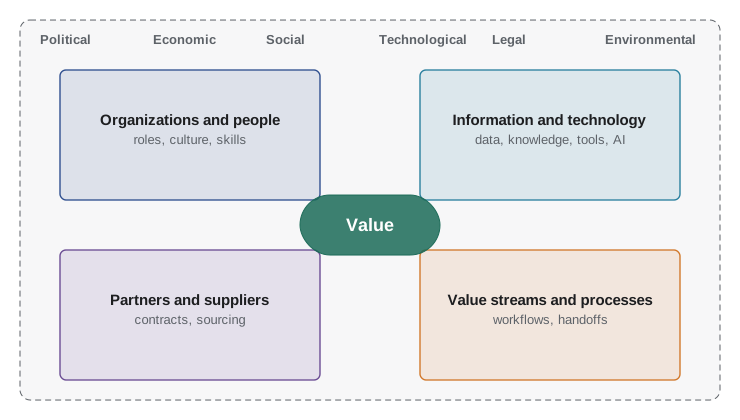
| Dimension | What it covers | Exam clue words |
|---|---|---|
| Organizations and people | Structures, roles, responsibilities, culture, skills, competencies, leadership, staffing | roles, culture, skills, training, structure, authority |
| Information and technology | Information and knowledge needed, and the technologies that support services; includes security and compliance of information | data, knowledge, tools, AI, cloud, information security |
| Partners and suppliers | Relationships with other organizations involved in design, delivery and improvement; sourcing strategy | contracts, suppliers, sourcing, outsourcing, integration, partners |
| Value streams and processes | How parts of the organization work together to create value; activities, workflows, controls and procedures | workflow, sequence of activities, process, handoffs, value stream |
Organizations and people
This dimension covers formal structures and roles, but also culture, competencies and communication. ITIL stresses that organizations need a culture that supports their objectives and the right level of capacity and competency among staff. Leaders should champion values and motivate people. Questions might describe a skills gap, a change to reporting lines, or a culture of blame, and ask which dimension is concerned.
A useful check: if the issue would be fixed by training, hiring, reorganizing, changing incentives or changing how people behave, it belongs to organizations and people. Kofi's service desk had a high rate of incorrectly categorized incidents. The fix was a short training session and a clearer guide, so the concern was organizations and people, even though the categories lived in a tool.
Information and technology
This dimension covers the information and knowledge needed to manage services and the technologies that support them. For services, it includes information managed by the service, the knowledge needed to deliver it, and the technology used, such as workflow tools, knowledge bases, monitoring, automation, cloud platforms and AI. Information security and regulatory requirements for information, such as privacy law, also sit here.
Distractors often try to move information concerns into other dimensions. If a question describes a decision about how customer data is stored and protected, the dimension is information and technology, even though a supplier may host the data. If it describes choosing and managing the hosting supplier and the contract, the dimension is partners and suppliers.
Partners and suppliers
Every organization relies on others to some degree. This dimension covers relationships with other organizations involved in designing, developing, deploying, delivering, supporting and improving services, from simple supply contracts to deep partnerships with shared goals and risks. It also covers sourcing strategy: deciding what to do in-house and what to obtain from others, influenced by factors such as strategic focus, corporate culture, resource scarcity, cost and subject-matter expertise.
Larchmont relies on a cloud provider for hosting, a mapping company for live truck locations and a regional carrier network for overflow loads. A question describing a change to any of these relationships, or a decision to outsource, points to partners and suppliers.
Value streams and processes
This dimension defines the activities, workflows, controls and procedures needed to achieve agreed objectives. It addresses how the various parts of the organization work in an integrated and coordinated way to create value. A value stream is a series of steps to create and deliver products and services; a process is a set of interrelated or interacting activities that transform inputs into outputs. Questions that describe sequences of activities, handoffs, workflows or the steps from demand to value point here.
Worked problem
Placing concerns in dimensions
Larchmont is launching live truck tracking. Place each concern in a dimension: (1) dispatchers need training to update locations correctly; (2) location data must be protected under privacy law; (3) the mapping company's contract must allow commercial use of its data; (4) the steps from a truck reporting its position to the customer seeing it must be defined.
Show solution
- (1) Training and skills: organizations and people.
- (2) Protection of information: information and technology.
- (3) Contract with another organization: partners and suppliers.
- (4) Sequence of steps from event to customer: value streams and processes.
Answer: 1 organizations and people; 2 information and technology; 3 partners and suppliers; 4 value streams and processes.
External factors
The four dimensions are affected by external factors that the organization cannot control. ITIL uses the PESTLE model to describe them: political, economic, social, technological, legal and environmental factors. A new privacy regulation is a legal factor; a recession is economic; a shift in customer expectations is social. Questions sometimes ask what PESTLE stands for, or which factor a scenario describes.
For Larchmont in the United States, examples include new state privacy laws (legal), fuel price swings (economic), state and federal emissions rules (environmental and political) and customer expectations of mobile self-service (social).
The product and service lifecycle (Version 5 only)
Version 5 adds a product and service lifecycle with eight activities: discover, design, acquire, build, transition, operate, deliver and support. The lifecycle describes what happens to a product or service over its whole life, from the first idea to retirement, and it is meant to be iterative: feedback from use returns to discovery. ITIL-150 lesson 2 covered it in depth. The Version 5 syllabus gives it about four questions.
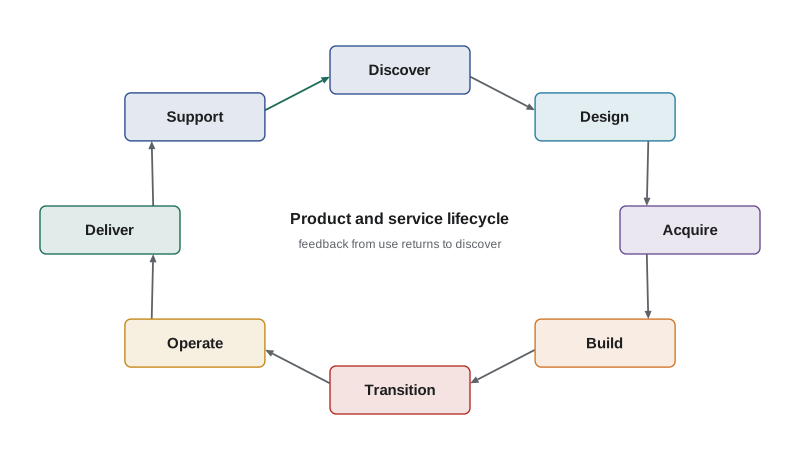
| Activity | What happens | Larchmont example |
|---|---|---|
| Discover | Understand needs, opportunities and problems; explore ideas | Interviewing shippers about why they still phone in bookings |
| Design | Shape the product or service and its experience | Designing the new booking flow and support model |
| Acquire | Obtain components, services or capabilities from outside | Contracting the mapping company for live locations |
| Build | Create or configure components | Developing the booking app and integrations |
| Transition | Move new or changed products and services into use | Releasing the app to a first ring of customers |
| Operate | Run and maintain the technology and resources | Monitoring and running the platform day to day |
| Deliver | Provide the product or service to consumers so they gain value | Customers booking and tracking loads |
| Support | Help users and fix issues | Service desk handling booking questions and incidents |
Learn the eight activities in order. A good memory aid is to think of a product's life: you discover a need, design an answer, acquire and build the parts, transition them into use, operate the result, deliver it to consumers and support them. The exam may ask for the order, for the activity a scenario describes, or for the relationship between the lifecycle and the value chain.
Lifecycle and value chain
A frequent source of confusion is how the lifecycle relates to the value chain. In ITIL 4, the service value chain had six activities: plan, improve, engage, design and transition, obtain or build, and deliver and support. Published Version 5 study guides describe the eight lifecycle activities as the activities of the value chain inside the value system. The value system and the idea of a value chain remain; what changes is the set of activities. Plan and improve move up into governance and continual improvement, engage is spread across discover, deliver and support, and the old combined activities are split into finer ones.
For the exam, two points matter. First, the value system has not been replaced: it still has its five components, and the value chain is still one of them. Second, value chain activities are not a fixed sequence. They are combined in different ways into value streams for different kinds of demand, as lesson 7 explains. An option claiming that the activities must always run in order from discover to support, like a waterfall, is a distractor.
Questions may also probe the difference between the lifecycle and a project. A project ends; the lifecycle continues as long as the product exists, with feedback driving continual improvement. This connects to ITIL-150's point that digital products are never finished, and to the guiding principle progress iteratively with feedback.
# Drill: put shuffled lifecycle activities back in order and check a scenario mapping
lifecycle = ["discover", "design", "acquire", "build", "transition", "operate", "deliver", "support"]
shuffled = ["operate", "discover", "build", "support", "design", "transition", "acquire", "deliver"]
ordered = sorted(shuffled, key=lifecycle.index)
print("In order:", " -> ".join(ordered))
scenarios = {
    "Interviewing customers about unmet needs": "discover",
    "Signing a contract with a mapping data company": "acquire",
    "Releasing the app to a first ring of users": "transition",
    "Answering a user who cannot log in": "support",
}
for text, activity in scenarios.items():
    position = lifecycle.index(activity) + 1
print(f"{activity:<11} (activity {position} of 8): {text}")In order: discover -> design -> acquire -> build -> transition -> operate -> deliver -> support discover (activity 1 of 8): Interviewing customers about unmet needs acquire (activity 3 of 8): Signing a contract with a mapping data company transition (activity 5 of 8): Releasing the app to a first ring of users support (activity 8 of 8): Answering a user who cannot log in
Practice set
| Question | Answer and reasoning |
|---|---|
| Which dimension is most concerned with roles, skills and culture? | Organizations and people. |
| A company decides to outsource its data center to a cloud provider. Which dimension is most directly involved? | Partners and suppliers: a sourcing decision and a supplier relationship. |
| What does PESTLE stand for? | Political, economic, social, technological, legal, environmental. |
| Which Version 5 lifecycle activity comes directly after build? | Transition. |
| Which statement about the Version 5 lifecycle activities is correct? A) They replace the value system. B) They end when a project closes. C) They can be combined in different ways into value streams. D) They must always run as a strict sequence. | C. The activities are combined flexibly into value streams; the value system remains. |
How Kofi and Lena studied these areas
Kofi found the dimensions easy to recognize but kept mixing up the lifecycle activities acquire and build. His fix was a one-line rule: acquire means getting something from outside the organization, build means creating or configuring it inside. Lena knew the lifecycle well from her product work but sometimes placed data quality concerns under value streams and processes because the data flowed through a process. Her rule was to ask whether the concern was about the information itself, which belongs to information and technology, or about the sequence of work, which belongs to value streams and processes.
Both wrote the four dimensions and the eight lifecycle activities from memory each morning for a week, then checked them. Writing a list from memory takes under a minute and is a quick form of retrieval practice. By the end of the week neither of them missed an item, and these two areas became reliable marks in every mock exam.
Common mistakes
MistakeAssuming technology is the most important dimension.
InsteadAll four dimensions must be balanced; neglecting any one harms value.
MistakePlacing data protection under partners and suppliers because a supplier hosts the data.
InsteadProtection of information belongs to information and technology; the contract belongs to partners and suppliers.
MistakeSaying Version 5 replaces the value system.
InsteadThe value system keeps its five components; the value chain activities are now the eight lifecycle activities.
MistakeLearning the lifecycle activities without their order.
InsteadLearn the sequence: discover, design, acquire, build, transition, operate, deliver, support.
MistakeTreating PESTLE factors as dimensions.
InsteadPESTLE factors are external influences on all four dimensions.
Summary and key terms
- The four dimensions are organizations and people, information and technology, partners and suppliers, and value streams and processes.
- All four must be considered for every product, service and practice; exam questions ask you to place a concern in the right one.
- External factors are summarized as PESTLE: political, economic, social, technological, legal and environmental.
- Version 5 adds an eight-activity product and service lifecycle: discover, design, acquire, build, transition, operate, deliver, support.
- Published Version 5 guides describe the eight lifecycle activities as the value chain activities; they combine flexibly into value streams and continue for the whole life of a product.
- Four dimensions
- The perspectives that must all be considered for products and services to create value.
- PESTLE
- Political, economic, social, technological, legal and environmental factors that influence an organization from outside.
- Sourcing strategy
- Decisions about which work to do in-house and which to obtain from partners and suppliers.
- Product and service lifecycle
- In Version 5, the eight activities a product or service goes through over its life.
Practice problems
Work each problem on paper first, then reveal the answer to check.
Name the four dimensions.
Show answer
Organizations and people; information and technology; partners and suppliers; value streams and processes.
Which dimension covers workflows and handoffs between teams?
Show answer
Value streams and processes.
A new privacy law is passed. Which PESTLE factor is it?
Show answer
Legal (often also political).
List the eight lifecycle activities in order.
Show answer
Discover, design, acquire, build, transition, operate, deliver, support.
Which lifecycle activity covers contracting a supplier for a component?
Show answer
Acquire.
How do the Version 5 lifecycle activities relate to the value chain?
Show answer
Published guides describe them as the value chain activities inside the value system; plan and improve move to governance and continual improvement.
Lesson quiz · 5 questions
Score 60% or more to complete this lesson.
Create a free account to save your progress, take quizzes and earn a certificate.