
ITIL-150 · Lesson 9 of 12 · 21 min
AI risk management, controls and assurance
Lesson 8 set up the governance structure: principles, roles, an inventory, risk tiers and policy. This lesson is about the work that makes governance real: assessing the risks of a specific AI system, applying controls across its lifecycle, testing for fairness and robustness, monitoring it in use, handling AI incidents, managing AI suppliers and giving assurance to the board and regulators. It follows Larchmont's two hardest cases: the payments fraud score supplied by a vendor and the paused résumé screening feature.
AI risks
AI risks can be grouped in several ways. A practical grouping for service managers covers harms to people (unfair treatment, privacy intrusion, safety, loss of autonomy), harms to the organization (wrong decisions, financial loss, legal liability, reputational damage, operational disruption) and harms to society (misinformation, environmental cost, concentration of power). Many risks cross groups: a biased screening tool harms applicants, exposes the employer to legal claims and damages trust.
| Risk | Example | Typical controls |
|---|---|---|
| Inaccuracy | Fraud score blocks legitimate payments | Validation on local data, thresholds, human review of blocks, monitoring |
| Bias and unfairness | Screening tool favors applicants from certain schools or areas | Bias testing by group, feature review, human decisions, audits |
| Lack of transparency | Customers do not know a bot or model affected them | Notices, labels, explanations on request |
| Privacy | Model trained on personal data without a lawful basis | Privacy impact assessment, minimization, retention, consent where needed |
| Security | Prompt injection, data poisoning, model theft | Threat modeling, least privilege, testing, monitoring |
| Drift | Fraud patterns change after a new payment method launches | Performance monitoring, drift alerts, retraining schedule |
| Over-reliance | Staff accept suggestions without checking | Training, confidence display, sampling reviews |
| Supplier dependence | Vendor changes the model or stops the service | Contract terms, change notice, exit plans |
The AI impact assessment
An AI impact assessment (sometimes called an algorithmic impact assessment) examines a proposed AI system before deployment: its purpose and necessity, the people it affects, the data it uses, how it could cause harm, how likely and severe those harms are, and what controls will reduce them. It is usually combined with or linked to a privacy impact assessment. Canada's federal Directive on Automated Decision-Making requires an Algorithmic Impact Assessment questionnaire for federal systems, and ISO/IEC 42005 offers international guidance; many private organizations adapt these.
Larchmont's assessment template has eight parts: purpose and alternatives (could the goal be met without AI?), people affected and how, data sources and lawfulness, performance requirements and testing plan, fairness analysis, transparency and explanation, human oversight design, and monitoring and exit plan. High-risk systems must complete all eight with sign-off from the system owner, privacy and the AI governance group; medium-risk systems complete a shorter version.
Lifecycle controls
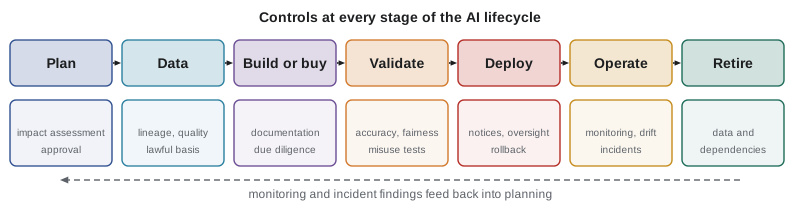
AI controls work best when spread across the lifecycle. Before building or buying, the impact assessment and approval decide whether to proceed. Data controls cover lineage (where data came from), quality, representativeness, lawful basis and protection. Development or procurement controls require documentation, often in the form of model cards or system cards that describe intended use, training data, performance, limitations and known risks. Validation tests accuracy, fairness, robustness and misuse before go-live. Deployment controls include notices to people affected, human oversight design and the ability to roll back. Operating controls cover monitoring, drift detection, incident handling and periodic review. Retirement controls handle data and dependencies when the system is withdrawn.
These map naturally onto ITIL practices. Change enablement controls model updates and new versions; release and deployment management handle progressive rollout; monitoring and event management watch performance and drift; incident and problem management handle failures; supplier management covers vendors; information security management covers threats; and continual improvement uses findings to improve systems. AI governance does not need a separate operational world.
Testing for fairness
Fairness testing compares how a system performs or what outcomes it produces for different groups of people. Common checks include comparing selection or approval rates across groups, comparing error rates (for example, how often legitimate payments are wrongly blocked for each group) and examining which input features drive outcomes. Some features, such as postal code or school attended, can act as proxies for protected characteristics like race or ethnicity even when those characteristics are not used directly.
Fairness is not a single number. Different fairness measures can conflict: equal selection rates, equal error rates and equal accuracy cannot always all be achieved at once when groups differ in their underlying data. Choosing which measures matter for a given use is a judgment that involves the business, legal advice and the people affected, and it should be documented.
Worked problem
Selection rate comparison
In a test of the résumé screening feature on 1,000 past applications, it advanced 180 of 600 applicants from urban postal codes and 64 of 400 from rural postal codes. Compare the selection rates and compute the ratio of the lower to the higher.
Show solution
- Urban selection rate = 180 / 600 = 30 %.
- Rural selection rate = 64 / 400 = 16 %.
- Ratio = 16 % / 30 % = 0.53.
- The rural rate is about half the urban rate; postal code may be acting as a proxy for other characteristics.
Answer: A ratio of 0.53 is a large disparity. Larchmont kept the feature paused, asked the vendor which features drove the scores and decided that, if used at all, it would only sort applications for human review, never reject them.
# Selection-rate ratios and a simple drift check (invented data)
groups = {"urban": (180, 600), "rural": (64, 400), "applied in French": (22, 90)}
rates = {g: sel / n for g, (sel, n) in groups.items()}
best = max(rates.values())
for g, r in rates.items():
    print(f"{g:<18} selection {r * 100:5.1f} %   ratio to highest {r / best:.2f}")

# Population stability index (PSI) for a fraud score distribution: training vs this month
import math
bins_train = [0.40, 0.30, 0.15, 0.10, 0.05]
bins_now   = [0.30, 0.28, 0.18, 0.14, 0.10]
psi = sum((n - t) * math.log(n / t) for t, n in zip(bins_train, bins_now))
print(f"PSI = {psi:.3f} (rules of thumb: <0.1 stable, 0.1-0.25 watch, >0.25 investigate)")urban selection 30.0 % ratio to highest 1.00 rural selection 16.0 % ratio to highest 0.53 applied in French selection 24.4 % ratio to highest 0.81 PSI = 0.084 (rules of thumb: <0.1 stable, 0.1-0.25 watch, >0.25 investigate)
In the United States, Title VII of the Civil Rights Act, the Age Discrimination in Employment Act and the ADA prohibit employment discrimination, including policies with a disparate impact that cannot be justified. The long-standing 'four-fifths rule' from the 1978 Uniform Guidelines treats a selection rate for any group below 80 % of the highest group's rate as evidence of adverse impact, a rule of thumb rather than a legal test. A 2025 executive order directed federal agencies to move away from disparate-impact enforcement, but private lawsuits and state laws still apply, and laws such as New York City's Local Law 144 require bias audits and notices for automated employment decision tools.
Explainability and transparency
Explainability means being able to give meaningful reasons for an AI-influenced outcome at the level the audience needs. A customer whose payment was blocked needs a plain reason and a way to resolve it; an analyst needs to know which signals drove a fraud score; an auditor needs to know how the model was validated. Some models are inherently interpretable, such as simple scorecards; others need explanation techniques that estimate which inputs mattered. Explanations should be tested with real users to check that they help.
Transparency also means telling people when AI is involved. Larchmont's policy requires notices when customers interact with the virtual agent, when AI materially influences a decision about a customer or applicant, and when content is AI-generated in ways a reasonable person would want to know. It also requires an accessible route to a human review of significant decisions.
Monitoring AI in operation
Once deployed, AI systems need monitoring on several fronts: performance (accuracy, precision and recall, measured against ground truth as it becomes available), fairness (outcomes by group over time), data drift (whether inputs still look like the training data, measured with statistics such as the population stability index), usage (whether people use and override it as expected) and incidents and complaints. Each monitored measure needs a threshold and an owner who acts when it is crossed.
The payments fraud score illustrated why. Three months after Larchmont launched a new corporate card payment option, the share of payments blocked for review doubled and the population stability index rose to about 0.24. The model had never seen corporate card patterns. Because monitoring caught it, Larchmont and the vendor adjusted thresholds within a week and scheduled retraining, rather than discovering the problem through angry customers.
AI incidents
An AI incident is an event in which an AI system causes or nearly causes harm: a virtual agent gives dangerous advice, a model makes systematically unfair decisions, an AI feature leaks data, or an automated action disrupts a service. AI incidents should flow through the normal incident management practice with additional steps: preserve inputs and outputs for investigation, consider switching the AI off or reverting to a manual process, assess whether people were harmed and need to be informed, and check whether legal or regulatory reporting applies, for example privacy breach reporting.
Problem management then looks for causes, which may lie in data, model design, prompts, integration, oversight or process. Public databases such as the AI Incident Database, run by the Responsible AI Collaborative, collect reported incidents from many organizations and are useful for learning what has gone wrong elsewhere.
Managing AI suppliers
Most of Larchmont's AI comes from suppliers, so supplier management carries much of the risk. Due diligence asks how the AI was built and tested, what data it was trained on, how it performs on data like Larchmont's, how bias was assessed, how customer data is used and protected, whether the supplier holds relevant certifications such as ISO/IEC 42001 or ISO/IEC 27001, and how incidents and model changes are handled.
| Contract term | Why it matters |
|---|---|
| Data use restrictions | Prevents the supplier training its models on your confidential or personal data without agreement |
| Performance and testing information | Gives access to validation results and the right to test on your own data |
| Change notification | Requires notice before material model changes that could alter outcomes |
| Transparency and explanation support | Ensures you can explain outcomes to customers, staff and regulators |
| Incident notification | Requires prompt notice of AI incidents and security breaches |
| Audit and assurance rights | Allows audits or provides independent reports |
| Exit and data return | Lets you leave without losing data or service continuity |
Assurance
The board needs confidence that AI governance works. Assurance comes in layers, often described as three lines: system owners and teams manage risk day to day; risk, compliance, privacy and security functions set standards and challenge; internal audit gives independent assurance. External assurance can add certification to ISO/IEC 42001 or independent audits of specific systems, which some laws require.
Larchmont's AI governance group reports to the board's risk committee each quarter with the inventory by risk tier, new approvals, assessments completed, monitoring alerts and incidents, and progress on open actions. Internal audit included AI governance in its annual plan for the first time, testing a sample of three systems from registration to monitoring.
Common mistakes
MistakeTreating AI risk as a one-time check before launch.
InsteadApply controls across the whole lifecycle, including monitoring, incidents and retirement.
MistakeTesting only overall accuracy.
InsteadTest fairness by group, robustness and misuse, on data like your own.
MistakeAssuming a vendor's AI is the vendor's responsibility.
InsteadYou remain accountable; use due diligence and contract terms to manage supplier AI.
MistakeUsing AI to reject people automatically in high-stakes decisions.
InsteadKeep meaningful human decisions and an accessible route to review.
MistakeHandling AI failures outside normal incident management.
InsteadRoute AI incidents through incident management with extra steps for evidence, harm and reporting.
Summary and key terms
- AI risks include inaccuracy, bias, opacity, privacy, security, drift, over-reliance and supplier dependence, affecting people, the organization and society.
- An AI impact assessment examines purpose, people affected, data, harms and controls before deployment.
- Controls span the lifecycle and map onto existing ITIL practices such as change, release, monitoring, incident, problem and supplier management.
- Fairness testing compares outcomes and errors across groups; measures can conflict, so choices must be justified and documented.
- Monitoring covers performance, fairness, drift, usage and incidents, each with thresholds and owners.
- Supplier contracts and layered assurance give the board confidence that AI is controlled.
- AI impact assessment
- A structured review of an AI system's purpose, effects on people, data, risks and controls before deployment.
- Model card
- A document describing a model's intended use, training data, performance, limitations and risks.
- Proxy variable
- An input that indirectly stands in for a protected characteristic, such as postal code for ethnicity.
- Population stability index (PSI)
- A statistic comparing the distribution of a variable now with its distribution in training data, used to detect drift.
- AI incident
- An event where an AI system causes or nearly causes harm.
Practice problems
Work each problem on paper first, then reveal the answer to check.
Name four parts of Larchmont's AI impact assessment.
Show answer
Any four: purpose and alternatives, people affected, data and lawfulness, performance and testing, fairness, transparency and explanation, human oversight, monitoring and exit.
Group A is selected at 40 % and group B at 28 %. What is the ratio, and would it pass a four-fifths rule of thumb?
Show answer
28 / 40 = 0.70, below 0.80, so it would be flagged as possible adverse impact.
Why can a model be unfair even if it never uses protected characteristics?
Show answer
Other inputs, such as postal code or school, can act as proxies for protected characteristics.
What did monitoring reveal about the fraud score after the corporate card launch?
Show answer
Blocked payments doubled and PSI rose to about 0.24, showing drift because the model had not seen corporate card patterns.
Give three supplier contract terms for AI.
Show answer
Any three: data use restrictions, performance information and testing rights, change notification, explanation support, incident notification, audit rights, exit and data return.
What extra steps does AI incident handling add to normal incident management?
Show answer
Preserve inputs and outputs, consider switching off or reverting to manual, assess harm to people and informing them, check legal reporting.
Lesson quiz · 5 questions
Score 60% or more to complete this lesson.
Create a free account to save your progress, take quizzes and earn a certificate.