
ITIL-150 · Lesson 4 of 12 · 21 min
Automation and DevOps
Larchmont's baseline showed 45 production changes a month and a lead time of 74 days from approved idea to production. The board wants changes deployed on demand with a lead time under ten days. That cannot happen by asking the change advisory board to meet more often. It needs a different way of moving work from idea to customer, built on automation and on the culture and practices known as DevOps.
This lesson explains what DevOps is and is not, the main technical practices (continuous integration, continuous delivery, infrastructure as code and automated testing), how to measure delivery performance, how service management controls such as change enablement work inside automated pipelines, and how to choose what to automate in service operations as well as in software delivery. Lesson 5 continues with platforms, observability and AIOps.
What DevOps is
DevOps is a set of cultural values, practices and tools that bring software development and IT operations together so that organizations can deliver changes quickly, safely and reliably. The term emerged around 2009 from practitioners frustrated by the wall between developers, who were rewarded for change, and operations staff, who were rewarded for stability. DevOps argues that, done well, speed and stability reinforce each other: small, frequent, automated changes are easier to test, easier to understand and easier to undo than large, rare ones.
DevOps is often summarized with the acronym CALMS: culture (shared responsibility and trust between teams), automation (of builds, tests, deployments and infrastructure), lean (small batches, flow and waste reduction), measurement (data about delivery and operations) and sharing (of knowledge, tools and lessons). Another common summary is the 'three ways': optimize flow from development to operations to the customer, create fast feedback from operations back to development, and build a culture of continual learning and experimentation.
DevOps is not a job title, a tool or a team that sits between development and operations, although organizations often use those labels. Buying a pipeline product or renaming the operations team does not change outcomes if handoffs, queues and blame remain. ITIL and DevOps are compatible: ITIL describes what an organization needs to manage services well, and DevOps describes a way of doing much of that work quickly and safely.
The delivery pipeline
A deployment pipeline is the automated path a change takes from a developer's commit to production. Each stage builds confidence: the code compiles, unit tests pass, security scans find no serious flaws, integration and performance tests pass in a production-like environment, and the change is released to users, often progressively. If any stage fails, the pipeline stops and the team gets fast feedback.
| Practice | What it means | Why it matters |
|---|---|---|
| Version control for everything | Code, configuration, infrastructure definitions and pipeline definitions in one history | Every change is traceable and reversible |
| Continuous integration (CI) | Developers merge small changes into the main branch at least daily, with automated build and tests | Integration problems are found within minutes |
| Continuous delivery (CD) | Every change that passes the pipeline is releasable at any time | Release becomes a business decision, not a technical event |
| Continuous deployment | Every change that passes the pipeline goes to production automatically | Maximum flow, suitable when controls are mature |
| Infrastructure as code (IaC) | Servers, networks and cloud resources defined in files and created by tools | Environments are consistent and rebuildable |
| Automated testing | Unit, integration, security, performance and accessibility tests run in the pipeline | Quality is checked every time, not only before big releases |
| Trunk-based development | Short-lived branches merged quickly into the main line | Avoids painful merges of long-running branches |
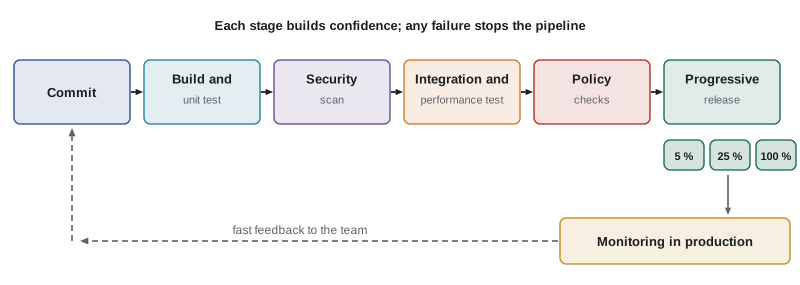
The pipeline also generates evidence. Every run records who changed what, which tests ran, which checks passed and when the change reached production. This evidence is valuable for auditors and for incident investigation, and it is far more complete than a change form filled in by hand.
Measuring delivery performance
The DORA research program, started by the DevOps Research and Assessment group and continued at Google, has surveyed tens of thousands of technology professionals since 2014. It popularized four key measures of software delivery performance, often called the DORA metrics. Two measure throughput and two measure stability, and the research found that high performers do well on all four at once.
| Measure | Definition | Type | Larchmont baseline |
|---|---|---|---|
| Deployment frequency | How often the organization deploys to production | Throughput | About twice a week across all systems |
| Lead time for changes | Time from code committed to running in production | Throughput | About 19 days (74 days from approved idea) |
| Change failure rate | Share of deployments that cause a failure needing remediation | Stability | 17 % |
| Time to restore service | How long it takes to recover from a failed change or incident | Stability | Median 6 hours |
Later DORA reports refined the names and added measures, for example describing recovery as failed deployment recovery time and looking at rework, and they emphasize that the measures describe teams and systems, not individuals. Using them to rank or reward individual engineers encourages gaming. Used well, they show where flow is blocked and whether stability improves as speed increases.
# Compute DORA-style measures from a month of deployment records (invented)
from statistics import median
deploys = [
    # (day, lead_time_hours, failed, hours_to_restore_if_failed)
    (1, 30, False, 0), (2, 52, False, 0), (4, 20, True, 3.5), (5, 44, False, 0),
    (8, 26, False, 0), (9, 70, True, 9.0), (11, 18, False, 0), (12, 33, False, 0),
    (15, 22, False, 0), (16, 41, False, 0), (18, 15, True, 1.0), (19, 29, False, 0),
    (22, 24, False, 0), (23, 36, False, 0), (25, 19, False, 0), (26, 27, False, 0),
    (29, 21, False, 0), (30, 25, False, 0),
]
n = len(deploys)
failed = [d for d in deploys if d[2]]
print(f"deployments in 30 days: {n} (about {n / 30 * 7:.1f} per week)")
print(f"median lead time: {median(d[1] for d in deploys):.0f} hours")
print(f"change failure rate: {len(failed) / n * 100:.0f} %")
print(f"median time to restore after failed change: {median(d[3] for d in failed):.1f} hours")deployments in 30 days: 18 (about 4.2 per week) median lead time: 26 hours change failure rate: 17 % median time to restore after failed change: 3.5 hours
These figures describe Larchmont Connect's team three months into its new pipeline: about four deployments a week, a median lead time of a little over a day, a change failure rate of 17 % and a median recovery of 3.5 hours. Throughput has improved sharply; stability has not yet, which tells the team to invest in automated testing and progressive release before pushing frequency higher.
Change enablement in an automated world
ITIL's change enablement practice exists to maximize the number of successful changes by ensuring risks are properly assessed, changes are authorized and the change schedule is managed. Nothing in that purpose requires a weekly meeting. ITIL 4 already encouraged decentralizing change authority and treating low-risk, well-understood changes as standard changes that are pre-authorized.
In a DevOps pipeline, much of change control becomes automated. Risk is assessed by rules and data: the size of the change, the components touched, test results, the team's recent failure rate and the time of day. Low-risk changes that pass all checks are authorized automatically, with peer review of code providing a human check. Higher-risk changes, such as database schema changes during month-end, are routed for additional review. Change advisory boards, where they remain, focus on genuinely risky or cross-team changes and on reviewing patterns rather than individual forms.
Worked problem
Designing automated change authorization
Larchmont classifies a deployment as low risk if it changes fewer than 400 lines, touches no database schema, passes all tests, comes from a team with a change failure rate under 15 % over 90 days, and is outside the month-end freeze. Last month, 140 of 180 deployments met all the rules. How many required manual review, and what share of manual reviews would change if the failure-rate threshold were raised to 20 %, letting 18 more qualify?
Show solution
- Manual reviews now = 180 - 140 = 40.
- With the looser threshold, manual reviews = 40 - 18 = 22.
- Reduction = 18 / 40 = 45 % fewer manual reviews.
- But teams with 15-20 % failure rates would now deploy without review, so the decision should be tested against their incident data first.
Answer: 40 manual reviews now, 22 with the looser rule, a 45 % cut. The trade-off is risk: loosen thresholds only after checking that the extra changes do not drive incidents.
Regulated US firms must show that automated controls are effective. Public companies' internal control over financial reporting, assessed under Sarbanes-Oxley section 404, covers change management for systems that affect financial data, and auditors look for segregation of duties, authorization, testing and traceability. Banking regulators and frameworks such as the FFIEC IT examination guidance raise similar points. Automated pipelines can meet these expectations if they enforce peer review, prevent people from approving their own changes, protect pipeline configuration and keep tamper-resistant records.
Policy as code and guardrails
Policy as code expresses rules such as 'all storage must be encrypted' or 'no public network access to databases' in a machine-readable form that tools check automatically, in the pipeline before deployment and continuously in production. It turns governance from a document people are asked to read into a guardrail that prevents violations or flags them immediately. Guardrails let teams move fast within safe boundaries instead of waiting for approvals.
Good guardrails are few, clear and explained. If a check blocks a deployment, the message should say what rule was broken, why it matters and how to fix it. Exceptions should be possible through a documented, time-limited process with an owner. Larchmont's security team started with nine rules covering encryption, public exposure, secrets in code, approved base images and logging, and added more only when incidents or audits showed a need.
Automation in service operations
DevOps focuses on delivery, but automation applies just as much to service operations: fulfilling requests, handling routine incidents and running repetitive operational tasks. Examples include password resets, access requests with automated approval and provisioning, new-starter setup, restarting a failed service when a known error recurs, scaling capacity when load rises and closing tickets when monitoring shows recovery. Automation reduces toil, the repetitive manual work that scales with load and adds no lasting value, and frees people for work that needs judgment.
Not everything should be automated. Good candidates are frequent, rule-based, stable and well understood, with clear inputs and outcomes. Poor candidates are rare, change often, need judgment or have unclear processes. Automating a broken process simply produces broken results faster, so the first step is often to simplify the process, following the ITIL guiding principle 'optimize and automate', in that order.
| Candidate task | Volume per month | Minutes each | Rule-based? | Verdict |
|---|---|---|---|---|
| Password reset | 1,150 | 6 | Yes | Automate with self-service and identity checks |
| Warehouse scanner re-provisioning | 220 | 25 | Mostly | Automate the standard path, keep manual exceptions |
| New starter accounts and equipment | 60 | 90 | Yes, with approvals | Automate provisioning; keep a human welcome check |
| Investigating intermittent EDI failures | 15 | 120 | No | Keep manual; improve diagnostics and knowledge |
| Annual license true-up | 1 per year | 2,400 | Partly | Use reports; full automation not worth it yet |
Avoiding automation pitfalls
Automation creates its own risks. Scripts written by one person become critical systems that nobody else understands. Automated actions can fail silently or cascade: a self-healing script that restarts a service every minute can hide a serious problem. Automated approvals can be gamed if rules are poorly designed. Treat automation as a product: put it in version control, test it, monitor it, document it, give it an owner and review it.
People are affected too. Staff whose work is automated may fear for their jobs, and losing hands-on work can erode the skills needed when automation fails. Larchmont committed publicly that automation in LTS would redeploy staff, not cut jobs, during the three-year plan, and it trained service desk analysts to build and maintain workflows. Lesson 11 returns to the people side of transformation.
Common mistakes
MistakeTreating DevOps as a tool purchase or a new team between development and operations.
InsteadChange culture, flow and feedback; tools support the change but do not make it.
MistakeSpeeding up deployments without investing in testing and progressive release.
InsteadImprove stability measures alongside throughput.
MistakeKeeping a weekly meeting as the only route to change approval.
InsteadAutomate risk assessment and authorization for low-risk changes; focus human review on genuine risk.
MistakeAutomating a process before simplifying it.
InsteadOptimize first, then automate.
MistakeLeaving automation scripts unowned and untested.
InsteadManage automation as a product with version control, tests, monitoring and an owner.
Summary and key terms
- DevOps combines culture, automation, lean flow, measurement and sharing so that changes can be delivered quickly, safely and reliably.
- Pipelines with version control, CI, CD, infrastructure as code and automated tests build confidence in stages and generate audit evidence.
- The DORA measures (deployment frequency, lead time, change failure rate and time to restore) show throughput and stability together.
- Change enablement remains essential but becomes largely automated, with human review focused on higher-risk changes.
- Policy as code turns governance rules into automated guardrails.
- Automation in operations reduces toil; choose frequent, rule-based, stable tasks and manage automation as a product.
- DevOps
- Cultural values, practices and tools that unite development and operations to deliver changes quickly, safely and reliably.
- Continuous integration
- Frequently merging small code changes into a shared main line with automated builds and tests.
- Continuous delivery
- Keeping every change that passes the pipeline in a releasable state.
- Infrastructure as code
- Defining infrastructure in files that tools use to create and change it consistently.
- Toil
- Repetitive manual operational work that scales with load and adds no lasting value.
Practice problems
Work each problem on paper first, then reveal the answer to check.
What does the CALMS acronym stand for?
Show answer
Culture, automation, lean, measurement and sharing.
Distinguish continuous delivery from continuous deployment.
Show answer
Continuous delivery keeps every passing change releasable; continuous deployment releases every passing change to production automatically.
Name the four DORA measures and their types.
Show answer
Deployment frequency and lead time for changes (throughput); change failure rate and time to restore (stability).
How can automated pipelines satisfy segregation of duties expectations?
Show answer
By enforcing peer review, preventing self-approval, protecting pipeline configuration and keeping tamper-resistant records.
Name three features of a good automation candidate.
Show answer
Frequent, rule-based, stable and well understood, with clear inputs and outcomes.
Why should DORA measures not be used to rank individual engineers?
Show answer
They describe teams and systems; using them on individuals encourages gaming and blame.
Lesson quiz · 5 questions
Score 60% or more to complete this lesson.
Create a free account to save your progress, take quizzes and earn a certificate.