
ITIL-141 · Lesson 4 of 12 · 28 min
Service configuration management and the CMDB
When the Larchmont warehouse management system slows down at 02:00, the on-call engineer needs answers fast. Which servers does it run on? Which database? Which network link connects the distribution centers? Which change was made last week, and to what? Which supplier supports the storage array? Without reliable answers, the engineer guesses, escalates or waits. Service configuration management is the practice that makes those answers available.
This lesson covers the purpose of service configuration management, configuration items and their attributes, relationships and service models, the configuration management database (CMDB) and configuration management system, how configuration data is collected and kept accurate, how it supports impact analysis, and how to audit it.
Purpose of service configuration management
In plain words, the purpose of the service configuration management practice is to ensure that accurate and reliable information about the configuration of services, and the configuration items that support them, is available when and where it is needed. This includes information on how configuration items are configured and the relationships between them. Two phrases carry the weight. Accurate and reliable: wrong information is worse than none, because people act on it. When and where it is needed: information locked in a tool that nobody can query during an incident, or so detailed that nobody can find what matters, does not fulfill the purpose.
ITIL 4 also warns against collecting configuration information for its own sake. Gathering and maintaining configuration data costs money and effort. The practice should collect only what supports a clear purpose, such as incident diagnosis, change impact assessment, financial reporting, security or audit, and should stop collecting data that nobody uses.
Configuration items
A configuration item (CI) is any component that needs to be managed in order to deliver an IT service. CIs can be hardware, such as servers, laptops, network switches and printers; software, such as applications, operating systems and licensed products; services themselves, both those delivered to customers and those consumed from suppliers; documentation, such as SLAs, architecture diagrams and procedures; people or teams, when they are critical to a service; and facilities, such as data centers and network rooms. What counts as a CI depends on what the organization needs to manage.
Each CI has a type, an identifier and a set of attributes. Attributes might include name, owner, location, version, status, supplier, support contract, cost and the service it supports. The attributes worth recording are those someone will use. A server CI might need its operating system version for security patching, its owner for approvals and its support contract for incident escalation. Its color is irrelevant.
| CI type | Example at Larchmont | Useful attributes |
|---|---|---|
| Business service | Shipment booking | Service owner, customers, SLA, criticality |
| Application | Warehouse management system v8.4 | Version, vendor, support contract, owner |
| Server or virtual machine | wms-app-02 | Operating system, location, environment, patch level |
| Database | wms-db-prod | Engine and version, backup schedule, data classification |
| Network link | Carrier circuit to the Brandon center | Carrier, circuit ID, bandwidth, support number |
| Cloud service | Hosting region for the shipment portal | Provider, region, account, availability commitment |
| Document | Shipment portal SLA | Version, review date, owner |
Relationships and service models
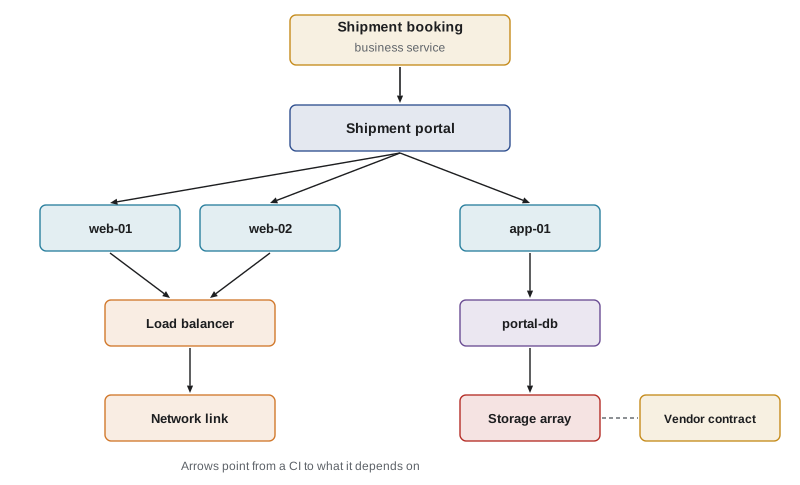
The real value of configuration information lies in relationships. Knowing that a server exists is mildly useful; knowing that the shipment booking service depends on the portal application, which runs on two web servers and an application server, which use a database, which sits on a storage array supported by a particular vendor, is extremely useful. Relationships let people trace from a failing component to the services it affects, and from a service to the components that could be causing its problems.
A service model is a description of how a service is built from its CIs and how they relate. Common relationship types include depends on, runs on, connects to, is hosted by, is supported by and is a component of. Service models are often visualized as dependency maps. ITIL 4 encourages organizations to model the services that matter most first, at a level of detail that supports real decisions, rather than trying to map everything at once.
CMDB and configuration management system
A configuration management database (CMDB) is a database used to store configuration records throughout their lifecycle. In practice, few organizations keep all configuration information in a single database. More often, the CMDB is federated: it brings together data from several sources, such as discovery tools, cloud provider inventories, the asset register, the software catalog and the service management tool, and presents a combined view. ITIL uses the term configuration management system (CMS) for the whole set of tools, data and information used to support service configuration management.
Each attribute should have one authoritative source. If the server's operating system version comes from a discovery tool and someone also edits it by hand in the CMDB, the two will drift. Designing which source owns which attribute, and how conflicts are resolved, is called reconciliation, and it is one of the most important decisions in building a CMDB.
| Data source | Typical attributes it owns | Notes |
|---|---|---|
| Network discovery tool | Hostnames, IP addresses, operating system, installed software | Scans regularly; good for hardware and software inventory |
| Cloud provider inventory | Cloud resources, regions, tags, sizes | Resources change quickly; pull frequently through provider interfaces |
| IT asset register | Purchase date, cost, warranty, financial owner | Owned by IT asset management (lesson 5) |
| Service management tool | Services, service owners, SLAs, incident and change links | Usually where the CMDB is presented |
| Identity directory | People, teams, managers | Used for ownership and approvals |
| Manual entry | Relationships discovery cannot see, business criticality | Keep to a minimum and assign owners |
Collecting and maintaining configuration data
Configuration data can be collected manually, automatically or both. Automated discovery tools scan networks and cloud accounts to find devices and software and to infer some relationships from network traffic or application configuration. Automation keeps data fresher and cheaper to maintain, but it cannot see everything: it may not know which business service a server supports or who owns it. Manual entry fills those gaps but decays quickly unless someone is responsible for keeping it current.
The most reliable way to keep configuration data accurate is to update it as part of the work that changes the configuration. When a change is implemented, the change record should update the affected CIs. When a release is deployed, the deployment pipeline should register the new version. When infrastructure is created from code, as with infrastructure-as-code tools, the code and its state files can feed the CMDB directly. Configuration data maintained as a side task, separate from the work, almost always becomes stale.
Configuration data across the lifecycle
CIs pass through a lifecycle: planned, ordered, in build, in test, live, under maintenance, retired and disposed. Recording status lets people see, for example, which servers are live and which are waiting to be decommissioned. Baselines capture the configuration of a service or set of CIs at a point in time, such as the approved configuration before a major release. A baseline lets teams compare the current state with a known good state and roll back if needed.
Supporting other practices
Service configuration management supports almost every other practice. Incident management uses service models to diagnose faults and to find which services and users are affected. Problem management looks for patterns across CIs, such as all incidents involving one model of switch. Change enablement uses relationships to assess the impact and risk of a change. Release and deployment management use baselines and version information. IT asset management shares data about hardware and software. Information security management uses CI data to find unpatched systems and to understand where sensitive data lives. Service level management uses service models to understand composite availability. Financial management uses CI data to allocate costs to services.
| Practice | How it uses configuration information |
|---|---|
| Incident management | Diagnose faults, identify affected services and users, find support contacts |
| Problem management | Spot trends across CI types, models and versions |
| Change enablement | Assess impact and risk using dependencies |
| Release and deployment | Track versions, baselines and environments |
| Information security | Find vulnerable or unpatched CIs and sensitive data locations |
| Service level management | Understand service composition and availability |
| IT asset management | Share inventory, cost and lifecycle data |
Impact analysis with dependency traversal
One of the most valuable uses of a CMDB is impact analysis: if this CI fails or changes, which services are affected? Answering requires following relationships upward from the CI to everything that depends on it, directly or indirectly. The reverse question, which CIs could be causing a problem with this service, follows relationships downward. Both are graph traversals, and a small example shows how they work.
# Impact analysis on a small CMDB relationship graph
from collections import deque
# edges: (dependent, depends_on)
edges = [
    ("Shipment booking", "Shipment portal"),
    ("Customer tracking", "Shipment portal"),
    ("Shipment portal", "web-01"), ("Shipment portal", "web-02"),
    ("Shipment portal", "app-01"), ("app-01", "portal-db"),
    ("Warehouse operations", "WMS"), ("WMS", "wms-app-02"), ("wms-app-02", "wms-db"),
    ("portal-db", "storage-array-A"), ("wms-db", "storage-array-A"),
    ("web-01", "core-switch-1"), ("web-02", "core-switch-2"), ("app-01", "core-switch-1"),
]
services = {"Shipment booking", "Customer tracking", "Warehouse operations"}
up = {}
for dep, on in edges:
    up.setdefault(on, []).append(dep)

def impacted(ci):
    seen, q = set(), deque([ci])
    while q:
        for parent in up.get(q.popleft(), []):
            if parent not in seen:
                seen.add(parent); q.append(parent)
    return seen

for ci in ["storage-array-A", "core-switch-1", "web-02"]:
    hit = impacted(ci)
    print(f"{ci:<16} affects services: {sorted(hit & services)}")
print(f"{'':<16} via: {sorted(hit - services)}")storage-array-A affects services: ['Customer tracking', 'Shipment booking', 'Warehouse operations']
via: ['Shipment portal', 'WMS', 'app-01', 'portal-db', 'wms-app-02', 'wms-db']
core-switch-1 affects services: ['Customer tracking', 'Shipment booking']
via: ['Shipment portal', 'app-01', 'web-01']
web-02 affects services: ['Customer tracking', 'Shipment booking']
via: ['Shipment portal']The output shows that the storage array is a hidden single point of failure: both the shipment portal and the warehouse management system depend on it, so its failure would hit three business services. The traversal treats every dependency as hard, so it also lists the services above web-02 even though web-01 could keep the portal running. Real tools record whether a relationship is redundant so impact analysis can distinguish "affected" from "at risk". Even this simple version shows why accurate relationships matter: a missing edge would make the storage array look harmless.
How much detail?
Deciding the scope and level of detail is the central design choice in service configuration management. Too little detail and the CMDB cannot answer important questions. Too much and the cost of keeping it accurate overwhelms the benefit, data quality collapses and people stop trusting it. A useful approach is to start from the questions the CMDB must answer, for example "which business services does this CI affect?" and "who supports this CI?", then record only the CIs, attributes and relationships needed to answer them for the most critical services. Coverage can then expand as value is proven.
Configuration audits and verification
Configuration audits compare recorded configuration with reality. They can be done by automated discovery, by sampling records and checking them physically or in system consoles, or by reviewing changes to confirm the CMDB was updated. Audit results are expressed as discrepancy rates: the share of sampled records with at least one significant error. Discrepancies should be corrected, but more importantly their causes should be fixed, for example by adding a CMDB update step to a change model or connecting a new discovery source.
Worked problem
Configuration audit
LTS audits a random sample of 200 server CIs. Discovery confirms 186 exist as recorded. Of those, 9 have the wrong owner and 6 the wrong operating system version. 14 records describe servers that no longer exist. Separately, discovery finds 23 live servers with no CMDB record. What is the discrepancy rate of the sample, and what does the unrecorded count suggest?
Show solution
- Records with errors = 14 missing servers + 9 wrong owner + 6 wrong version = 29 (assuming no record has both owner and version errors).
- Discrepancy rate = 29 ÷ 200 = 14.5 %.
- The 23 unrecorded servers are not in the sample denominator, so they need a separate measure: completeness.
Answer: The sample discrepancy rate is 14.5 %. The 23 unrecorded live servers point to a completeness gap, likely servers created outside the change process or in an unscanned network.
# Simulate a configuration audit: estimate the discrepancy rate with a confidence interval
import random, math
random.seed(41)
population = 2400                     # server CIs in the CMDB
true_error_rate = 0.12                # unknown in practice
records = [random.random() < true_error_rate for _ in range(population)]
n = 200
sample = random.sample(records, n)
errors = sum(sample)
p = errors / n
se = math.sqrt(p * (1 - p) / n) * math.sqrt((population - n) / (population - 1))
print(f"errors in sample: {errors} of {n}  ->  discrepancy rate {p * 100:.1f} %")
print(f"approximate 95 % interval: {max(0, p - 1.96 * se) * 100:.1f} % to {(p + 1.96 * se) * 100:.1f} %")
print(f"estimated records with errors in the CMDB: about {p * population:.0f}")errors in sample: 26 of 200 -> discrepancy rate 13.0 % approximate 95 % interval: 8.5 % to 17.5 % estimated records with errors in the CMDB: about 312
Roles and governance
Typical roles include a configuration manager or practice owner who designs the CMDB model, sets data standards and reports on quality; CI owners who are accountable for the accuracy of their CIs; and data stewards for particular sources. Governance decides which CI types and attributes are in scope, which sources are authoritative, how quality is measured and who may change the model. Without governance, CMDBs tend to sprawl, with duplicate CI types and inconsistent naming that make queries unreliable.
Measuring the practice
Measures for service configuration management include accuracy (discrepancy rate from audits), completeness (share of discovered CIs that are recorded), currency (age of the last update), coverage (share of critical services with complete service models), and usage (how often incident and change records reference CIs, and whether people report that the data helped). Usage is the most telling: a CMDB that people consult during incidents and changes is earning its keep.
ITIL (Version 5) note
Published summaries of ITIL (Version 5), checked in October 2026, keep the name service configuration management and place it in the product and service management group. The practice remains closely linked to IT asset management, which lesson 5 covers.
Common mistakes
MistakeRecording every possible CI and attribute.
InsteadStart from the questions the data must answer and record only what supports them.
MistakeTreating the CMDB as a single database filled by hand.
InsteadFederate authoritative sources, automate discovery and assign each attribute one owner.
MistakeUpdating the CMDB as a separate administrative task.
InsteadUpdate configuration data as part of changes, releases and infrastructure-as-code workflows.
MistakeIgnoring relationships.
InsteadModel dependencies for critical services so impact analysis works.
MistakeFixing audit discrepancies one by one.
InsteadCorrect the records and fix the process that let them go wrong.
Summary and key terms
- Service configuration management ensures accurate and reliable information about services and CIs is available when and where needed.
- CIs include hardware, software, services, documents, people and facilities; record only useful attributes.
- Relationships and service models are where most of the value lies, enabling impact and root cause analysis.
- A CMDB is usually federated within a wider configuration management system, with one authoritative source per attribute.
- Data stays accurate when updates are built into changes, releases and automated discovery.
- Dependency traversal finds affected services and hidden single points of failure.
- Audits measure accuracy and completeness, and governance keeps the model coherent.
- Service configuration management
- The practice of ensuring accurate, reliable configuration information is available when and where needed.
- Configuration item
- Any component that needs to be managed in order to deliver an IT service.
- Configuration management database
- A database used to store configuration records throughout their lifecycle.
- Configuration management system
- The set of tools, data and information used to support service configuration management.
- Service model
- A description of how a service is built from its configuration items and their relationships.
- Federated CMDB
- A CMDB that combines data from several authoritative sources into one view.
- Reconciliation
- Deciding which source owns each attribute and resolving conflicts between sources.
- Baseline
- A recorded configuration at a point in time used for comparison or rollback.
- Discovery
- Automated scanning that finds devices, software and some relationships.
- Configuration audit
- A check that recorded configuration matches reality.
Practice problems
Work each problem on paper first, then reveal the answer to check.
State the purpose of service configuration management in plain words.
Show answer
To ensure accurate and reliable information about services and the CIs that support them, including their configuration and relationships, is available when and where needed.
Give four types of configuration item.
Show answer
Any four of: hardware, software, services, documentation, people or teams, facilities.
Why are relationships more valuable than lists of CIs?
Show answer
They let people trace from a failing component to affected services and from a service to possible causes.
What is a federated CMDB?
Show answer
One that brings together data from several authoritative sources into a combined view.
Why should each attribute have one authoritative source?
Show answer
To prevent conflicting values and drift between sources.
What is the most reliable way to keep configuration data current?
Show answer
Update it as part of the work that changes configuration, such as changes, releases and infrastructure-as-code.
An audit of 150 records finds 18 with errors. What is the discrepancy rate?
Show answer
18 ÷ 150 = 12 %.
Distinguish accuracy from completeness.
Show answer
Accuracy is whether recorded data is correct; completeness is whether all real CIs are recorded.
How does change enablement use configuration information?
Show answer
To assess the impact and risk of a change by following dependencies.
Name one sign that a CMDB is earning its keep.
Show answer
People consult it during incidents and changes and report that the data helped.
Lesson quiz · 5 questions
Score 60% or more to complete this lesson.
Create a free account to save your progress, take quizzes and earn a certificate.