
ITIL-120 · Lesson 7 of 12 · 29 min
Keep it simple and practical
Complexity creeps into organizations. Each incident leads to a new control, each audit finding to a new form, each exception to a new rule. Over years, processes accumulate steps that nobody can fully explain, and the effort spent following them grows while the value they deliver stays the same or falls. The sixth guiding principle pushes back against this drift. It asks organizations to use the minimum number of steps needed to achieve an objective, to eliminate anything that does not add value, and to design solutions that are practical for the people who must use them. This lesson explains what simplicity means in service management, how to decide what to remove, how simplicity and control can coexist, and why simple is not the same as easy.
What the principle asks
Keep it simple and practical means: always use the minimum number of steps to accomplish an objective. Outcome-based thinking should be used to produce practical solutions that deliver valuable outcomes. If a process, service, action or metric fails to provide value or produce a useful outcome, eliminate it. Although this principle may seem obvious, it is frequently ignored, resulting in overly complex methods of work that rarely maximize outcomes or minimize cost.
Applying the principle involves:
- Ensuring value: every activity should contribute to value creation.
- Simplicity is the ultimate sophistication: it can be harder to design something simple than something complicated.
- Doing fewer things, but doing them better: focus effort where it produces the most value.
- Respecting the time of the people involved: needless steps and reports waste the time of staff and consumers alike.
- Making things easier to understand, so people are more likely to adopt them.
- Looking for quick wins that show progress and build momentum.
Why complexity grows
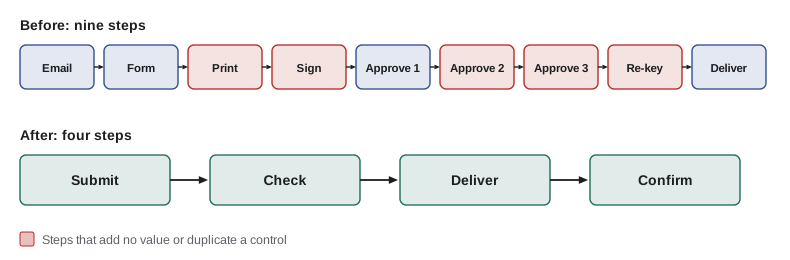
Complexity rarely comes from a single bad decision. It accumulates through reasonable responses to individual events. After a failed change, a review step is added. After a security incident, an extra approval is required. After an audit, a new record must be kept. Each addition made sense at the time, but nobody reviews whether the reasons still apply. Meanwhile, exceptions multiply: special handling for one customer, a different form for one department, an extra report for one manager.
The result is a process that tries to handle every possible case. ITIL warns against this directly: trying to design a process or service that accounts for every exception leads to over-complication. A better approach is to design for the common cases and create clear, simple rules for handling exceptions when they arise.
Deciding what to remove
Removing steps requires judgment. Some steps that appear to add no value actually protect against real risks; removing them could cause harm. Others exist only because nobody questioned them. A useful approach is to ask three questions of each step:
- What value does this step add, and for whom?
- What risk does it control, and how likely and serious is that risk?
- Could the same value or control be achieved more simply, for example by automating it or combining it with another step?
| Type of step | Typical example | Usual action |
|---|---|---|
| Adds value for the consumer | Configuring the requested access | Keep and do it well |
| Controls a significant risk | Approval of high-risk changes | Keep, but make it proportionate |
| Required by law or regulation | Retaining financial records | Keep, in the simplest compliant form |
| Controls a minor risk at high cost | Manager approval for every password reset | Simplify or remove |
| Adds no value and controls no risk | Printing and filing an electronic form | Remove |
Worked problem
Simplifying an approval process
A standard software request needs three approvals: line manager, department head and IT security. Data for the past year shows 4,800 requests, of which 99.6 % were approved at every stage. Each approval adds an average wait of 1 day and 5 minutes of the approver's time. The only rejections came from IT security, for software not on the approved list. Propose a simpler design and estimate the effort saved.
Show solution
- Rejections: 0.4 % of 4,800 = about 19 requests, all for unapproved software.
- Simpler design: requests for software on the approved list need only line manager approval; IT security reviews only requests for software not on the list.
- Approvals removed: two per request for approved software. If about 4,780 requests were for approved software, that removes about 9,560 approvals.
- Approver time saved: 9,560 × 5 minutes = 47,800 minutes, or about 797 hours a year. Requesters also wait about 2 days less.
Answer: Limiting security review to unlisted software and removing the department head approval saves about 800 hours of approver time a year and two days of waiting per request, while keeping the control that actually catches risky requests.
Simplicity and control
A common objection to simplification is that it weakens control. In practice, overly complex controls often weaken control, because people find ways around them. An approval that is always granted becomes a rubber stamp, providing a false sense of security. A form with forty fields leads people to enter placeholder data. A policy too long to read is not followed.
Simple, well-designed controls tend to be followed more consistently. The principle therefore supports effective governance (lesson 10): controls should be proportionate to the risk they manage, clear enough to be followed and checked, and reviewed regularly to confirm they still work.
Worked problem
Cost of a rubber-stamp control
A change advisory board meets weekly and reviews about 60 changes, of which 50 are low-risk standard changes it always approves. Ten people attend for 2 hours. The average loaded cost of attendees is $85 per hour. What share of the meeting cost goes on reviewing changes that are always approved, assuming time is spread evenly across changes?
Show solution
- Weekly meeting cost: 10 people × 2 hours × $85 = $1,700.
- Share spent on low-risk standard changes: 50 ÷ 60 ≈ 83 %.
- Cost of reviewing always-approved changes: 83 % × $1,700 ≈ $1,417 a week, or about $73,700 a year.
- Pre-authorizing standard changes, as ITIL's change enablement practice allows, would let the board focus its time on the 10 changes where its judgment matters.
Answer: About $73,700 a year goes on reviewing changes that are always approved. Pre-authorizing them simplifies the process and improves control by focusing attention where risk is real.
Simple is not the same as easy
Designing something simple can be hard. It takes effort to understand a process well enough to know which steps matter. It takes courage to remove a step that someone senior once insisted on. And it takes discipline to resist adding complexity each time an exception arises. The principle quotes a familiar idea: simplicity is the ultimate sophistication.
Simple also does not mean simplistic. A simple solution handles the real problem well with the fewest moving parts. A simplistic solution ignores important parts of the problem. Removing a security review entirely, for example, would be simplistic if it exposed the organization to serious risk. The aim is to find the simplest design that still achieves the outcome.
Quick wins
The principle encourages looking for quick wins: small, visible improvements that deliver value quickly and build support for further change. Removing a pointless report, shortening a confusing form or publishing a clear knowledge article are typical examples. Quick wins demonstrate that improvement is possible and that suggestions are acted on, which encourages people to suggest more. They should, however, be part of a broader direction, not a substitute for addressing harder problems.
Worked problem
Scoring quick wins by value and effort
A team lists four simplification ideas with value and effort each scored 1–5: retire a duplicate report (value 2, effort 1), shorten the request form (value 4, effort 2), merge two approval steps (value 4, effort 3), redesign the whole change process (value 5, effort 5). Rank them by value divided by effort.
Show solution
- Retire duplicate report: 2 ÷ 1 = 2.0.
- Shorten request form: 4 ÷ 2 = 2.0.
- Merge approval steps: 4 ÷ 3 ≈ 1.33.
- Redesign change process: 5 ÷ 5 = 1.0.
Answer: The report retirement and form shortening tie for first as quick wins, then merging approvals, then the full redesign. The redesign may still be worth doing, but quick wins build momentum first.
Practical, not just simple
The word "practical" in the principle matters. A solution must work for the people who use it, in the conditions where they use it. A process designed in a meeting room may be elegant on paper but impractical for an agent juggling calls. Involving the people who do the work in designing it (lesson 5) is the best way to ensure solutions are practical. Testing designs in real conditions, in small iterations (lesson 4), confirms they work before they are rolled out widely.
Practicality also applies to documentation. A two-page guide that people actually read is more useful than a hundred-page manual that sits unopened. Knowledge articles should be written for the reader, using plain language and showing the steps in order. Templates, checklists and examples often help more than long explanations.
Links to Lean and other principles
This principle reflects Lean thinking, which classifies activities that do not add value as waste and seeks to eliminate them. Lean identifies forms of waste such as waiting, over-processing, unnecessary motion, defects and unused talent, all of which appear in service management. The principle also works closely with optimize and automate (lesson 8): simplify first, then automate what remains. Automating a complicated process simply produces complicated automation.
Keeping things simple over time
Simplification is not a one-off project. Because complexity accumulates through reasonable reactions to individual events, it returns unless organizations review their processes regularly. Some practical habits help:
- Give every control, report and approval an owner who must confirm, at least yearly, that it still adds value or manages a real risk.
- When adding a new step after an incident, set a review date and remove the step if the risk has been addressed another way.
- Track how often exception paths are used; an exception used constantly is really part of the standard process and should be designed in, while one never used may be removed.
- Ask new staff what confuses them. People new to a process notice complexity that long-serving staff no longer see.
These habits make simplicity part of normal management rather than a periodic clean-up. They also support governance, since a regularly reviewed set of controls is easier to explain to auditors and governing bodies than an accumulated collection whose purpose nobody remembers.
Key point to remember
Every step should earn its place. If nobody can say what value a step adds or what significant risk it controls, it is a candidate for removal, and the effort saved can be spent on work that matters.
Common mistakes
MistakeDesigning a process to handle every possible exception.
InsteadDesign for common cases and create simple rules for exceptions.
MistakeKeeping approvals that are always granted.
InsteadRemove or pre-authorize rubber-stamp approvals and focus review where risk is real.
MistakeRemoving controls without assessing the risk they manage.
InsteadSimplify controls proportionately, keeping those that address significant risks.
MistakeAutomating a complicated process as it stands.
InsteadSimplify the process first, then automate what remains.
MistakeTreating simple as simplistic.
InsteadFind the simplest design that still achieves the outcome and manages risk.
Summary and key terms
- Use the minimum number of steps needed to achieve an objective.
- Eliminate any process, action or metric that fails to provide value or a useful outcome.
- Complexity accumulates through reasonable reactions to individual events; it must be actively reviewed.
- Design for common cases and handle exceptions with simple rules.
- Overly complex controls often weaken control by encouraging workarounds and rubber-stamping.
- Simple is not easy and is not simplistic; it takes effort and judgment.
- Quick wins build momentum, and practical design involves the people who do the work.
- Simplification
- Removing steps, rules or components that do not add value or control significant risk.
- Rubber stamp
- An approval that is always granted without real review.
- Quick win
- A small improvement that delivers visible value quickly.
- Exception handling
- Rules for dealing with cases that fall outside the standard process.
- Proportionate control
- A control whose strength matches the size of the risk it manages.
- Standard change
- A low-risk, pre-authorized change that is well understood and documented.
- Waste
- In Lean, any activity that consumes resources without adding value.
- Over-processing
- Doing more work than the consumer needs or values.
- Simplistic
- Oversimplified in a way that ignores important parts of a problem.
- Value-to-effort ratio
- A simple score dividing expected value by expected effort to rank options.
Practice problems
Work each problem on paper first, then reveal the answer to check.
State the principle keep it simple and practical in one sentence.
Show answer
Use the minimum number of steps to achieve an objective, removing anything that does not add value.
Why should processes not try to handle every exception?
Show answer
It leads to over-complication; design for common cases with simple exception rules.
What three questions help decide whether to remove a step?
Show answer
What value does it add; what risk does it control; could it be achieved more simply?
How can complex controls weaken control?
Show answer
People find workarounds, and approvals become rubber stamps.
An approval is granted 100 % of the time. What should be considered?
Show answer
Removing or pre-authorizing it, since it provides no real control.
What is the difference between simple and simplistic?
Show answer
Simple solves the real problem with few moving parts; simplistic ignores important parts of it.
An idea has value 3 and effort 1; another value 5 and effort 4. Which ranks higher by value/effort?
Show answer
The first, with 3.0 against 1.25.
Why simplify before automating?
Show answer
Automating a complicated process produces complicated automation.
Name three forms of Lean waste.
Show answer
Waiting, over-processing and defects.
How can solutions be made practical?
Show answer
Involve the people who do the work and test designs in real conditions.
Lesson quiz · 5 questions
Score 60% or more to complete this lesson.
Create a free account to save your progress, take quizzes and earn a certificate.