
ITIL-101 · Lesson 7 of 12 · 27 min
Higher-level modules and exam styles
Once Foundation is behind you, the ITIL scheme changes character. The higher-level modules go deeper into how to apply ITIL in real situations, they require accredited training, and several use a different exam style: open-book, scenario-based exams that test application and analysis rather than recall. Candidates who approach them like a bigger Foundation exam are often surprised. This lesson describes each Version 5 advanced module at the level a candidate needs for planning, explains the difference between closed-book and open-book exams, discusses how to prepare for scenario-based questions, and works through timing and pass-mark arithmetic for higher-level exams. Exam formats for Version 5 advanced modules (number of questions, time and pass marks) had not been confirmed consistently by independent sources at the time of writing (October 2026), so the figures in examples are illustrative; check each module's official exam specification before you plan.
The Practice Manager specializations
The three Practice Manager specialization modules each cover a group of related practices and focus on how to run them well: their purpose, key activities, roles, metrics, how they interact with other practices and how to improve them. Descriptions at the time of writing group them as follows.
- Monitor, Support and Fulfill: operational practices that keep services running and fulfill user needs, such as monitoring and event management, incident management, the service desk and service request management.
- Plan, Implement and Control: practices that introduce and control change, such as change enablement, release and deployment management, and configuration management.
- Collaborate, Assure and Improve: practices that build relationships and assure quality, such as relationship management, service level management, supplier management and continual improvement.
Exact practice groupings should be checked against the official module descriptions. These modules are examined by closed-book multiple-choice exams, closer in style to Foundation but with more application-level questions.
The Managing Professional modules
The three Managing Professional modules, Product, Service and Experience, address the management of digital products and services from different angles. Product focuses on designing, building and evolving digital products; Service on designing, delivering and supporting services built on them; and Experience on understanding and improving the experiences of customers, users and employees. Together with Transformation, they are designed for practitioners who coordinate teams and value streams. At the time of writing, they are described as having open-book exams.
Strategy and Transformation
Strategy is aimed at people who set direction: aligning digital products and services with organizational goals, making investment decisions and positioning the organization in its market. Transformation, shared by all designations, covers how organizations change: planning and leading transformation, managing organizational change, and building capabilities. Both are described as open-book.
AI Governance
The AI Governance extension module covers the responsible use of artificial intelligence: setting policies, managing risks such as bias and privacy, assigning accountability and complying with regulation. It does not count toward a designation but can be valuable for practitioners whose organizations are adopting AI tools in service management. It is described as using a closed-book multiple-choice exam.
| Module | Designation(s) | Exam style (at the time of writing) |
|---|---|---|
| Monitor, Support and Fulfill | Practice Manager | Closed-book multiple choice |
| Plan, Implement and Control | Practice Manager | Closed-book multiple choice |
| Collaborate, Assure and Improve | Practice Manager | Closed-book multiple choice |
| Product | Managing Professional | Open book (planned) |
| Service | Managing Professional | Open book (planned) |
| Experience | Managing Professional | Open book (planned) |
| Strategy | Strategic Leader | Open book (planned) |
| Transformation | All three | Open book (planned) |
| AI Governance | Extension | Closed-book multiple choice |
Closed book versus open book
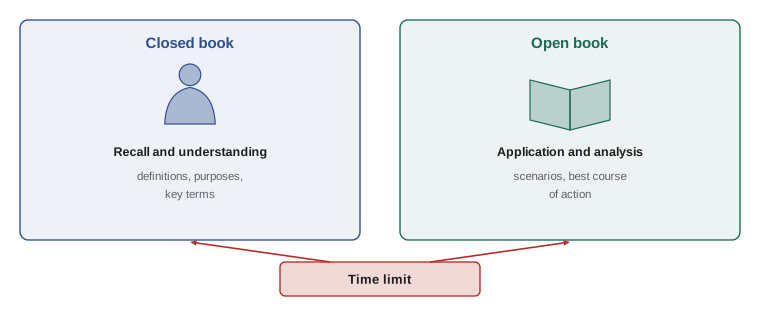
In a closed-book exam, you rely on memory and understanding; preparation emphasizes learning concepts thoroughly enough to recognize them in questions. In an open-book exam, you may consult the official publication, usually a clean copy without notes, sometimes in digital form within the exam software. The ability to look things up shifts what is tested: questions focus on applying concepts to scenarios, choosing the best course of action among plausible options, and analyzing situations. The time limit is the binding constraint. If you have to search for every answer, you will not finish.
Effective open-book preparation therefore has two parts: understanding the material well enough that you only need to look up a few details, and knowing the publication's structure so that you can find things quickly. Practice with the same version of the book you will have in the exam. If tabs or annotations are not permitted, learn the table of contents and the location of key models and lists.
Scenario-based questions
Higher-level questions typically present a scenario, a description of an organization, its situation and its problems, followed by questions that ask what the organization should do, which approach best addresses a problem, or which statement best explains a situation. Several options may be partly right. The skill is to choose the best answer in the context described. Useful habits:
- Read the question first, then the scenario, so you know what to look for.
- Underline or note key constraints in the scenario: budget limits, culture, regulation, urgency.
- Eliminate options that contradict the scenario or ITIL principles, then compare what remains.
- Prefer options that address the root of the problem, involve stakeholders and progress iteratively, which reflects ITIL's guiding ideas.
- Watch qualifiers such as "first", "best" and "most important".
Timing for higher-level exams
Because formats vary by module and were not consistently confirmed at the time of writing, the following example uses illustrative numbers. Always replace them with the official figures for your module.
Worked problem
Timing an open-book exam
Suppose an open-book module exam has 40 scenario-based questions in 90 minutes. A candidate estimates she needs about 1 minute to read each scenario and question carefully, and that she will need to consult the book for about one question in four, at roughly 2 extra minutes each. Can she finish, and how much review time remains?
Show solution
- Reading and answering: 40 questions × 1.5 minutes (1 minute reading plus 0.5 minute deciding) = 60 minutes.
- Lookups: one in four questions is 10 questions × 2 minutes = 20 minutes.
- Total: 60 + 20 = 80 minutes, leaving 10 minutes for review.
- If she needed to look up every second question (20 × 2 = 40 minutes), the total would be 100 minutes, over the limit.
Answer: With lookups for one question in four she finishes in about 80 minutes with 10 to spare; heavier reliance on the book would make her run out of time, which is why understanding the material matters even in open-book exams.
Pass marks at higher levels
Pass marks for higher-level ITIL exams have historically been in a similar range to Foundation, around 60–70 %, but check the official figure. Pass-mark arithmetic works the same way: multiply the pass percentage by the number of questions and round up if the result is not a whole number.
Worked problem
Rounding a pass mark
An illustrative exam has 30 questions and a pass mark of 70 %. How many correct answers are needed?
Show solution
- Compute 0.70 × 30 = 21.
- The result is a whole number, so 21 correct answers are needed.
- If the exam had 33 questions, 0.70 × 33 = 23.1, which rounds up to 24, because 23 would be only 69.7 %.
Answer: 21 out of 30; when the calculation is not a whole number, round up to the next whole question.
How training prepares you
Because advanced modules require accredited training, preparation is more structured than for Foundation. Courses typically include the official materials, exercises based on case studies, sample exams and, often, the exam voucher. Make the most of training by doing pre-course reading, asking about real situations from your work, practicing sample exams under timed conditions and, for open-book modules, using the training to learn the book's structure. Most candidates take each advanced exam soon after training, often within a few weeks, while the material is fresh.
Pacing a multi-module journey
Taking several advanced modules is a significant commitment. A sensible pace for working professionals is one module every two to three months, which allows time to apply ideas at work and to prepare for each exam without burnout. Employers often prefer this pace because it spreads costs across budget periods.
Working with case studies in training
Advanced training usually revolves around a case study, a fictional organization described in some detail, with exercises asking what it should do in various situations. Treat the case study as practice for scenario questions. For each exercise, identify the problem, the constraints and the stakeholders, and explain why your chosen approach fits better than alternatives. Discussing answers with other students is valuable because it exposes you to different reasoning, which is exactly what open-book scenario questions test.
Building a personal index for open-book exams
Where the rules allow, some candidates prepare a mental or written map of where things are in the publication: which chapter covers which model, where key lists appear, where examples are found. Check the exam rules carefully before relying on anything written; in many open-book exams only a clean copy of the official publication is permitted, and notes or tabs may be forbidden. Even without written aids, practicing lookups until you can find any key topic within a minute or so makes a large difference to timing.
Applying what you learn between modules
Advanced modules are most useful when you apply them. After each module, choose one idea to try at work within a month: perhaps a better way of measuring a practice, a change to how a team handles requests, or a more structured approach to a stakeholder conversation. Note what happened. These small experiments improve your understanding, give you real examples to use in later scenario questions and interviews, and show your employer a return on the training they may have funded.
| After module | Example idea to apply |
|---|---|
| Monitor, Support and Fulfill | Review incident categories and target times with the service desk |
| Plan, Implement and Control | Introduce a lighter approval path for low-risk standard changes |
| Collaborate, Assure and Improve | Hold a short service review with a key customer |
| Experience | Map a user journey and remove one point of friction |
| Strategy | Draft a one-page summary linking a service to organizational goals |
Comparing the effort of closed-book and open-book modules
Candidates sometimes ask which kind of module is harder. The answer depends on the person. Closed-book modules reward memory and steady revision; candidates who like flashcards and structured review often find them comfortable. Open-book modules reward judgment, reading speed and experience; candidates who have worked in complex organizations often find scenarios familiar, while those new to management may find the options hard to tell apart. Knowing your own strengths helps you decide where to put extra preparation.
Reading scenarios efficiently
Scenarios can be long. A practical method is to read the question first, skim the scenario for the facts that matter to that question, then read the options. Mark facts such as the organization's goal, its main problem, any constraint, and who is affected. Many wrong options ignore one of these facts. If a scenario is used for several questions, a quick summary in a few words on your scratch paper or whiteboard, where permitted, can save rereading time.
| Scenario fact | Why it matters |
|---|---|
| Goal | The best option advances it |
| Main problem | The best option addresses its cause |
| Constraint | Options that ignore it are wrong |
| Stakeholders | Good options involve the right people |
| Timing | Words like first or next change the answer |
Signs that you are ready for an advanced exam
Readiness for an advanced exam looks a little different from Foundation readiness. Good signs include scoring comfortably above the pass mark on official sample exams under timed conditions; being able to explain why each wrong option in a sample question is wrong; finding key topics in the publication quickly, where it is allowed; and recognizing situations from your own work in the scenarios. Warning signs include running short of time on sample exams, relying on the book for most answers, or choosing options because they sound like ITIL rather than because they fit the scenario. If you see warning signs, use the time before the exam for targeted practice rather than more reading. Ask your trainer for advice as well; trainers see many candidates and can often tell quickly which areas need work.
Common mistakes
MistakeTreating open-book exams as easy.
InsteadPrepare to understand the material and look up only details.
MistakeNot learning the book's structure.
InsteadPractice finding key models and lists quickly.
MistakeChoosing a partly right answer without reading the scenario.
InsteadChoose the best answer in the context given.
MistakeAssuming all advanced exams share one format.
InsteadCheck each module's official exam specification.
MistakeRounding a pass mark down.
InsteadRound up to the next whole question.
Summary and key terms
- Version 5 has three Practice Manager specializations, three MP modules, Strategy and Transformation.
- Practice Manager modules and AI Governance use closed-book multiple choice.
- Product, Service, Experience, Strategy and Transformation are planned as open book.
- Open-book exams test application and analysis under time pressure.
- Scenario questions ask for the best answer in context.
- Plan time for reading, deciding and limited lookups.
- Check official formats; illustrative figures are not exam specifications.
- Advanced module
- Any module above Foundation in the scheme.
- Specialization module
- Practice Manager module covering a practice group.
- Open-book exam
- Exam permitting the official publication.
- Scenario
- Description of a situation used in questions.
- Best answer
- The most suitable option in context.
- Qualifier
- Word such as first, best or most that changes a question.
- Case study
- Extended example used in training.
- Exam specification
- Official details of an exam's format.
- Lookup time
- Time spent consulting the book in an exam.
- AI Governance
- Extension module on responsible AI use.
Practice problems
Work each problem on paper first, then reveal the answer to check.
Name the three Practice Manager specializations.
Show answer
Monitor, Support and Fulfill; Plan, Implement and Control; Collaborate, Assure and Improve.
Name the three Managing Professional modules.
Show answer
Product, Service and Experience.
Which modules are planned as open book?
Show answer
Product, Service, Experience, Strategy and Transformation.
What does an open-book exam mainly test?
Show answer
Application and analysis.
What is the binding constraint in an open-book exam?
Show answer
Time.
What should you read first in a scenario question?
Show answer
The question, then the scenario.
What is 70 % of 33, rounded correctly?
Show answer
24.
Is AI Governance part of a designation?
Show answer
No, it is an extension.
What pace suits most professionals for advanced modules?
Show answer
One every two to three months.
Where are the official exam formats found?
Show answer
In each module's exam specification.
Lesson quiz · 5 questions
Score 60% or more to complete this lesson.
Create a free account to save your progress, take quizzes and earn a certificate.