
ITIL-101 · Lesson 1 of 12 · 25 min
What ITIL is and why organizations use it
ITIL is the most widely used body of guidance for managing technology-enabled services. Banks, hospitals, governments, universities, retailers, telecommunications companies and cloud providers use it to organize how they design, deliver, support and improve the digital products and services their customers depend on. Hundreds of thousands of people take an ITIL exam every year, and "ITIL Foundation" appears in a large share of job postings for service desk analysts, IT operations staff, service managers, business analysts and many other roles. This course explains how ITIL certification works from start to finish: what ITIL is, where it came from, how the qualification scheme is organized, what the Foundation exam looks like, which higher-level modules exist, how to choose a path, how to prepare and how to keep a certification current. The rest of this program then covers the content of the Foundation exam in depth. This first lesson sets the scene: what ITIL is and is not, the problems it helps organizations solve, who uses it and why, and how to decide whether an ITIL certification is the right next step for you.
A note on this program
ITIL® and PRINCE2® are registered trademarks of the PeopleCert group. This course and the rest of the ITIL Foundation Prep program are independent study materials written from publicly available information about the qualification scheme. Facts about exams, fees and rules are given as they stood at the time of writing (October 2026) and should always be confirmed with PeopleCert or an accredited training organization before you book anything.
What ITIL is
ITIL is a framework of best practice guidance for service management: the set of organizational capabilities used to turn technology and know-how into value for customers in the form of products and services. It describes concepts, principles, models and practices that organizations can adopt and adapt to their own situation. It does not prescribe one correct way of working, and it is not a standard you certify an organization against, in the way ISO/IEC 20000 is. Instead, it offers a shared vocabulary and a collection of proven approaches that people can apply with judgment.
Three features make ITIL distinctive. First, it is about value: the guidance repeatedly asks how an activity helps customers achieve outcomes they care about, rather than how busy a department is. Second, it is holistic: it looks at people and organizations, information and technology, partners and suppliers, and value streams and processes together, rather than treating technology in isolation. Third, it is practical: much of the material consists of management practices, such as incident management, change enablement and service level management, that describe what good looks like and how to get there.
| ITIL is | ITIL is not |
|---|---|
| Guidance that organizations adapt to their context | A rigid method that must be followed step by step |
| A shared vocabulary for service management | A software product or tool |
| A basis for individual professional certification | An organizational certification (that is ISO/IEC 20000) |
| Relevant to all technology-enabled services | Only about IT help desks |
| Compatible with agile, DevOps and lean | An alternative that replaces them |
The problems ITIL helps solve
Organizations adopt ITIL because the same problems appear wherever technology supports a business. Outages last longer than they should because nobody knows who owns a system or how to restore it. The same faults recur because teams fix symptoms without investigating causes. Changes are made without enough testing or communication, and something breaks on a Friday evening. Customers are promised one thing by sales and get another from operations. Different teams use different tools and words for the same things, so handoffs fail. Costs grow without anyone being able to say what value they produce. Suppliers are managed contract by contract rather than as partners in delivering a service. New AI and automation tools are introduced without clear ownership or risk controls.
ITIL does not magically remove these problems, but it gives organizations a structured way to recognize them and agree on improvements. A shared understanding of what an incident is, what a problem is, how a change should be assessed, what a service level agreement should contain and how to measure customer experience allows people across departments, and across organizations, to work together more effectively.
Who uses ITIL
ITIL is used in organizations of every size and sector. Large enterprises and governments often adopt it widely, sometimes with a dedicated service management office. Managed service providers and outsourcers use it because their contracts are built on service levels and well-defined practices. Software companies and cloud providers use parts of it alongside agile and DevOps approaches, particularly for incident response, problem management and change. Smaller organizations often adopt a light version, taking the vocabulary and a few key practices without building elaborate processes. In Canada and the United States, ITIL is common in banking, insurance, public sector, health care, telecommunications, energy and retail, and it is often referenced in government procurement documents and job descriptions.
Individuals take ITIL certifications for many reasons. For newcomers to IT, Foundation offers a structured introduction to how technology services are run. For experienced practitioners, higher-level modules offer depth in specific practices or in leadership and strategy. For managers and consultants, ITIL provides a common language with clients and colleagues. And for many people, an employer simply requires it.
The value of certification for individuals
Certification has several benefits, and it is worth being clear about what it does and does not show. An ITIL certificate demonstrates that you have learned and been tested on a defined body of knowledge, at a particular level. At Foundation level, that means you understand key concepts, terms and principles well enough to recognize and apply them in simple situations. It does not demonstrate that you can run a service desk, lead a major incident or redesign a value stream. Those skills come from experience, and higher-level modules test more applied understanding.
In practice, a certificate can help you pass résumé screening, satisfy contract requirements, move into service management roles and speak a common language with colleagues. Surveys published by training organizations often report salary premiums for certified staff, but such surveys are rarely independent and are hard to compare, so treat specific figures with caution. The more reliable benefit is that structured study tends to improve how people think about their work.
Worked problem
Is Foundation worth it for you?
A service desk analyst earning $55,000 a year is considering ITIL Foundation. A self-study exam bundle costs about $540 and she expects to spend about 30 hours studying. Her manager says certified analysts are considered for team lead roles, which pay about $8,000 more. How might she reason about the investment?
Show solution
- Direct cost: about $540, plus 30 hours of her own time.
- Potential benefit: if certification improves her chance of promotion within two years from, say, 30 % to 45 %, the expected gain is about 0.15 × $8,000 = $1,200 per year once promoted.
- Other benefits: a clearer understanding of the work, a shared vocabulary with her team and a stronger résumé if she moves employers.
- Risks: the promotion depends on many factors; the certificate alone will not deliver it.
Answer: The cost is modest compared with the possible benefits, but the decision rests on her goals and her employer's practices; the certificate supports, rather than guarantees, career progress.
The value for organizations
Organizations benefit from staff who share a vocabulary and an understanding of good practice. When the service desk, operations, development, security and business relationship teams all understand what an incident, a problem, a change and a service level mean, collaboration improves. Certification can also support procurement: many clients ask outsourcers to show that their staff are trained in recognized frameworks. However, certificates do not by themselves improve services. Organizations that send staff to training without changing how they work often see little benefit. The most successful adoptions treat ITIL as a toolkit for continual improvement, applied to real problems with measurable goals.
ITIL and other frameworks
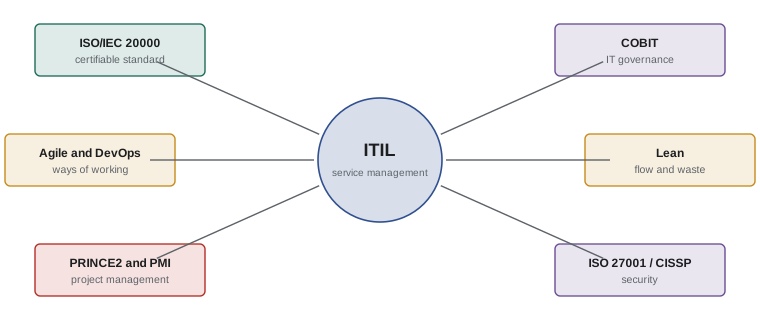
ITIL is one of several frameworks and standards that people in technology organizations meet. Understanding how they fit together helps you choose certifications and avoid confusion:
- ISO/IEC 20000-1 is an international standard for service management systems, against which organizations can be audited and certified. ITIL guidance can help an organization meet it.
- COBIT, from ISACA, focuses on the governance and management of enterprise information and technology, including control objectives useful to auditors.
- Agile approaches such as Scrum and Kanban focus on delivering products iteratively; DevOps brings development and operations together with automation. ITIL's current guidance is designed to work alongside them.
- Lean focuses on flow and eliminating waste, and influences ITIL's value stream thinking.
- Project management frameworks such as PRINCE2 (also owned by PeopleCert) and the PMI standards guide projects that often create or change services.
- Security frameworks and certifications, such as ISO/IEC 27001 and the CISSP, cover information security in depth; ITIL includes an information security management practice that connects to them.
Common misconceptions
Several misconceptions about ITIL are worth clearing up early. ITIL is not only for large organizations; small teams can adopt a few practices without bureaucracy. ITIL is not opposed to agile; its recent guidance explicitly incorporates agile and DevOps thinking. ITIL is not a process manual to be copied; the guidance itself warns against following it rigidly. ITIL is not only about IT departments; the latest version broadens its scope to digital products and services across whole organizations. And passing Foundation does not make someone a service management expert; it is the first step in a longer path of learning and practice.
How this course is organized
The remaining lessons explain the certification journey in order. Lesson 2 gives a short history of ITIL. Lesson 3 describes the ITIL product family and the PeopleCert ecosystem. Lesson 4 compares ITIL 4 and ITIL (Version 5). Lesson 5 explains the qualification scheme and designations. Lesson 6 looks at the Foundation exam in detail. Lesson 7 covers higher-level modules and exam styles. Lesson 8 helps you choose a path by role. Lesson 9 covers training options. Lesson 10 covers study strategies and resources. Lesson 11 builds a study plan, and Lesson 12 covers maintaining certification and a capstone personal plan.
A day in the life of ITIL ideas
To see how ITIL shows up in ordinary work, imagine a Monday morning at a mid-sized insurance company. At 8:15, an adjuster reports that the claims system is slow. The service desk logs the report, checks whether others are affected and finds that several branches have the same problem. Because the company follows ITIL-style incident management, the desk knows how to classify the issue, who to notify and what target applies for restoring service. By 9:00, the technical team has applied a temporary fix and service is restored. Later that week, problem management investigates the underlying cause and finds a database setting changed during a recent update. Change enablement then reviews how that update was approved and adds a check to similar changes in future.
None of these steps is unique to ITIL. Many organizations would do something similar without ever naming a framework. What ITIL adds is a shared vocabulary, a set of tested practices and a way of connecting them so that fixing today's problem also reduces tomorrow's. A certified person who understands these connections can contribute more quickly in a new workplace because the ideas are familiar even when the tools and job titles differ.
Questions to ask yourself before starting
Before moving on, it is worth answering a few questions in writing. What do you hope ITIL certification will do for you: a new job, a promotion, more confidence in your current role or a better understanding of how your organization works? Does your employer use ITIL, and if so, which version? How much time can you realistically give to study each week? Is anyone likely to pay for training? Your answers will shape the choices you make in Lessons 8, 9 and 11, and returning to them at the end of the course will show how your thinking has developed.
Common mistakes
MistakeTreating ITIL as a rigid process manual.
InsteadAdopt and adapt the guidance to your context.
MistakeBelieving ITIL replaces agile or DevOps.
InsteadUse ITIL alongside them.
MistakeConfusing ITIL with ISO/IEC 20000.
InsteadITIL is guidance for people; ISO/IEC 20000 is an auditable standard for organizations.
MistakeExpecting a certificate to guarantee a promotion.
InsteadTreat it as support for skills and experience.
MistakeRelying on salary survey figures without question.
InsteadCheck who published the survey and how.
Summary and key terms
- ITIL is widely used best practice guidance for service management.
- It focuses on value, takes a holistic view and offers practical practices.
- It helps with outages, recurring faults, risky changes and unclear ownership.
- It is used across sectors, often alongside agile, DevOps and lean.
- Certification shows tested knowledge, not experience or job performance.
- ITIL connects to ISO/IEC 20000, COBIT, PRINCE2 and security frameworks.
- ITIL
- Best practice guidance for service management.
- Service management
- Capabilities for delivering value through services.
- Practice
- A set of organizational resources for performing work.
- Value
- The perceived benefits, usefulness and importance of something.
- ISO/IEC 20000
- Auditable international standard for service management systems.
- COBIT
- Framework for governance and management of enterprise IT.
- DevOps
- Approach combining development and operations with automation.
- PeopleCert
- Company that owns ITIL and runs its certifications.
- Foundation
- The entry-level ITIL certification.
- Accredited training
- Training delivered by an organization approved by PeopleCert.
Practice problems
Work each problem on paper first, then reveal the answer to check.
What is ITIL?
Show answer
Best practice guidance for service management.
Name three features that make ITIL distinctive.
Show answer
Focus on value, holistic view, practical practices.
How does ITIL differ from ISO/IEC 20000?
Show answer
ISO/IEC 20000 is an auditable standard for organizations; ITIL is guidance.
Name three problems ITIL helps address.
Show answer
Long outages, recurring faults, risky changes, unclear ownership.
What does a Foundation certificate demonstrate?
Show answer
Tested knowledge of key concepts and terms.
What does it not demonstrate?
Show answer
Practical experience or job performance.
Name two frameworks ITIL works alongside.
Show answer
Agile, DevOps, Lean, COBIT, PRINCE2.
Who owns ITIL?
Show answer
The PeopleCert group.
Why treat salary surveys with caution?
Show answer
They are often not independent and hard to compare.
Is this program accredited training?
Show answer
No, it is independent study material.
Lesson quiz · 5 questions
Score 60% or more to complete this lesson.
Create a free account to save your progress, take quizzes and earn a certificate.