
HSE-406 · Lesson 9 of 12 · 21 min
Supervision, oversight and field audits
During last August's shutdown, nobody from Harrowgate Foods Inc. had a defined job of watching contractor work. The maintenance planners who had hired the contractors were busy with their own crews. Elena Novak's team of two walked the plant when they could, but they were also running orientation at the gate and handling the plant's own incidents. Contractors' supervisors were often responsible for several crews in different areas, and one of them, Coastal's owner, was working on another job across town on the morning of the fire. The result was that for long stretches of the day, nobody with authority was watching the most dangerous work on site.
Good planning, selection, orientation and permits make safe work possible. Supervision and oversight make sure it actually happens, by watching the work, spotting drift from the plan and acting before drift becomes an incident. This lesson covers who supervises contractor work, what the host's oversight should look like, how field audits work and what to do with what they find.
Supervision and oversight are different jobs
It helps to separate two ideas that are often confused. Supervision is the direct, continuous direction of a crew's work by someone responsible for it. Oversight is the host's monitoring of whether contractors are working safely and as agreed. The contractor supervises its own crew. The host oversees the contractor. Both are needed, and neither replaces the other.
The contractor's supervisor is the most important safety role on any contractor job. That person plans the day's work, briefs the crew, checks that controls are in place, corrects unsafe acts and stops the work if conditions change. The new contracts at Harrowgate Foods Inc. require each contractor to name a competent supervisor who is on site whenever its crew is working, as Lesson 6 described. For high-risk jobs, the plant also sets a maximum crew size per supervisor, usually eight, so that a supervisor can actually see the work. Jen MacLeod, who supervised Bayview's crew of twenty-two on the freezer installation, appointed two lead hands with defined areas, each reporting to her.
The host's oversight is lighter but must be real. A host that leaves everything to the contractor's supervisor has no way of knowing whether that supervision is happening. A host that tries to supervise every contractor task directly will both fail and confuse the lines of authority. The right level is the one that lets the host see, on a regular and planned basis, whether the work matches the plan, and gives it the ability to act when it does not.
Under the multi-employer citation policy, a controlling employer must exercise reasonable care to prevent and detect violations. OSHA expects the frequency and depth of a host's monitoring to reflect the hazards of the work, the speed at which conditions change and what the host knows about the contractor's record.
Levels of oversight
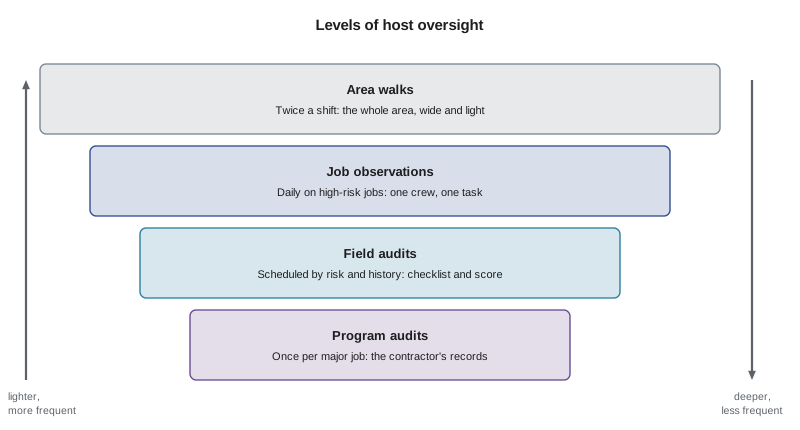
Harrowgate Foods Inc.'s program defines four kinds of oversight activity, from light and frequent to deep and occasional:
- Area walks by the area owner or a designated supervisor, at least twice a shift in any area with contractor work. The purpose is to see the area as a whole: who is there, whether permits are displayed, whether barriers and housekeeping are in order, whether anything has changed.
- Job observations by the job owner, focused on one crew doing one task. The observer watches the work for ten to fifteen minutes, checks it against the permit and the work plan, and talks to the crew about how the job is going.
- Field audits by the health and safety team or another trained auditor, using a structured checklist for the job's activities: hot work, isolation, confined space, work at height, lifting. A field audit takes thirty to sixty minutes and produces a score and a list of findings.
- Program audits of a contractor's records, such as training certificates, inspection records, incident reports and subcontractor documents, usually once per major job or once a year for resident contractors.
How often to audit
Field audits take time, so they must be planned. Harrowgate Foods Inc. sets a minimum frequency for each job by risk level and adjusts it for the contractor's record. A contractor new to the site, one approved with conditions or one whose last rating was poor gets more frequent audits. A contractor with a long, good record at the plant gets fewer, though never none for high-risk work.
# Plan field audits for the shutdown by risk level and contractor history
BASE = {"high": 1.0, "medium": 0.33, "low": 0.0}     # audits per working day
ADJUST = {"new": 1.5, "conditional": 1.5, "poor rating": 2.0, "good record": 0.75, "normal": 1.0}

jobs = [
    ("Spiral freezer install", "high", "normal", 12),
    ("Ammonia valve station", "high", "good record", 5),
    ("Roof section", "high", "new", 8),
    ("Duct cleaning", "high", "conditional", 6),
    ("Floor recoating", "medium", "poor rating", 4),
    ("Mixer rewiring", "high", "normal", 3),
]
total = 0
for name, risk, hist, days in jobs:
    n = round(BASE[risk] * ADJUST[hist] * days)
    if risk == "high": n = max(n, 2)
    total += n
    print(f"{name:<24} {risk:<7} {hist:<12} {days:>2} days -> {n} audits")
print("total field audits planned:", total, "| about", round(total / 14, 1), "per day")Spiral freezer install high normal 12 days -> 12 audits Ammonia valve station high good record 5 days -> 4 audits Roof section high new 8 days -> 12 audits Duct cleaning high conditional 6 days -> 9 audits Floor recoating medium poor rating 4 days -> 3 audits Mixer rewiring high normal 3 days -> 3 audits total field audits planned: 43 | about 3.1 per day
The plan came to about four field audits a day over the fourteen-day shutdown, plus the area walks and job observations. That was more than Elena's team of two could manage alongside orientation and incident response. Rachel Okoye approved two measures: three plant supervisors were trained as field auditors and released from their normal duties for the shutdown, and an outside safety consultant was hired for the two busiest weeks to audit the high-risk jobs.
Conducting a field audit
A field audit is not an inspection of the contractor's paperwork in a site trailer. It happens at the job, while the work is under way. The plant's audit checklists are short, specific to each activity and built around the controls in the permit and work plan. The hot work checklist, for example, asks whether the permit is displayed and current, whether combustibles have been cleared or protected for the full radius, whether the gas test has been done and recorded, whether the fire watch is present, trained, equipped and doing nothing else, and whether the crew can explain what they would do if a fire started.
Elena trained the auditors to do three things on every audit:
- Look before talking. Spend the first few minutes watching the work from a distance, before the crew knows they are being audited, to see how it is really being done.
- Talk to the crew. Ask open questions: what are the main hazards today? What would you do if the alarm sounded? Is anything making this job harder than it should be? Workers often know about problems that no checklist captures.
- Recognize good work. Note what is being done well and say so to the crew and its supervisor. An audit that only finds fault teaches contractors to hide things from auditors.
Findings are recorded on a tablet with photos, rated by severity and shared with the contractor's supervisor and the job owner before the auditor leaves the area. Serious findings are corrected on the spot. All findings go into a shared log so that patterns across contractors and areas can be seen.
Acting on what is found
Oversight that does not lead to action is worse than none, because it teaches everyone that the rules are optional. Harrowgate Foods Inc.'s program sets out a graded response so that auditors and supervisors know what to do and contractors know what to expect:
- Immediate danger or a life-saving rule breach. Stop the work at once. Make the area safe. The contractor's supervisor and the job owner are called to the job. Work does not restart until the cause is understood and corrected. A worker who knowingly broke a life-saving rule is removed from site.
- Serious finding without immediate danger. Correct before work continues, with the supervisor present. Record and follow up the same shift.
- Minor finding. Correct within the shift. Record and check at the next area walk.
- Repeated findings of the same kind, or several serious findings for one contractor, lead to a meeting with the contractor's management, a written corrective action plan and more frequent audits. If performance does not improve, the plant can remove the contractor from the job and from the approved list.
Stopping work is a right every worker on site has, as Lesson 7 explained, not just auditors. During the shutdown, two plant operators stopped contractor jobs: one when a roofer was working near an unprotected edge without being tied off, and one when a contractor started grinding without a hot work permit near the frozen meals packaging line. In both cases the job owner backed the operator, and Elena made a point of thanking both operators at the next morning meeting.
Worked problem
A field audit on the roof
Show solution
- The roof section job, by a contractor new to the site, was scheduled for three field audits in its first four days. On the second day, the outside consultant audited the job mid-morning.
- From the ground, she saw that the warning line around the work area had been moved closer to the edge than the work plan allowed and that two roofers were working outside it without fall protection.
- She called the contractor's supervisor, stopped the work at the edge and asked the crew why the line had moved. They explained that the material hoist had been relocated, and the old line position blocked access to it. Nobody had updated the plan.
- The supervisor reset the warning line, the crew tied off for work near the hoist, and the work plan was updated with the new layout. The consultant noted that the crew had been open about the reason, and recorded it as a serious finding without a life-saving rule breach.
Answer: The audit caught drift from the plan caused by a real change on the job, and the response fixed both the condition and the plan without punishing the crew for telling the truth.
Keeping oversight constructive
Some contractors resent being audited. Some hosts audit in a way that makes resentment reasonable: auditors who arrive without warning, look only for faults, issue findings with no explanation and leave. Elena wanted oversight that contractors would see as part of a partnership. The plant's auditors introduce themselves to the supervisor, explain what they will look at and share findings before they leave. Contractors receive their audit results each day and can respond to any finding they think is wrong. Good audit results count in the contractor's performance rating, as Lesson 11 describes, so contractors have a reason to want auditors to see their work.
Jen MacLeod told the plant's leadership after the shutdown that Bayview's own safety performance had improved because of the plant's audits. 'My lead hands knew someone would be looking, so they looked first,' she said. 'And when the auditor found something, she told us how to fix it rather than just writing it down.'
Nights, weekends and the daily report
Contractor work does not stop at five o'clock, and neither can oversight. Some of the highest-risk shutdown jobs, including this year's platform bracket and the duct cleaning, were deliberately scheduled for nights to keep them away from other crews. The plant therefore named a night shutdown coordinator for each night of the shutdown, a trained supervisor with authority to stop work, who carried out the area walks and at least one field audit on each high-risk night job. Dev Sandhu, who already knew the night shift well, took the role for the first week.
Every morning at seven, the coordinator for the previous shift gave a short written report to the shutdown control room: the permits open and closed, the audits done and their scores, any stops, incidents or near misses and anything the day shift needed to know. Elena's team combined the reports into a one-page daily summary for Marcus Bell and the contractor supervisors. The summary also showed the trend in audit scores for each contractor, which made it easy to see when a firm was slipping before a pattern turned into an incident.
Common mistakes
MistakeAssuming the contractor's supervisor is watching the work without checking.
InsteadRequire a named supervisor on site and verify supervision through oversight.
MistakeTrying to supervise every contractor task directly.
InsteadOversee through area walks, observations and audits, and leave crew direction to the contractor.
MistakePlanning audits only if time allows.
InsteadSchedule audits by risk level and contractor history, and resource the plan.
MistakeAuditing only paperwork in the site office.
InsteadAudit at the job, while the work is under way, and talk to the crew.
MistakeRecording findings without acting on them.
InsteadUse a graded response, from on-the-spot correction to removal from the approved list.
Summary and key terms
- Supervision is the contractor's direct direction of its crew; oversight is the host's monitoring of the contractor.
- The contractor's named supervisor is the key safety role, with crew size limits for high-risk work.
- Host oversight includes area walks, job observations, field audits and program audits.
- Audit frequency is set by risk level and adjusted for the contractor's history, and the plan must be resourced.
- Field audits happen at the job: look first, talk to the crew and recognize good work.
- Findings lead to a graded response, and oversight stays constructive so contractors have reason to welcome it.
- Supervision
- The direct, continuous direction of a crew's work by the person responsible for it.
- Oversight
- The host's monitoring of whether contractors are working safely and as agreed.
- Field audit
- A structured check of a contractor job at the work location while the work is under way.
- Area walk
- A regular walk through an area with contractor work to see the area as a whole.
- Graded response
- A defined set of actions matched to the severity of an audit finding.
Practice problems
Work each problem on paper first, then reveal the answer to check.
What is the difference between supervision and oversight?
Show answer
Supervision is the contractor directing its crew; oversight is the host monitoring the contractor.
Why does the plant limit crew size per supervisor on high-risk jobs?
Show answer
So the supervisor can actually see the work.
Name the four kinds of oversight activity.
Show answer
Area walks, job observations, field audits and program audits.
What are the three things auditors do on every audit?
Show answer
Look before talking, talk to the crew and recognize good work.
Why did the roofers move the warning line?
Show answer
The material hoist had been relocated and the old line blocked access to it; the plan had not been updated.
Lesson quiz · 5 questions
Score 60% or more to complete this lesson.
Create a free account to save your progress, take quizzes and earn a certificate.