
HSE-406 · Lesson 4 of 12 · 21 min
Planning the work and scoping hazards
Most contractor incidents are planned long before they happen. Not deliberately, but through decisions made weeks or months earlier: a scope of work that leaves out the hazards around the job, a schedule that puts two crews in the same space at the same time, a contract that does not mention the ammonia line running above the work. When Luis Ortega and Elena Novak reviewed last August's fire, they found that the steelwork above the bakery oven line had been described in Bayview's scope in one line: 'Remove and relocate platform bracket as required for freezer infeed.' Nobody had asked what was under the platform, who would be working there at the same time or whether the work needed heat.
This lesson covers the first stage of the lifecycle: planning and scoping. It is the stage most often rushed and the one where the host has the most to offer, because only the host knows its own site. A good scope tells a contractor what the work is, where it is, what hazards it involves, what hazards surround it and what the host expects. It also gives the job a risk level that drives every later stage.
What a scope of work should contain
A scope of work is the document that defines what a contractor is being hired to do. It is usually written by the job owner, often with help from engineering or maintenance, and becomes part of the request for quotation and later the contract. Many scopes describe only the technical result. A safe scope also describes the conditions under which the work will be done. Harrowgate Foods Inc.'s new template has eight sections:
- Description of the work: what is to be done, to what standard, with drawings and specifications.
- Location: the exact areas, including access routes, laydown areas and any work at height or in confined spaces.
- Timing: dates, shifts, hours of work and any constraints from production or other contractors.
- Activity hazards: the hazards the work itself involves, such as hot work, lifting, work at height, energy isolation or chemical use.
- Site hazards: the hazards in and around the work area that the contractor may not know about, from the area hazard sheet.
- Interfaces: other crews, plant operations and equipment that will be active nearby, and any work above or below.
- Host-provided items: what the host will supply, such as isolation of plant equipment, fire watch support, scaffolding, power, water or rescue.
- Safety requirements: permits needed, competencies required, the site rules that apply and any job-specific controls.
The last four sections were the ones missing from last year's scopes. Luis admitted that maintenance planners had written scopes the way engineers think about a job, as a list of things to be built, removed or connected. Adding the site hazards and the interfaces forced the planners to walk the area before writing the scope. That walk turned out to be the single most useful change in the planning stage.
Area hazard sheets
To make the site hazards section easy to complete, Elena's team produced an area hazard sheet for each part of the main plant: the bakery hall, the frozen meals room, the spiral freezer area, the engine room, the boiler room, the roof, the warehouse and the yard. Each sheet is one page with a plan of the area and a list of its hazards and controls. The engine room sheet, for example, lists the ammonia inventory and piping, the emergency shut-off and ventilation switches, the ammonia detectors and their alarm set points, the compressor start-up logic, high-pressure steam lines, the confined spaces in the area, the eyewash and shower locations and the nearest muster point.
Area hazard sheets are written once and updated when the area changes. They serve three purposes in the program. Job owners use them to write the site hazards section of the scope. Area owners use them for area orientation, covered in Lesson 7. And contractor supervisors receive them with the request for quotation, so that their price and their plan reflect the real conditions. A contractor who knows from the start that the platform bracket is above flour dust and a working sanitation crew can plan for a cold-cutting method, a fire watch or a night-time slot.
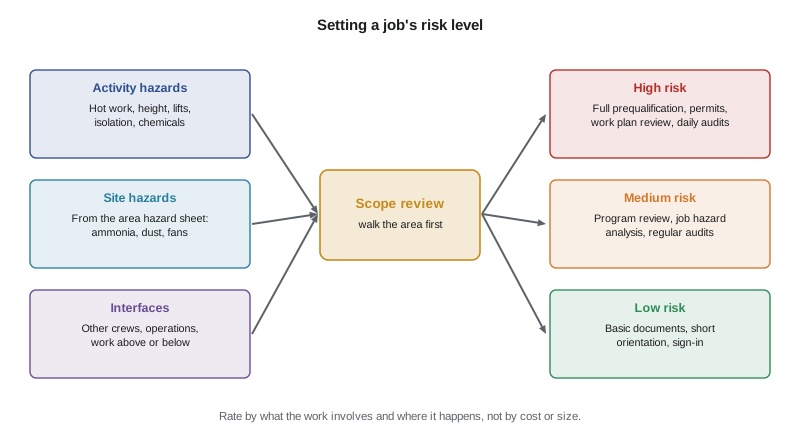
The interaction between work and site
The most dangerous hazards in contractor work often come from interactions that neither side sees on its own. A welder knows welding produces sparks. A sanitation supervisor knows flour dust accumulates on ceiling panels. Neither, alone, sees that a welder on a platform above the sanitation crew's area creates a fire hazard and a falling-object hazard for the crew below. The scope review is where those interactions are found, by putting the activity hazards and the site hazards side by side.
Elena's team uses a simple prompt list for the interface section, asking for each job:
- What could this work do to the area: sparks, heat, dust, noise, vibration, falling objects, chemicals, released energy, blocked exits or disabled fire protection?
- What could the area do to this work: moving equipment, automatic starts, stored energy, process chemicals, temperature extremes, traffic or slippery floors?
- What could this work do to other crews nearby, and what could they do to it?
- Does this work disable or impair any safety system, such as fire detection, sprinklers, ammonia detection, emergency lighting or alarms?
- Will the work change the plant in a way that needs a management of change review?
The last question links contractor planning to change management, covered in HSE-404. Installing a new spiral freezer changes the refrigeration system, the electrical load, the floor layout and the evacuation routes. Those changes need a management of change review before the work starts and a pre-startup safety review before the freezer is used. The contractor builds the change; the host must manage it.
Because the Gainesville ammonia system is covered by OSHA's process safety management standard, 29 CFR 1910.119, whose paragraph (h) covers contractors, its management of change and pre-startup safety review requirements in paragraphs (l) and (i) apply to the freezer installation, whoever does the work.
Rating the job's risk
The scope review ends with a risk level. Harrowgate Foods Inc. uses three, defined by simple criteria so that job owners can apply them consistently. The criteria are deliberately based on what the work involves, not on how big or expensive the job is. A two-hour job to replace one ammonia valve is high risk. A two-week job to repaint the office corridor is low.
| Level | Criteria (any one is enough) | Examples |
|---|---|---|
| High | Hot work; confined space entry; work at height over 10 ft (3 m) or on a roof; energy isolation of plant equipment; work on the ammonia, steam or gas systems; crane or heavy lifts; demolition; work affecting fire protection | Freezer installation, valve station, roof section, duct cleaning, boiler repair |
| Medium | Work in production or process areas with plant hazards nearby but no high-risk activity; use of hazardous chemicals; work in traffic areas; electrical work on de-energized equipment the contractor isolates itself | Floor recoating near ammonia lines, sanitation, forklift service, pest control |
| Low | Work outside production areas with no high-risk activity and no plant hazards nearby | Office painting, scale calibration in the lab, parts delivery, landscaping |
# Rate each shutdown job from its scope answers
HIGH = {"hot work", "confined space", "height", "isolation", "ammonia", "lift", "fire protection"}
MEDIUM = {"process area", "chemicals", "traffic", "electrical"}

def rate(activities, process_area):
    a = set(activities)
    if a & HIGH:
        return "high", sorted(a & HIGH)
    if (a & MEDIUM) or process_area:
        return "medium", sorted(a & MEDIUM) or ["process area"]
    return "low", []

jobs = [
    ("Platform bracket relocation", ["hot work", "height"], True),
    ("Floor recoating, frozen meals", ["chemicals"], True),
    ("Duct cleaning above bakery", ["height", "confined space"], True),
    ("Lab scale calibration", [], False),
    ("Mixer rewiring", ["electrical", "isolation"], True),
]
for name, acts, proc in jobs:
    level, why = rate(acts, proc)
print(f"{name:<30} {level:<7} {', '.join(why)}")Platform bracket relocation high height, hot work Floor recoating, frozen meals medium chemicals Duct cleaning above bakery high confined space, height Lab scale calibration low Mixer rewiring high isolation
The output matched what Elena and Luis had found by hand in Lesson 1, but the rating now happened at the scope stage, before any contractor was invited to bid, rather than after the shutdown. The duct cleaning job, which the scope had described as 'clean bakery exhaust ducts', turned out to involve entry into large ducts that met the definition of a confined space and work above the ovens. It became a high-risk job.
Planning a shutdown as a whole
Rating individual jobs is not enough when forty of them happen in the same two weeks. A shutdown has hazards of its own that no single job carries: congestion, simultaneous operations, fatigue, permit overload and the gap between the plant's normal emergency response and the conditions during the shutdown. Harrowgate Foods Inc. now runs a shutdown planning process that starts five months before the shutdown date.
- Work list freeze. The list of jobs is fixed six weeks before the shutdown. Jobs added later need approval from the plant manager, Marcus Bell, because late jobs are the ones most likely to be poorly scoped.
- Sequencing and space. A schedule shows which crews will be in which area on each shift, and no two jobs may be planned in the same space, or one above another, without a documented coordination plan.
- Hours of work. Shifts are limited to twelve hours, with no more than seven consecutive days for any contractor worker, and contractor firms must show how they will meet that limit.
- Permit capacity. The number of permits that need issuing each morning is estimated, and enough trained issuers are scheduled so that permits are not rushed.
- Emergency response. Rescue arrangements for confined spaces and work at height are planned in advance, fire protection impairments are scheduled and the fire department is told, and the muster plan is updated for the number of people on site.
- Restart. A restart plan sets out how areas are handed back, how equipment is checked before start-up and how contractors still working are protected when production resumes.
Hours of work deserve special attention. Contractors are often paid by the hour or under a fixed price with penalties for late completion, and both can encourage long shifts. During last year's shutdown, some of Coastal's welders worked sixteen-hour days. Fatigue reduces attention and judgment, and it was a contributing factor in the fire watch leaving early. The new limits are written into the contracts and checked against the gate records.
Worked problem
Rescoping the duct cleaning job
Show solution
- The original scope said only 'clean bakery exhaust ducts, all sections'. The job owner, a bakery maintenance planner, walked the area with Elena's team using the bakery hall hazard sheet.
- The walk found that three duct sections were large enough to enter, had limited openings and could hold flammable residue and cleaning chemical vapors, so they met the definition of a confined space. The ducts also ran above the oven line, at heights of 4 m to 6 m (13 ft to 20 ft).
- The interface questions found that the ovens' exhaust fans could start automatically, that a sprinkler line ran alongside the ducts and that the sanitation crew would be cleaning the oven line below on the same nights.
- The revised scope rated the job high, required a confined space entry plan with rescue, lockout of the exhaust fans by the plant, scheduling on nights when the oven line was not being cleaned and a contractor with documented confined space experience.
Answer: A one-line scope became a two-page scope with a high risk rating. Two of the three firms that had planned to bid withdrew because they could not show confined space capability, which was exactly the outcome the program needed.
The host's contribution
Planning is the stage where the host's knowledge matters most. A contractor can bring skill, equipment and its own procedures, but it cannot know about the flour dust on the ceiling panels, the automatic start on the exhaust fans or the sanitation crew working below unless the host tells it. Each of last year's incidents could be traced back to something the host knew and did not include in the scope. Each of this year's scopes was reviewed against that lesson before it was released.
Common mistakes
MistakeWriting a scope that describes only the technical result.
InsteadInclude site hazards, interfaces, host-provided items and safety requirements.
MistakeRating a job's risk by its size or cost.
InsteadRate it by what the work involves and where it happens.
MistakePlanning each shutdown job separately.
InsteadPlan the shutdown as a whole, including space, hours, permits and emergency response.
MistakeWriting scopes at a desk.
InsteadWalk the area with the area hazard sheet before writing the scope.
MistakeTreating a contractor-built change as the contractor's concern.
InsteadManage the change through the host's management of change and pre-startup review.
Summary and key terms
- Many contractor incidents start with a scope that leaves out site hazards and interfaces.
- A safe scope covers the work, location, timing, activity hazards, site hazards, interfaces, host-provided items and safety requirements.
- Area hazard sheets give job owners, area owners and contractors a shared picture of each area's hazards.
- Interface questions find the hazards created when the work meets the site and other crews.
- Jobs are rated low, medium or high by what they involve, and the rating drives every later stage.
- Shutdowns need whole-event planning for space, hours, permits, emergency response and restart.
- Scope of work
- The document that defines what a contractor is hired to do and the conditions under which it will be done.
- Area hazard sheet
- A one-page description of an area's hazards and controls used for scoping and orientation.
- Interface
- A point where contractor work meets plant operations, equipment or other crews.
- Simultaneous operations
- Two or more activities in the same space or above one another at the same time.
- Work list freeze
- The date after which jobs can be added to a shutdown only with senior approval.
Practice problems
Work each problem on paper first, then reveal the answer to check.
What was missing from the scope for the platform bracket job last year?
Show answer
Any mention of what was under the platform, who would be working there, or whether the work needed heat.
Name the four scope sections that were missing from last year's scopes.
Show answer
Site hazards, interfaces, host-provided items and safety requirements.
Why is a two-hour valve replacement rated high risk while a two-week painting job is low?
Show answer
Risk is rated by what the work involves (ammonia, isolation, hot work), not by size or cost.
Why are late additions to a shutdown work list a concern?
Show answer
They are the jobs most likely to be poorly scoped.
What did the duct cleaning walk find?
Show answer
Confined spaces, work at height, automatic fans, a sprinkler line and the sanitation crew below.
Lesson quiz · 5 questions
Score 60% or more to complete this lesson.
Create a free account to save your progress, take quizzes and earn a certificate.