
HSE-401 · Lesson 3 of 12 · 21 min
Leadership behaviors that matter
Three weeks after the spiral conveyor injury, Rachel Okoye asked every manager and supervisor at Harrowgate Foods Inc. to write down the three things they had done in the past month that showed their crews safety mattered. Most lists were short and similar: 'attended the safety meeting', 'signed off the monthly inspection', 'reminded the crew about PPE'. Then she asked the same question of 40 front-line workers across the three sites, about their own supervisor. The most common answer was 'I don't know' and the second most common was 'he tells us to be safe at the start of the shift'.
The exercise made a simple point. Leaders often believe they are showing commitment to safety because they attend the right meetings and say the right words. Workers judge commitment by different evidence: what leaders do when it costs them something. This lesson looks at the leadership behaviors that research and experience link to stronger safety cultures, and at why consistency between words and actions matters more than any single gesture.
Why leaders shape culture
Schein argued that the most powerful way leaders embed culture is through what they systematically pay attention to, measure and control; how they react to critical incidents and crises; how they allocate resources; what they role-model and coach; how they allocate rewards and status; and how they recruit, promote and remove people. Speeches and posters come much lower down his list. People are constantly reading these signals, because they need to know what is really expected to keep their jobs and get ahead.
This is true at every level. Senior leaders set priorities, budgets and targets. Middle managers translate them into schedules and staffing. Front-line supervisors decide, shift by shift, whether a crew stops or keeps going. Studies of safety climate consistently find that the immediate supervisor has the strongest influence on how workers behave, because the supervisor is the person whose reactions they see every day.
Leadership styles and safety
Researchers have studied which leadership styles are linked to better safety outcomes. Two broad patterns stand out.
- Transactional leadership works through clear expectations, monitoring and consequences: set the rule, check compliance, reward or correct. It is necessary, especially for critical rules such as lockout, and it is how most safety systems are built.
- Transformational leadership works through vision, example, individual attention and intellectual challenge: explaining why safety matters, showing it personally, caring about individual workers and inviting them to question how work is done. Studies across industries have linked transformational safety leadership to higher safety participation, better climate scores and fewer injuries.
Good safety leaders use both. They are clear and firm about the few rules that protect people from death and serious injury, and they engage, explain and listen about everything else. A leader who only enforces gets compliance while watched. A leader who only inspires, without holding anyone to account, gets warm feelings and drift.
The behaviors that make the biggest difference
Elena Novak pulled together the leadership behaviors most often linked to strong safety cultures in research and in the experience of companies that had improved. She grouped them into six areas and used them to build a leadership expectation for Harrowgate.
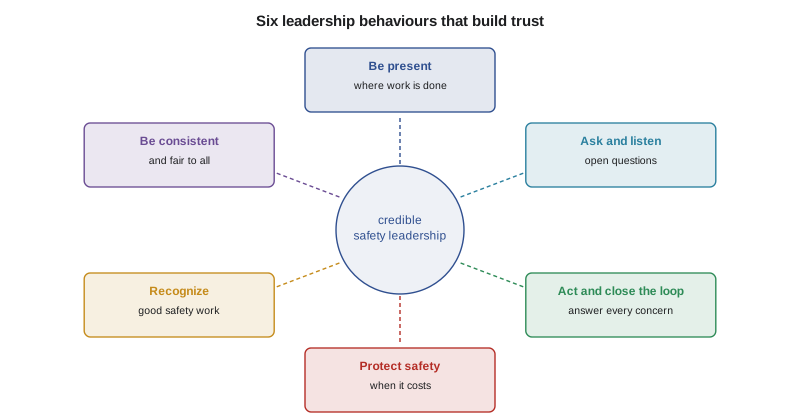
Be present where work is done. Leaders who spend time on the floor, at the docks and on night shift see how work really happens and show that they care enough to come and look. This is sometimes called visible felt leadership: not just being seen, but being felt as someone who genuinely cares. Lesson 4 covers how to make these visits useful.
Ask and listen. Good safety leaders ask open questions such as 'What makes this job hard?' and 'What would you change if you could?' and then listen without defending. Workers know the hazards and workarounds better than anyone. Leaders who do most of the talking learn little.
Act on what you hear, and close the loop. Nothing destroys trust faster than asking for concerns and then doing nothing. Not every concern can be fixed immediately, but every concern deserves an answer: what will be done, by when, or why not. Closing the loop is how workers learn that speaking up is worth it.
Protect safety when it costs. The moments that define a leader are when safety costs time, money or output. Stopping a line, delaying a shipment, buying the better guard or adding a second person to a task sends a message that no poster can match. So does backing up a supervisor or worker who stopped a job, even when it turns out the job was safe.
Recognize good safety work. Noticing and thanking people for reporting hazards, stopping unsafe work, improving a procedure or helping a new worker builds the behaviors you want. Lesson 7 covers how to recognize safety without creating incentives to hide injuries.
Be consistent and fair. Workers watch whether the same rules apply to everyone, including supervisors, high performers and managers, and whether leaders react the same way to bad news on a busy day and a quiet one. Inconsistency teaches people that safety is negotiable.
Say-do gaps
The most damaging leadership signal is a gap between what leaders say and what they do. Every gap teaches people that the real rules are different from the stated ones. At Harrowgate Foods Inc., the investigation and the follow-up interviews found several:
| What leaders said | What workers saw |
|---|---|
| "Safety is our first priority." | Morning meetings started with output and on-time delivery; safety was a one-line item at the end. |
| "Stop the job if it is not safe." | A line lead who stopped the oven line for a guard problem was asked by the shift manager why she had not "worked around it". |
| "Report every near miss." | Near miss reports at the distribution center were followed by retraining for the person who reported. |
| "Everyone wears hearing protection on the floor." | Managers walked the bakery floor without hearing protection during visits. |
| "We care about night shift." | No senior leader had visited night sanitation in over a year. |
None of these gaps was intended. Each made sense to the person involved at the time: the shift manager was worried about the oven line, the managers were only on the floor for a few minutes, the distribution center manager thought retraining was supportive. But workers do not see intentions. They see actions, and they draw conclusions.
Closing a say-do gap usually needs two things: changing the behavior, and saying out loud that it has changed. When Marcus Bell moved safety to the top of the morning meeting, he told the supervisors why: 'I have been sending the wrong message for two years by asking about restarts first.' Owning the gap publicly made the change credible.
Commitment shows in decisions about resources
Leaders also show what they value through budgets and staffing. After the injury, maintenance proposed moving the spiral conveyor disconnect to the floor beside the machine and adding a second sanitation worker on nights. Together these would cost about the same as one week of overtime. They had been proposed twice before and deferred both times. Rachel approved them within a day and told the night crew directly. More than any speech, that decision told the night shift that something had changed.
Leadership commitment is not just good practice; it also connects to legal exposure. Under the federal Occupational Safety and Health Act (OSH Act), the employer is responsible for compliance, and OSHA treats a supervisor's knowledge of a hazard as the employer's knowledge. Willful and repeat violations carry much higher penalties, and a willful violation that causes a death can be referred for criminal prosecution. OSHA's recommended practices for safety and health programs put management leadership first among the core elements, describing it as top management demonstrating commitment, setting goals, allocating resources and setting an example.
The supervisor's special role
Front-line supervisors face the sharpest goal conflicts. They are measured on output, quality, attendance and cost, and they are told safety comes first. Most of them were promoted because they were good at the job, not because they were trained to lead. Supporting supervisors is one of the most effective things senior leaders can do for safety culture. At Harrowgate Foods Inc. that meant:
- making it explicit, in writing and in person, that a supervisor who stops work for safety will be backed even if production suffers;
- giving supervisors time in the schedule for pre-shift talks, walk-arounds and coaching;
- training them in how to have safety conversations, respond to reports and apply fair accountability;
- removing measures that rewarded supervisors for low reported injury counts;
- asking supervisors regularly what gets in the way of working safely, and acting on the answers.
Tracking leadership behaviors
Rachel wanted to know whether leaders were actually changing what they did. She asked each of the 22 managers and supervisors to log four behaviors each week: floor visits including at least one on a back shift, safety conversations held, concerns closed with an answer to the person who raised them, and recognitions given. After eight weeks, Elena summarized the logs.
# Eight weeks of leader activity logs (totals across 22 leaders).
weeks = [1, 2, 3, 4, 5, 6, 7, 8]
visits = [18, 25, 31, 36, 40, 41, 44, 46]
backshift = [2, 4, 7, 9, 12, 13, 15, 16]
conversations = [35, 52, 70, 81, 90, 94, 99, 103]
raised = [14, 20, 24, 27, 26, 25, 24, 22]
closed = [3, 8, 13, 18, 21, 22, 22, 21]
for w, v, b, c, r, k in zip(weeks, visits, backshift, conversations, raised, closed):
    print(f"Week {w}: visits {v:2d} ({b:2d} back shift), conversations {c:3d}, "
          f"concerns closed {k:2d}/{r:2d} = {100*k/r:3.0f}%")
print(f"Back-shift share rose from {100*backshift[0]/visits[0]:.0f}% to {100*backshift[-1]/visits[-1]:.0f}%")Week 1: visits 18 ( 2 back shift), conversations 35, concerns closed 3/14 = 21% Week 2: visits 25 ( 4 back shift), conversations 52, concerns closed 8/20 = 40% Week 3: visits 31 ( 7 back shift), conversations 70, concerns closed 13/24 = 54% Week 4: visits 36 ( 9 back shift), conversations 81, concerns closed 18/27 = 67% Week 5: visits 40 (12 back shift), conversations 90, concerns closed 21/26 = 81% Week 6: visits 41 (13 back shift), conversations 94, concerns closed 22/25 = 88% Week 7: visits 44 (15 back shift), conversations 99, concerns closed 22/24 = 92% Week 8: visits 46 (16 back shift), conversations 103, concerns closed 21/22 = 95% Back-shift share rose from 11% to 35%
The logs showed real progress: floor visits more than doubled, back-shift visits rose from about one in nine to about one in three, and the share of concerns closed with an answer rose from about one in five to almost all of them. They also showed something Elena flagged: the number of concerns raised peaked in week 4 and then started to fall. That could mean fewer problems, or it could mean people had raised the obvious issues and were waiting to see whether the hard ones got fixed. Behavior logs are a useful prompt, but they measure activity. Lesson 11 covers how to check whether that activity is changing what workers experience.
Worked problem
Responding when a line lead stops the oven line
Show solution
- Situation: Tanya Morris, a line lead, stops the oven line because a guard on the tray loader is cracked. The shift is already 400 trays behind.
- Old response: the shift manager asks why she did not 'work around it' and restarts the line with a cable tie on the guard.
- New response: the shift manager comes to the line, thanks Tanya in front of the crew, and asks maintenance to fix or replace the guard before restart.
- He tells the scheduler the shift will be short and why, and mentions the stop at the next morning meeting as an example of the expectation.
- Follow-up: he checks with Tanya a week later that the guard is fixed and that she has not been criticized by anyone for the lost output.
Answer: Backing a worker who stops for safety, visibly and at a cost, does more for culture than any slogan.
Common mistakes
MistakeBelieving attendance at safety meetings shows commitment.
InsteadWorkers judge commitment by what leaders do when safety costs time, money or output.
MistakeAsking for concerns and not answering them.
InsteadClose the loop on every concern: what will be done, by when, or why not.
MistakeRelying only on rules and discipline.
InsteadCombine firm, transactional control of critical rules with transformational engagement and listening.
MistakeTreating say-do gaps as minor.
InsteadEach gap teaches people that the real rules differ from the stated ones; fix the behavior and say so.
MistakeLeaving supervisors alone with the goal conflict.
InsteadBack them in writing and in person, give them time and training, and remove measures that reward low reported injuries.
Summary and key terms
- Leaders embed culture through what they pay attention to, how they react to incidents, how they allocate resources, what they model and what they reward.
- The immediate supervisor has the strongest day-to-day influence on worker safety behavior.
- Good safety leaders combine firm control of critical rules with transformational engagement, explanation and listening.
- Six key behaviors: be present, ask and listen, act and close the loop, protect safety when it costs, recognize good safety work, and be consistent and fair.
- Say-do gaps are the most damaging leadership signal; close them by changing behavior and acknowledging the change.
- Behavior logs can track leader activity but must be checked against what workers actually experience.
- Visible felt leadership
- Leadership presence in the workplace that is seen and also felt as genuine care for people.
- Transactional leadership
- Leading through clear expectations, monitoring and consequences.
- Transformational leadership
- Leading through vision, example, individual attention and inviting people to challenge how work is done.
- Say-do gap
- A difference between what leaders say they value and what they actually do.
- Closing the loop
- Telling the person who raised a concern what will be done about it, by when, or why not.
Practice problems
Work each problem on paper first, then reveal the answer to check.
According to safety climate research, which leader most strongly influences day-to-day worker safety behavior?
Show answer
The immediate supervisor.
Name the six leadership behaviors in this lesson.
Show answer
Be present where work is done; ask and listen; act on what you hear and close the loop; protect safety when it costs; recognize good safety work; be consistent and fair.
Give one say-do gap found at the company and how it could be closed.
Show answer
For example, managers walking the floor without hearing protection; close it by always wearing it and saying that the expectation applies to everyone.
Why did Elena flag the falling number of concerns raised after week 4?
Show answer
It might mean fewer problems, or that workers were waiting to see whether the hard issues would be fixed before raising more.
What is the difference between transactional and transformational safety leadership?
Show answer
Transactional sets rules, monitors and applies consequences; transformational explains why, models, cares about individuals and invites challenge.
Lesson quiz · 5 questions
Score 60% or more to complete this lesson.
Create a free account to save your progress, take quizzes and earn a certificate.