
HSE-401 · Lesson 2 of 12 · 22 min
How culture forms and how it fails
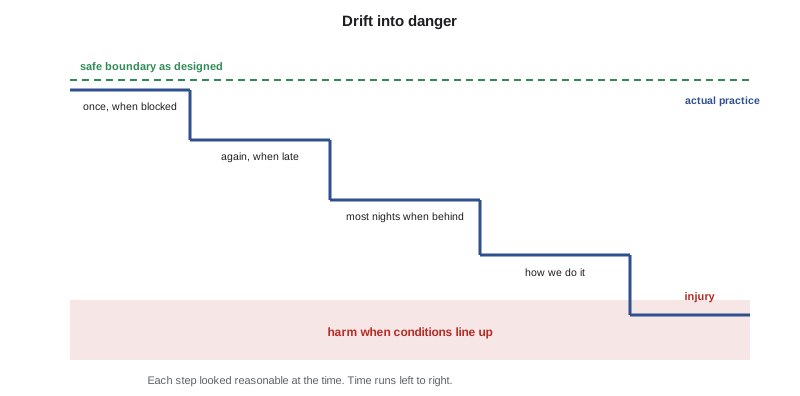
Nobody at Harrowgate Foods Inc. decided to stop locking out the spiral conveyor. There was no meeting where a supervisor announced that lockout was optional on night shift. The shortcut grew a little at a time. First, someone skipped lockout once when the disconnect on the mezzanine was blocked by a pallet of flour. Nothing happened. A few weeks later, a crew running late did it again to save ten minutes. Nothing happened. Within a year, it was simply how night sanitation got the spiral clean in time for the 5:00 a.m. restart. Every time it worked without harm, the shortcut looked a little safer and a little more normal.
This lesson looks at how safety culture forms, how it drifts and how it fails. You will meet the idea of normalization of deviance, see how production pressure and goal conflict shape everyday decisions, and look at three well-documented disasters to see the same patterns at a much larger scale. The point is not to frighten anyone. The point is to recognize the early signs at your own workplace while they are still small and cheap to fix.
Culture is learned from experience
People learn what is really expected at work in the same way they learn anything else: by watching, trying and seeing what happens. Schein described culture as what a group learns as it solves its problems. When a way of working succeeds, the group repeats it, and over time it becomes 'just how we do things here'. Nobody needs to write it down.
That learning process is powerful and mostly helpful. It is how new employees pick up the hundreds of small skills that procedures never capture. But it has a dangerous side. A shortcut that saves time and causes no harm is a success from the group's point of view. The group learns that the shortcut works. What it does not learn is that the margin of safety has shrunk, because the cost of the shortcut only shows up on the rare day when everything lines up badly.
Several forces shape what a workplace learns about safety:
- What leaders pay attention to: what they ask about, measure and visit. If the morning meeting starts with output, waste and on-time delivery, and safety is a quick line at the end, people learn the order of priorities.
- What gets rewarded and punished: bonuses, praise, promotions and discipline. A night supervisor praised for never missing the 5:00 restart learns what matters.
- How leaders react to bad news: whether a near miss report leads to a fix or to questions about who was careless.
- Stories people tell: the supervisor who got fired for stopping a line, or the one who got promoted for 'finding a way'. Stories travel fast and outlive the facts.
- Who gets hired and who leaves: people who fit the real culture stay; people who do not, quit.
- The design of the work itself: a disconnect at the far end of a mezzanine makes lockout slow; a disconnect beside the conveyor makes it easy.
Normalization of deviance
The sociologist Diane Vaughan coined the term normalization of deviance in her 1996 study of the decision to launch the space shuttle Challenger in January 1986. Engineers had seen erosion of the rubber O-ring seals in the solid rocket boosters on earlier flights. The erosion was not supposed to happen at all. But each time it happened and the flight returned safely, the observed erosion was reclassified as an acceptable risk, and the boundary of what counted as normal moved. On a cold January morning, below the temperatures of any previous launch, the seals failed and the shuttle broke apart 73 seconds after liftoff, killing all seven crew members.
Vaughan's key finding was that the people involved were not reckless or careless. They followed the rules and procedures of their organization. The problem was that the organization had gradually come to accept a deviation as normal, through a series of decisions that each seemed reasonable at the time. That is exactly what happened with the spiral conveyor, at a much smaller scale.
Signs that deviance may be normalizing in your workplace include:
- People say 'we always do it this way' about something that does not match the procedure.
- Alarms, warnings or fault codes are routinely silenced or ignored because they are 'always going off'.
- Temporary fixes, such as a bypassed interlock or a cable tie on a guard, become permanent.
- New employees are told by co-workers to forget what they learned in training.
- Audits always find the same minor issues, and nobody is surprised.
- Near misses stop being reported because 'that happens all the time'.
Goal conflict and production pressure
Every organization pursues several goals at once: safety, output, quality, cost, customer service and on-time delivery. Most of the time they are compatible. Sometimes they are not, and the people at the sharp end have to resolve the conflict in the moment. The night sanitation crew faced a real goal conflict: clean the spiral properly and safely, or have it ready for 5:00. Nobody gave them a clear way to resolve it, except the unspoken message that the bread run came first.
Production pressure is not always explicit. It can come from tight staffing, equipment that breaks down, a schedule that assumes everything goes right, piece-rate pay, a customer penalty clause or simply the visible frustration of a supervisor. Leaders often do not realize how loudly these signals speak. Marcus Bell, the plant manager, was genuinely surprised to learn that night sanitation felt the restart time was sacred. He had never said so. But he had asked about late restarts in every morning meeting for two years, and never once asked how sanitation was getting the work done.
A practical test for any leader is to ask: when safety and production conflict here, who decides, how do they decide, and what happens to them afterwards? If the honest answer is 'the crew decides, alone, and gets praised for making the target', the culture is teaching people to take risks.
Westray: culture failure in Nova Scotia
On May 9, 1992, a methane and coal dust explosion tore through the Westray coal mine in Plymouth, Pictou County, Nova Scotia, killing all 26 miners underground. The mine had been open for only about eight months. The public inquiry led by Justice Peter Richard, whose report in 1997 was titled The Westray Story: A Predictable Path to Disaster, found that the explosion was not an accident of nature. Miners had raised concerns about methane, coal dust and unsafe practices. Rock dusting to suppress coal dust was inadequate. Methane monitors were reportedly tampered with. Pressure to produce coal was intense, and management treated safety as an obstacle. The provincial regulator had inspected the mine and identified problems but had not enforced the law effectively.
Justice Richard's report described a management culture that put production ahead of safety, and a regulatory culture that failed to hold the company to account. After years of advocacy by families and the labor movement, Parliament amended the Criminal Code in 2004. The Westray amendments added section 217.1, which places a legal duty on everyone who directs how another person does work to take reasonable steps to prevent bodily harm, and made it easier to hold organizations criminally liable. For Canadian leaders, Westray is a reminder that culture failures can have legal consequences far beyond regulatory fines.
Deepwater Horizon and Columbia
On April 20, 2010, a blowout on the Deepwater Horizon drilling rig in the Gulf of Mexico killed 11 workers and caused one of the largest marine oil spills in history. The US National Commission and the Chemical Safety Board found a series of decisions, made under time and cost pressure, that reduced safety margins: interpreting a critical pressure test as successful when the results were ambiguous, and relying on a blowout preventer that failed. A striking detail was that the rig had been celebrating years without a lost-time injury on the day of the blowout. Its personal injury record was excellent. Its control of major process hazards was not. Lesson 9 returns to this gap between personal safety and serious-event risk.
On February 1, 2003, the space shuttle Columbia broke up on re-entry, killing seven astronauts. A piece of foam insulation had broken off the external tank during launch and struck the left wing. Foam strikes had happened on many earlier flights and had come to be seen as a maintenance issue rather than a safety threat. The Columbia Accident Investigation Board concluded that NASA's organizational culture had as much to do with the accident as the foam. It found that the agency had not learned the lessons of Challenger, that schedule pressure shaped decisions and that engineers with concerns did not feel able to push them through the hierarchy.
| Event | What drifted | Pressure | Missed signals |
|---|---|---|---|
| Challenger, 1986 | O-ring erosion accepted as normal | Launch schedule | Engineers warned about cold temperatures |
| Westray, 1992 | Methane and coal dust controls | Coal production targets | Miners raised concerns; regulator did not enforce |
| Columbia, 2003 | Foam strikes treated as routine | Flight schedule | Engineers could not get imagery requests through |
| Deepwater Horizon, 2010 | Ambiguous test results accepted | Time and cost of the well | Good injury record masked process risk |
| Spiral conveyor, Gainesville | Lockout skipped when behind | 5:00 a.m. restart | Workers said it happened most nights |
Why smart organizations miss the signs
If the pattern is so clear afterwards, why do capable people miss it beforehand? Several features of organizations make drift hard to see from the inside:
- Success breeds confidence: a long run without serious harm is taken as proof that the system is safe, rather than as luck that may run out.
- Information is filtered upward: each level of management summarizes and softens bad news before passing it on. By the time it reaches the top, a pattern of shortcuts has become 'a minor procedural issue on nights'.
- Signals are weak and mixed: the evidence of drift is spread across many small reports, each of which looks trivial alone.
- Measures point the wrong way: injury rates measure outcomes that are rare and lagging, so they say little about the margins that are eroding.
- People fear the messenger's fate: if past messengers were ignored or punished, the next person stays quiet.
Spotting drift with simple data
Elena asked the safety committee to help pull together the evidence of drift at the Gainesville plant. They looked at how often the sanitation crew had finished cleaning the spiral in less time than the full procedure needed, using the cleaning start and end times already recorded on the sanitation checklist.
# Minutes taken to clean the spiral on night shift, by month.
# A full lockout-and-clean takes at least 70 minutes; less means steps were skipped.
months = ["Mar", "Apr", "May", "Jun", "Jul", "Aug", "Sep", "Oct", "Nov", "Dec", "Jan", "Feb"]
minutes = [
    [78, 75, 72, 80, 74], [74, 71, 69, 73, 76], [70, 68, 72, 66, 71],
    [69, 65, 70, 64, 72], [66, 62, 68, 60, 70], [64, 58, 66, 61, 63],
    [62, 57, 60, 55, 64], [60, 54, 58, 52, 61], [58, 50, 55, 53, 57],
    [55, 49, 52, 48, 56], [53, 47, 50, 46, 52], [51, 45, 48, 44, 50],
]
FULL = 70
for m, row in zip(months, minutes):
    short = sum(1 for t in row if t < FULL)
print(f"{m}: average {sum(row)/len(row):5.1f} min, {short}/{len(row)} shifts under {FULL} min")Mar: average 75.8 min, 0/5 shifts under 70 min Apr: average 72.6 min, 1/5 shifts under 70 min May: average 69.4 min, 2/5 shifts under 70 min Jun: average 68.0 min, 3/5 shifts under 70 min Jul: average 65.2 min, 4/5 shifts under 70 min Aug: average 62.4 min, 5/5 shifts under 70 min Sep: average 59.6 min, 5/5 shifts under 70 min Oct: average 57.0 min, 5/5 shifts under 70 min Nov: average 54.6 min, 5/5 shifts under 70 min Dec: average 52.0 min, 5/5 shifts under 70 min Jan: average 49.6 min, 5/5 shifts under 70 min Feb: average 47.6 min, 5/5 shifts under 70 min
The pattern is unmistakable once the data are laid out: average cleaning time fell steadily over a year, and by the autumn every sampled shift was finishing faster than a full lockout-and-clean allows. The data had been sitting on a clipboard in the sanitation office all along. Nobody had looked at it, because nobody had asked the question. Drift is often visible in ordinary records if you know what to look for.
Worked problem
Finding the decisions that led to the spiral conveyor injury
Show solution
- List the decisions that were made over the year, not just the event itself: the disconnect placement, the restart time, the staffing level, the praise for on-time restarts, the audit form that only checked paperwork.
- For each decision, ask what the people involved knew and what pressure they were under. Each one was reasonable from where they stood.
- Look for the moment each deviation became normal: the first time lockout was skipped without consequence, and the point where new crew members were taught the shortcut.
- Identify the missed signals: shorter cleaning times on the checklist, comments in a toolbox talk, a near miss at the spiral in October that was recorded as 'worker reminded'.
- Ask what would have caught the drift earlier: a leader asking night crews how the spiral really gets cleaned, and data on cleaning times reviewed monthly.
Answer: The injury was the end of a year-long drift made of reasonable-looking decisions and ignored signals, not a single bad choice on one night.
Common mistakes
MistakeBlaming the person who took the final shortcut and stopping there.
InsteadLook for how the shortcut became normal and which decisions and pressures made it seem reasonable.
MistakeTaking a long period without serious incidents as proof of safety.
InsteadTreat it as a reason to look harder for drift and eroding margins.
MistakeAssuming disasters happen only in high-hazard industries.
InsteadThe same pattern of drift, pressure and missed signals appears in food plants, warehouses and offices.
MistakeBelieving leaders will hear about problems if they exist.
InsteadBad news is filtered as it rises; leaders must go and look and ask open questions.
MistakeIgnoring routine records such as checklists and logs.
InsteadOrdinary records often show drift clearly when someone looks for trends.
Summary and key terms
- Culture is learned from experience: what leaders attend to, reward, punish and tolerate, and how work is designed.
- Normalization of deviance is the gradual acceptance of a deviation as normal because it has not yet caused harm.
- Goal conflict between safety and production is often resolved silently by front-line workers unless leaders make the choice explicit.
- Challenger, Westray, Columbia and Deepwater Horizon all show drift, pressure and ignored warnings; Westray led to section 217.1 of Canada's Criminal Code.
- Organizations miss drift because success breeds confidence, information is filtered upward and injury rates lag.
- Simple trend data from routine records can reveal drift long before an injury.
- Normalization of deviance
- The gradual process by which an unacceptable practice becomes accepted as normal because it has not yet caused harm.
- Drift
- The slow movement of actual practice away from the safe boundary through many small, locally reasonable decisions.
- Goal conflict
- A situation in which safety competes with other goals such as output, cost or schedule.
- Production pressure
- Explicit or implicit pressure to meet output, time or cost targets.
- Weak signal
- An early, small or ambiguous sign that something is going wrong.
- Westray amendments
- The 2004 changes to Canada's Criminal Code, including section 217.1, made after the 1992 Westray mine explosion.
Practice problems
Work each problem on paper first, then reveal the answer to check.
Who coined the term normalization of deviance, and in studying which event?
Show answer
Diane Vaughan, in her study of the 1986 Challenger launch decision.
Give three signs that deviance may be normalizing in a workplace.
Show answer
Any three of: practice differs from procedure; alarms routinely ignored; temporary fixes become permanent; new workers told to forget training; audits find the same issues; near misses no longer reported.
What did the Westray inquiry find about management and the regulator?
Show answer
Management put production ahead of safety and ignored concerns; the regulator identified problems but did not enforce the law effectively.
Why was the Deepwater Horizon injury record misleading?
Show answer
The rig had an excellent personal injury record but weak control of major process hazards, so the record said little about the risk of a blowout.
What did the sanitation checklist data show?
Show answer
Average cleaning times fell steadily over a year until every sampled shift finished faster than a full lockout-and-clean allows.
Lesson quiz · 5 questions
Score 60% or more to complete this lesson.
Create a free account to save your progress, take quizzes and earn a certificate.