
HSE-391 · Lesson 6 of 12 · 22 min
Sit-to-stand and standing aids
▶ Video coming soon A video version of this lesson is on the way.
Between the patient who needs a full-body lift and the patient who can walk with supervision there is a large group who can do part of the work themselves. They can sit on the edge of the bed, take some weight through their legs and hold on with their hands, but they cannot stand up and turn safely on their own. On 4 West and at Maple Court, this group is often the largest of all, and it is the group most often moved by hand, because staff think of them as "almost independent". The 3 East injury in Lesson 1 was a patient of this kind.
This lesson covers the equipment for this group: powered sit-to-stand aids, non-powered standing and turning aids, gait belts, and walking slings and vests. It explains who each one is for, who it is not for, how it is used, and why getting these patients up with equipment is good for their recovery as well as for staff.
Powered sit-to-stand aids
A powered sit-to-stand aid, sometimes called a standing lift or stand assist lift, is a wheeled machine with a footplate, a pad that the patient's shins or knees rest against, handles to hold, and a powered arm that raises the patient from sitting to standing using a sling or belt around the lower back. The patient helps by taking weight through their legs and holding on; the machine does the lifting and keeps them from falling.
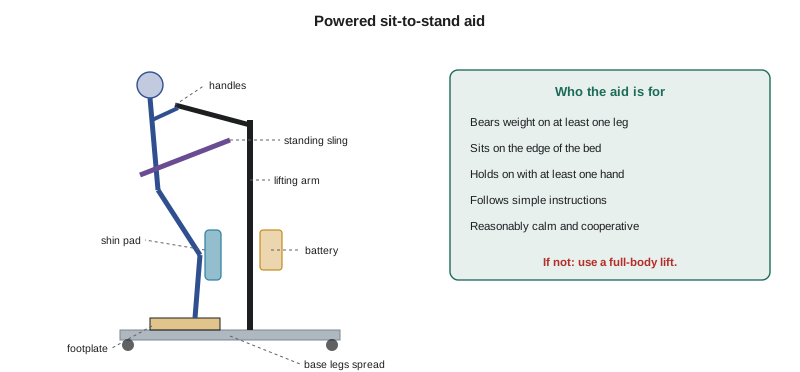
A sit-to-stand aid is right for a patient who:
- can bear weight through at least one leg, at least for a short time;
- can sit on the edge of the bed or chair with little or no support;
- can hold on with at least one hand;
- can follow simple instructions and is reasonably calm; and
- reaches level 3 on the bedside mobility assessment (Lesson 3), or level 2 with some weight-bearing.
It is not right for a patient who:
- cannot bear any weight, or has a fracture, recent surgery or pain in the legs or hips that stops them standing;
- cannot sit upright or hold their head up;
- is very confused, agitated or likely to let go or push backwards;
- has severe contractures that stop the feet going flat on the footplate or the knees meeting the pad;
- has shoulder problems or fragile skin under the arms, because some standing slings pull up under the armpits; or
- is too tired, dizzy or unwell to stand today.
Patients who fall outside these limits need a full-body lift. As always, the assessment can move the plan toward more support, never less.
Using a sit-to-stand aid
- Prepare. Check the care plan, the aid (inspection tag, battery, brakes, controls) and the sling. Explain the move. Make sure the patient is wearing non-slip footwear or has bare feet if the plan says so.
- Position. Help the patient sit near the edge of the bed or chair, with feet flat and hip-width apart. Bring the aid in, open the base legs if needed, and place the patient's feet on the footplate with the shins against the pad. Put the aid's brakes on if the manufacturer says to for standing.
- Fit the sling. Place the standing sling around the patient's lower back, below the shoulder blades and above the waist, and fasten it as the design requires. Attach the sling to the arm with the loop lengths in the plan.
- Stand. Ask the patient to hold the handles and lean slightly forward. Raise them slowly with the hand control while encouraging them to push up with their legs. Stop when they are upright and check: are they comfortable, steady and alert? Is anything pulling under the arms?
- Move. Release the brakes and move the aid slowly to the chair, commode or toilet. Keep the patient upright and close to the aid, and do not travel far.
- Sit. Position the chair behind the patient, put its brakes on, and lower the patient slowly while the second worker guides them back into the seat.
Two staff are present for sit-to-stand transfers at Northbridge unless the patient's care plan says one is enough, which is common for stable residents who use the aid every day. Patients should be kept standing only as long as the task needs. Signs of trouble are dizziness, sweating, pallor, breathlessness, the knees buckling or the patient letting go; the response is to lower them straight back to the bed or chair.
Non-powered standing and turning aids
A non-powered standing aid, often called a stand-and-turn aid or rotating platform, has a footplate that turns, a knee pad and a frame with a bar to hold. The patient pulls themselves up to standing using the bar, with staff supervising and guiding. The worker then turns the platform so the patient faces the other way, and the patient sits down on the chair or commode behind them. No lifting is done by the worker; the patient's own strength does the standing.
Because the patient must be able to stand up with only a little help, these aids are for patients who can already stand but cannot step and turn safely, typically level 4 on the bedside assessment. They are light, quick to use and good for short transfers such as bed to commode at night. They are not a substitute for a powered aid when the patient cannot stand up without being pulled.
Gait belts and transfer belts
A gait belt, also called a transfer belt, is a strong belt fastened around the patient's waist over clothing, usually with handles. It gives staff a secure place to hold a patient who can stand and walk, to steady them, guide them and help them keep their balance. It is a useful tool, and Northbridge's policy requires one for every patient who walks with staff assistance.
A gait belt is not a lifting device. It does not reduce the weight of the patient; it only gives the worker something to hold. When it is used to pull a patient up from a chair or to take their weight as their knees buckle, the worker is doing a manual lift, with the load held at arm's length and often with a twist. That is exactly what happened on 3 East. The rule at Northbridge is simple: a gait belt is for steadying, not for lifting. If a patient needs to be pulled up, they need a sit-to-stand aid. If a patient starts to fall while wearing a gait belt, the belt is used to guide them down, not to hold them up, as Lesson 8 explains.
Walking slings and vests
Getting patients walking again is one of the main goals of hospital care. Walking prevents the loss of strength and balance that comes with bed rest, and it shortens stays. But walking a weak patient is one of the riskiest tasks for staff, because the patient may fall at any moment and the natural reaction is to catch them.
Ambulation vests and walking slings solve this by attaching the patient to a ceiling lift or a floor lift designed for walking. The vest fits around the chest and the lift takes up the slack, so that the patient walks under their own power but cannot fall. If their knees buckle, the lift holds them, and staff can lower them into a chair or back to bed. With a room-covering ceiling track, a patient can walk the length of the room, and some units have track in a corridor or therapy area for longer walks.
At Northbridge, physical therapists lead the early walking of post-operative and stroke patients, and the new program added walking vests to 4 West and 3 East. Grace's argument for them was partly about staff safety and partly about patients: with the vests, nurses walked patients more often between therapy sessions, because they were no longer afraid of a fall.
How many sit-to-stand aids does a unit need?
4 West had one powered sit-to-stand aid, shared with 3 East. Grace suspected that this was why so many level 3 patients were moved by hand. She took the bedside mobility levels recorded each morning for two weeks and counted how many level 3 patients each unit had each day, then estimated how many sit-to-stand transfers that meant.
# Level 3 patients each morning on 4 West and 3 East over 14 days
west = [7, 9, 8, 6, 10, 8, 7, 9, 11, 8, 7, 6, 9, 10]
east = [5, 4, 6, 7, 5, 6, 4, 5, 6, 7, 5, 4, 6, 5]
TRANSFERS_PER_PATIENT = 6      # bed, chair, toilet and back, per day
MINUTES_PER_TRANSFER = 5       # including fetching the aid
AID_HOURS_AVAILABLE = 14       # 0700 to 2100, when most transfers happen

daily = [w + e for w, e in zip(west, east)]
avg = sum(daily) / len(daily)
need_minutes = avg * TRANSFERS_PER_PATIENT * MINUTES_PER_TRANSFER
aids_needed = need_minutes / (AID_HOURS_AVAILABLE * 60)
print(f"average level 3 patients per day: {avg:.1f} (max {max(daily)})")
print(f"sit-to-stand minutes needed per day: {need_minutes:.0f}")
print(f"aids needed if used at 100 per 100 of available time: {aids_needed:.1f}")
print(f"aids needed at 50 per 100 use (to avoid queues): {aids_needed / 0.5:.1f}")average level 3 patients per day: 13.6 (max 17) sit-to-stand minutes needed per day: 407 aids needed if used at 100 per 100 of available time: 0.5 aids needed at 50 per 100 use (to avoid queues): 1.0
The two units together averaged about 14 level 3 patients a day, needing about seven hours of sit-to-stand time. A single aid could in theory cover that, but only if it were in use for half of every hour of the day and always in the right place. Equipment that is in use half the time means that the next person who needs it usually has to wait, and on a busy unit waiting turns into a manual lift. Grace recommended at least two aids for each unit, which the committee approved in the next budget, and the number of standing transfers done by hand on the two units fell sharply.
Worked problem
A resident whose ability changes during the day
Mr. Hughes, a resident in the Cedar household at Maple Court, has Parkinson's disease. In the morning, after his medication takes effect, he can stand with help and walk a few steps with his walker. By late afternoon, as each dose wears off, he becomes stiff and slow, and twice last month his legs froze as he stood up. How should his transfer plan be written?
Show solution
- His ability changes in a predictable way, so a single method for the whole day is wrong. At his best he is level 4; at his worst, level 2.
- The care plan gives two methods. When he is well (usually from about an hour after his morning and midday doses), he uses a non-powered standing aid for short transfers and walks with his walker and a gait belt for steadying. When he is stiff or slow, or if staff are in any doubt, he uses the powered sit-to-stand aid.
- Staff do the quick check before every transfer: Can he sit up straight and lift each foot when asked? If not, they use the powered aid.
- The plan asks the nurse to review his medication times with his physician, because a change might give him more good hours, and asks the physical therapist to teach staff how to help him start moving when he freezes.
Answer: Write two methods into the plan, tied to how he is at the time: a standing aid and walker when he is well, a powered sit-to-stand aid when he is stiff, with a quick check before every transfer.
Common mistakes
MistakeUsing a gait belt to pull a patient up to standing.
InsteadA gait belt is for steadying; a patient who needs to be pulled up needs a sit-to-stand aid.
MistakeUsing a sit-to-stand aid for a patient who cannot bear weight.
InsteadPatients who cannot take weight through at least one leg need a full-body lift.
MistakeTreating "almost independent" patients as safe to move by hand.
InsteadThis group causes many injuries; assess them and use the equipment the level calls for.
MistakeUsing a non-powered standing aid for a patient who cannot stand up without help.
InsteadThose aids need the patient to stand on their own; use a powered aid instead.
MistakeKeeping a patient standing in the aid while doing other tasks.
InsteadStand them only as long as needed and lower them at once if they become dizzy or weak.
Summary and key terms
- Many patients can do part of the work of a transfer; they need equipment that uses their ability safely.
- Powered sit-to-stand aids raise a patient who can bear weight on at least one leg, sit, hold on and follow instructions.
- They are not for patients who cannot bear weight, cannot sit up, are very confused, have contractures or have shoulder problems.
- Non-powered standing and turning aids are for patients who can stand up on their own but cannot step and turn safely.
- A gait belt is for steadying and guiding, never for lifting.
- Walking vests and slings attached to a lift let weak patients walk without the risk of a fall.
- Units need enough standing aids that one is free when needed; waiting leads to manual lifts.
- Sit-to-stand aid
- A powered machine that raises a patient from sitting to standing with a sling around the lower back while the patient bears some weight.
- Standing and turning aid
- A non-powered frame with a rotating footplate that a patient pulls up on and is turned on.
- Gait belt
- A belt fastened around the patient's waist that gives staff a secure hold for steadying and guiding.
- Ambulation vest
- A harness attached to a lift that supports a patient who is practicing walking.
- Weight-bearing on one leg
- The minimum leg strength needed to use a powered sit-to-stand aid.
Practice problems
Work each problem on paper first, then reveal the answer to check.
Give four criteria a patient must meet to use a powered sit-to-stand aid.
Show answer
Bear weight on at least one leg, sit with little support, hold on with at least one hand, follow simple instructions and be reasonably calm.
Name three patients who should not use a sit-to-stand aid.
Show answer
Any three of: cannot bear weight, cannot sit upright, very confused or agitated, severe contractures, shoulder problems, too dizzy or tired today.
What is the difference between a powered sit-to-stand aid and a non-powered standing aid?
Show answer
The powered aid lifts the patient to standing; with the non-powered aid the patient must stand up themselves and is then turned.
What is a gait belt for, and what is it not for?
Show answer
It is for steadying and guiding a patient who can stand and walk; it is not for lifting.
Why did nurses walk patients more often after walking vests were introduced?
Show answer
Because the lift prevents a fall, so they were no longer afraid of the patient falling.
Why is one sit-to-stand aid shared between two busy units not enough, even if its total hours would fit?
Show answer
It will often be in use or in the wrong place when needed, and waiting leads staff to lift by hand.
Lesson quiz · 5 questions
Score 60% or more to complete this lesson.
Create a free account to save your progress, take quizzes and earn a certificate.