
HSE-391 · Lesson 4 of 12 · 24 min
Mechanical lifts
▶ Video coming soon A video version of this lesson is on the way.
A mechanical lift takes the weight of the patient so the worker does not have to. It is the single most effective control for the most dangerous patient handling tasks: moving a dependent patient between bed, chair, commode, toilet, bath and stretcher, lifting a patient from the floor, and holding a patient or a limb for care. Lesson 3 showed how a mobility assessment tells staff when a full-body lift is needed. This lesson explains the two main kinds of lift, how they are used safely and why the time they seem to take is usually an illusion. Slings, which are the part of the lift that touches the patient, have their own lesson next.
Two kinds of lift
Northbridge, like most hospitals, uses two kinds of full-body lift.
- Ceiling lifts run on a track fixed to the ceiling. A motor unit with a lifting strap and a spreader bar travels along the track. A single straight track covers a line from the bed to the chair or the bathroom door. A traverse system, sometimes called an X-Y or room-covering system, has a moving rail between two fixed rails, so the motor can reach almost any point in the room. Some tracks continue through the bathroom door so that a patient can be moved straight to the toilet or shower. Motors may be fixed to one track or portable, so that one motor can be moved between rooms that have track installed.
- Floor lifts, also called mobile or portable lifts, stand on a wheeled base with two legs that can be spread apart. A mast rises from the base and a boom reaches out over the patient, with the spreader bar at its tip. An electric actuator, run by a rechargeable battery, raises and lowers the boom. Floor lifts can go anywhere the floor allows, including a room without track, a bathroom or a patient's home.
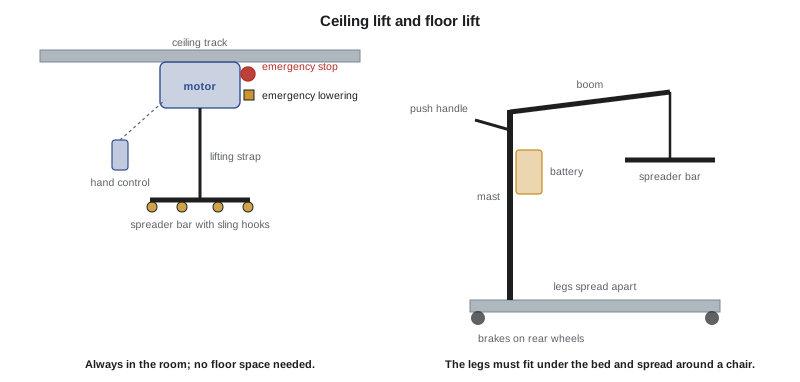
Both kinds have the same safety features. An emergency stop button cuts power. An emergency lowering control, either a pull cord or a button that works without the main power, lets staff lower the patient if the lift fails partway through a move. Every lift has a rated maximum load, marked on the motor or the mast and in the manual, and every lift must be inspected and serviced on a schedule. Many have built-in scales that weigh the patient during the lift, which saves another transfer onto a chair scale.
Why ceiling lifts are better where they can be installed
Floor lifts are essential, but where ceiling lifts can be installed they are better for staff and for patients, and the research and the experience of hospitals agree.
- No pushing. A floor lift with a patient in it can weigh more than 440 lb (200 kg), and pushing it over carpet, door thresholds or a sloped floor, and turning it in a tight space, is a significant strain injury hazard on its own. A ceiling lift glides along its track with a touch.
- Always there. A ceiling lift is in the room when it is needed. A floor lift has to be found, often charged, and brought, and if it is in use elsewhere staff are tempted to lift by hand. Ceiling lifts are used much more often than floor lifts for the same patients.
- Less space. Floor lifts need room for their base and for turning, which many patient rooms and nearly all bathrooms do not have.
- Faster. Once staff are used to them, ceiling lift transfers take about the same time as a careful manual transfer and less time than fetching a floor lift.
- More stable. A ceiling lift does not tip, and the patient swings less.
The disadvantages are cost and building work. A ceiling lift system costs much more than a floor lift, and the ceiling must be able to carry the load, which may need structural work. That is why Northbridge's 4 West has track in only 20 of its 32 rooms, and why the new policy requires every renovation to be reviewed for lift coverage. Floor lifts remain necessary for rooms without track, for bathrooms that track does not reach, for moving patients between areas and for getting patients up from the floor.
Lifting capacity
Every lift, sling and spreader bar has a safe working load, the maximum weight it is designed to carry. The lowest rating in the system is the one that counts: a ceiling motor rated for 550 lb (250 kg) used with a sling rated for 440 lb (200 kg) can only carry 200 kg. Standard lifts at Northbridge are rated for 440 to 550 lb (about 200 to 250 kg). Bariatric motors and floor lifts rated for 660 lb (300 kg) or more are kept on 4 West, in the emergency department and in a central equipment pool. Lesson 9 covers bariatric equipment.
Staff need to know the patient's weight to choose equipment, and a guess is often far off. Patients' weights should be measured on admission and recorded in the chart, and a lift's built-in scale is a convenient way to update them.
Using a ceiling lift for a full-body transfer
Northbridge's procedure for moving a dependent patient from bed to chair with a ceiling lift has six stages. The details for each lift model are in its manual and in the unit training, but the stages are the same.
- Prepare. Check the care plan for the method and sling size. Check the lift: no damage, a current inspection tag, a charged battery and the emergency controls in place. Check the sling: right type and size, clean, no damage, label readable. Explain the move to the patient. Clear a path, place the chair where the track can reach it, and put the chair's brakes on.
- Position the bed. Raise the bed to a height where staff can work without bending, usually about the height of the worker's hip, and put the bed brakes on. Lower the side rail on the side where staff are working.
- Apply the sling. Roll the patient to one side, place the folded sling behind them, roll them back to the other side and pull the sling through. Lesson 7 shows how slide sheets make rolling easier. Check that the sling is centered and that the leg pieces are positioned as the sling design requires.
- Attach and lift. Bring the spreader bar down, attach the shoulder loops or clips first and then the leg loops, using the loop lengths the care plan specifies. Raise the patient just clear of the bed, then stop and check: every loop is secure, the patient is comfortable and sitting in the sling as expected, nothing is pulling on lines or tubes.
- Move and lower. Move the patient along the track to above the chair, turning them gently so they face the right way. Lower slowly while the second worker guides the hips back into the seat, using the sling handles if it has them, never by lifting.
- Finish. Remove or tuck the sling, depending on the plan, make the patient comfortable, put the bed down and the side rails as the care plan says, return the motor to its charging point if it has one, and record the move if the unit requires it.
The usual Northbridge rule is that two trained staff are present for a full-body transfer with any lift. A ceiling lift may be used by one worker for some tasks, such as repositioning a patient in bed with a repositioning sling, when the patient's assessment and care plan allow it. Floor lifts are always used with two staff, because one must steady the patient and guide the lift while the other operates it.
Using a floor lift
Floor lifts follow the same stages, with three extra concerns.
- Clearance. The legs of the lift must fit under the bed, which needs a gap of 4 to 6 in (about 10 to 15 cm) under the frame, and must spread around the chair or commode. Low beds, beds with solid bases and some recliner chairs do not allow this.
- Brakes. Most manufacturers say that the lift's brakes should be left off during lifting and lowering, so that the lift can settle under the patient's center of gravity rather than tip or swing the patient. Some say otherwise for particular models. Follow the instructions for the lift in use, and teach them in unit training.
- Moving with a patient. Keep the patient low, close to the mast and facing it, push with the handle rather than pulling the mast, and move slowly over thresholds. Move the patient only as far as needed: the lift is for transferring between surfaces in the same room, not for carrying patients down a corridor.
Does a lift take longer?
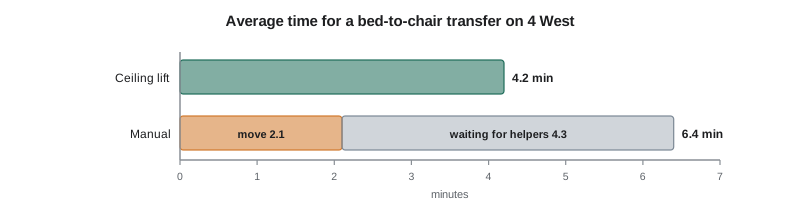
The most common reason staff give for not using a lift is that it takes too long. Grace decided to measure it. With the help of the 4 West peer leaders, she timed 40 bed-to-chair transfers of level 1 and level 2 patients over two weeks, half with ceiling lifts and half done manually by two or three staff in rooms without track, and also timed how long staff waited for a second or third person to come and help.
# Bed-to-chair transfers on 4 West: minutes from start of task to patient seated
lift_rooms = [4.0, 3.5, 5.0, 4.5, 3.0, 4.0, 6.0, 3.5, 4.0, 4.5,
              3.5, 5.5, 4.0, 3.0, 4.5, 4.0, 5.0, 3.5, 4.0, 4.5]   # ceiling lift, 2 staff
manual_move = [2.0, 1.5, 2.5, 2.0, 1.5, 3.0, 2.0, 2.5, 1.5, 2.0,
               2.5, 2.0, 1.5, 2.0, 3.0, 2.0, 2.5, 2.0, 1.5, 2.0]   # the move itself
manual_wait = [3.0, 6.0, 0.5, 4.0, 8.0, 2.0, 5.0, 1.0, 7.0, 3.5,
               2.5, 9.0, 4.0, 0.0, 6.5, 3.0, 5.5, 2.0, 10.0, 4.5]  # waiting for helpers

def mean(xs):
    return sum(xs) / len(xs)

manual_total = [m + w for m, w in zip(manual_move, manual_wait)]
print(f"ceiling lift, start to seated: {mean(lift_rooms):.1f} min")
print(f"manual, the move itself:       {mean(manual_move):.1f} min")
print(f"manual, including the wait:    {mean(manual_total):.1f} min")
print(f"staff-minutes per transfer: lift {2 * mean(lift_rooms):.1f}, "
f"manual {2.5 * mean(manual_move) + mean(manual_wait):.1f}")ceiling lift, start to seated: 4.2 min manual, the move itself: 2.1 min manual, including the wait: 6.4 min staff-minutes per transfer: lift 8.3, manual 9.5
The manual move itself was about half the time of the lift transfer, which is why it feels faster. But once the time spent waiting for helpers was counted, the manual transfers took longer on average, and they used more staff time, because a third person often had to leave their own patients to help. And the manual transfers were the ones that hurt people. When Grace showed the results at a unit meeting, Amira said that the wait was the part nobody ever counted: "You stand there holding the patient on the edge of the bed, waiting, and then you just do it with whoever is there."
What goes wrong with lifts
Lifts are much safer than manual handling, but they can fail, and patients have been seriously injured and killed in lift incidents. the FDA has published safety information on patient lifts, and manufacturers issue alerts about the most common causes:
- Using the wrong sling, or a sling from another manufacturer that is not designed for the lift's spreader bar, so that loops slip off.
- Using the wrong sling size, so the patient slides through the leg openings or out of the back.
- Attaching loops or clips incorrectly, or not checking them before lifting fully.
- Exceeding the rated load of the lift, sling or spreader bar.
- Worn or damaged slings and straps, or lifts that were not serviced.
- Floor lifts tipping because the legs were closed, the patient was moved high and fast, or the lift was pushed over a threshold or slope.
- A spreader bar striking the patient's head or face when it is lowered or swings.
- Leaving a patient alone in a lift.
Most of these are prevented by the steps in the procedure: the right sling in the right size, the check after lifting just clear of the bed, keeping within rated loads, servicing on schedule, and never leaving a patient suspended. Lessons 5 and 11 cover slings and maintenance.
Worked problem
Room 412 without its ceiling lift
The ceiling lift in room 412 has failed again, and a work order is in. The patient, a man of 180 lb (about 82 kg) assessed at level 2, needs to get out of bed for a chest X-ray in a chair. The unit's two floor lifts are both in use, and the night staff have suggested a three-person manual lift. What should Amira, as charge nurse, do?
Show solution
- A level 2 patient needs a full-body lift. A three-person manual lift of 82 kg puts 55 lb (about 25 kg) on each worker, far over the guideline, so it is not an option.
- Amira checks the equipment board: the central equipment pool has a floor lift available. She asks Kevin to bring it, with a charged battery.
- While they wait, she confirms that the floor lift's legs will fit under the bed in 412 and that the chair can be placed with room for the lift to spread its legs around it. The X-ray can be done at the bedside if the lift does not arrive in time.
- She checks the work order: this is the third failure of the 412 lift in two months. She reports this to Sarah and to Grace, because a ceiling lift that keeps failing is a hazard in itself: it trains staff to expect to lift by hand.
Answer: Do not lift by hand. Get a floor lift from the equipment pool, check clearance, consider a bedside X-ray if needed, and report the repeated failures as a system problem.
Common mistakes
MistakeSaying a lift is too slow without counting the wait for helpers.
InsteadMeasure the whole task: a lift transfer is usually as quick or quicker, and it uses fewer staff.
MistakeLifting a patient fully before checking the loops.
InsteadLift just clear of the bed, stop and check every loop and the patient before going higher.
MistakeUsing a lift or sling near or above its rated load.
InsteadKnow the patient's weight and check the lowest rating of lift, sling and spreader bar.
MistakePushing a floor lift with a patient down a corridor.
InsteadUse the lift to transfer within a room; use a stretcher or wheelchair to travel.
MistakeLeaving a patient suspended in a lift to fetch something.
InsteadPrepare everything before lifting and never leave a patient alone in a lift.
Summary and key terms
- Mechanical lifts take the patient's weight and are the main control for dependent transfers.
- Ceiling lifts run on tracks; traverse systems cover most of a room. Floor lifts stand on a wheeled base and can go anywhere the floor allows.
- Ceiling lifts need no pushing, are always in the room, need less space and are used more; floor lifts are still needed for rooms without track and for floors.
- The lowest safe working load of the lift, sling and spreader bar is the limit.
- A safe transfer has six stages: prepare, position the bed, apply the sling, attach and test, move and lower, and finish.
- Floor lifts need clearance under the bed and around the chair, and are used with two staff.
- Counting the wait for helpers, lift transfers are usually no slower than manual ones.
- Ceiling lift
- A lift whose motor runs on a track fixed to the ceiling.
- Traverse system
- A ceiling track arrangement with a moving rail between two fixed rails, allowing the lift to reach most of a room.
- Floor lift
- A wheeled lift with a mast and boom, also called a mobile or portable lift.
- Spreader bar
- The bar at the end of a lift's strap or boom to which the sling loops or clips are attached.
- Safe working load
- The maximum weight a lift, sling or spreader bar is designed to carry.
- Emergency lowering
- A control that lowers the patient if the lift's normal power fails.
Practice problems
Work each problem on paper first, then reveal the answer to check.
Give three reasons ceiling lifts are used more than floor lifts.
Show answer
They are always in the room, need no pushing or fetching, need less space, and are faster to use.
A ceiling motor is rated for 250 kg and the sling for 200 kg. What is the system's limit?
Show answer
200 kg, the lowest rating.
What should staff do after raising the patient just clear of the bed?
Show answer
Stop and check every loop, the patient's position and comfort, and any lines or tubes.
Name two checks before using a floor lift for a bed-to-chair transfer.
Show answer
That the legs fit under the bed and can spread around the chair; and the battery, inspection tag and sling.
In Grace's time study, why did manual transfers take longer on average?
Show answer
Because of the time spent waiting for helpers.
Name three common causes of lift incidents.
Show answer
Any three of: wrong sling or size, incorrect loop attachment, exceeding rated loads, worn slings, tipping floor lifts, spreader bar strikes and leaving a patient alone.
Lesson quiz · 5 questions
Score 60% or more to complete this lesson.
Create a free account to save your progress, take quizzes and earn a certificate.