
HSE-380 · Lesson 12 of 12 · 17 min
Capstone: first-shift orientation and a kitchen safety walk
▶ Video coming soon A video version of this lesson is on the way.
This lesson brings the course together in the two tools that do the most to prevent kitchen injuries: a good first shift for every new worker, and a regular safety walk that finds hazards and gets them fixed. Both are simple, both cost little, and both are skipped in many restaurants because there is always something more urgent. At Juniper Street, Aisha's review showed that most injuries happened to people in their first months and that most hazards had been visible for weeks before they hurt anyone. The first-shift orientation and the monthly safety walk are her answer to those two findings.
Part 1: the first shift
Juniper hires a new worker almost every week in the busy season. On a Tuesday in May, two new people start: Owen, 22, a line cook with two years of experience at a burger restaurant, and Grace, 16, a new prep helper and host in her first job. Their first shifts follow the same plan, adjusted for their jobs and Grace's age.
OSHA standards require training on specific hazards, such as hazard communication, personal protective equipment and lockout, before a worker is exposed, in a language the worker understands. Juniper's first-shift checklist covers those requirements and the other topics OSHA's young worker guidance recommends.
| Topic | What Juniper covers | Who |
|---|---|---|
| Supervisor | Who your supervisor is on each shift and how to reach them | Aisha |
| Rights and duties | Your rights to a safe workplace, training and reporting without retaliation | Aisha |
| Reporting | How to report injuries, near misses and hazards, and where the log is | Aisha |
| Kitchen language | Behind, corner, hot, sharp, door, and calling hazards | Tomás |
| Knives | The claw and bridge, carrying, the knife tray, cut gloves | Luis |
| Machines | Which machines you may use, guards, unplugging, the age rule | Tomás |
| Burns | Fryer rules, dry cloths, steam, oil handling, burn first aid | Ben |
| Floors | Shoes, mats, the spill steps | Aisha |
| Walk-ins | Inside releases, the alarm, cold gear, the CO2 alarm | Aisha |
| Lifting | Storage heights, carts, the stockpot method | Aisha |
| Chemicals | HazCom labels, safety data sheets, dispensers, never mixing, eyewash | Kofi |
| Heat | Signs of heat illness, water, breaks, the buddy system | Tomás |
| Emergencies | Exits, fire extinguishers, the hood suppression pull station, the muster point | Daniel |
| First aid | First-aid kits, the attendant on each shift, how to get help | Aisha |
| Young workers | Task and hours limits, supervision, the posted list | Olivia |
Showing, not telling
A checklist read aloud in the office is quickly forgotten. Juniper's orientation is a walk through the kitchen with each topic taught where it happens, and each new worker shows the skill back before signing off.
- At the walk-ins, the new worker presses the inside release from inside each room, finds the alarm button and the freezer jackets, and reads the carbon dioxide alarm status.
- At the chemical shelf, they find the safety data sheet for the oven cleaner, point to its pictograms, fill a sanitizer bottle from the dispenser and test it with a strip.
- At the eyewash, they run it for a few seconds.
- At the prep station, they dice an onion with the claw grip under Luis's eye and carry a knife past him with the right call.
- At the line, Owen shows the fryer routine, including shaking frozen product at the drip shelf; Grace does not work the fryer on her first shift.
- At the exits, they walk the route to the muster point.
Owen knew a lot already, which is a risk of its own: experienced workers bring habits from other kitchens. His old restaurant had let cooks clean the slicer without unplugging it, and had no rule about who could use it. The orientation is where those differences surface. Grace, in her first job, needed more time on the basics and on speaking up; Olivia made a point of telling her twice that asking questions is part of the job.
Grace, at 16, may not operate or clean the slicer, the grinder or the floor mixer, or load or operate the baler, under the Hazardous Occupations Orders. Federal law does not limit her hours, though Georgia's child labor law has its own rules for minors. Her name goes on the posted list of workers under 18.
Follow-up
The first shift is only the start. New workers are paired with an experienced buddy for their first two weeks: Owen with Ben on the line, Grace with Luis in prep and Olivia at the host stand. Aisha checks in with each new worker at the end of their first week and again after a month, with three questions: what has surprised you, what has been hard, and what have you seen that looks unsafe? The answers often find hazards that the regular staff no longer see.
The program below tracks orientation sign-offs for the new hires in May and flags anything missing before a worker's third shift, which is Juniper's deadline for finishing every topic.
# Orientation sign-off tracker for new hires (invented records).
TOPICS = ["supervisor", "rights", "reporting", "language", "knives", "machines",
          "burns", "floors", "walk-ins", "lifting", "chemicals", "heat",
          "emergencies", "first aid", "young workers"]
signed = {
    "Owen":  {"shift": 3, "done": set(TOPICS) - {"young workers", "heat"}},
    "Grace": {"shift": 2, "done": set(TOPICS) - {"machines", "lifting", "chemicals"}},
    "Tariq": {"shift": 4, "done": set(TOPICS)},
}
for name, rec in signed.items():
    missing = [t for t in TOPICS if t not in rec["done"]]
    pct = 100 * (len(TOPICS) - len(missing)) / len(TOPICS)
    status = "complete" if not missing else ("OVERDUE" if rec["shift"] >= 3 else "in progress")
    print(f"{name:6s} shift {rec['shift']}: {pct:5.1f}% done, {status}")
    if missing:
print(" missing:", ", ".join(missing))Owen shift 3: 86.7% done, OVERDUE
missing: heat, young workers
Grace shift 2: 80.0% done, in progress
missing: machines, lifting, chemicals
Tariq shift 4: 100.0% done, completeOwen's heat and young-worker topics were still unsigned at his third shift. The young-worker topic matters for Owen because he will often be the adult on the line beside Noah and Grace, and Aisha covered both topics before his next shift. Grace's missing topics are normal for her second shift, and they were done by her third.
Part 2: the kitchen safety walk
A safety walk, also called a workplace inspection, is a planned walk through the workplace to look for hazards. Juniper's joint committee members do one every month, with Aisha and Kofi leading and a different worker from the line or the front of house joining each time. They walk the kitchen zone by zone from Lesson 1, with a checklist built from this course, at a time when the kitchen is working but not in the middle of the rush, usually mid-afternoon.
OSHA standards require regular inspections of specific items, such as walking surfaces and fire extinguishers, and the General Duty Clause expects employers to find and fix recognized hazards. A regular safety walk is the most direct way to meet both. Many states with safety committee rules require committees to inspect the workplace on a set schedule.
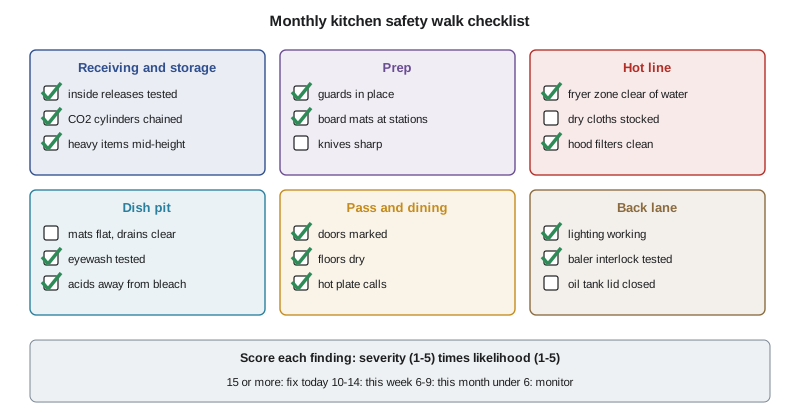
What the May walk found
On the May walk, Aisha, Kofi and Hana found nine problems. Some were small and fixed on the spot, and some needed money or a contractor. Not every finding is equally urgent, so each one was given a score for how serious an injury it could cause and how likely that injury is, each from 1 to 5. The product of the two scores sets the priority: the higher the score, the sooner the fix. HSE-103 covers risk scoring in detail.
# Score and rank safety walk findings: risk = severity x likelihood (1-5 each).
findings = [
    ("Freezer inside release slow to open", 5, 3),
    ("Slicer ring guard cracked", 5, 2),
    ("Bleach shelf has delimer on it again", 4, 3),
    ("Dish pit drainage mat edge curling", 3, 4),
    ("Two dry oven cloths left for the whole line", 3, 4),
    ("Eyewash test log not signed for 3 weeks", 4, 2),
    ("Back lane light out by the baler", 3, 3),
    ("Sanitizer bottle at the bar has no label", 2, 3),
    ("First-aid kit at the line short of burn dressings", 2, 3),
]
def action(score):
    if score >= 15:
        return "stop and fix today"
    if score >= 10:
        return "fix this week"
    if score >= 6:
        return "fix this month"
    return "monitor"
ranked = sorted(findings, key=lambda f: -f[1] * f[2])
for i, (item, sev, lik) in enumerate(ranked, 1):
    score = sev * lik
    print(f"{i}. {score:2d} {action(score):18s} {item}")
total = sum(s * l for _, s, l in findings)
print(f"Total risk score: {total} across {len(findings)} findings")1. 15 stop and fix today Freezer inside release slow to open 2. 12 fix this week Bleach shelf has delimer on it again 3. 12 fix this week Dish pit drainage mat edge curling 4. 12 fix this week Two dry oven cloths left for the whole line 5. 10 fix this week Slicer ring guard cracked 6. 9 fix this month Back lane light out by the baler 7. 8 fix this month Eyewash test log not signed for 3 weeks 8. 6 fix this month Sanitizer bottle at the bar has no label 9. 6 fix this month First-aid kit at the line short of burn dressings Total risk score: 90 across 9 findings
The ranking matched what the walkers felt. The slow freezer release went to the top with a score of 15: the room was restricted to quick grabs only and the refrigeration technician was called that afternoon. The delimer had drifted back to the bleach shelf because a new delivery had been put away by someone who did not know the rule, so the committee added a labeled tub for acids and a sign on the shelf. The cracked slicer guard took the slicer out of service until the part arrived two days later, with the deli meat sliced by hand in the meantime. Everything else was assigned a name and a date on the whiteboard.
Closing the loop
A safety walk that produces a list nobody acts on teaches everyone that safety walks do not matter. Juniper's committee closes the loop in four steps.
- Every finding gets an owner and a target date before the walk ends.
- The whiteboard by the office shows open items, and the general manager reviews it weekly.
- The next walk starts by checking last month's items.
- The committee reports what was fixed at the monthly staff meeting, so people see that what they report gets done.
The monthly score is a leading indicator of the kind Lesson 1 described. Over the year, Aisha tracks the total risk score of each walk, the number of findings fixed on time and the number of near misses reported. A falling total score, a high share of fixes done on time and a steady flow of near-miss reports are signs the program is working, months before the injury rate can show it.
Looking back at Juniper's year
Every serious injury and near miss from Lesson 1 now has a control in place. The table summarizes them and points to the lesson where each was covered.
| Event | Root causes | Controls now in place | Lesson |
|---|---|---|---|
| Luis’s knife cut | Dull knife, sliding board, rushed prep | Sharpening log, board mats, prep schedule | 3 |
| Slicer near miss with Ethan | New cook unaware of age rule | Posted permission list, orientation line, labels | 2, 4 |
| Ben’s fryer burn | Ice on frozen fries, no drip station | Drip shelf, ice bin moved, basket lifts planned | 5 |
| Kofi’s fall | Worn mats, blocked drain, grease film, glass shortage | New mats, drain checks, squeegee routine, more glasses | 6 |
| Freezer latch | Failed door heater, slamming | Repair, daily release test, alarm button | 7 |
| Hana’s back strain | Reach and twist with a full pot | Ladle first, front burner, cart, kettle for big batches | 8 |
| Bleach beside delimer | No storage rule | Separate acid tub, shelf sign, walk check | 9 |
None of these fixes was expensive, and none relied on telling people to be more careful. Each changed the job: a tool, a layout, a schedule, a rule or a check. That is the main lesson of this course.
Where to go next
The rest of the food services track builds on this course and on Juniper Street. HSE-381 covers safe food handling: time and temperature, cross-contamination, allergens, cleaning and sanitizing, and passing a health inspection. HSE-382 covers kitchen fires, hood systems, wet chemical suppression, Class K extinguishers and gas appliances. HSE-383 covers the front of house: servers and bartenders, alcohol service, aggressive guests, the patio and delivery driving.
For supervisors: making orientation and walks stick
- Block time for orientation on the schedule. A new worker who is thrown straight onto the line during a rush has not been oriented, whatever the paperwork says.
- Keep the orientation checklist short enough to finish on the first shift and use the follow-up visits for the rest.
- Walk with a different worker each month. Fresh eyes find different hazards.
- Score findings honestly, act on the top ones the same day, and tell people what was fixed.
- Review the checklist each year and after any serious injury, near miss or major change such as new equipment.
Summary and key terms
- Most kitchen injuries happen to new workers, so every new worker needs a hands-on first-shift orientation with a record and follow-up.
- Teach each topic where it happens and have the new worker show it back, and pay attention to habits that experienced workers bring from other kitchens.
- A monthly safety walk by zone, with workers and supervisors together, finds hazards before they hurt anyone.
- Scoring findings by severity and likelihood puts the most dangerous problems first, and every finding needs an owner and a date.
- Closing the loop and tracking leading indicators show whether prevention is working and keep people reporting.
- Orientation
- The training a new worker receives before or at the start of work about hazards, rules, rights and emergencies.
- Buddy system
- Pairing a new worker with an experienced worker for their first weeks.
- Safety walk
- A planned inspection of the workplace to find and record hazards.
- Risk score
- A number combining how severe and how likely an injury is, used to rank hazards.
- Closing the loop
- Making sure every hazard found is fixed, checked and reported back to workers.
Common mistakes
MistakeAn experienced cook does not need orientation.
InsteadExperienced workers need to learn this kitchen’s equipment, rules and emergency plan, and may bring unsafe habits from elsewhere.
MistakeA safety walk is done once the checklist is filled in.
InsteadIt is done when every finding has been fixed, checked and reported back.
MistakeSmall findings such as missing labels can wait until the big ones are fixed.
InsteadLow-scoring items still get an owner and a date; many take seconds to fix on the spot.
Practice problems
Work each problem on paper first, then reveal the answer to check.
A finding has severity 4 and likelihood 4. What action does Juniper’s scoring call for?
Show answer
A score of 16, so stop and fix it today.
Why does Juniper ask new workers what looks unsafe after their first week?
Show answer
New workers notice hazards that regular staff have stopped seeing.
Name two leading indicators Aisha tracks.
Show answer
The total risk score of each walk, the share of findings fixed on time, near misses reported or orientation completion rates.
Lesson quiz · 5 questions
Score 60% or more to complete this lesson.
Create a free account to save your progress, take quizzes and earn a certificate.