
HSE-372 · Lesson 6 of 12 · 22 min
Silica, mold and dust in demolition and renovation
Once the asbestos, lead, PCBs and other hazardous materials are out, what is left of a building is mostly concrete, brick, block, mortar, plaster, drywall, wood and steel. Taking those apart makes dust, and lots of it. Some of that dust is a nuisance. Some of it causes permanent lung disease. In the Halvorsen Building renovation, the dust problem is sharpened by the people on the other floors, who did not sign up to breathe it. And in both buildings, water damage had grown mold in places nobody had looked for years.
This lesson covers respirable crystalline silica, mold and general construction dust in demolition and renovation: where they come from, how they harm people, and how they are controlled, from the excavator breaking the Norwood Block foundations to a carpenter cutting a doorway in an occupied office.
Respirable crystalline silica
Crystalline silica, mostly in the form of quartz, is one of the most common minerals in the earth's crust. It is in sand, stone, concrete, mortar, brick, block, many plasters, terrazzo, tile and engineered stone. It is harmless as a solid. When these materials are broken, cut, drilled, ground, crushed or swept, they release particles fine enough to reach the deepest parts of the lungs. That fraction is called respirable crystalline silica.
Breathing it can cause silicosis, an incurable scarring of the lungs that can be disabling or deadly; lung cancer; chronic obstructive pulmonary disease; and kidney disease. Heavy exposure over a short time can cause acute silicosis within months. More often, the disease develops over years of exposure that no single day made obvious.
Demolition and renovation are among the highest silica exposure tasks in construction because they break up so much material in a short time, often indoors, often dry, and often with tools that throw dust into the worker's breathing zone.
- Mechanical demolition of concrete and masonry with breakers, crushers and pulverizers.
- Jackhammers and chipping hammers breaking slabs, walls and footings.
- Cutting and coring concrete and block with saws and core drills.
- Drilling holes in concrete for anchors and services.
- Grinding concrete and removing coatings.
- Removing plaster and mortar by hand or with power tools.
- Dry sweeping and using compressed air to clean up dust, which puts settled silica back in the air.
- Crushing and sorting concrete for recycling on site.
OSHA's respirable crystalline silica standard for construction, 1926.1153, sets a permissible exposure limit of 50 µg/m³ averaged over eight hours and an action level of 25 µg/m³. Employers can either follow Table 1, which lists common tasks such as jackhammers, handheld saws, walk-behind saws, drills, grinders and heavy equipment used to break or abrade concrete, with the engineering controls, work practices and respirators required for each, or measure exposure and control it to below the limit. The standard also requires a written exposure control plan naming a competent person, a ban on dry sweeping and compressed air where they would create exposure, medical exams for workers who must wear respirators 30 or more days a year, and recordkeeping.
Controls that work
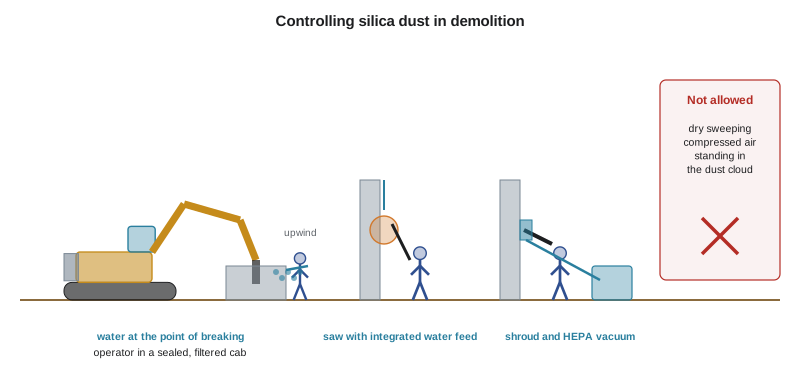
- Water. Water at the point of dust generation is the most effective single control for breaking and cutting. Saws and core drills with integrated water feed, breakers with water spray nozzles, and a worker with a hose wetting the debris as an excavator breaks it all cut silica levels dramatically, provided enough water reaches the right spot.
- Local exhaust. Tools with shrouds connected to a vacuum with a HEPA filter capture dust at the source, which suits drilling and grinding indoors where water would cause damage.
- Enclosed cabs. Excavator and loader cabs with sealed doors, filtered and pressurized air keep the operator out of the dust cloud.
- Work practices. Positioning workers upwind, not standing in the dust cloud, rotating tasks, wetting before sweeping, HEPA vacuuming instead of sweeping, and never using compressed air to clean.
- Respirators. Where controls are not enough to bring levels down, workers wear respirators with the right protection factor, fit tested and worn properly. For many demolition tasks, respirators are needed in addition to water or exhaust, not instead of them.
Silica on the Norwood Block
Breaking out the Norwood Block's basement walls and footings with a hydraulic breaker was the worst silica task on the job. Prairie Wrecking LLC's plan put a dedicated worker on a fire hose, standing upwind and well outside the machine's swing radius, wetting the point of impact continuously. The excavator cab was enclosed, with its pressurization and filter checked before the shift. Workers who had to approach the breaking area wore half-face respirators with P100 filters. On the sawcutting of the slab edges, the saws had water feed, and the slurry was vacuumed rather than left to dry and blow around.
Mold
Mold grows wherever building materials stay damp: behind leaking roofs and windows, around plumbing leaks, in basements, under carpets and inside walls where condensation collects. Drywall paper, wood, ceiling tiles, carpet and insulation are its favorite food. Disturbing moldy materials releases spores and fragments that can cause allergic reactions, asthma attacks and irritation of the eyes, nose and throat, and in people with weakened immune systems, infections. Some workers become sensitized and react strongly to small exposures afterward.
There are no exposure limits for mold in the way there are for silica or asbestos. Instead, the approach is to find it, fix the water problem, and remove moldy materials in a way that keeps spores from spreading, with the level of control matched to the size of the job.
EPA guidance on mold remediation in commercial buildings sorts jobs by area: small jobs under about 10 ft² (0.9 m²) that trained staff can handle with basic protection, medium jobs of about 10 to 100 ft² (0.9 to 9 m²) that need limited containment, and large jobs over about 100 ft² (9 m²) that need full containment under negative pressure and an experienced remediation contractor.
In the Halvorsen Building, the renovation found mold behind the drywall under three windows on the third floor where a failed seal had let water in for years, 43 ft² (about 4 m²) in all. The renovation contractor isolated the area with a polyethylene enclosure and a HEPA negative air machine exhausting outside, the workers wore half-face respirators with P100 filters, disposable coveralls and gloves, and the moldy drywall and insulation were cut out wet, bagged inside the enclosure and removed. The window was fixed before new materials went in, because removing mold without fixing the leak just schedules the next removal.
Dust in an occupied building
Dust from renovation travels. It rides on air currents through ceiling plenums, open doors, elevator shafts and stairwells, and it gets drawn into the building's ventilation system and delivered to every floor. In the Halvorsen Building, the tenants on the first and fourth floors were still working, and one tenant on the ground floor ran a small daycare. Dust control was not just about the workers.
- Isolate the work area with full-height dust barriers sealed at the floor, walls and ceiling deck, not just the suspended ceiling. Zippered doors or two-door anterooms control entry.
- Keep the work area at negative pressure with HEPA air machines exhausting outside, so dust flows inward rather than out to the occupied areas.
- Seal the ventilation. Return air grilles in the work area are sealed so the air system does not carry dust through the building, and the building operator rebalances the system.
- Control dust at the tool, with water or shrouded tools and HEPA vacuums.
- Walk-off mats and cleaning. Sticky mats at the exit and HEPA vacuuming of the path out stop dust tracking into the corridors.
- Schedule the dustiest work after hours when the floors next to and below the work are empty.
- Monitor. Simple real-time dust monitors at the barrier and in the occupied areas show whether the controls are holding.
Estimating the dilution in an enclosure
To size the negative air machines for the mold enclosure, Owen checks how many air changes per hour they will provide. A common target for this kind of enclosure is at least four air changes per hour, with more for dustier work.
# Air changes per hour for a negative pressure enclosure (invented dimensions).
length_m, width_m, height_m = 6.0, 3.0, 2.7
volume_m3 = length_m * width_m * height_m
volume_ft3 = volume_m3 * 35.315

machine_cfm = 500                 # rated airflow of one HEPA unit, cubic feet per minute
derate = 0.7                      # allowance for filter loading and ducting losses
machines = 1
airflow_ft3_per_hr = machines * machine_cfm * derate * 60
ach = airflow_ft3_per_hr / volume_ft3
print(f"Enclosure volume: {volume_m3:.1f} m3 ({volume_ft3:,.0f} ft3)")
print(f"Effective airflow: {machines * machine_cfm * derate:.0f} cfm")
print(f"Air changes per hour: {ach:.1f}")
target = 4
print("Meets the 4 ACH target" if ach >= target else "Add another machine")Enclosure volume: 48.6 m3 (1,716 ft3) Effective airflow: 350 cfm Air changes per hour: 12.2 Meets the 4 ACH target
One machine gives well over the target for this small enclosure, so the main job of the air machine is to hold the enclosure at negative pressure and clean the air between tasks. For a large Type 3 or Class I asbestos enclosure, the same calculation often calls for several machines.
Worked problem
Coring through the third floor slab
Show solution
- The Halvorsen renovation needs six new holes cored through the concrete slab of the third floor for plumbing. The office directly below on the second floor is part of the renovation, but the daycare is on the ground floor two levels down.
- Owen checks the controls. The core drill has a water feed, so the main silica control is in place. But water and slurry can run through the hole onto the floor below.
- The crew sets up a catch pan and a wet vacuum under each hole on the second floor, closes off the area below, and schedules the coring for Saturday when the building is empty.
- Before coring, an electrician scans the slab to check for embedded conduit and post-tensioning, which is covered in lesson 7.
- The crew HEPA vacuums the area afterward, and Owen checks the dust monitor reading at the stair door to the daycare floor, which stays at background all day.
Answer: Silica control at the tool, protection of the floor below and scheduling around occupants work together. In an occupied building, the plan has to protect people who are not on the crew.
Monitoring silica exposure
Controls are only as good as the evidence that they work. On the Norwood Block, Anika's technician put personal air sampling pumps on the breaker operator, the water hose worker and a laborer during the first full day of foundation breaking. Each pump drew air through a cyclone that separates the respirable fraction onto a filter, which went to a laboratory for analysis. The results came back within a few days and gave each worker's eight-hour time-weighted average exposure.
The results confirmed what the plan expected. The operator in the sealed, pressurized cab was well below the limit. The water hose worker, standing upwind, was below the limit but above half of it on one sample taken when the wind shifted. The laborer who had walked into the dust cloud to retrieve a tool was above the limit for the short time he was there. The plan changed in two ways: the hose worker got a longer hose so he could stay farther upwind, and the exclusion zone around the breaker was enforced for everyone, including workers on short errands.
Sampling also protects workers in the long run. Exposure records are kept for many years, so that if a worker develops lung disease decades later, there is a record of what they were exposed to. Workers who wear respirators regularly for silica work may need medical examinations, including lung function tests and chest X-rays, under the employer's program and, in the United States, under the silica standard.
Housekeeping between tasks
Silica dust that settles on floors, ledges, equipment and clothing can be stirred back into the air by the next worker who walks through. Good housekeeping keeps the background low: wetting debris before it is moved, HEPA vacuuming settled dust rather than sweeping it, cleaning tools and machines with water or vacuums instead of compressed air, and keeping work clothes out of lunchrooms and vehicles. These steps sound minor, but on a demolition site they decide whether the whole site is dusty or only the work face.
Common mistakes
MistakeTreating concrete dust as harmless nuisance dust.
InsteadConcrete, brick, block and mortar dust contains respirable crystalline silica that causes permanent lung disease.
MistakeCleaning up with a broom or compressed air.
InsteadWet the dust or use a HEPA vacuum; dry sweeping and compressed air put silica back in the air.
MistakePutting the water hose operator downwind in the dust cloud.
InsteadPosition the water worker upwind and outside the machine's reach, aiming at the point of breaking.
MistakeCutting out moldy drywall without fixing the leak.
InsteadFind and fix the water source, or the mold will return.
MistakeHanging a dust barrier only up to the suspended ceiling.
InsteadSeal barriers to the structure above the ceiling, or dust travels through the plenum.
Summary and key terms
- Breaking, cutting, drilling and grinding concrete, masonry and plaster release respirable crystalline silica, which causes silicosis, lung cancer, COPD and kidney disease.
- OSHA 1926.1153 sets a 50 µg/m³ limit and 25 µg/m³ action level and offers Table 1 task controls, with a written exposure control plan and a ban on dry sweeping and compressed air.
- The main silica controls are water at the point of breaking, local exhaust at the tool, enclosed cabs, good work practices and respirators where needed.
- Mold remediation is sized by area, with isolation and negative pressure for larger jobs, and always includes fixing the water source.
- In occupied buildings, dust barriers sealed to the structure, negative pressure, sealed ventilation, walk-off mats, after-hours scheduling and monitoring protect the occupants.
- Respirable crystalline silica
- Fine quartz and similar mineral particles small enough to reach the deepest parts of the lungs.
- Silicosis
- Incurable scarring of the lungs caused by breathing respirable crystalline silica.
- Air changes per hour
- The number of times the volume of air in a space is replaced in an hour.
- Dust barrier
- A temporary wall, usually polyethylene on a frame, sealed to the floor, walls and structure above to keep dust in a work area.
- Local exhaust
- A system that captures dust at the tool, such as a shroud connected to a HEPA vacuum.
- Plenum
- The space above a suspended ceiling, often used for return air, through which dust can travel.
Practice problems
Work each problem on paper first, then reveal the answer to check.
Name five demolition or renovation tasks that release silica.
Show answer
Any five of mechanical demolition of concrete, jackhammering, cutting, coring, drilling, grinding, removing plaster or mortar, dry sweeping and crushing concrete.
What is the most effective single control for silica when breaking concrete?
Show answer
Water applied at the point where the material is being broken or cut.
Why are dry sweeping and compressed air not allowed for cleaning silica dust?
Show answer
They put settled silica dust back into the air where workers breathe it.
What must happen besides removing moldy materials?
Show answer
The water source that caused the mold must be found and fixed.
Why must return air grilles in a renovation area be sealed?
Show answer
So the building ventilation system does not carry dust from the work area to occupied floors.
Lesson quiz · 5 questions
Score 60% or more to complete this lesson.
Create a free account to save your progress, take quizzes and earn a certificate.