
HSE-372 · Lesson 3 of 12 · 21 min
Hazardous materials surveys and abatement roles
While Helen Kowal was tracing load paths through the Norwood Block, Anika Rao of Keystone Environmental LLC was working through the same rooms with a different question: what in this building could hurt the people who take it apart? She cut small samples out of floor tiles, ceiling texture, pipe insulation, drywall joints, window caulking and roofing. She scraped paint chips from door frames and the steel stair stringers. She read the labels on fluorescent light ballasts, counted thermostats, photographed the rooftop air conditioner's nameplate and drilled two small holes through the dry cleaner's floor to look at what lay underneath.
This lesson covers the hazardous materials survey: what it looks for, how it is done, what goes into the report, and how the report leads to abatement. It also explains who does what during abatement and how the site decides when a building is clear for demolition. Lessons 4, 5 and 6 cover the individual materials in depth.
Why a survey comes first
Many hazardous building materials look exactly like their harmless replacements. Vinyl floor tile with asbestos looks like vinyl floor tile without it. Lead paint looks like any other paint. A PCB ballast looks like any other ballast until you read its label. The only reliable way to know is to survey before the work, sample where needed and have the samples analyzed by an accredited laboratory. A crew that discovers asbestos by breaking it has already been exposed, and so has everyone downwind of them.
Under OSHA's asbestos standard, building and facility owners must determine the presence, location and quantity of asbestos-containing material and presumed asbestos-containing material before work begins, and tell employers and workers who will work in or near it. In buildings built no later than 1980, thermal system insulation and sprayed or troweled surfacing material are presumed to contain asbestos unless an inspection shows they do not, and resilient flooring installed no later than 1980 is treated the same way. The asbestos NESHAP adds an environmental requirement: before demolition or renovation of a facility, the owner or operator must have the affected part thoroughly inspected for asbestos. In Texas, DSHS licenses asbestos inspectors and requires an inspection by a licensed inspector before renovation or demolition of public buildings, a category Texas defines broadly. DSHS also requires notice at least 10 working days before any demolition, even when no asbestos is present, and before renovation that disturbs asbestos above the set thresholds.
What the survey looks for
A full pre-demolition survey is broader than asbestos. For the Norwood Block and the dry cleaner, Anika's scope covered:
- Asbestos in floor tiles and mastic, ceiling tiles and texture, drywall joint compound, plaster, pipe and boiler insulation, duct wrap, sprayed fireproofing, roofing, window caulking and putty, cement board and siding, and vermiculite insulation.
- Lead in paint on walls, trim, doors, windows, steel and exterior surfaces, and in older plumbing solder and flashing.
- Polychlorinated biphenyls (PCBs) in fluorescent light ballasts, older transformers and capacitors, and some caulking and paints from the 1950s to the 1970s.
- Mercury in fluorescent tubes, high-intensity discharge lamps, thermostats, switches and some old boilers and pressure gauges.
- Ozone-depleting substances and other refrigerants in air conditioners, refrigerators, freezers and chillers.
- Silica-containing materials, which in practice means almost all concrete, block, brick, mortar, plaster and stone.
- Mold and biological hazards, including mold from leaks, bird and bat droppings, rodent droppings and discarded needles in vacant spaces.
- Fuel and chemicals in tanks, drums, pipes, pits and drains, and contamination in the soil and slab, especially under former industrial or dry cleaning uses.
- Radioactive sources in some old smoke detectors and exit signs, which are collected rather than thrown out.
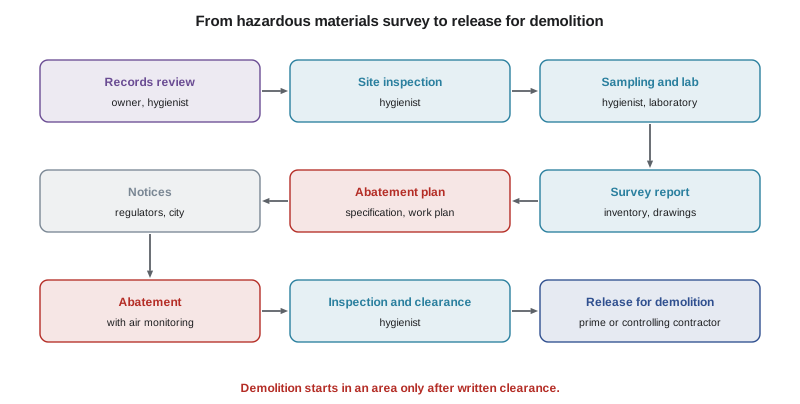
How a survey is done
A good survey follows a pattern that holds whatever the material.
- Review records. Previous asbestos reports, building age, renovation history and product information all help Anika decide where to look and what to sample.
- Divide the building into homogeneous materials. A homogeneous material is one that looks the same, was installed at the same time and serves the same purpose, such as the 12 in (300 mm) beige floor tile in the second-floor offices. Each homogeneous material is sampled as a group, not tile by tile.
- Sample. Small samples are cut or scraped with hand tools, with the material wetted first and the worker wearing a respirator, and the hole sealed afterward. The number of samples depends on the material and the area; surfacing materials and large areas need more samples than a small run of pipe insulation. Some materials are simply presumed to contain asbestos instead of being sampled, which is cheaper but means they must be removed as asbestos.
- Analyze. Bulk samples go to an accredited laboratory, usually for polarized light microscopy. Paint chips go for lead analysis. Ballast labels and dates are checked against lists of PCB and non-PCB ballasts.
- Look in hidden places. Above ceilings, inside wall cavities, in pipe chases and shafts, under newer flooring, behind cladding, on the roof and under the slab. A survey for demolition must be intrusive, because demolition will open every hidden space.
- Report. The report lists every material, where it is, how much there is, whether it is friable or non-friable, its condition and what must be done with it, with drawings and photographs.
Friable means the material can be crumbled, powdered or reduced to dust by hand pressure when dry. Friable asbestos materials such as pipe insulation, sprayed fireproofing and ceiling texture release fibers much more easily than non-friable materials such as vinyl floor tile or cement board. Non-friable materials can become friable when they are broken, ground, sanded or crushed, which is exactly what demolition does.
What the Norwood Block survey found
Anika's report listed fourteen hazardous materials. The main ones were:
- 9 in (230 mm) vinyl floor tile and black mastic in the original 1961 store and basement, both with chrysotile asbestos, 7,000 ft² (about 650 m²).
- Pipe insulation on the basement heating lines and boiler, with amosite asbestos, 300 ft (about 90 m), in fair to poor condition.
- Drywall joint compound in the 1978 offices, with a low percentage of chrysotile.
- Window caulking and glazing putty with asbestos and, in the caulking, PCBs above the regulated level.
- Lead paint on the steel stairs, door frames, window frames and the original exterior trim.
- 112 fluorescent light fixtures, of which 64 had ballasts labeled or dated as containing PCBs.
- 230 fluorescent tubes and 9 thermostats containing mercury.
- A rooftop air conditioner with 20 lb (about 9 kg) of an ozone-depleting refrigerant.
- An abandoned heating oil tank in the basement, partly full.
- Chlorinated solvent staining in the dry cleaner's floor and a floor drain that led to an old sump.
From survey to abatement
The report becomes the basis for an abatement specification: a document, usually written by the hygienist, that tells the abatement contractor exactly what to remove, by what method, with what controls, and to what standard of cleanliness. The specification for the Norwood Block required:
- removal of all asbestos-containing materials that demolition would disturb, which in practice meant all of them;
- enclosures under negative air pressure for the friable pipe insulation, and lower-risk methods for floor tile and mastic;
- removal of PCB ballasts and caulking, mercury lamps and thermostats, kept separate and labeled for disposal as hazardous waste;
- refrigerant recovery by a certified technician before the air conditioner was lifted off the roof;
- removal of lead-painted window frames as whole units rather than scraping, with lead paint on the steel stairs left in place for demolition by shearing rather than torch cutting;
- pumping out and removal of the oil tank by a qualified contractor, and assessment of the soil around it;
- air monitoring throughout, and visual inspection and air clearance sampling before each area was released.
Who does what during abatement
- The owner hires the hygienist, gives the report to every contractor and pays for the abatement. On a demolition, the owner cannot hand the problem to the demolition contractor without telling them what is there.
- The hygienist writes the specification, reviews the contractor's work plan, monitors the air inside and outside the work areas, inspects the work and issues clearance.
- The abatement contractor removes the materials under its own work plan, trains and protects its workers, maintains the enclosures and air filtration, and packages and ships the waste. Jamal Wright, Clearline's supervisor, was on site every day.
- The controlling contractor keeps everyone else out of the abatement areas, schedules abatement before demolition, coordinates the notices and makes sure no demolition starts in an area until it has written clearance. Owen Hartley kept a clearance board in the site office showing each area's status.
- Workers of other trades stay out of marked abatement areas and stop work and report if they find a suspect material that is not in the report.
Clearance and release for demolition
Abatement is finished when the hygienist says it is. For the friable pipe insulation, that meant three checks: a visual inspection confirming no visible debris or residue in the enclosure, the application of a lockdown sealant on the cleaned surfaces, and air samples taken after aggressive air movement showing fiber levels below the clearance criterion in the specification. Only then was the enclosure taken down. For the whole building, Anika issued a written release listing each area, the materials removed and any materials left in place, and confirming that demolition could proceed. Carla Mendes would not let Prairie Wrecking LLC start without it.
Sampling counts for the survey
Before the survey, Anika plans how many bulk samples she needs. Her firm's procedure sets a minimum number by material type and area, similar to common practice. A short program builds the sampling plan.
# Sampling plan for homogeneous materials (invented procedure, metric and imperial).
import math

def samples(kind, area_m2):
    if kind == "surfacing":          # sprayed or troweled materials
        if area_m2 < 93:             # under about 1,000 sq ft
            return 3
        if area_m2 <= 465:           # up to about 5,000 sq ft
            return 5
        return 7
    if kind == "thermal":            # pipe and boiler insulation
        return 3
    return 3                         # floor tile, caulking, joint compound and other materials

plan = [
    ("Basement ceiling texture", "surfacing", 300),
    ("Heating pipe insulation", "thermal", 0),
    ("9 in floor tile and mastic", "misc", 650),
    ("1978 drywall joint compound", "misc", 900),
    ("Window caulking", "misc", 0),
]
total = 0
for name, kind, area in plan:
    n = samples(kind, area)
    total += n
    print(f"{name:30} {n} samples  ({area} m2 = {area*10.764:,.0f} sq ft)")
print("Total bulk samples:", total)Basement ceiling texture 5 samples (300 m2 = 3,229 sq ft) Heating pipe insulation 3 samples (0 m2 = 0 sq ft) 9 in floor tile and mastic 3 samples (650 m2 = 6,997 sq ft) 1978 drywall joint compound 3 samples (900 m2 = 9,688 sq ft) Window caulking 3 samples (0 m2 = 0 sq ft) Total bulk samples: 17
Anika then adds extra samples wherever a material looks different, was repaired or appears in more than one era of the building. Missing a material because it was assumed to match another is a common cause of surprise asbestos during demolition.
Worked problem
The tile under the carpet
Show solution
- Three weeks into abatement, Dev Sandhu is helping a carpentry crew pull carpet off the second floor of the Halvorsen Building for the renovation next door. Under the carpet in one office is a layer of small square vinyl tiles that are not in the renovation's asbestos report.
- Dev remembers the orientation: stop, do not disturb it, keep others away and report. He tells his foreman, who stops the carpet removal in that office and calls Owen.
- Owen tapes off the office and calls Anika, who finds that the report had sampled the visible floor finishes but not what was under the carpet. She samples the tile and the mastic.
- The tile comes back with chrysotile asbestos. The office is added to the abatement scope, Clearline Abatement LLC removes the tile under its procedures, and the hygienist clears the room before the carpentry crew returns.
- The report is updated, and the next survey Tallgrass orders specifies intrusive sampling under all floor coverings.
Answer: A survey is only as good as the places it looks. When a worker finds a suspect material not in the report, the right response is to stop, isolate, report and sample before work continues.
Common mistakes
MistakeAssuming a material is safe because it looks new or like a modern product.
InsteadOnly sampling and analysis, or presuming it hazardous, tells you whether it contains asbestos or lead.
MistakeUsing a non-intrusive survey for a demolition.
InsteadDemolition opens every hidden space, so the survey must look behind, under and above finishes.
MistakeBreaking a suspect material to see what is inside.
InsteadStop, isolate the area, report and have the material sampled properly.
MistakeStarting demolition in an area because the abatement crew has left.
InsteadWait for the hygienist's written clearance for that area.
MistakeThrowing fluorescent tubes, ballasts and thermostats in with general debris.
InsteadRemove and store them separately for proper disposal.
Summary and key terms
- Many hazardous building materials look like harmless ones; only a survey with sampling and analysis, or presuming them hazardous, identifies them.
- OSHA requires owners to identify asbestos and presumed asbestos before work, the NESHAP requires an inspection before demolition or renovation, and Texas DSHS requires licensed inspectors and notice at least 10 working days before demolition.
- A pre-demolition survey covers asbestos, lead, PCBs, mercury, refrigerants, silica, mold and biological hazards, fuel and chemicals, and radioactive sources.
- The hygienist writes the abatement specification, monitors and clears the work; the abatement contractor removes the materials; the controlling contractor schedules, isolates and enforces clearance.
- Demolition starts in an area only after written clearance from the hygienist.
- Homogeneous material
- A material that looks the same, was installed at the same time and serves the same purpose, and is sampled as a group.
- Friable
- Able to be crumbled, powdered or reduced to dust by hand pressure when dry.
- Presumed asbestos-containing material
- Material treated as containing asbestos without sampling, because of its type and age.
- Bulk sample
- A small piece of a building material taken for laboratory analysis.
- Abatement specification
- A document that sets out what hazardous materials must be removed, how, with what controls and to what clearance standard.
- Intrusive survey
- A survey that opens ceilings, walls, floors and other hidden spaces to find materials that demolition will disturb.
Practice problems
Work each problem on paper first, then reveal the answer to check.
Why is a hazardous materials survey done before demolition rather than during it?
Show answer
Because many hazardous materials look harmless, and a crew that discovers them by breaking them has already been exposed.
What does friable mean, and why does it matter?
Show answer
Able to be crumbled by hand pressure when dry; friable asbestos materials release fibers much more easily, and demolition can make non-friable materials friable.
Name five places a survey must look for hidden materials.
Show answer
Any five of above ceilings, inside wall cavities, pipe chases and shafts, under newer flooring, behind cladding, on the roof, under the slab and in pits and drains.
What three checks cleared the pipe insulation enclosure?
Show answer
A visual inspection with no visible debris, a lockdown sealant on cleaned surfaces, and air clearance samples below the criterion after aggressive air movement.
What should a worker do on finding a suspect material not in the report?
Show answer
Stop work, avoid disturbing it, keep others away and report it so it can be sampled before work continues.
Lesson quiz · 5 questions
Score 60% or more to complete this lesson.
Create a free account to save your progress, take quizzes and earn a certificate.