
HSE-372 · Lesson 5 of 12 · 21 min
Lead, PCBs, mercury and other hazardous materials
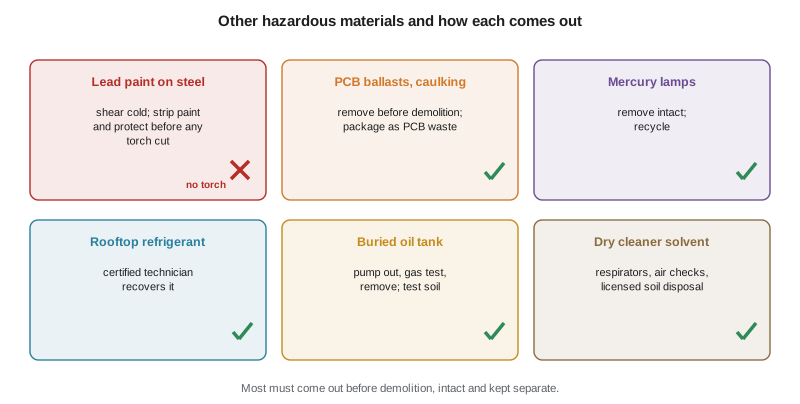
Asbestos gets most of the attention, but the Norwood Block's hazardous materials report listed thirteen other materials, and several of them were more likely to hurt the demolition crew than the asbestos that had been carefully removed in sealed enclosures. Lead paint on the steel stairs could turn into toxic fume the moment someone touched it with a cutting torch. PCB caulking around the windows was a persistent environmental contaminant. Fluorescent tubes broken in a debris pile would release mercury vapor. The rooftop air conditioner held refrigerant that it is illegal to vent. The abandoned oil tank and the dry cleaner's floor drain raised the possibility of flammable vapors and contaminated soil.
This lesson covers these other hazardous materials: what they are, where they are found, how they harm workers and the environment, and how they are handled before and during demolition and renovation.
Lead
Lead was a common ingredient in paint until the second half of the twentieth century. It made paint durable and bright, and red lead primer was the standard rust protection for structural steel for decades. Lead was also used in plumbing solder, pipes, flashing, roofing, radiation shielding and some ceramic tiles.
The United States banned lead paint for residential use in 1978, and the EPA treats housing built before 1978 as likely to contain lead paint. Industrial coatings on steel, such as red lead primer, stayed in use longer.
How lead harms workers
Lead enters the body mainly by breathing dust or fume, and by swallowing dust from hands, food, drinks or cigarettes handled with dirty hands. It builds up in the blood and bones. High exposure damages the nervous system, kidneys, blood and reproductive system, causing fatigue, headaches, stomach pain, memory problems, high blood pressure and reduced fertility. Lead also crosses the placenta and harms a developing baby. Workers can carry lead dust home on their clothes, boots and in their vehicles, exposing their children, who are especially vulnerable.
Which demolition tasks create lead exposure
Intact lead paint is not an inhalation hazard. Exposure comes from disturbing it:
- Torch cutting or welding painted steel, which vaporizes the lead into fume. This is the highest-exposure task in most demolitions and can produce extremely high airborne lead levels in seconds.
- Abrasive blasting and power grinding or sanding of lead paint.
- Manual demolition of painted walls and structures, which releases lead dust.
- Scraping, heat-gun stripping and dry sweeping of lead paint chips and dust.
- Cutting old lead pipe or soldered joints with heat.
OSHA's lead standard for construction, 1926.62, sets a permissible exposure limit of 50 µg/m³ averaged over eight hours and an action level of 30 µg/m³. For trigger tasks such as torch cutting, abrasive blasting and manual demolition of lead-painted structures, the employer must provide respirators and other interim protection until an exposure assessment shows lower levels are achieved. Above the action level, the standard requires exposure monitoring, blood lead testing and medical surveillance; above the limit, it requires engineering controls, respirators, protective clothing, hygiene facilities, a written compliance program and medical removal protection when blood lead is too high. Separately, the EPA's Renovation, Repair and Painting rule requires certified firms and renovators, and lead-safe work practices, for work that disturbs paint in housing and child-occupied facilities built before 1978.
Lead on the Norwood Block
Anika's specification avoided torch cutting of painted steel wherever possible. The steel stairs and the 1978 steel frame were taken down with a hydraulic shear on an excavator, which cuts steel cold without vaporizing the paint. Where torch cutting could not be avoided, such as freeing two embedded column bases, the paint was first stripped back at least 4 in (100 mm) on each side of the cut line with a chemical stripper, the cutter wore a powered air-purifying respirator with HEPA filters, and the area was cleaned with a HEPA vacuum afterward. Window frames with lead paint were removed as whole units. Workers washed hands and faces before eating, changed out of work clothes before leaving, and had no eating or drinking in the work area.
PCBs
Polychlorinated biphenyls (PCBs) are synthetic oils that were used from the 1930s to the late 1970s because they do not burn and do not conduct electricity. They were used in transformers, capacitors and fluorescent light ballasts, and as additives in caulking, sealants, paints and adhesives. PCBs persist in the environment for decades, build up in fish, animals and people, and are linked to cancer and effects on the immune, nervous and reproductive systems. Burning them can form even more toxic compounds.
- Light ballasts. Fluorescent fixtures installed before about 1980 often have ballasts with a small capacitor containing PCB oil. Ballasts marked "No PCBs" or made after 1979 generally do not. Ballasts are removed from the fixtures, checked, and those with PCBs or unknown status are packaged separately as PCB waste. Leaking ballasts are handled with chemical-resistant gloves and cleaned up as a spill.
- Caulking and sealants from the 1950s to the 1970s, especially around windows, expansion joints and masonry, can contain PCBs at high concentrations, and the PCBs can migrate into the adjacent brick or concrete.
- Transformers and capacitors in older electrical rooms may contain PCB oil. The utility or a qualified electrical contractor removes them.
PCBs are regulated federally under the federal PCB rules under the Toxic Substances Control Act (40 CFR 761), which banned their manufacture in 1979, restrict their remaining uses and set disposal rules. Building materials such as caulking with PCBs at or above 50 parts per million are regulated as PCB bulk product waste, and PCB ballasts and capacitors must be disposed of through approved routes, not in general demolition debris.
The Norwood Block's window caulking tested above the regulated level. Clearline Abatement LLC removed the windows as whole units and cut the caulking out, with the adjacent brick tested to see whether PCBs had migrated into it. They had not, beyond a thin edge that was removed with the caulking.
Mercury
Mercury is a liquid metal that gives off toxic vapor at room temperature. In buildings it is found in fluorescent tubes and compact fluorescent lamps, high-intensity discharge lamps, thermostats with glass switches, float switches in sumps and tanks, some old pressure gauges and manometers, and some old boilers and gas regulators. Breathing mercury vapor damages the nervous system and kidneys. Breaking a single fluorescent tube releases only a small amount, but breaking hundreds in a debris pile releases a lot, in a hot, enclosed space.
Lamps and mercury devices are removed intact before demolition, packed in their original boxes or in purpose-made containers, and recycled through a lamp and mercury recycler. On the Norwood Block, Dev Sandhu spent two days carefully removing 230 fluorescent tubes and packing them in boxes for the recycler, while an electrician removed the thermostats.
Refrigerants and ozone-depleting substances
Air conditioners, refrigerators, freezers, water coolers and chillers contain refrigerants, many of which deplete the ozone layer or are powerful greenhouse gases. Under Section 608 of the Clean Air Act, it is illegal to knowingly vent most refrigerants, and refrigerant must be recovered by an EPA-certified technician before equipment is dismantled or disposed of, with records kept. The rooftop unit on the Norwood Block was drained by a certified technician into a recovery cylinder and tagged as empty before the crane lifted it off.
Fuel tanks, pits and contaminated soil
Older buildings were often heated with fuel oil stored in tanks in the basement or buried in the yard. When the building switched to natural gas, the tank was often abandoned in place, sometimes with oil still in it. Old tanks, pits, sumps and drains can contain flammable liquids and vapors that ignite when hot work or a spark reaches them, and contaminated soil can expose excavation workers to chemicals.
Removing a fuel tank is specialist work. In Texas, the TCEQ regulates underground storage tanks, although tanks storing heating oil used on the premises are often exempt from the federal underground storage tank rules; either way, safe removal requires a qualified contractor and testing of the soil when the tank comes out. On the Norwood Block, the tank contractor pumped out the remaining oil, tested the tank atmosphere, made it safe by purging and ventilation, cut it open only after a gas test showed no flammable vapor, and removed it. Anika sampled the soil around it.
The dry cleaner was more serious. Dry cleaners commonly used tetrachloroethylene, a chlorinated solvent also called perchloroethylene or perc, which is toxic and a probable human carcinogen. Spills and leaks soaked into floor slabs and the soil below and can give off vapor for decades. Anika's drilling found solvent in the soil under the floor drain. The slab and soil in that area were treated as contaminated: workers breaking the slab wore respirators with organic vapor cartridges and chemical-resistant gloves, air was monitored with a photoionization detector, and the contaminated soil was excavated and taken to a facility licensed to receive it, under the Texas Commission on Environmental Quality (TCEQ) requirements.
Other hazards worth a line in the plan
- Radioactive sources in some old ionization smoke detectors and self-luminous exit signs, which are collected and returned rather than crushed.
- Treated wood with creosote or other preservatives, which should not be burned.
- Bird, bat and rodent droppings in attics, towers and vacant spaces, which can carry fungal and viral diseases and are wetted and removed with respiratory protection.
- Sharps and discarded needles in buildings that have been vacant, which call for puncture-resistant gloves, a sharps container and caution when reaching into hidden spaces.
- Chemicals left behind by former tenants, in drums, pails and laboratories.
A lead exposure check
Owen uses a short program to compare the lead results from two tasks with the limit and decide what controls are needed.
# Lead exposure assessment for two tasks (invented results, ug/m3).
LIMIT_TLV = 50   # 0.05 mg/m3 ACGIH TLV, as ug/m3
LIMIT_US = 50    # US permissible limit
ACTION_US = 30   # US action level

tasks = {
    "shearing painted steel stairs": [(180, 12), (60, 4)],     # (minutes, ug/m3)
    "torch cutting with paint stripped": [(45, 140), (15, 30)],
}
for task, parts in tasks.items():
    twa = sum(m * c for m, c in parts) / 480
    print(f"{task}: 8-hour TWA {twa:.1f} ug/m3")
    if twa > LIMIT_US:
        print("   above the limit: engineering controls, respirators, hygiene, medical surveillance")
    elif twa > ACTION_US:
        print("   above the US action level: monitoring and blood lead testing")
    else:
print(" below the action level: keep current controls")shearing painted steel stairs: 8-hour TWA 5.0 ug/m3 below the action level: keep current controls torch cutting with paint stripped: 8-hour TWA 14.1 ug/m3 below the action level: keep current controls
Even with the paint stripped back, the brief torch cut produces a high short-term concentration. Averaged over the shift it sits just under the action level, but the peak is why the cutter needs a respirator during the cut. Shearing the stairs cold keeps exposure low all day.
Worked problem
The stair stringers and the torch
Show solution
- On the third day of demolition, a Prairie Wrecking LLC worker wants to free a steel stair stringer that is pinned under debris by cutting it with an oxy-fuel torch. It would take two minutes.
- Gord Pelletier stops him. The stringers are covered in red lead primer, and the plan says no torch cutting of painted steel without stripping and a respirator.
- Gord asks the excavator operator to lift the debris off with the grapple instead, and the shear cuts the stringer cold.
- Where a torch cut is truly needed later, the paint is stripped back first, the cutter wears a powered respirator with HEPA filters and the area is HEPA-vacuumed afterward.
- At the next toolbox talk, Gord explains why: a few minutes of cutting through lead paint can give a worker more lead in their lungs than weeks of other demolition work.
Answer: Heat turns lead paint into fume. Use cold cutting where possible; where heat is needed, strip the paint first and protect the worker.
Common mistakes
MistakeTorch cutting painted steel because it is the fastest way.
InsteadShear or saw cold, or strip the paint back and use respiratory protection before any hot cut.
MistakeEating lunch in the work area or going home in dusty work clothes.
InsteadWash hands and face before eating, eat in a clean area and change before going home.
MistakeLeaving light fixtures in the building to be crushed with the debris.
InsteadRemove ballasts and lamps intact first and manage PCB ballasts and mercury lamps separately.
MistakeCutting a refrigerant line to drain an old air conditioner.
InsteadHave a certified technician recover the refrigerant before the unit is moved or scrapped.
MistakeCutting into an old fuel tank without testing it.
InsteadPump out, ventilate and gas test before any cutting or hot work on a tank.
Summary and key terms
- Lead in paint and coatings becomes a serious hazard when disturbed, especially by torch cutting, grinding and blasting; cold cutting and stripping paint first reduce exposure.
- OSHA 1926.62 sets a 50 µg/m³ limit and 30 µg/m³ action level, with interim protection for trigger tasks; the EPA RRP rule covers older housing and child-occupied facilities.
- PCBs in ballasts, caulking and electrical equipment are removed before demolition and managed as PCB waste under federal rules.
- Mercury lamps and devices are removed intact and recycled; refrigerants are recovered by a certified technician.
- Fuel tanks, pits and contaminated soil need specialist removal, gas testing before cutting, and licensed disposal.
- Red lead primer
- A rust-protective paint containing lead oxide, widely used on structural steel for decades.
- Lead fume
- Very fine lead particles formed when lead is heated above its melting point, as in torch cutting painted steel.
- PCBs
- Polychlorinated biphenyls, persistent synthetic oils once used in electrical equipment, ballasts and caulking.
- Ballast
- The electrical component in a fluorescent light fixture that controls the current; older ones may contain PCBs.
- Refrigerant recovery
- Removing refrigerant from equipment into a cylinder, by a certified technician, so it is not released.
- Perchloroethylene
- A chlorinated solvent used in dry cleaning that can contaminate slabs and soil and give off toxic vapor.
Practice problems
Work each problem on paper first, then reveal the answer to check.
Why is torch cutting painted steel such a high lead exposure task?
Show answer
The heat vaporizes the lead in the paint into fume, which produces very high airborne lead levels in seconds.
How can workers take lead home, and how is that prevented?
Show answer
On clothes, boots, skin and in vehicles; changing out of work clothes, washing and keeping work and clean areas separate prevents it.
Where are PCBs found in older buildings?
Show answer
In fluorescent light ballasts, transformers and capacitors, and in some caulking, sealants and paints from the 1950s to the 1970s.
What must happen before an old air conditioner is removed?
Show answer
A certified technician must recover the refrigerant.
Why is an old fuel tank gas tested before it is cut open?
Show answer
It may contain flammable vapor that a torch or spark could ignite.
Lesson quiz · 5 questions
Score 60% or more to complete this lesson.
Create a free account to save your progress, take quizzes and earn a certificate.