
HSE-370 · Lesson 7 of 12 · 23 min
Electrical hazards and utilities
Electricity is one of the four leading causes of construction deaths, and it kills workers who are not electricians as often as those who are. A laborer guiding a dump truck that raises its box into an overhead line, a roofer carrying a metal ladder near a service drop, an operator whose excavator bucket cuts a buried cable, a painter using a damaged extension cord in a puddle: none of them were doing electrical work. This lesson explains how electricity injures, how to work safely near overhead and buried power lines and other buried utilities, how temporary power on a site is kept safe, and why only qualified workers work on electrical equipment.
At Cottonwood Place, the electrical hazards include the overhead distribution lines along the street on the north side, the buried services in the lane (power, gas, water, sewer and telecommunications), the temporary power system that feeds the crane, the hoist and the tools on every floor, and later in the job the building's own electrical system as it is installed and energized.
How electricity injures
Electricity flows through any path it can find to the ground, and a human body is a good conductor. When a worker becomes part of that path, by touching a live conductor or something that is touching one, current flows through the body. The effects depend on how much current flows, the path it takes and how long it lasts. A current smaller than what a household light bulb draws can disturb the rhythm of the heart and kill. Higher currents cause deep burns along the path, even where the skin looks only slightly marked.
Electricity injures in four main ways:
- Electric shock, when current passes through the body, which can stop the heart or breathing.
- Burns, from current passing through tissue, from contact with hot surfaces, or from the intense heat of an arc.
- Arc flash and arc blast, when current jumps through the air between conductors or to the ground, releasing heat hot enough to ignite clothing and a pressure wave that can throw a worker and send molten metal flying.
- Falls and other secondary injuries, when a shock makes a worker lose their grip on a ladder or jerk away from the contact and fall.
Workers who receive a shock should always be checked by a medical professional, even if they feel fine. Internal burns and heart rhythm problems can show up hours later.
Overhead power lines
Overhead power lines are not insulated for contact. The covering on a distribution line, if it has one, is there to protect the wire from the weather, not to protect people. Contact with an overhead line causes many construction deaths each year, almost always through equipment or materials: crane booms and load lines, concrete pump booms, dump truck boxes, excavator arms, aerial lifts, scaffold poles, ladders and lengths of pipe, rebar or gutter being carried upright. Electricity can also arc across a gap to equipment that comes close to a high-voltage line without touching it.
OSHA's construction standards require workers and equipment to stay a safe distance from energized overhead lines. For general work, the rule is at least 10 feet from lines up to 50 kilovolts, with more distance for higher voltages. For cranes and derricks, the simplest option under the standard is to keep every part of the equipment, load line and load at least 20 feet away from lines up to 350 kilovolts, with a planning meeting, warning lines or barriers and a dedicated spotter when the equipment could get closer. If work must happen inside these distances, the employer must have the utility, CPS Energy, de-energize and ground the line or follow the standard's procedures for working closer.
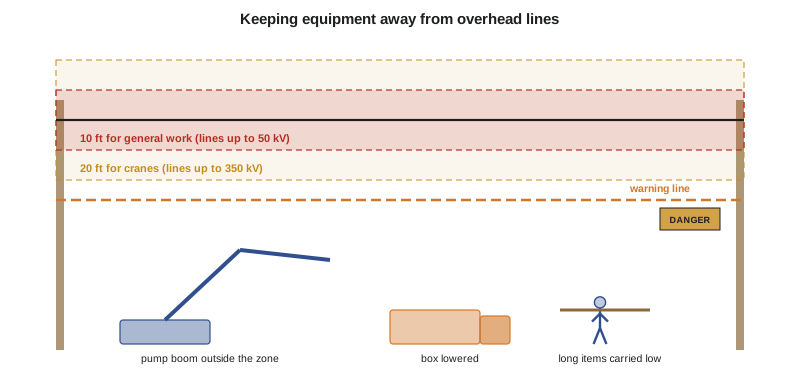
At Cottonwood Place, the overhead lines on the street were the first hazard identified in the site safety plan. Tallgrass Construction Inc. asked CPS Energy to confirm the voltage, then installed a barrier along the north edge of the site at the required distance, with signs facing both the site and the street. The concrete pump sets up only in the laydown area, the tower crane's swing is limited by its control system so that it cannot swing a load over the street side, and dump trucks lower their boxes before they leave the laydown area. Workers carrying long items keep them horizontal and low when they are near the street side.
If a vehicle or machine does contact a power line, the people on the ground are in the greatest danger. The ground around the contact point can become energized, with voltage dropping off in rings away from the point. A worker who walks or steps across those rings can be electrocuted. The rules are simple and must be followed exactly:
- Operator: stay in the cab unless there is a fire. If you must leave, jump clear with both feet together, without touching the machine and the ground at the same time, then shuffle away with small steps, feet never separating, until you are at least 10 meters (33 feet) away.
- Everyone else: stay back at least 10 meters (33 feet), keep others away, call 911 and the utility, and do not touch the machine or anyone in contact with it.
- Nobody goes near until the utility confirms the line is de-energized and grounded.
Buried utilities
Under every city site is a network of buried utilities: power cables, gas lines, water mains, sewers, telecommunications and fiber-optic cables, and sometimes old abandoned lines that appear on no drawing. Striking a buried power cable can electrocute the excavator operator or a worker in the trench. Striking a gas line can cause a fire or explosion. Even striking a fiber-optic line can cause a costly outage. Many utility strikes happen because the work went ahead without a current locate, or because the crew dug by machine inside the zone where hand digging was required.
Before any digging at Cottonwood Place, Silva Earthworks calls or submits a request to Texas 811, the free one-call service that notifies the utility owners. Texas law requires excavators to give notice a few working days before digging. The utilities mark the approximate location of their lines with paint and flags in standard colors: red for power, yellow for gas, orange for communications, blue for water and green for sewer. Locate tickets are valid only for a limited time and only for the area described, so they are renewed when they expire or the work moves. The marks show an approximate location, not an exact one. Within a tolerance zone on either side of each mark, workers expose the line by hand digging or with vacuum excavation before machines dig nearby.
Private lines are a common gap. One-call services locate the public utility lines up to the property line or the meter, but not private lines on the site itself, such as a power feed to a parking lot light or an old service to a demolished building. Cottonwood Place hired a private locating company to scan the whole site before excavation, and found two abandoned services that were on no drawing.
If a buried line is struck, the crew stops work at once. For a gas line, everyone moves away upwind, no one starts or shuts off engines near the leak or uses anything that could make a spark, and someone calls 911 and the gas utility from a safe distance. A damaged line that is not leaking is still reported, because damage to the coating can cause a failure later. Nobody tries to fix or bend a damaged line back.
Temporary power on site
Every construction site runs on temporary power: a service from the utility or a generator, distribution panels on each floor, and cords and lights feeding tools. Temporary systems take a beating. Cords are run over by equipment, dragged across rebar, left in water and pinched in doors. Panels get knocked, covers go missing and breakers are taped on. The basic protection is the ground fault circuit interrupter, or GFCI, which switches off the power in a fraction of a second when it detects current leaking to ground, such as through a worker's body.
OSHA's construction electrical rules require employers to protect workers using temporary power, either with GFCIs on all 120 volt, single-phase 15 and 20 amp receptacle outlets that are not part of the permanent wiring, or with an assured equipment grounding conductor program of regular cord and equipment testing. Tallgrass Construction Inc. uses GFCIs on every floor. Workers test the GFCI with its test button at the start of each shift. If it does not trip, the outlet is tagged out of service and reported.
Rules for cords and tools on site:
- Inspect cords and tools before each use: cracked or cut insulation, exposed wires, a missing ground pin, damaged plugs or taped repairs mean the item is tagged and removed.
- Use cords rated for hard or extra-hard use, of the right size for the load, and never daisy-chain several cords together.
- Keep cords out of water, off sharp edges and away from traffic. Route them overhead where possible.
- Never run cords through doorways or windows where they can be pinched, or under materials where damage cannot be seen.
- Do not use tools with a missing guard, a damaged housing or a bypassed switch.
- Keep panel covers closed and do not open temporary panels unless you are qualified.
Only qualified workers do electrical work
Electrical work, including connecting, disconnecting, troubleshooting and repairing electrical equipment, is done only by qualified electrical workers, such as licensed electricians and apprentices working under them. A qualified worker treats every circuit as live until it has been de-energized, locked out and tested. Other workers do not open panels, change fuses, reset breakers that keep tripping, or work on wiring to save time. A breaker that trips repeatedly is a sign of a fault; resetting it again and again is how workers are hurt.
As the building's permanent electrical system is installed and energized, the hazards shift. Rooms that were dead last week are live this week. At Cottonwood Place, Tasha Brooks's crew posts a sign on every electrical room, panel and piece of equipment as it is energized, locks electrical rooms and keeps a list at the trailer of what has been energized. Other trades are told at the coordination meeting which areas are now live.
Checking approach distances
When a piece of equipment works near overhead lines, the operator and signaler must keep track of how close any part of it could get. The program below checks a concrete pump boom set up at different distances from the street-side lines, using simple geometry. The line height, the boom reach and the limit are illustrative figures for this example.
# Closest approach of a pump boom tip to an overhead line (illustrative figures).
import math
LINE_HEIGHT = 30.0    # ft above grade
LIMIT = 10.0          # ft minimum distance for this line in the example
BOOM_REACH = 92.0     # ft, horizontal reach of the boom from the turret
BOOM_HEIGHT = 30.0    # ft, height of the boom tip when fully extended toward the line

for setup in (50.0, 80.0, 105.0, 130.0):   # horizontal distance from turret to line, ft
    horiz_gap = max(setup - BOOM_REACH, 0.0)
    vert_gap = abs(LINE_HEIGHT - BOOM_HEIGHT)
    closest = math.hypot(horiz_gap, vert_gap)
    verdict = "outside the limit" if closest >= LIMIT else "TOO CLOSE: move the pump"
print(f"Turret {setup:5.1f} ft from the line: closest approach {closest:4.1f} ft -> {verdict}")Turret 50.0 ft from the line: closest approach 0.0 ft -> TOO CLOSE: move the pump Turret 80.0 ft from the line: closest approach 0.0 ft -> TOO CLOSE: move the pump Turret 105.0 ft from the line: closest approach 13.0 ft -> outside the limit Turret 130.0 ft from the line: closest approach 38.0 ft -> outside the limit
A pump with its turret too close to the street could put the boom tip right into the line. Only the two set-ups farthest away keep the boom outside the limit when it is fully extended in the worst direction, which is why the site plan puts the pump in the laydown area and limits the boom's working area with the operator's controls and a signaler.
Worked problem
The raised dump box
Show solution
- A dump truck delivers fill to the north side of the site near the end of the excavation phase. The driver, new to the site, plans to spread the load by driving forward slowly with the box raised.
- The traffic control person sees the box rising as the truck heads toward the street side, where the overhead lines cross. She signals the driver to stop and lower the box.
- The box stops about 4 meters below the lines. The driver had not noticed them because he was watching the ground behind the truck.
- Owen Hartley reviews the near miss. The driver had received the short orientation at the gate, but the overhead lines had not been pointed out because the delivery was meant to go to the south side.
- The site adds the overhead lines to the gate briefing for every driver, paints a warning line on the ground at the limit, adds a rule that boxes are lowered before the truck crosses it, and installs signs at cab height on the barrier.
Answer: A worker who was watching the right thing stopped a contact that could have killed the driver or anyone touching the truck. The site then made the hazard visible to every driver and set a physical line where boxes must be down.
Common mistakes
MistakeAssuming an overhead line is insulated because it has a covering.
InsteadTreat every overhead line as energized and uninsulated; keep the minimum distance.
MistakeDigging by machine right on top of a locate mark.
InsteadExpose the line by hand or vacuum excavation within the tolerance zone first.
MistakeResetting a breaker that keeps tripping.
InsteadStop, tag the circuit and call a qualified electrical worker; repeated tripping means a fault.
MistakeUsing a cord with a missing ground pin or taped insulation.
InsteadTag and remove it, and use a cord in good condition with GFCI protection.
MistakeRunning toward a coworker in contact with a fallen line.
InsteadStay back about 10 meters (33 feet), call 911 and the utility, and keep others away.
Summary and key terms
- Electricity kills non-electricians as often as electricians, mostly through overhead lines, buried cables and damaged temporary wiring.
- Electricity injures through shock, burns, arc flash and blast, and falls after a shock.
- Workers and equipment stay at least 10 feet from lines up to 50 kV, and cranes at least 20 feet from lines up to 350 kV under the simplest option.
- Buried utilities are located through the one-call service and private locators, and exposed by hand or vacuum within the tolerance zone.
- Temporary power is protected by GFCIs, tested each shift, with cords and tools inspected before use.
- Only qualified workers do electrical work, and every circuit is treated as live until locked out and tested.
- Minimum approach distance
- The closest that workers, equipment or materials may come to an energized overhead line, which increases with voltage.
- Locate
- The marking of buried utility lines on the ground by the utility owners or a private locator before digging.
- Tolerance zone
- The band on either side of a locate mark where digging must be done by hand or vacuum excavation.
- Ground fault circuit interrupter (GFCI)
- A device that cuts power in a fraction of a second when it detects current leaking to ground.
- Arc flash
- A sudden release of heat and light when current jumps through the air, which can cause severe burns.
- Qualified electrical worker
- A worker with the training and authorization to work on electrical equipment, such as a licensed electrician.
Practice problems
Work each problem on paper first, then reveal the answer to check.
Name three ways a non-electrician can be electrocuted on a construction site.
Show answer
Any three of: equipment or materials contacting overhead lines, striking a buried cable, damaged cords or tools, working near equipment assumed to be off.
What distances does OSHA set for general work and for cranes near overhead lines?
Show answer
At least 10 feet for general work near lines up to 50 kV; 20 feet for cranes under the simplest option for lines up to 350 kV.
What should an operator do if their machine contacts a power line?
Show answer
Stay in the cab unless there is a fire; if they must leave, jump clear with feet together and shuffle away.
Why did Cottonwood Place hire a private locator in addition to the one-call service?
Show answer
One-call services do not locate private lines on the site, and the private scan found two abandoned services.
What should a worker do when a GFCI does not trip during its test?
Show answer
Tag the outlet out of service and report it.
Lesson quiz · 5 questions
Score 60% or more to complete this lesson.
Create a free account to save your progress, take quizzes and earn a certificate.