
HSE-370 · Lesson 12 of 12 · 21 min
Daily routines: pre-task planning, inspections and reporting
The hazards in the earlier lessons are controlled by guardrails, shoring, separation, dust capture and PPE. But a construction site changes every day, and controls that were in place yesterday may be missing today. What keeps a site safe over months is a set of routines repeated every shift: planning each task before it starts, inspecting the work area and equipment, reporting hazards and near misses, stopping work when something is wrong, and handing over clearly at the end of the day. This final lesson brings those routines together and looks at how workers use their right to refuse unsafe work.
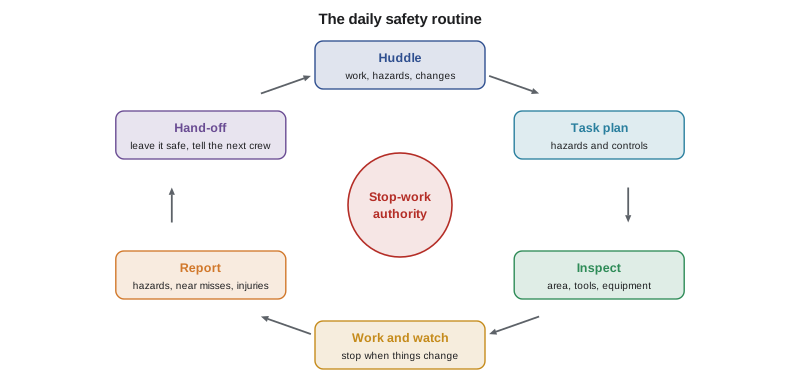
The start-of-shift huddle
Every crew at Cottonwood Place starts the day with a short huddle, usually ten minutes, led by its foreman. The huddle covers the day's work, where each worker will be, what has changed on the site since yesterday, such as a new floor opening, a crane lift over the area or another trade starting work nearby, and any lessons from incidents or near misses. Once a week, the huddle becomes a longer toolbox talk on one topic, such as ladder use, heat, silica or a recent incident on another site. Toolbox talks work best when they are short, specific to the work the crew is doing that week and give workers a chance to speak, not just listen.
Planning each task
Before a crew starts a task, it identifies the hazards of the task and the controls it will use. On many US sites, this is called a pre-task plan or a job hazard analysis, or JHA. It is a short written form completed by the crew at the work location, not in the trailer: the task, the steps, the hazards at each step, the controls, the PPE needed, and the signatures of the crew. If the task or the conditions change during the day, such as rain starting, a different crew arriving or a new step added, the crew stops and updates the plan.
A task plan is only as good as the thinking that goes into it. A form copied from yesterday, with the same hazards ticked and the same signatures, is paperwork, not planning. Owen Hartley checks a sample of the task plans every day by asking the crew about them at the work location. He looks for plans that name the real hazards of today's work, controls that are actually in place, and crews that can explain them. He also asks the one question that matters most: "What could kill or seriously hurt someone on this task, and what is stopping it?"
Inspections
Inspections find hazards before they hurt someone. Cottonwood Place uses several layers, each looking at different things on a different schedule:
| Inspection | Who does it | When | What it covers |
|---|---|---|---|
| Pre-use equipment check | The operator or user | Before each use or shift | Ladders, harnesses, tools, cords, aerial lifts, the crane, telehandlers, the hoist. |
| Work area check | The crew | Start of shift and when conditions change | Edges, openings, access, housekeeping, the task plan's controls. |
| Excavation and scaffold inspection | A competent person | Before each shift and after rain or changes | Protective systems, walls, scaffolds, tags. |
| Foreman walk | Each foreman | Daily | The crew's work areas and the hazards they create for others. |
| Site inspection | The safety coordinator | Weekly | The whole site, with results in the hazard log. |
| Site safety committee inspection | Committee members | Monthly, before each meeting | Selected areas, with written recommendations. |
| Third-party inspection | Engineers, the crane inspector, the owner's consultant | As scheduled | Shoring, formwork, crane, temporary structures. |
Every hazard found goes into the site hazard log with the employer responsible, a priority and a date for correction. Owen sorts hazards by how serious they are: an unguarded edge or a damaged sling is fixed at once, before work continues; a missing fire extinguisher sign can wait a day. Hazards that keep coming back, such as covers moved from floor openings, point to a system problem that needs a different fix.
Reporting hazards, near misses and injuries
Reporting is how one worker's observation protects everyone else. At Cottonwood Place, workers report hazards and near misses to their foreman the same day, or directly to Owen or a committee member, and report every injury, however small, before the end of the shift. Reports are expected and protected; nobody is disciplined for reporting. Owen reviews every report, and the crew that reported it hears what was done about it, because workers stop reporting if their reports disappear.
Injuries also have to be reported outside the site. A worker who is injured must tell their employer as soon as possible so that a workers' compensation claim can be filed. OSHA requires employers to report a work-related fatality within 8 hours, and an in-patient hospitalization, amputation or loss of an eye within 24 hours. Employers with more than ten employees in most industries, including construction, must also keep the OSHA 300 log of recordable injuries and illnesses.
Stopping unsafe work
Every worker at Cottonwood Place has the authority to stop work they believe is unsafe, whether it is their own work or another crew's, and whatever their position. A laborer can stop a crane lift; an apprentice can stop a journeyworker. Stopping work is not an accusation. It is a pause to check, fix and restart. The procedure is simple:
- Stop: say "stop" clearly, or give the emergency stop signal for equipment, and make the area safe if you can do so without risk.
- Talk: explain the concern to the people involved and to their foreman.
- Fix: the foreman and crew correct the hazard or change the plan.
- Restart: work restarts when the people involved agree it is safe, and the stop is recorded so others can learn from it.
Carla Mendes thanks every worker who stops work in good faith at the next coordination meeting, even when the concern turned out to be unfounded. She knows that the first time a worker is made to feel foolish for stopping work is the last time anyone on that crew will do it.
The right to refuse
Stop-work authority usually resolves a concern in minutes. When it does not, workers in the United States have a narrower legal right to refuse. Under OSHA's rules, a worker may refuse work when they believe in good faith that it poses an imminent danger of death or serious injury, a reasonable person would agree, there is not enough time to get the hazard fixed through normal channels such as an OSHA inspection, and the worker has asked the employer to eliminate the danger if possible and the employer has not. A worker who refuses should stay at the site unless told to leave and offer to do other safe work. Workers can also file a complaint with OSHA and request an inspection, and it is illegal to retaliate against a worker for raising safety concerns. A worker who believes they were punished for doing so can file a whistleblower complaint with OSHA, generally within 30 days. On top of the law, Tallgrass Construction Inc.'s site rules let any worker refuse work they believe is unsafe without penalty, and the refusal is handled the same way as a stop-work.
Ending the shift
Many incidents happen at the start of a shift because of conditions left by the end of the previous one: a guardrail removed and not replaced, a trench left open without a barricade, a hole cut late in the day and covered with loose plywood, equipment left with a raised bucket. At Cottonwood Place, each crew leaves its area safe at the end of the shift: guardrails and covers back in place, trenches barricaded or covered, equipment parked with attachments lowered and keys removed, cords unplugged and coiled, and waste removed. The foreman tells the next crew or the site superintendent about anything unusual, such as a partly completed lift, a shoring adjustment or an open permit. Where there is a night crew or another trade arriving the next morning, the hand-off is written on the floor's daily board.
Tracking the hazard log
A hazard log is only useful if items get closed. Owen reviews the log every Monday. The program below sorts an invented set of open items by priority and flags any that are past their due date.
# Open items from the Cottonwood Place hazard log (invented), checked on day 52 of the job.
TODAY = 52
items = [  # (id, description, employer, priority 1 = immediate, day found, days allowed)
    ("H-311", "Cover not secured, level 4 duct opening", "Mechanical", 1, 52, 0),
    ("H-305", "Missing toe board, east edge level 6", "Forming", 1, 52, 0),
    ("H-298", "GFCI not tripping, level 2 panel", "Electrical", 2, 48, 2),
    ("H-290", "Extinguisher missing at hot work area L3", "Steel", 2, 45, 2),
    ("H-277", "Walkway lighting out, lane crossing", "Tallgrass", 3, 41, 7),
]
for hid, desc, emp, pri, found, allowed in sorted(items, key=lambda x: (x[3], x[4])):
    due = found + allowed
    status = "OVERDUE" if TODAY > due else ("due today" if TODAY == due else f"due day {due}")
    print(f"P{pri} {hid} {emp:10} {desc:42} {status}")
overdue = sum(1 for i in items if TODAY > i[4] + i[5])
print(f"{len(items)} open items, {overdue} overdue")P1 H-311 Mechanical Cover not secured, level 4 duct opening due today P1 H-305 Forming Missing toe board, east edge level 6 due today P2 H-290 Steel Extinguisher missing at hot work area L3 OVERDUE P2 H-298 Electrical GFCI not tripping, level 2 panel OVERDUE P3 H-277 Tallgrass Walkway lighting out, lane crossing OVERDUE 5 open items, 3 overdue
Two priority 1 items are being fixed today, as they should be. Three items are overdue: the faulty GFCI, the missing extinguisher and the lighting at the lane crossing. None of them caused an injury, but each removes a layer of protection. Owen raises the overdue items at that week's coordination meeting with the foremen responsible, and a log with items that stay open week after week tells him that the hazard log has become a filing exercise instead of a tool.
Worked problem
The scaffold with a missing plank
Show solution
- Late in his third month, Dev Sandhu is sent to help a masonry crew on a frame scaffold on the south face. At the second lift, he sees that one plank is missing from the platform and the gap is covered with a sheet of plywood resting on the frames, and the scaffold tag is yellow, not green.
- He stops before stepping onto the platform and tells the masonry foreman he will not work there until it is checked. The foreman is annoyed: the crew has been working from it since the morning.
- Dev calls Owen Hartley. Owen comes up, agrees the scaffold is not fit to use, and stops work on it. The scaffold subcontractor is called back to replace the plank and re-inspect.
- Within an hour the scaffold is repaired and tagged green. The masonry crew restarts.
- At the next coordination meeting, Carla thanks Dev by name. The masonry foreman adds a check of the scaffold tag to his crew's task plan.
Answer: Dev used his stop-work authority the way it is meant to be used: he raised a specific concern, got the right person involved and let the hazard be fixed. Being thanked publicly, not blamed, is what makes the next worker willing to do the same.
Common mistakes
MistakeCopying yesterday's task plan without looking at today's work.
InsteadComplete the plan at the work location for today's task and conditions, and update it when they change.
MistakeReporting only injuries, not near misses.
InsteadReport hazards and near misses the same day; they show where the next injury will come from.
MistakeWaiting for the foreman to notice a hazard you have already seen.
InsteadUse your stop-work authority and raise it right away.
MistakeLeaving a work area at the end of the shift with a guardrail down or a trench open.
InsteadLeave the area safe and tell the next crew what changed.
MistakeMaking fun of a worker whose stop-work concern turned out to be unfounded.
InsteadThank every good-faith stop; the next one may prevent a death.
Summary and key terms
- A changing site stays safe through routines repeated every shift.
- Start-of-shift huddles and weekly toolbox talks share the day's work, hazards and changes.
- Pre-task plans or job hazard analyses are completed at the work location and updated when conditions change.
- Layered inspections feed one hazard log, with priorities and due dates that are tracked to closure.
- Workers report hazards, near misses and injuries; OSHA requires fatalities to be reported within 8 hours and hospitalizations, amputations and eye losses within 24 hours.
- Anyone can stop unsafe work, and workers have a legal right to refuse dangerous work without reprisal.
- Pre-task plan
- A short written assessment of a task's hazards and controls, completed by the crew at the work location before starting.
- Toolbox talk
- A short safety discussion with a crew on one topic, usually held weekly at the work site.
- Hazard log
- A record of hazards found on site, with the employer responsible, priority and correction date.
- Stop-work authority
- The authority of any worker to stop work they believe is unsafe until it is checked and corrected.
- Right to refuse
- The legal right of a worker to refuse work they believe is dangerous, without being penalized.
- Hand-off
- The communication at the end of a shift about the state of the work area and anything that has changed.
Practice problems
Work each problem on paper first, then reveal the answer to check.
What should a start-of-shift huddle cover?
Show answer
The day's work, where each worker will be, what has changed on the site, and lessons from incidents and near misses.
What makes a task plan real planning rather than paperwork?
Show answer
It is completed at the work location for today's task, names the real hazards, lists controls that are in place, is understood by the crew and is updated when conditions change.
Name four of the inspection layers at Cottonwood Place.
Show answer
Any four of: pre-use equipment checks, work area checks, competent person inspections, foreman walks, weekly site inspections, committee inspections and third-party inspections.
Under what conditions may a US worker refuse work under OSHA's rules?
Show answer
When they believe in good faith there is an imminent danger of death or serious injury, a reasonable person would agree, there is no time to fix it through normal channels, and they asked the employer to fix it.
What should be done to a work area at the end of the shift?
Show answer
Guardrails and covers in place, trenches barricaded, equipment parked with attachments lowered and keys removed, cords coiled, waste removed and the next crew told what changed.
Lesson quiz · 5 questions
Score 60% or more to complete this lesson.
Create a free account to save your progress, take quizzes and earn a certificate.