
HSE-370 · Lesson 6 of 12 · 20 min
Struck-by and caught-between hazards
After falls, being struck by something or caught between things kills more construction workers than any other kind of event. The objects involved are the ordinary machinery and materials of every site: dump trucks and loaders, excavators and telehandlers, concrete trucks and pump booms, bundles of rebar and stacks of block, hammers and bolts that fall from height, and the trench walls covered in lesson 8. This lesson looks at how workers on foot are struck by mobile equipment, how they are crushed between equipment and structures, how falling and flying objects injure them, and the controls that keep people and machines apart.
Workers on foot and mobile equipment
A construction site mixes heavy equipment with workers on foot in a small, changing space. Equipment operators sit high above the ground with large blind spots, especially behind and to the right of the machine. Engines and backup alarms are loud, and on a busy site alarms are sounding everywhere, so workers stop hearing them. Ground conditions change, and routes that were clear yesterday may be blocked today. The workers most often killed by reversing equipment are not careless; they are standing where the operator cannot see them, often doing their own job, such as a laborer checking grade behind an excavator or a traffic control person at the gate.
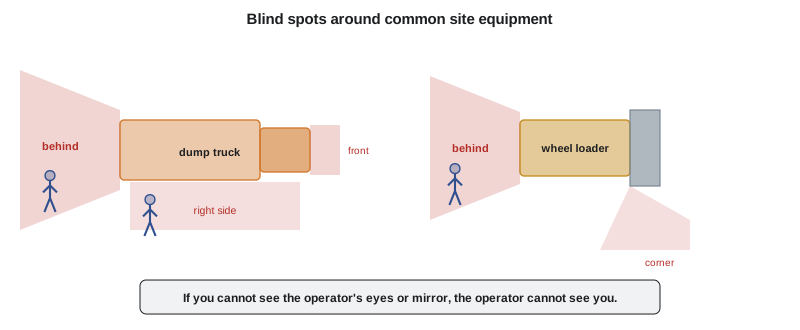
Keeping people and machines apart
The most effective control for mobile equipment is separation: designing the site so that vehicles and workers on foot are not in the same place at the same time. Training workers to look out for trucks is useful, but it depends on every worker paying attention every minute of the day. At Cottonwood Place, the traffic management plan, part of the site safety plan, uses several layers:
- Separate routes. A one-way vehicle route through the laydown area, a fenced pedestrian walkway, separate vehicle and pedestrian gates, and marked crossings with stop signs for vehicles.
- Designing out reversing. The vehicle route is a loop so most trucks drive through rather than back up. Where reversing cannot be avoided, it happens in a marked zone that workers on foot do not enter.
- Exclusion zones around working equipment. The area within reach of an excavator's swing, a loader's work area and a concrete pump's outriggers is barricaded or marked, and workers on foot stay out unless they have made eye contact with the operator and the operator has stopped.
- Signalers. A trained signaler guides every vehicle that reverses on site and every machine working in a tight space, such as next to the occupied office building.
- Visibility. Every worker wears high-visibility clothing, and equipment working at dawn or dusk has lights.
- Speed limits. A site speed limit of 6 mph, posted at the gate.
OSHA's construction standards require vehicles and earthmoving equipment with an obstructed view to the rear to have a working backup alarm that can be heard above the surrounding noise, or to back up only when an observer signals that it is safe. At Cottonwood Place, Tallgrass Construction Inc. requires both. Signalers are trained, use agreed signals and stay in the operator's view at all times.
Signalers are workers on foot standing near reversing equipment, so they have their own rules. At Cottonwood Place, a signaler stands where the operator can see them, never directly behind the vehicle, never between the vehicle and a fixed object, and never walks backward while signaling. If the signaler is lost from view, the operator stops. The signaler does nothing else while guiding a vehicle: no phone, no second task.
Rules for workers on foot
Even with good separation, workers on foot need a few habits that become automatic:
- Stay on the walkways and use the marked crossings.
- Never walk behind a reversing vehicle or between a vehicle and a wall, stack or trench.
- Make eye contact with the operator before approaching equipment, and wait for the operator to stop and lower the bucket or forks.
- Do not assume the operator has seen you because you heard the backup alarm.
- Stay out of the swing area of excavators and cranes.
- Do not ride on equipment unless it has a seat for a passenger.
- Never stand under a raised bucket, a raised dump box or a suspended load.
Caught-between hazards
A worker is caught between when they are crushed between a moving object and a fixed one, or between two moving objects. On construction sites, the most common situations are:
- Between a machine and a wall or structure. An excavator swings its counterweight while a worker stands between the machine and the shoring wall. A truck reverses toward a loading dock where a worker is guiding it.
- Under or inside a machine. A worker reaches into a running mixer, or works under a dump box that is held up only by the hydraulics.
- Rollovers. A loader, telehandler or skid steer tips over on a slope or at an excavation edge and the operator is thrown out and crushed. Rollover protective structures and seatbelts keep the operator inside the protected zone.
- Between materials. Rolling pipe, toppling stacks of block or drywall, and loads that shift while being moved.
- Collapses. Trench walls, formwork, and walls or structures being demolished. Lesson 8, HSE-371 and HSE-372 cover these.
The controls follow the same pattern as for struck-by hazards: keep people out of the zone where they could be caught, block or lower equipment before anyone works under or near it, and stop machinery before anyone reaches into it. A dump box raised for maintenance is held up with its body prop, not the hydraulics. An excavator's swing area next to the shoring wall is barricaded. Equipment being serviced is shut off, the key removed, and the attachment lowered to the ground. Where maintenance involves stored energy, such as hydraulics, springs or electrical power, the equipment is locked out under the employer's lockout procedure.
Falling objects
On a building like Cottonwood Place, anything dropped from an upper floor becomes a falling object. A small tool dropped from height gathers enough speed to cause a serious head injury, even through a hard hat. Falling-object hazards come from work at height, from crane lifts and from wind lifting loose materials off the decks. Cottonwood Place controls them in layers:
| Control | How it is used at Cottonwood Place |
|---|---|
| Prevent the drop | Toe boards on guardrails, debris netting on scaffolds and open edges, tool tethers for work above level 3, materials kept in closed bins. |
| Catch the drop | Catch platforms and fans at selected floors around the building perimeter, netting over the walkway beside the office building. |
| Keep people out of the drop zone | Barricaded exclusion zones below work at height and below crane lifts, with signs and a spotter when needed. |
| Protect people who must pass | A covered walkway from the gate to the building entrance, and a covered hoarding over the public sidewalk on the street side. |
| Protect the head | Hard hats worn at all times; Type 2 hard hats, which protect against impacts from the side as well as the top, on the structure floors. |
The public matters too. Pedestrians on the street, office workers next door and drivers in the lane did not choose to be near a construction site. The covered hoarding over the sidewalk, the netting along the office building and the rule that nothing is lifted over the lane while it is open to traffic exist to protect them.
Flying objects and tools
Struck-by injuries also come from objects thrown by tools and machines: fragments from cut-off saws and grinders, nails from nail guns, chips from chipping hammers and concrete breaking, and pieces of a grinding wheel that shatters. These cause eye injuries, puncture wounds and, rarely, deaths. The controls are guards kept in place, the right disc or wheel for the tool and its speed, safety glasses at all times and face shields for cutting and grinding, keeping other workers out of the line of fire, and, for nail guns, tools with a sequential trigger that fires only when the nose is pressed against the work first. TRD-104 covers tools and guarding in detail.
How fast equipment closes the gap
Workers often think they will have time to step out of the way of a reversing machine. The program below estimates how far a reversing loader travels from the moment a worker steps behind it until it stops, if the operator reacts only when the worker is seen in the mirror. The speeds are typical site speeds; the reaction time and braking figures are illustrative.
# Distance a reversing machine travels before it stops (illustrative figures).
REACT = 1.5            # s, operator reaction time once the worker is seen
DECEL = 6.5            # ft/s^2, braking deceleration on site gravel
for mph in (3, 6, 9):
    v = mph * 5280 / 3600                  # ft/s
    react_dist = v * REACT
    brake_dist = v * v / (2 * DECEL)
    total = react_dist + brake_dist
print(f"{mph} mph: {react_dist:4.1f} ft while reacting + {brake_dist:4.1f} ft braking = {total:4.1f} ft")3 mph: 6.6 ft while reacting + 1.5 ft braking = 8.1 ft 6 mph: 13.2 ft while reacting + 6.0 ft braking = 19.2 ft 9 mph: 19.8 ft while reacting + 13.4 ft braking = 33.2 ft
Even at a site speed of 6 mph, the loader travels about 19 feet before it stops, more than its own length, and that assumes the operator sees the worker at all. Reaction time, not braking, accounts for most of the distance at low speed. The lesson for workers on foot is that there is no safe distance behind a reversing machine. The lesson for the site is that separation and signalers are needed, because a worker's reflexes cannot make up for an operator's blind spot.
Worked problem
The concrete truck in the lane
Show solution
- A ready-mix truck must reverse down the lane to reach the pump. The lane is narrow, with the excavation shoring on one side and the neighboring building on the other.
- Carla Mendes had planned for this in the traffic management plan: the lane is closed to other traffic during the pour, a signaler guides each truck, and workers on foot stay on the far side of a barricade.
- Halfway through the pour, a laborer from another crew walks into the lane to retrieve a shovel left near the pump hopper. He walks behind the reversing truck.
- The signaler sees him, gives the stop signal, and the driver stops with the worker about 3 meters behind the truck.
- Owen Hartley reviews the near miss. The barricade had a gap where the walkway met the lane. The gap is closed, a second signaler is added at the lane entrance for pours, and the event is shared at the next morning toolbox talk.
Answer: The traffic plan worked because the signaler was watching only the truck. The near miss revealed a gap in the separation, which was fixed at the source.
Common mistakes
MistakeRelying on backup alarms to warn workers on foot.
InsteadSeparate people and equipment, and use trained signalers; alarms become background noise.
MistakeWalking behind a reversing truck because the driver "must have seen you".
InsteadMake eye contact and wait for the operator to stop before approaching.
MistakeStanding between an excavator and the shoring wall while it works.
InsteadStay out of the swing area; barricade it where space is tight.
MistakeWorking under a dump box held up by its hydraulics.
InsteadUse the body prop or blocking, and shut off and lock out as required.
MistakeLeaving tools and small materials loose near an open edge on an upper floor.
InsteadTether tools, use toe boards and closed bins, and keep the drop zone below clear.
Summary and key terms
- Struck-by and caught-between events are among the leading causes of construction deaths.
- Mobile equipment has large blind spots; separation of people and vehicles is the most effective control.
- Traffic management uses separate routes, designed-out reversing, exclusion zones, signalers, visibility and speed limits.
- Workers on foot stay on walkways, make eye contact with operators and never walk behind reversing equipment.
- Caught-between hazards are controlled by keeping people out of crush zones, blocking raised equipment and stopping machinery before reaching in.
- Falling objects are controlled by preventing drops, catching them, keeping people out of drop zones and protecting those who must pass.
- Blind spot
- An area around a vehicle or machine that the operator cannot see directly or in mirrors.
- Signaler
- A trained worker who guides a vehicle or machine using agreed signals while staying in the operator's view.
- Traffic management plan
- The part of a site plan that sets out vehicle routes, pedestrian routes, crossings, reversing areas and signalers.
- Exclusion zone
- An area workers on foot must not enter while equipment is working or loads are overhead.
- Rollover protective structure (ROPS)
- A frame on mobile equipment that protects the operator if the machine overturns, used with a seatbelt.
- Drop zone
- The area below work at height or a lifted load where falling objects could land.
Practice problems
Work each problem on paper first, then reveal the answer to check.
Why is separation more effective than telling workers to watch out for trucks?
Show answer
It does not depend on every worker paying attention every minute; people and vehicles are simply kept apart.
Where should a signaler stand while guiding a reversing vehicle?
Show answer
Where the operator can see them, never directly behind the vehicle or between it and a fixed object.
Name three caught-between situations on a construction site.
Show answer
Any three of: between a machine and a wall, under a raised dump box, inside running machinery, a rollover, rolling or toppling materials, or a collapse.
What are the five layers of falling-object control at Cottonwood Place?
Show answer
Prevent the drop, catch the drop, keep people out of the drop zone, protect people who must pass, and protect the head.
What did the stopping-distance program show?
Show answer
Even at low site speeds, a reversing loader travels several meters before stopping, mostly during the operator's reaction time, so workers cannot count on stepping aside.
Lesson quiz · 5 questions
Score 60% or more to complete this lesson.
Create a free account to save your progress, take quizzes and earn a certificate.