
HSE-370 · Lesson 5 of 12 · 22 min
Falls from heights and openings
Falls kill more construction workers than any other hazard. They happen from roofs, floor edges, openings in floors, ladders, scaffolds, aerial lifts, the back of trucks and the edges of excavations. They happen to experienced workers as often as to new ones, and they often happen during short jobs that did not seem to need protection: a quick measurement at a floor edge, a minute on a ladder, a single sheet of plywood carried across a roof. This lesson explains when fall protection is needed, the order in which fall hazards should be controlled, how guardrails, covers and fall arrest systems work, and why every fall protection plan needs a rescue plan.
At Cottonwood Place, fall hazards change as the building rises. During the excavation phase, workers can fall into the excavation along the lane and the office building. During the structure phase, every floor has open edges, stair and elevator shafts, and openings for ducts and pipes. During the finishing phase, the hazards move to roofs, balconies, window openings, ladders and scissor lifts. This lesson is the overview every worker needs; HSE-212 covers fall protection in depth, and TRD-105 covers scaffolds and aerial work platforms.
When fall protection is required
OSHA's construction fall protection standard requires fall protection for workers on walking and working surfaces with an unprotected side or edge 6 feet or more above a lower level, including leading edges, holes, ramps, runways, excavation edges and formwork. Different rules apply to scaffolds, which need protection at 10 feet, and to ladders and steel erection, which have their own requirements. Workers must also be protected at any height from falling into or onto dangerous equipment. At Cottonwood Place, Tallgrass Construction Inc.'s rule is stricter for the edges of floors, openings and the excavation: every open edge is protected, whatever its height, from the moment it is created.
Height is not the only factor. A fall of 1.5 meters (5 feet) onto concrete can cause a fatal head injury. A fall into an open excavation, a fall onto exposed rebar or a fall down a stair shaft can be deadly from a modest height. Short duration does not reduce the danger either. Most of the falls investigated on construction sites happen during tasks that took only a few minutes.
The order of controls for falls
The best way to deal with a fall hazard is to remove it. Where that is not possible, workers should be protected by measures that do not depend on each worker doing the right thing every time. Personal equipment, such as harnesses, comes last. The order used at Cottonwood Place follows the general hierarchy of controls:
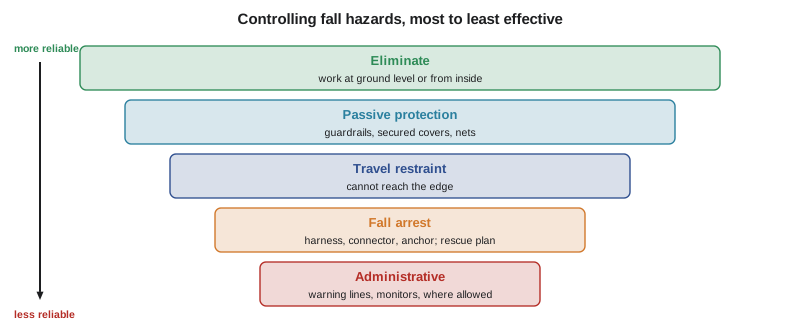
- Eliminate the hazard. Do the work from the ground or from inside the building. At Cottonwood Place, the precast stair units arrive with their handrails already attached, the guardrail posts for the roof are cast into the parapet, and window wall units are installed from inside the floor, not from the outside.
- Passive protection. Guardrails, secured covers and safety nets protect everyone in the area, all the time, without any action by the worker.
- Travel restraint. A harness and a short lanyard or line attached to an anchor prevent the worker from reaching the edge at all.
- Fall arrest. A harness, a connecting device and an anchor stop a fall after it begins. Fall arrest prevents death but can still injure, and the worker must be rescued quickly.
- Administrative controls. Measures such as warning lines, controlled access zones and safety monitors warn workers or limit who goes near the edge. They are allowed only in specific situations, and only where the rules permit them.
Guardrails
A guardrail is a barrier along an edge strong enough to stop a worker from falling. OSHA requires the top rail to be 42 inches, plus or minus 3 inches, above the walking surface and able to withstand a force of 200 pounds applied outward or downward. A midrail, screen or mesh fills the space below, and a toe board stops tools and materials from being kicked off the edge where people work or pass below. At Cottonwood Place, the forming subcontractor installs perimeter guardrails at each floor edge before the deck is stripped, and the guardrail stays until the exterior wall is closed in.
The most common guardrail failure is not a broken rail but a removed one. A section is taken down to land materials from the crane or to install a window unit, and it is not put back. Cottonwood Place's rule is that a guardrail section can be removed only by the crew that needs the opening, with the foreman's permission, and only after the workers near the opening are tied off or the area is closed with a barrier. The guardrail goes back as soon as the task is finished, and the Tallgrass Construction Inc. laborers check every floor edge at the end of the shift.
Covers over floor openings
Floor openings are everywhere on a building under construction: shafts for stairs and elevators, openings for ducts, pipe sleeves and skylights. A worker carrying a sheet of plywood or walking backward while pulling a hose cannot see an opening. Covers must be:
- Strong enough to support at least twice the weight of the workers, equipment and materials that could be on them at one time.
- Secured so they cannot be moved by wind, equipment or people, normally with screws or cleats that fit inside the opening.
- Marked with the word HOLE or COVER, or a bright paint pattern, so no one picks one up thinking it is a loose sheet of plywood.
- Larger than the opening with enough bearing on each side.
Larger openings, such as elevator shafts and stair wells, are protected with guardrails on all open sides. A cover is never removed without permission, and an opening is never left uncovered while unattended, even for a few minutes.
Personal fall arrest systems
Where guardrails and covers are not practical, such as when the ironworkers are connecting beams or a worker leans out to seal a window from an aerial lift, workers use a personal fall arrest system. A complete system has three parts, often called the ABCs:
- Anchor: a secure point that can hold the forces of a fall, such as an engineered anchor cast into the slab, a beam clamp or an engineered horizontal lifeline. A guardrail, a pipe or a conduit is not an anchor.
- Body support: a full-body harness, fitted snugly, with the back D-ring between the shoulder blades. Body belts are not used for fall arrest.
- Connector: the lanyard, self-retracting lifeline or rope grab that connects the harness to the anchor, with a shock absorber that limits the force on the body.
Workers who use fall arrest must be trained in selecting, fitting, inspecting and using it, and they inspect their harness and lanyard before every use: webbing cut, frayed or burned, stitching pulled, hardware cracked or bent, a shock absorber that has been deployed. Any equipment that has stopped a fall is removed from service.
Fall clearance
A fall arrest system only works if there is enough room below the worker for the system to stop the fall before the worker hits the level below. The required clearance adds up the free fall distance, the length the shock absorber stretches as it deploys, the harness stretch and the shift of the D-ring, the height of the worker's body below the D-ring, and a safety margin. With a standard lanyard and a shock absorber, the total is often more than the height of one floor.
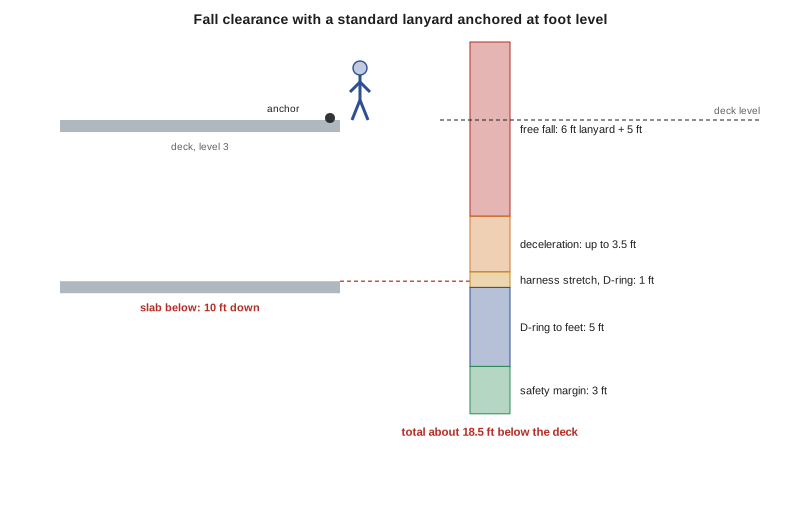
The program below adds up the clearance for a worker tied off at foot level and at shoulder height, and compares it with the 3.1 meter (10 foot) floor-to-floor height at Cottonwood Place. The figures are typical values for a standard shock-absorbing lanyard; real values come from the equipment manufacturer.
# Fall clearance check, US customary (typical values; use the manufacturer's figures in practice).
LANYARD = 6.0        # ft
DECEL = 3.5          # ft, maximum shock absorber deployment
STRETCH = 1.0        # ft, harness stretch and D-ring shift
BODY = 5.0           # ft, D-ring to the worker's feet
MARGIN = 3.0         # ft
FLOOR = 10.0         # ft, floor-to-floor height at Cottonwood Place
DRING = 5.0          # ft, height of the back D-ring above the walking surface

for name, anchor_height in [("anchor at foot level", 0.0), ("anchor at shoulder height", 5.0)]:
    free_fall = LANYARD + (DRING - anchor_height)
    need = LANYARD + DECEL + STRETCH + BODY + MARGIN - anchor_height
    ok = "OK" if need <= FLOOR else "NOT ENOUGH"
print(f"{name}: free fall {free_fall:.1f} ft, need {need:.1f} ft below the deck, have {FLOOR} ft -> {ok}")anchor at foot level: free fall 11.0 ft, need 18.5 ft below the deck, have 10.0 ft -> NOT ENOUGH anchor at shoulder height: free fall 6.0 ft, need 13.5 ft below the deck, have 10.0 ft -> NOT ENOUGH
With the anchor at foot level, the worker free falls 11 feet and needs 18.5 feet of clearance, almost two floors. Even with the anchor at shoulder height, the worker needs 13.5 feet, more than one floor. That is why fall arrest on the structure floors at Cottonwood Place uses overhead anchors with self-retracting lifelines, which lock within a short distance, and why guardrails are always the first choice.
Rescue after a fall
A worker hanging in a harness after a fall is not safe yet. Suspended in a harness, a worker can develop suspension intolerance, sometimes called suspension trauma: the leg straps restrict blood flow, blood pools in the legs, and the worker can lose consciousness within minutes. Rescue has to be fast and planned in advance. Calling 911 and waiting for the fire department is not a rescue plan on its own. At Cottonwood Place, the fall protection plan for each phase includes a rescue plan: which workers are trained in rescue, the equipment kept on each floor, such as a rescue kit with a pulley system, how an aerial lift or the hoist can reach a suspended worker, and how to keep the worker as comfortable as possible until they are down. Harnesses on site have relief straps that let a suspended worker stand in a loop to take pressure off the legs.
The fall protection plan
Where workers rely on fall arrest or travel restraint, or the work involves leading edges, Tallgrass Construction Inc. prepares a written fall protection plan for the work area. OSHA requires a written, site-specific plan prepared by a qualified person when an employer uses certain alternative measures, such as for leading-edge work where conventional protection is not feasible, and Tallgrass Construction Inc. uses one for every phase of the work regardless. The plan identifies the fall hazards in the area, the fall protection system for each, the anchor points and how they were selected, the procedures for assembling, inspecting and removing the system, and the rescue procedure. Workers review the plan with their foreman before starting work in the area.
Ladders, scaffolds and lifts
Many falls happen from equipment that was meant to give workers safe access to height. A few basic rules prevent most of them:
- Ladders: pick the right ladder for the job, inspect it before use, set it on firm level ground at about 4 to 1, extend it 1 meter (3 feet) above the landing, secure it, face it and keep three points of contact. Do not stand on the top two steps of a stepladder or overreach; move the ladder instead.
- Scaffolds: use only scaffolds erected and inspected by competent people, with full decking, guardrails, base plates and ties to the building. Do not climb the cross-braces, remove parts, or use a scaffold that has a red tag or no tag.
- Aerial and scissor lifts: operate only if trained and authorized, inspect before use, stay inside the guardrails, wear a harness tied to the designated anchor in a boom lift, keep clear of overhead power lines and avoid soft ground, holes and slopes.
Worked problem
The missing guardrail at the hoist landing
Show solution
- On level 5, a crew removes a section of guardrail to land a pallet of block from the crane at the edge of the slab.
- The pallet is landed, the crew moves the block inside, and the crew breaks for lunch without replacing the guardrail.
- Lena Petrov, coming up the stairs after lunch, sees the open edge. She stands by it, calls her foreman, and keeps workers away until the guardrail is reinstalled.
- Owen Hartley reviews the event with the crew. The crew had permission to remove the guardrail but no plan for who would replace it.
- The site changes its procedure: a removable guardrail gate is installed at each landing area, with a self-closing bar, and the foreman who approves a removal signs for its replacement on the daily task plan.
Answer: Guardrails rarely fail on their own; they are removed and not replaced. A gate designed for landing materials, and one named person responsible for closing it, fixed the condition instead of relying on memory.
Common mistakes
MistakeSkipping fall protection for a "quick" job at an edge.
InsteadProtect the edge or tie off for every task, however short.
MistakeTying off to a guardrail, conduit or pipe.
InsteadUse an anchor rated for fall arrest, selected by a competent person.
MistakeUsing a standard lanyard with an anchor at foot level one floor up.
InsteadCheck fall clearance; anchor overhead or use a self-retracting lifeline.
MistakeCovering a floor opening with an unmarked, loose sheet of plywood.
InsteadUse a secured, marked cover strong enough for twice the expected load.
MistakeRelying on the fire department as the only rescue plan.
InsteadHave a site rescue plan, trained workers and equipment ready on each floor.
Summary and key terms
- OSHA requires fall protection at 6 feet in construction, with separate rules for scaffolds, ladders and steel erection.
- Eliminate fall hazards first, then use passive protection such as guardrails, covers and nets, then travel restraint and fall arrest.
- Guardrails and covers fail most often because they are removed and not replaced.
- A personal fall arrest system needs an anchor, a full-body harness and a connector, inspected before each use.
- Fall clearance is often more than one floor height, so anchors should be overhead or self-retracting lifelines used.
- Every fall protection plan needs a rescue plan, because suspension in a harness can become life-threatening within minutes.
- Guardrail
- A barrier along an edge with a top rail, intermediate rail and toe board, strong enough to stop a worker from falling.
- Travel restraint
- A system that stops a worker from reaching an edge where they could fall.
- Personal fall arrest system
- A full-body harness, connector and anchor that stop a fall after it begins.
- Fall clearance
- The distance needed below a worker for a fall arrest system to stop a fall before the worker strikes a lower level.
- Suspension intolerance
- A dangerous condition in which a worker suspended in a harness loses consciousness as blood pools in the legs; also called suspension trauma.
- Fall protection plan
- A written plan for a work area that identifies fall hazards, the protection for each, anchor points, procedures and rescue.
Practice problems
Work each problem on paper first, then reveal the answer to check.
At what height does OSHA require fall protection on most construction surfaces?
Show answer
At 6 feet or more, with 10 feet for scaffolds and separate rules for ladders and steel erection.
List the controls for a fall hazard from most to least effective.
Show answer
Eliminate the hazard, passive protection such as guardrails and covers, travel restraint, fall arrest, then administrative controls.
What makes a floor opening cover acceptable?
Show answer
It is strong enough for twice the expected load, secured against movement, marked HOLE or COVER and larger than the opening.
What are the ABCs of a personal fall arrest system?
Show answer
Anchor, body support (a full-body harness) and connector.
Why is calling 911 not enough as a rescue plan for a worker suspended in a harness?
Show answer
Suspension intolerance can cause loss of consciousness within minutes, so rescue must start on site right away.
Lesson quiz · 5 questions
Score 60% or more to complete this lesson.
Create a free account to save your progress, take quizzes and earn a certificate.