
HSE-370 · Lesson 3 of 12 · 22 min
Site orientation, the safety plan and site rules
Every construction site is different. The hazards depend on the phase of work, the layout of the site, the neighbors, the equipment and the trades on site that week. A worker who has spent twenty years in construction still walks onto a new site not knowing where the muster point is, which areas are off limits, how deliveries move through the gate or which floor openings are still uncovered. The site orientation is how that knowledge reaches each worker before they start work. Behind the orientation sits the site safety plan, the written description of how the site will be kept safe, and the site rules, the short list of things everyone must do. This lesson covers all three.
Why every worker gets an orientation
OSHA's construction standards require employers to instruct each worker in the recognition and avoidance of unsafe conditions and in the rules that apply to the work, and many individual standards add specific training requirements, such as fall protection, scaffolds, ladders, excavation competent persons and HazCom. OSHA expects training to be given in a language and vocabulary the worker understands. Many contractors in Texas also require workers to hold an OSHA 10-hour or 30-hour construction outreach card, although federal law does not require one. On a multi-employer site, the controlling contractor usually runs a site orientation for everyone, and each employer adds the parts that are specific to its own work.
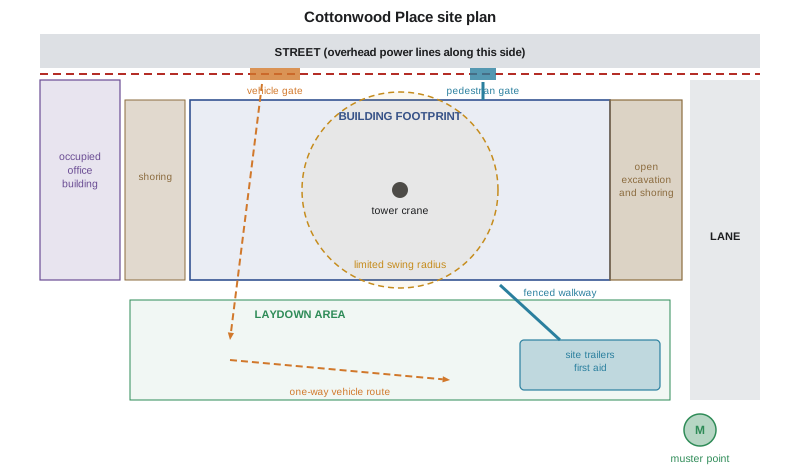
At Cottonwood Place, the rule is simple: no one works on site until they have completed the Tallgrass Construction Inc. orientation, and no one stays on site after it unless they also have their own employer's task training. The orientation takes about 45 minutes. It is given every morning at 6:30 and again at noon, and Owen Hartley gives it in person. He uses a printed site plan, walks the group to the edge of the excavation and the base of the crane, and ends with a short quiz. Workers who do not pass go through the parts they missed again. Each worker who completes it signs the record and gets an orientation sticker for their hard hat, so a supervisor can see at a glance who has not been oriented.
What the orientation covers
| Topic | What workers learn at Cottonwood Place |
|---|---|
| Who is in charge | The controlling contractor, the site superintendent, the safety coordinator, their own foreman and the committee members, with names and phone numbers. |
| Site layout | The gate, the vehicle route, the pedestrian walkway, the laydown and trailer area, the crane, the hoist and the stairs that are open each week. |
| Current hazards | The open excavation along the lane, the crane swing area, open floor edges, overhead power lines on the street, the occupied office building next door. |
| Site rules | The required protective equipment, the no-go zones, the rules for phones, smoking, impairment and housekeeping. |
| Emergency procedures | The alarm, the muster point, first aid, how to call for help, the evacuation routes from each floor. |
| Reporting | How to report hazards, near misses and injuries, and that reporting is expected and protected. |
| Rights | The right to know, to participate and to refuse unsafe work, and how to stop work. |
| Permits | Which work needs a permit, such as hot work, cutting into a deck, excavation and lifts over the lane. |
| HazCom | Where the safety data sheets are kept and how to read a label. |
Owen keeps the orientation current. When the job moves to a new phase, the hazards change and so does the orientation. During the excavation phase, it spends a lot of time on trench edges, the shoring along the office building and the dump truck route. During the structure phase, it covers the crane, open floor edges and formwork. During the finishing phase, it covers temporary electrical, scissor lifts, silica dust from cutting and the many trades working on the same floor.
The site safety plan
The site-specific safety plan is the written document that describes how safety will be managed on this particular project. It is not the company's general safety manual; it applies that manual to this site. Tallgrass Construction Inc. wrote the Cottonwood Place plan before work started and updates it at each phase. Owners and regulators increasingly expect one on larger projects, and many owners require it in the contract.
The Cottonwood Place plan includes:
- A description of the project, the site and its surroundings, including the street, the lane, the occupied office building and the power lines.
- The names and roles of the people responsible for safety, and how employers on site will coordinate.
- A hazard assessment for each phase of work, with the controls that will be used, such as the shoring design for the excavation, the fall protection plan for the structure and the traffic management plan.
- The site rules.
- The orientation and training requirements, including which workers need certificates such as fall protection, aerial lift operation and first aid.
- The emergency response plan.
- The inspection schedule and who carries out each inspection.
- The permits used on site and who can issue them.
- How incidents and near misses are reported and investigated.
- How subcontractors' own safety programs are reviewed before they start.
Workers do not need to read the whole plan. They need to know that it exists, where it is kept, and what it says about their own work. The parts that matter most to most workers are the site rules, the emergency plan and the hazard assessment for the work they are doing.
The emergency response plan
Every site needs a plan for what happens when something goes wrong. The plan must match the site's real hazards. A plan written for a single-story house is not enough for an eight-floor building with a tower crane and a deep excavation next to an occupied building. At Cottonwood Place, the emergency response plan covers:
- Raising the alarm. An air horn system on each floor, three long blasts for evacuation, and the rule that anyone who sees a fire or serious injury calls 911 first and then the site superintendent.
- First aid. The first aid station in the main trailer, the names of trained first aiders on each shift, and the location of the automated external defibrillator.
- Evacuation. Two open stairways from every floor, kept clear at all times, and the muster point in the southeast corner of the parking lot.
- Head count. Each foreman counts their crew at the muster point and reports to the site superintendent, using the daily sign-in sheet.
- Guiding emergency services. A worker is sent to the gate to meet the ambulance or fire truck and guide it in, because the site entrance is hard to find from the street.
- Rescue. Specific plans for rescuing a worker suspended in a fall harness, a worker injured in the excavation and a worker injured on a crane or in the hoist, with the equipment and trained people for each.
- Other events. Severe weather, a gas line strike, a concrete or chemical spill and an incident involving the public.
Severe weather is a real part of the plan in San Antonio. Summer thunderstorms with lightning and high winds can arrive quickly, flash flooding can fill an excavation within minutes, and extreme heat is a hazard for much of the year. The plan says when the crane stops for wind, when workers come down from the upper floors during lightning, and how the work schedule changes during heat waves.
The site rules
Site rules are the short list of things everyone on the site must do, whatever their employer. They work best when they are few, clear and enforced the same way for everyone. Cottonwood Place has twelve:
- Complete the site orientation and sign in every day before starting work.
- Wear a hard hat, safety boots, high-visibility clothing and safety glasses at all times outside the trailers. Wear hearing protection and gloves where posted or required by the task.
- Use the pedestrian walkways and gates. Never walk through the vehicle route or under a crane load.
- Never remove a guardrail, cover or barricade. If it must be moved for your work, get permission, protect the area another way and put it back.
- Use fall protection wherever the fall protection plan requires it.
- Keep your work area clean, and keep stairways, walkways and exits clear.
- Do not operate any equipment you are not trained and authorized to use.
- Get a permit before hot work, cutting into a floor or wall, excavating or lifting over the lane.
- Report every hazard, near miss and injury to your foreman the same day.
- No alcohol, cannabis or other impairing substances on site, and no working while impaired, including by fatigue or medication.
- Use phones only when you are stopped in a safe place, never while walking near equipment or working at an edge.
- Anyone can stop work that looks unsafe. No one will be disciplined for stopping work in good faith.
Rules mean little if they are not enforced. Tallgrass Construction Inc. enforces its site rules with a simple progression: a conversation and correction for a first minor breach, a written warning for a repeated one, and removal from the site for serious or deliberate breaches, such as removing a guardrail without permission or working at height without fall protection. The same rules apply to the Tallgrass Construction Inc. foremen and to the owner's representatives who visit the site.
Visitors, drivers and short-term workers
Some of the people most at risk on a site are the ones who are there for the shortest time: delivery drivers, inspectors, surveyors, the owner's representatives and workers who come for a single day to service equipment. They do not know the site, and they are often too busy to want a 45-minute orientation. Cottonwood Place gives them a short visitor orientation instead: a five-minute briefing at the gate covering the required protective equipment, the walkways, the no-go areas and the emergency signal. Visitors are escorted at all times. Delivery drivers stay with their vehicles in the delivery zone unless a Tallgrass Construction Inc. worker escorts them, and a trained signaler guides every truck that reverses on site.
Who has been oriented?
The orientation record is only useful if someone checks it. Each morning, Owen compares the day's sign-in sheet with the orientation record. The program below does the same thing with invented names, to catch anyone who signed in but has not been oriented.
# Compare today's sign-in sheet with the orientation record (invented names).
oriented = {"D. Sandhu", "L. Petrov", "M. Silva", "T. Brooks", "R. Lindqvist", "A. Nowak", "J. Reyes"}
signed_in_today = ["D. Sandhu", "L. Petrov", "K. Osei", "M. Silva", "T. Brooks", "P. Grant", "J. Reyes"]

not_oriented = [w for w in signed_in_today if w not in oriented]
print("Signed in today:", len(signed_in_today))
print("Not yet oriented:", ", ".join(not_oriented) if not_oriented else "none")
for w in not_oriented:
print(f" {w}: stop at trailer for 6:30 or 12:00 orientation before starting work")Signed in today: 7 Not yet oriented: K. Osei, P. Grant K. Osei: stop at trailer for 6:30 or 12:00 orientation before starting work P. Grant: stop at trailer for 6:30 or 12:00 orientation before starting work
Two workers, K. Osei and P. Grant, signed in without an orientation. Both turned out to be new workers sent by a drywall subcontractor that morning. Their foreman had assumed the orientation they had on another Tallgrass Construction Inc. project counted. It did not, because Cottonwood Place has its own hazards, layout and emergency plan. Both went through the noon session before starting work.
Worked problem
The concrete pump operator
Show solution
- A concrete pump truck arrives at 6:15 for a deck pour on level 4. The operator has never been to Cottonwood Place.
- The traffic control person at the gate stops the truck and calls Owen, who gives the operator a short orientation at the gate: the walkway, the no-go areas, the emergency signal, the muster point and the overhead power lines on the street side.
- The pump operator explains he usually sets up on the street. Owen shows him on the site plan that the street side has overhead power lines within reach of the boom, so the pump must set up in the laydown area, which the plan already identifies as the pump location.
- A Tallgrass Construction Inc. signaler guides the truck into position. The operator sets the outriggers on cribbing because the laydown area was recently backfilled.
- The operator's name goes on the sign-in sheet and the orientation record, with a note that he received the short version and must be escorted away from the pump.
Answer: Even a worker who will be on site for only a few hours needs to know the site-specific hazards. Here, the orientation kept the pump boom away from overhead power lines, one of the leading causes of electrocution in construction.
Common mistakes
MistakeAccepting another site's orientation as good enough.
InsteadEvery site has its own hazards, layout and emergency plan; orient each worker to this site.
MistakeWriting the site safety plan once and filing it.
InsteadUpdate it at each phase, and update the orientation with it.
MistakeLetting delivery drivers wander the site to find someone to sign for a load.
InsteadKeep drivers in the delivery zone or escort them, and guide every reversing truck.
MistakeHaving rules that are enforced for workers but not for supervisors or visitors.
InsteadApply the same rules to everyone on the site.
MistakeWriting an emergency plan without rescue plans for the site's real hazards.
InsteadPlan rescues for falls, excavations and cranes, with trained people and equipment ready.
Summary and key terms
- Every worker needs a site orientation before starting work, because every site has its own hazards, layout and emergency plan.
- The orientation covers who is in charge, the site layout, current hazards, rules, emergency procedures, reporting, rights, permits and HazCom.
- The site-specific safety plan applies the company program to the project and is updated at each phase.
- The emergency response plan covers alarms, first aid, evacuation, head counts, guiding emergency services, rescue and severe weather.
- Site rules are few, clear and enforced the same way for everyone.
- Visitors, drivers and short-term workers get a short orientation and are escorted.
- Site orientation
- Training given to every person before they start work on a site, covering its rules, hazards and emergency plan.
- Site-specific safety plan
- A written plan describing how safety will be managed on a particular project, updated as the work changes.
- Emergency response plan
- The part of the safety plan that sets out alarms, first aid, evacuation, head counts, rescue and response to specific emergencies.
- Muster point
- The place where workers gather after an evacuation so they can be counted.
- Site rules
- The short list of requirements that apply to everyone on a site, whatever their employer.
Practice problems
Work each problem on paper first, then reveal the answer to check.
Why must a worker with years of experience still complete a site orientation?
Show answer
Each site has its own hazards, layout, rules and emergency plan that the worker cannot know in advance.
Name four things the Cottonwood Place emergency response plan covers.
Show answer
Any four of: raising the alarm, first aid, evacuation, head count, guiding emergency services, rescue plans and other events such as severe weather or a gas line strike.
What should happen when a guardrail must be moved for a task?
Show answer
Get permission, protect the area another way while it is down, and put it back as soon as the task is done.
How does Cottonwood Place handle a delivery driver who will be on site for twenty minutes?
Show answer
A short visitor orientation at the gate, staying in the delivery zone or being escorted, and a signaler for any reversing.
Why did Owen send the concrete pump to the laydown area?
Show answer
The street side has overhead power lines within reach of the pump boom.
Lesson quiz · 5 questions
Score 60% or more to complete this lesson.
Create a free account to save your progress, take quizzes and earn a certificate.