
HSE-370 · Lesson 2 of 12 · 20 min
The leading causes of serious injury and death
Construction workers are not hurt at random. The same few events kill and seriously injure construction workers year after year, on big projects and small ones, in every province and state. A worker who knows what those events are, and where they hide on their own site, knows where to look first. This lesson looks at the numbers behind construction injuries, the four events that cause most construction deaths, the injuries that keep workers off the job most often, and why counting minor injuries is not the same as preventing serious ones.
How many construction workers are hurt
In the United States, the Bureau of Labor Statistics (BLS), in its annual census of fatal occupational injuries, counted 1,034 deaths in private-industry construction in 2024, down from 1,075 in 2023. In 2023, construction accounted for about one in five of all worker deaths in the country, and its fatality rate was 9.6 deaths per 100,000 full-time-equivalent workers, well above the rate for all industries. Those numbers count traumatic deaths. Work-related diseases, such as lung cancer and mesothelioma from asbestos and silicosis from crystalline silica dust, kill many more construction workers over time, but they appear years later and are much harder to count.
Behind every death are many more serious injuries: amputations, fractured skulls and spines, crushed hands and feet, burns and electrical injuries that change a worker's life. Construction has some of the highest rates of injuries that result in days away from work, and Texas, with one of the largest construction workforces in the country, has had among the highest numbers of construction deaths of any state in recent years. For every injury that keeps a worker off the job, there are many more that are treated with first aid, and many more near misses that hurt no one this time.
The four leading causes of death
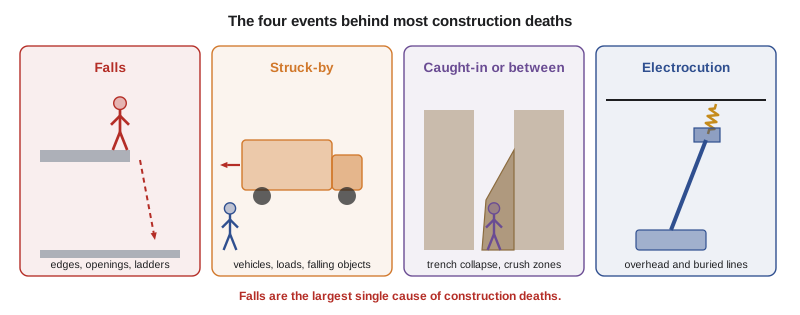
In the United States, OSHA groups the four events that cause most construction deaths into what it calls the Focus Four: falls, struck-by incidents, caught-in or caught-between incidents and electrocutions. The same four events dominate construction deaths in Canada, and Canadian safety associations teach them in much the same way.
Falls
Falls are the leading cause of traumatic death in construction. In 2024, BLS counted 389 construction deaths from falls, slips and trips, and almost all of them, about 96 percent, were falls to a lower level. Construction accounted for nearly half of all fatal falls, slips and trips in private industry. Workers fall from roofs, floor edges, ladders, scaffolds, openings in floors and the edges of excavations. A fall does not have to be from a great height to kill. Many deaths happen from heights of 10 to 20 feet (3 to 6 meters), and serious head and spine injuries happen from much lower, including falls from stepladders and from the back of trucks. Lesson 5 covers falls in detail.
Struck-by
A struck-by incident happens when a worker is hit by a moving object: a vehicle or piece of mobile equipment, a falling tool or material, a load swinging from a crane, a flying fragment from a saw or grinder, or a nail from a nail gun. On a busy site, the most dangerous struck-by hazard is usually reversing equipment. Dump trucks, loaders, telehandlers and concrete trucks have large blind spots, and workers on foot are often hidden in them. Falling objects are the other big struck-by hazard on a multi-story building like Cottonwood Place: a hammer dropped from the eighth floor can kill a worker on the ground. Lessons 6 and 9 cover struck-by hazards from equipment, materials and cranes.
Caught-in or caught-between
A caught-in or caught-between incident happens when a worker is crushed, squeezed, pinched or compressed between objects. The classic construction example is a trench collapse: one cubic meter of soil can weigh well over a metric ton, about as much as a small car, and a worker buried to the chest cannot breathe. Workers are also crushed between a machine and a wall, pulled into rotating parts, pinned under equipment that tips over, or caught between a load and a structure. Lessons 6 and 8 cover these hazards.
Electrocution
Construction workers are electrocuted most often by contact with overhead power lines, through a crane boom, a dump truck box, an aerial lift, a ladder or a length of pipe or rebar. Others are killed by buried cables struck while digging, by temporary wiring and damaged cords, or by working on equipment that was assumed to be off. Electrocution is often the first thing people think of when they think of electricians, but many of the workers electrocuted on construction sites are not electricians at all. Lesson 7 covers electrical hazards and utilities.
The injuries that keep workers off the job
The Focus Four cause most deaths, but they are not the most common injuries. The injuries that keep the most construction workers off the job are:
- Overexertion and strains, from lifting, carrying, pushing and pulling heavy or awkward materials such as drywall sheets, block, rebar and buckets, and from working in awkward postures such as overhead drilling or kneeling on concrete.
- Slips, trips and falls on the same level, over cords, debris, uneven ground, ice, mud and materials left in walkways. Lesson 4 covers housekeeping and access.
- Struck-by and contact injuries, such as cuts from knives and saws, eye injuries from dust and fragments, and crushed fingers.
- Exposure injuries, such as heat illness, cold stress and burns.
These injuries are less dramatic than a fall from the fifth floor, but they add up. A torn shoulder or a back injury can end a career in a trade that depends on the body. And many of them have the same root causes as the serious events: a cluttered work area, a rushed job, a missing tool, a task planned badly.
Serious injuries and fatalities: why counting is not enough
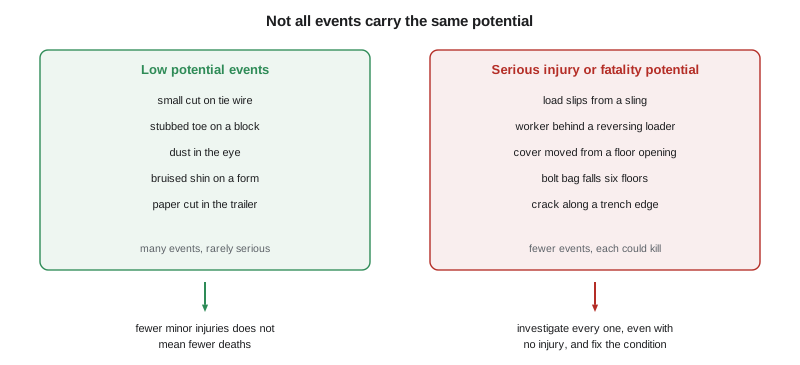
For decades, many companies judged their safety performance by counting recordable or lost-time injuries. That number matters, but it can mislead. A site can drive down its count of minor cuts and sprains while the conditions that kill people, such as unguarded floor openings, unsupported trench walls and workers walking behind reversing trucks, stay exactly the same. Research across many industries has found that serious and fatal injuries often do not fall in step with minor ones.
Many contractors now look separately at events with the potential for a serious injury or fatality, often called SIF potential. A near miss in which a bundle of rebar slips from a crane sling and lands in an empty laydown area hurt no one, but it had SIF potential: one minute earlier, two laborers were standing there. A sprained ankle from stepping off a curb is a real injury, but it did not have the same potential. A good safety program pays most attention to the first kind of event, even though it hurt no one.
Why these events keep happening
When investigators look at serious construction incidents, they rarely find a single careless worker. They find a combination of conditions that made the incident likely. Common ones include:
- Missing or removed protection, such as a guardrail taken down to land materials and not put back, or a trench box left on the truck because the job was "only a few minutes".
- Work that changed from the plan, such as an extra task added at the end of the day, or a different crew finishing someone else's job.
- Time pressure, such as a concrete truck arriving early or a crane booked for only a few hours.
- New or inexperienced workers, often in their first days on the site, who do not yet know where the hazards are or feel unable to speak up.
- Poor communication between trades, so one crew does not know what another is doing above, below or beside them.
- Normalized shortcuts, where a risky practice has been done many times without harm, so it no longer feels risky.
These conditions are why this course spends as much time on routines, such as orientation, pre-task planning, inspections and stopping unsafe work, as it does on individual hazards.
Looking at your own site
National statistics tell you what to look for. Your own site tells you where. Owen Hartley keeps a log of every injury, first aid case and near miss reported at Cottonwood Place, and every month he groups them by type and marks the ones with SIF potential. Two measures are common in both countries. The incident rate expresses the number of injuries per 100 full-time workers per year, using 200,000 hours (100 workers × 40 hours × 50 weeks) as the base. The fatality rate used in national statistics expresses deaths per 100,000 full-time-equivalent workers. The program below calculates the site's recordable incident rate from invented figures and shows what share of the month's reports had SIF potential.
# Cottonwood Place, months 1 to 6 (invented data).
hours_worked = 168_400          # total hours by all workers on site
recordable_injuries = 4          # injuries beyond first aid
rate = recordable_injuries * 200_000 / hours_worked
print(f"Recordable incident rate: {rate:.2f} per 100 full-time workers per year")

reports = [  # (event, SIF potential?)
    ("Cut finger on rebar tie wire", False),
    ("Rebar bundle slipped from sling, landed in empty laydown", True),
    ("Worker walked behind reversing loader, horn stopped him", True),
    ("Twisted ankle on form ply offcut", False),
    ("Floor opening cover moved by pallet jack", True),
    ("Dust in eye while grinding", False),
]
sif = [e for e, s in reports if s]
print(f"{len(sif)} of {len(reports)} reports had SIF potential:")
for e in sif:
print(" -", e)Recordable incident rate: 4.75 per 100 full-time workers per year 3 of 6 reports had SIF potential: - Rebar bundle slipped from sling, landed in empty laydown - Worker walked behind reversing loader, horn stopped him - Floor opening cover moved by pallet jack
The rate of 4.75 is a useful number to compare month to month, but Owen pays more attention to the second list. Three of the six reports could have killed someone, and none of them produced an injury. Each one led to a change: a tag line and a second check of the sling before every lift of loose material, a spotter rule for the loader in the laydown area, and screwed-down, marked covers on every floor opening.
Worked problem
The bolt bag on level 6
Show solution
- An ironworker on level 6 sets a canvas bag of bolts on the edge of a deck while he climbs to connect a beam. The bag slides off and falls six floors into the lane, landing two meters from a delivery driver.
- No one is hurt. The ironworker reports it to his foreman, who reports it to Owen Hartley at once.
- Owen classifies it as a near miss with SIF potential: a falling object from that height could easily have killed the driver.
- The review finds three conditions: no toe boards on that part of the deck edge, no tethering of tools and materials at height, and no exclusion zone in the lane below the steel erection work.
- The fixes are toe boards and debris netting along the open edges, a rule that tools and small materials above level 3 are tethered or kept in closed containers, and a barricaded exclusion zone below active steel work.
Answer: No one was injured, but the event had the potential for a fatality, so it was investigated as seriously as an injury. The fixes control the condition, not just the individual worker.
Common mistakes
MistakeJudging a site as safe because it has had few injuries this month.
InsteadLook for events and conditions with serious injury or fatality potential.
MistakeThinking electrocution is only an electrician's hazard.
InsteadOverhead and buried lines kill laborers, operators, roofers and drivers too.
MistakeIgnoring a near miss because no one was hurt.
InsteadReport it; near misses show where the next serious injury will come from.
MistakeBlaming a serious incident on one careless worker.
InsteadLook for the conditions that made it likely: missing protection, changed plans, pressure and communication gaps.
MistakeThinking a fall needs a great height to be serious.
InsteadFalls from ladders, trucks and low platforms cause serious head and spine injuries.
Summary and key terms
- Construction is one of the deadliest industries in both Canada and the United States, through traumatic deaths and occupational disease.
- Falls, struck-by, caught-in or caught-between and electrocution cause most construction deaths; falls are the largest single cause.
- Overexertion, same-level slips and trips, cuts and exposure injuries are the most common lost-time injuries.
- Events with serious injury or fatality potential deserve the most attention, even when no one is hurt.
- Serious incidents usually come from combinations of conditions, not one careless act.
- The incident rate uses 200,000 hours as a base; tracking SIF potential tells you more about where deaths could happen.
- Focus Four
- OSHA's name for the four leading causes of construction deaths: falls, struck-by, caught-in or caught-between, and electrocution.
- Struck-by
- An incident in which a worker is hit by a moving object, such as a vehicle, falling material or a swinging load.
- Caught-in or caught-between
- An incident in which a worker is crushed, squeezed or pinched between objects, including trench collapses.
- SIF potential
- The potential of an event, including a near miss, to cause a serious injury or fatality.
- Near miss
- An event that could have caused injury or damage but did not.
- Incident rate
- The number of injuries per 100 full-time workers per year, calculated with a base of 200,000 hours.
Practice problems
Work each problem on paper first, then reveal the answer to check.
What are the four leading causes of construction deaths?
Show answer
Falls, struck-by incidents, caught-in or caught-between incidents and electrocution.
Which is the largest single cause of traumatic construction deaths?
Show answer
Falls to a lower level.
Why do national fatality counts understate the deaths caused by construction work?
Show answer
Deaths from occupational diseases such as asbestos-related cancers and silicosis appear years later and are harder to count.
A site worked 250,000 hours and had 5 recordable injuries. What is its incident rate?
Show answer
5 × 200,000 / 250,000 = 4.0 per 100 full-time workers per year.
Why did Owen treat the falling bolt bag as seriously as an injury?
Show answer
It had serious injury or fatality potential; only luck kept the driver from being hit.
Lesson quiz · 5 questions
Score 60% or more to complete this lesson.
Create a free account to save your progress, take quizzes and earn a certificate.