
HSE-370 · Lesson 1 of 12 · 24 min
How a construction site is organized and who is in charge
A construction site is a workplace that builds itself out of existence. Every week the floors, walls, openings, roads and hazards change. The crew that poured the footings is gone by the time the roofers arrive, and the electricians who pull wire through the third floor in March were not on site in January. People from a dozen or more employers work side by side, often within arm's reach of a hazard created by someone else. That is why construction, year after year, has one of the highest rates of serious injury and death of any industry in both Canada and the United States, and why construction safety starts with a simple question: who is in charge of what?
This course gives every worker on a construction site, whatever their trade and however new they are, a clear picture of how a site is organized, the hazards that injure and kill construction workers most often, and the daily routines that keep those hazards under control. It sits between two other courses. TRD-101 Construction and Trade Safety follows a first-year apprentice learning the basics of a trade. CON-355 Safety Leadership for Site Supervisors is written for the superintendents and foremen who run the work. HSE-370 is the safety-stream view of the whole site: what any worker, from a general laborer to a visiting delivery driver, needs to understand to work safely among many trades.
The project in this course
This course and the five that follow it, HSE-371 to HSE-375, use one invented project. Cottonwood Place is an eight-story mixed-use building in San Antonio, Texas, with shops on the ground floor, seven floors of apartments above and one level of underground parking. The site is tight: a busy street on the north side, a lane on the east, an occupied office building on the west and a parking lot on the south that serves as the laydown and trailer area. A tower crane stands in the middle of the footprint. At the busiest point of the job, about 140 workers from 18 employers are on site on a single day.
The general contractor is Tallgrass Construction Inc., which is also the controlling contractor for the site. The people we will meet most often are:
- Carla Mendes, Tallgrass Construction Inc.'s site superintendent, who runs the site day to day.
- Owen Hartley, Tallgrass Construction Inc.'s site safety coordinator, who runs orientations, inspections and the safety program.
- Dev Sandhu, a general laborer with Tallgrass Construction Inc. who started on the project this spring. Much of the course follows his first months on site.
- Lena Petrov, a formwork carpenter with a concrete forming subcontractor, who is the site safety committee worker representative.
- Marco Silva, foreman for Silva Earthworks, the excavation and underground services subcontractor.
- Tasha Brooks, foreman for the electrical subcontractor.
- Ray Lindqvist, the tower crane operator.
How construction differs from other workplaces
In a factory, the building, the machines and the work processes stay much the same from year to year. Hazards can be studied, guarded and written into procedures that last. A construction site is different in at least five ways, and each of them shapes how safety has to work.
- The site changes every day. A floor edge that was protected by a wall yesterday may be open today because the wall panel was removed to bring in materials. A ramp that was safe on Monday is mud after Tuesday's rain. Hazard assessments have to be repeated far more often than in a fixed workplace.
- Many employers share one site. Each subcontractor has its own workers, supervisors, tools and habits. A hazard created by one employer, such as a hole cut in a deck by the plumbers, can injure the workers of another employer, such as the drywall crew who walk past it.
- The workforce turns over constantly. Trades arrive and leave as the job moves through its phases, and individual workers come and go. On a typical day at Cottonwood Place, several people are on site for the first time.
- Much of the work is at height, below grade or near heavy equipment. Falls, trench collapses, being struck by vehicles or loads and contact with electricity are built into the work itself.
- Schedules are tight and weather matters. Pressure to finish before winter, before a concrete pour or before the next trade arrives pushes people toward shortcuts.
None of this makes construction injuries inevitable. It means that safety on a construction site depends on organization: clear roles, shared rules, good communication between employers and routines that are repeated every day.
The parties to a construction project
Several organizations have a hand in every project, and each has a part to play in safety.
| Party | Who it is at Cottonwood Place | Main safety role |
|---|---|---|
| Owner | Cottonwood Place Developments, the developer | Hires competent contractors, provides information about existing hazards such as buried services, and allows time and money for safe work. |
| Designers | The architect and the structural, mechanical and electrical engineers | Design a building that can be built and maintained safely, such as permanent anchors on the roof. |
| Controlling contractor | Tallgrass Construction Inc. | Has general supervisory authority over the site, coordinates the subcontractors and is expected to find and fix hazards it can reasonably detect. |
| Employers (subcontractors) | Silva Earthworks, the forming company, the electrical company and 15 others | Protect their own workers, train and supervise them, and follow the site rules. |
| Supervisors and foremen | Carla Mendes, Marco Silva, Tasha Brooks and others | Direct the work so it is done safely and enforce the rules with their crews. |
| Workers | Dev Sandhu, Lena Petrov and about 140 others at peak | Work safely, use the protection provided and report hazards. |
| Regulator | OSHA | Sets and enforces the rules through inspections and citations. |
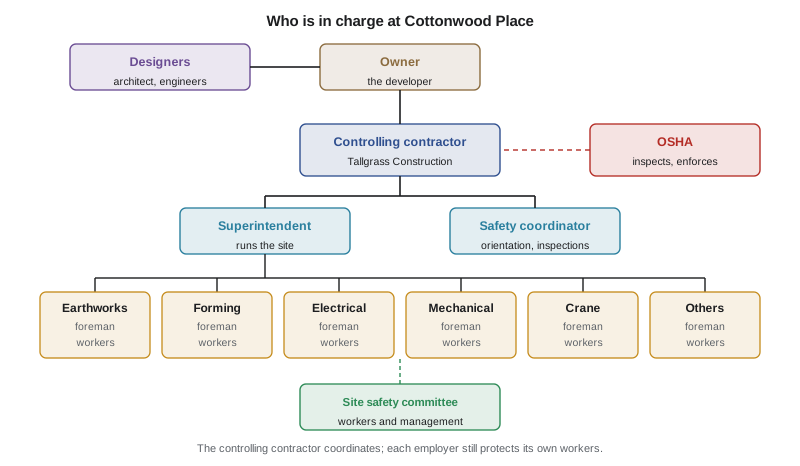
The controlling contractor
Federal OSHA does not use the term prime contractor. Instead, under OSHA's multi-employer citation policy, more than one employer can be cited for the same hazard on a construction site. OSHA looks at four roles. The creating employer caused the hazard. The exposing employer has its own workers exposed to it. The correcting employer is responsible for fixing it, such as the company hired to maintain guardrails. The controlling employer has general supervisory authority over the site, including the power to correct hazards or require others to correct them. On most sites, the general contractor is the controlling contractor, and courts have generally upheld OSHA's use of the policy.
At Cottonwood Place, Tallgrass Construction Inc. acts as the controlling contractor in several ways. It runs one orientation for everyone who comes on site, whatever their employer. It sets site rules that apply to all employers, such as where vehicles may drive and the rule that every open edge is guarded. It holds a weekly coordination meeting where foremen plan the next week's work and spot clashes, such as the crane swinging loads over the area where the electricians are working. It inspects the whole site every week and follows up with the employer responsible for each hazard found. And it keeps a list of every employer on site, with the name of its supervisor and its own safety documents.
Coordination does not take responsibility away from anyone else. Each subcontractor is still the employer of its own workers and still has to train them, supervise them, give them the right equipment and follow the law. When Silva Earthworks digs a trench, Silva Earthworks must make sure it is sloped or shored. Tallgrass Construction Inc.'s role is to check that it is, to stop the work if it is not, and to make sure the trench does not create a hazard for anyone else, such as a delivery driver backing toward an unguarded edge.
Employers, supervisors and workers
The OSH Act places the main legal duty on employers. Each employer must comply with the OSHA standards that apply to its work and, under the general duty clause, keep its workplace free of recognized hazards likely to cause death or serious physical harm. OSHA's construction standards in 29 CFR 1926 set specific rules for falls, excavations, scaffolds, ladders, electrical work, cranes and many other hazards, and they require employers to have a competent person for many tasks: someone who can identify existing and predictable hazards and has the authority to correct them promptly. Workers are expected to follow the employer's safety rules and use the protection provided, and they have protected rights to raise concerns, which later lessons cover.
In practice, the foreman is the person whose behavior matters most to a new worker. Foremen decide how the work will be done, who will do it and with what equipment. They notice when someone is struggling, when a shortcut is being taken and when conditions have changed. At Cottonwood Place, Carla Mendes tells every new foreman the same thing at their first coordination meeting: "Your crew will do what you do, not what you say. If you walk past an open edge, so will they."
The three rights of every worker
Workers in Texas, as in every state, have rights under the OSH Act that are often summarized in the same three ideas Canadians use. The right to know means being told about the hazards of the work through training, HazCom labels and safety data sheets, in a language the worker understands. The right to participate means raising safety concerns, taking part in safety programs and filing a complaint with OSHA, including asking for an inspection. The right to refuse is narrower: a worker may refuse work that poses an imminent danger of death or serious injury when there is no time to fix it through normal channels, after asking the employer to correct it. Retaliating against a worker for raising safety concerns is illegal, and a worker who is punished can file a whistleblower complaint with OSHA, generally within 30 days. Lesson 12 explains how these rights work on site.
Committees and representatives
Federal OSHA does not require safety committees, and Texas has no state law requiring them on private construction sites. Many contractors set them up anyway, because they work. At Cottonwood Place, Tallgrass Construction Inc. runs a site safety committee that brings together a worker and a foreman from each major subcontractor. It meets monthly, walks the site before each meeting, reviews every incident and near miss, and sends written recommendations to Carla Mendes, who answers each one in writing at the next meeting. Lena Petrov, a formwork carpenter, is one of the worker members.
Lena puts it plainly to new workers: "If you see something and don't want to raise it with your own foreman, tell me. I'll take it to the committee and nobody needs to know it came from you."
A site with many employers: how the pieces fit
On a shared site, most serious hazards sit at the boundaries between employers. The earthworks crew leaves a trench edge unguarded when it finishes for the day. The plumbers cut a hole in a deck and cover it with a sheet of plywood that is not secured or marked. The crane lifts a bundle of rebar over a lane where the masons are working. In each case, the employer that created the hazard is not the employer whose workers are exposed to it.
Cottonwood Place handles these boundaries with a few simple systems that later lessons look at in detail:
- One orientation for all, so every worker knows the site rules, the emergency plan and where the hazards are, whoever their employer is.
- A weekly coordination meeting and a daily look-ahead, so foremen know what the other trades will be doing next to them.
- Work permits for the highest-risk activities, such as hot work, cutting into a deck, excavation near the occupied building and crane lifts over the lane.
- Shared inspections and a single hazard log, so that a hazard found by anyone is assigned to the employer who must fix it, with a date.
- A clear rule that anyone can stop unsafe work, whoever's work it is.
Counting who is on site
Knowing who is on site matters for two reasons. In an emergency, the controlling contractor needs to know who to account for. And the number of new workers on site is one of the best warning signs of risk: workers in their first weeks on a job are injured at much higher rates than experienced workers on the same site. Owen Hartley keeps a simple count from the sign-in records. The program below uses invented sign-in data for four weeks of the job to find the peak number of workers and the share who were in their first week on site.
# Cottonwood Place sign-in summary (invented data): workers on site and first-week workers.
weeks = {
    "Week 14": {"on_site": 96,  "first_week": 21},
    "Week 15": {"on_site": 118, "first_week": 30},
    "Week 16": {"on_site": 141, "first_week": 34},
    "Week 17": {"on_site": 133, "first_week": 12},
}
for wk, d in weeks.items():
    share = d["first_week"] / d["on_site"]
    flag = "  <- extra supervision" if share >= 0.2 else ""
    print(f"{wk}: {d['on_site']:3d} on site, {d['first_week']:2d} new ({share:.0%}){flag}")
peak = max(weeks, key=lambda w: weeks[w]["on_site"])
print("Peak week:", peak, "with", weeks[peak]["on_site"], "workers")Week 14: 96 on site, 21 new (22%) <- extra supervision Week 15: 118 on site, 30 new (25%) <- extra supervision Week 16: 141 on site, 34 new (24%) <- extra supervision Week 17: 133 on site, 12 new (9%) Peak week: Week 16 with 141 workers
In weeks 15 and 16, when the mechanical and drywall subcontractors arrived, roughly one worker in four was new to the site. Tallgrass Construction Inc. responds to weeks like these by running extra orientation sessions, asking each subcontractor to pair new workers with an experienced worker for their first week, and having Owen Hartley walk the floors where the new crews are working.
Worked problem
Dev's first morning
Show solution
- Dev Sandhu arrives at Cottonwood Place at 6:30 on his first day. At the gate, the traffic control person stops him and directs him to the site trailer instead of letting him walk through the vehicle route.
- Owen Hartley runs his orientation. Dev learns who the controlling contractor is, who his own supervisor is, where the first aid station and muster point are, the site rules and the main hazards in the current phase of work: the open excavation along the lane, the crane and the open floor edges on levels 2 and 3.
- Dev is paired with an experienced laborer for the week. His foreman, Luis, shows him the task for the morning, cleaning up form material on level 2, and points out the edge protection and the floor openings.
- At 10:00, Dev sees a cover over a floor opening that has been pushed aside by a pallet jack. He is not sure whose job it is to fix it. He tells Luis, who puts the cover back, marks it and reports it to Owen so the plumbing crew that installed it can secure it properly.
- At the end of the day, Owen adds Dev's name to the list of workers who have completed orientation and gives him an orientation sticker for his hard hat.
Answer: On a multi-employer site, the worker does not need to know who created a hazard to deal with it. Dev reported it to his own foreman, the hazard was controlled at once, and the controlling contractor's system made sure the employer responsible fixed it properly.
Common mistakes
MistakeAssuming a hazard is not your problem because another trade created it.
InsteadReport every hazard you see; the site system assigns it to the right employer.
MistakeThinking the general contractor is responsible for everyone's safety, so subcontractors can relax.
InsteadEvery employer protects its own workers; the general contractor coordinates.
MistakeStarting work on a new site before orientation because "it is the same as the last job".
InsteadComplete the site orientation first; every site has its own hazards, rules and emergency plan.
MistakeKeeping a concern to yourself because you are new.
InsteadRaise it with your foreman, the safety coordinator or a committee member.
MistakeTreating the weekly coordination meeting as a scheduling meeting only.
InsteadUse it to spot where one trade's work creates hazards for another.
Summary and key terms
- Construction sites change daily, share space among many employers and turn over their workforce constantly, so safety depends on organization.
- In the US, OSHA's multi-employer policy can hold creating, exposing, correcting and controlling employers responsible for the same hazard.
- Every employer still protects its own workers, and supervisors and foremen set the example their crews follow.
- Workers have the right to know, to participate and to refuse unsafe work.
- Committees and worker representatives give workers a formal voice in safety.
- Most serious hazards on a shared site sit at the boundaries between employers, so orientation, coordination, permits, shared inspections and stop-work authority matter.
- Controlling contractor
- The employer, usually the general contractor, with general supervisory authority over a construction site, including the power to correct hazards or require others to correct them.
- Subcontractor
- An employer hired by the general contractor to do part of the work, such as excavation, forming or electrical work.
- Foreman
- The supervisor who directs a crew of workers on the site.
- Site safety committee
- A group of worker and management members who inspect the site, review incidents and make recommendations on health and safety.
- Orientation
- The training every person receives before starting work on a site, covering its rules, hazards and emergency plan.
Practice problems
Work each problem on paper first, then reveal the answer to check.
Name three ways a construction site differs from a fixed workplace such as a factory.
Show answer
Any three of: the site changes daily, many employers share it, the workforce turns over constantly, much of the work is at height, below grade or near heavy equipment, and schedules and weather add pressure.
What makes an employer the controlling contractor under OSHA's policy?
Show answer
It has general supervisory authority over the site, including the power to correct hazards or require others to correct them.
The plumbers cut a hole in a deck and the drywall crew walks past it. Who must protect the drywall workers?
Show answer
Their own employer must protect them, the plumbers must guard the hole they created, and the general contractor must check that it is done and coordinate the fix.
Why does Owen Hartley track the share of first-week workers on site?
Show answer
New workers are injured at much higher rates, so weeks with many new workers call for extra orientation, pairing and supervision.
What are the three basic rights of workers?
Show answer
The right to know, the right to participate and the right to refuse unsafe work.
Lesson quiz · 5 questions
Score 60% or more to complete this lesson.
Create a free account to save your progress, take quizzes and earn a certificate.