
HSE-219 · Lesson 5 of 12 · 30 min
Planning a lift: weights, roles and lift plans
Most crane incidents are decided before the hook moves. The load turned out heavier than the paperwork said, the crane was set up where the radius was longer than planned, nobody checked what was under the outriggers, or the person signaling could not see the load. Lift planning is the discipline of answering those questions in advance, writing the answers down and making sure everyone involved understands them.
This lesson covers how to decide how much planning a lift needs, how to find a load's weight and center of gravity, who does what on a lift, what goes into a lift plan, and how to run the pre-lift meeting and trial lift. The aim is not to turn supervisors into lift engineers but to make sure they can recognize a weak plan and stop a lift that has not been thought through.
Ordinary and critical lifts
Employers usually sort lifts into two or three categories. Routine lifts, such as unloading standard bundles from a truck well within capacity, can be covered by a general procedure and the operator's own checks. Critical lifts need a written, lift-specific plan reviewed and signed by competent people before the lift.
| Common critical lift trigger | Why it raises the risk |
|---|---|
| Load above a set percentage of chart capacity, often 75 percent | Less margin for errors in weight, radius or dynamic effects |
| Two or more cranes lifting one load | Load sharing changes as the load moves; one crane can be overloaded |
| Lifting people in a suspended platform | Any failure directly endangers the people being lifted |
| Lifts near energized power lines | Contact can kill people far from the crane |
| Blind lifts where the operator cannot see the load | All control depends on the signaler and communication |
| Lifts over occupied buildings, roads, operating plant or hazardous materials | A dropped load has severe consequences |
| Unusual, fragile, very high-value or unknown-weight loads | Weight, center of gravity or strength of lifting points is uncertain |
| Lifts using engineered rigging, below-the-hook devices or load turning | Complex rigging adds failure points |
The 75 percent trigger is common in employer programs, owner specifications and industry guidance, and some employers use 85 or 90 percent for the highest planning tier. OSHA's Subpart CC requires specific planning for certain lifts, such as power line work, multiple-crane lifts and hoisting personnel under 1926.1431, but leaves the general definition of a critical lift to employers.
Finding the weight of the load
Every lift calculation starts with the weight of the load, and the weight is the number most often wrong. Shipping weights may leave out packaging, skids or contents. Drawings may show dry weight without fluids. Fabricators may give an estimate before the item is finished. Good practice is to get the weight from at least one reliable source and check it against another.
- Manufacturer data or a certified weight on the item's nameplate.
- Shipping documents and bills of lading, checked for what they include.
- Calculation from dimensions and material density.
- Weighing with a load cell or dynamometer between the hook and the rigging, which is the most reliable method when available.
- Weighing on a truck scale, comparing loaded and empty weights.
| Material | Approximate density (lb/ft³) |
|---|---|
| Steel | 490 |
| Aluminum | 169 |
| Reinforced concrete | 150 to 156 |
| Water | 62.4 |
| Dry softwood lumber | 25 to 35 |
| Wet soil | 110 to 130 |
Worked problem
Weight of a steel plate and a precast panel
Estimate the weight of (a) a steel plate 10 ft by 5 ft by 1 in thick and (b) a precast concrete wall panel 20 ft by 8 ft by 8 in thick.
Show solution
- (a) Volume: \( 10 \times 5 \times \tfrac{1}{12} = 4.17 \) ft³.
- Weight: \( 4.17 \times 490 = 2042 \) lb.
- (b) Volume: \( 20 \times 8 \times \tfrac{8}{12} = 106.7 \) ft³.
- Weight: \( 106.7 \times 150 = 16\,000 \) lb, before any embedded items, insulation or lifting hardware. Using 156 lb/ft³ for heavy reinforcement gives about 16,600 lb.
Answer: About 2,040 lb for the plate and about 16,000 to 16,600 lb for the panel. Use the precaster's stated weight, which should be marked on the panel, and plan with the higher figure if in doubt.
Hidden weight is a frequent cause of overloads. Tanks and vessels may hold liquid or sludge. Pipe may be full of water or ice. Loads lifted from mud or water are held by suction until they break free, which can briefly add a large force. Old equipment may have been modified with heavier parts. Items frozen to the ground or bolted down must be freed completely before lifting; a crane should never be used to pull something loose.
Finding the center of gravity
The center of gravity is the point where the whole weight of the load can be considered to act. When a load is lifted, it rotates until its center of gravity hangs directly below the hook. If the hook is not above the center of gravity, the load tilts as it leaves the ground, may slide in the slings and can load one sling far more than the others.
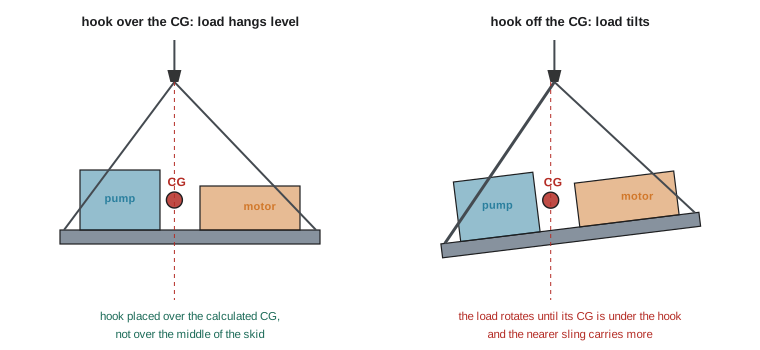
For symmetrical loads of uniform material, the center of gravity is at the geometric center. For skids, machinery and fabrications, it must be found from drawings, from the manufacturer or by calculation. To calculate it, take moments of each part's weight about a reference point.
Worked problem
Center of gravity of an equipment skid
An 8 ft skid carries a pump weighing 2,000 lb centered 1.5 ft from the left end and a motor weighing 1,300 lb centered 6 ft from the left end. The skid frame weighs 650 lb, centered at 4 ft. Where is the combined center of gravity?
Show solution
- Moments about the left end: pump \( 2000 \times 1.5 = 3000 \), motor \( 1300 \times 6 = 7800 \), frame \( 650 \times 4 = 2600 \) lb·ft.
- Total moment: \( 3000 + 7800 + 2600 = 13\,400 \) lb·ft.
- Total weight: \( 2000 + 1300 + 650 = 3950 \) lb.
- Center of gravity: \( x = \tfrac{13\,400}{3950} = 3.39 \) ft from the left end.
- The center of gravity is about 0.6 ft left of the skid's midpoint at 4 ft, so the hook must be positioned over 3.39 ft, not over the middle.
Answer: About 3.4 ft from the left end. Rigging from symmetric lifting points with equal slings would make the load tilt, so sling lengths or attachment points must be chosen to put the hook over that point.
A high center of gravity above the lifting points makes a load unstable: it can topple within its slings. Tall, narrow loads should be lifted from points above their center of gravity or with a spreader beam and a basket arrangement that cradles them.
Roles on a lift
Every lift needs clearly assigned roles, and every person needs to know who has which role before the lift begins. On small lifts, one person may cover more than one role, but each role must still be covered.
| Role | Main responsibilities |
|---|---|
| Lift director or lift supervisor | Plans or approves the lift, holds the pre-lift meeting, confirms qualifications, controls the area and has authority to stop the lift |
| Crane operator | Inspects and sets up the crane, verifies capacity, operates safely, refuses unsafe lifts |
| Rigger | Selects and inspects rigging, attaches it correctly, confirms the hook is over the center of gravity |
| Signaler | Directs the operator with agreed hand signals or radio and keeps the load and path in view |
| Spotter | Watches a specific hazard, such as a power line, outriggers or the swing radius, and warns the operator |
| Assembly or disassembly director | Directs crane assembly and disassembly following the manufacturer's procedure |
| Engineer | Designs or checks critical lifts, special rigging, ground support and lifting attachments |
On U.S. construction sites, the controlling entity, usually the general contractor, has specific duties under Subpart CC for ground conditions and site coordination, while the employer of the crane crew is responsible for operator, rigger and signal person qualification.
What goes into a lift plan
A lift plan answers, in writing, the questions that decide whether a lift will be safe. For routine lifts a short checklist may do. For critical lifts the plan is detailed, includes calculations and drawings, and is signed by the people responsible.
| Plan section | Content |
|---|---|
| Load | Description, verified weight and source, dimensions, center of gravity, lifting points and their rating |
| Crane | Make, model, serial number, configuration, boom length, counterweight, outrigger extension, working area |
| Capacity | Pick, maximum and set radii, chart capacities, deductions, net capacity and percentage of chart at the worst point |
| Rigging | Each component with its rated capacity, sling angles and calculated sling tension, hitch type, softeners |
| Ground and setup | Crane location, mats, ground bearing capacity, outrigger loads, buried hazards checked |
| Site hazards | Power lines and distances, obstructions, other cranes, traffic, public areas, exclusion zones |
| Environment | Maximum wind speed, visibility, lighting, temperature limits |
| People and communication | Names and roles, qualifications, signals or radio channel, stop authority |
| Sequence and contingency | Step-by-step sequence, trial lift, what to do if conditions change or the load must be held |
| Approvals | Signatures of the lift director, operator, rigger and engineer where required |
The pre-lift meeting and trial lift
A written plan only works if the people doing the lift know it. Before any critical lift, and before routine lifts on a new site or with a new crew, the lift director should hold a short meeting at the lift location. The crew walks the load path, confirms the radius and set-down point, checks the exclusion zone, agrees on signals and confirms who can stop the lift. Anyone who has a concern raises it then.
A trial lift tests the plan with the real load. The load is lifted just clear of the ground, typically a few centimeters, and held. The crew checks that the load hangs level, that the slings are seated and not slipping, that the brakes hold, that the outriggers and mats show no settlement and that the load moment indicator reads what the plan predicted. If anything is unexpected, the load is lowered and the plan corrected before the lift continues.
Worked problem
Using the trial lift to check the weight
A lift plan uses a weight of 11,500 lb for a transformer, including rigging. During the trial lift the load moment indicator shows 13,300 lb at the planned radius. The chart capacity is 15,400 lb. What should the lift director do?
Show solution
- The indicated load is \( 13\,300 - 11\,500 = 1800 \) lb, about 16 percent, more than planned.
- Percentage of chart now: \( \tfrac{13\,300}{15\,400} \times 100 = 86 \) percent instead of the planned 75 percent.
- The difference may be oil in the transformer that was not counted, a heavier rigging set or an indicator error, but the cause is unknown.
- Lower the load, stop and investigate. Recalculate with the higher weight, check the worst radius along the swing and decide whether the lift is still acceptable or needs a shorter radius or larger crane.
Answer: Lower the load and stop. An unexplained difference between planned and measured weight means the plan is wrong somewhere, and the lift must not continue until the reason is understood and the plan revised.
Multiple-crane lifts
When two cranes lift one load, the share each carries depends on the geometry of the rigging and the load's center of gravity, and it changes as the load is raised, tilted or moved. If one crane hoists faster or swings differently, it can pick up far more than its planned share. These lifts need an engineered plan, a single lift director, constant communication and usually a reduced percentage of each crane's chart. Lifting with two cranes is never a way to lift a load that is too heavy for one crane without proper engineering.
Common mistakes
MistakeTrusting the weight on a shipping document without checking what it includes.
InsteadVerify the weight from a reliable source and account for contents, packaging and rigging.
MistakeAssuming the center of gravity is in the middle of every load.
InsteadFind it from drawings, the manufacturer or a calculation and rig the hook over it.
MistakeUsing the crane to pull loose a load that is frozen or bolted down.
InsteadFree the load completely before lifting.
MistakeSkipping the pre-lift meeting because the crew is experienced.
InsteadWalk the lift with the crew every time conditions or people change.
MistakeContinuing after a trial lift shows unexpected weight or tilt.
InsteadLower the load, find the cause and revise the plan.
Summary and key terms
- Lifts are screened into routine and critical categories; critical lifts need a written, signed plan.
- Common critical triggers include loads over 75 percent of chart, multiple cranes, personnel lifting, power lines and blind lifts.
- Load weight is the number most often wrong; verify it and account for hidden contents and suction.
- The load settles with its center of gravity under the hook; find it and rig accordingly.
- Every lift needs clearly assigned roles, including someone with authority to stop it.
- A pre-lift meeting and a trial lift test the plan before the load is committed.
- Lift plan
- A written description of how a lift will be done safely, including load, crane, capacity, rigging, site and people.
- Lift director
- The competent person who plans or approves and directs a lift.
- Center of gravity
- The point where the whole weight of a load can be considered to act.
- Load cell
- An instrument placed between the hook and rigging to measure the actual load.
- Trial lift
- Lifting the load slightly clear of the ground and holding it to check rigging, balance, brakes and setup.
- Tandem lift
- A lift in which two or more cranes share one load.
- Spotter
- A worker assigned to watch a specific hazard and warn the operator.
Practice problems
Work each problem on paper first, then reveal the answer to check.
List four common triggers for a critical lift.
Show answer
Over 75 percent of chart, multiple cranes, lifting people, near power lines, blind lifts, over occupied areas.
Give three sources for a load's weight.
Show answer
Manufacturer data or nameplate, shipping documents, calculation from dimensions, weighing with a load cell or scale.
Estimate the weight of a steel plate 6 ft by 4 ft by 0.75 in.
Show answer
\( 6 \times 4 \times 0.0625 \times 490 = 735 \) lb.
Name two sources of hidden weight.
Show answer
Liquid or sludge in tanks, water or ice in pipe, suction from mud or water, heavier replacement parts.
What happens if the hook is not above the center of gravity?
Show answer
The load tilts as it lifts, may slide in the slings and overloads one sling.
A 900 lb part is at 0 ft and a 1,350 lb part is at 6 ft. Where is the center of gravity?
Show answer
\( 8100 / 2250 = 3.6 \) ft from the first part.
Who has authority to stop a lift?
Show answer
The lift director and the operator, and anyone who sees an emergency can give a stop signal.
What is checked during a trial lift?
Show answer
Level hang, seated slings, brakes holding, no outrigger settlement and indicated load matching the plan.
Why are multiple-crane lifts critical lifts?
Show answer
Load sharing changes as the load moves and one crane can be overloaded.
What should happen if the trial lift shows 15 percent more weight than planned?
Show answer
Lower the load, stop, find the cause and revise the plan.
Lesson quiz · 5 questions
Score 60% or more to complete this lesson.
Create a free account to save your progress, take quizzes and earn a certificate.