
HSE-219 · Lesson 10 of 12 · 28 min
Inspection, maintenance and records
Cranes and hoists wear out. Wire rope loses wires, hooks open, brakes wear, hydraulic hoses age, welds crack, and safety devices drift out of calibration. Inspection finds these problems before they cause a failure, maintenance fixes them, and records show that both happened. A crane with no inspection history is a crane nobody can vouch for.
This lesson describes the levels of inspection, what each covers and who does it, the removal criteria for crane wire rope and hooks, the events that call for a special inspection, and the records that should travel with every crane. It also covers maintenance practice and the special case of rented cranes.
Levels of inspection
Crane standards and regulations describe inspection in levels that increase in depth and decrease in frequency. The names differ between documents, but the pattern is consistent.
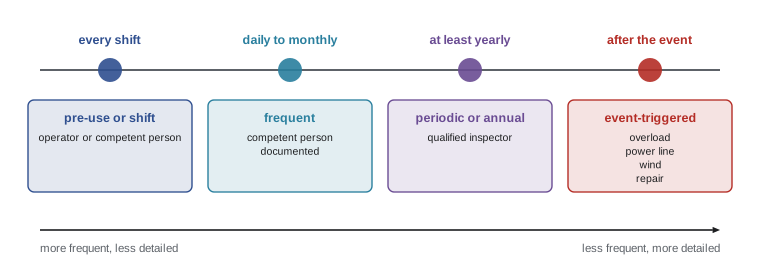
| Level | Typical frequency | Who | What |
|---|---|---|---|
| Pre-use or shift inspection | Before each shift or first use | Operator or a competent person | Visual and functional checks of controls, safety devices, rope, hook, leaks, tires or tracks, setup |
| Frequent inspection | Daily to monthly, depending on service | Competent person | More detailed checks, often documented monthly |
| Periodic or annual inspection | At least every 12 months, more often in severe service | Qualified inspector, often with an engineer's certification | Thorough inspection of structure, mechanisms, rope, brakes, safety devices; may include disassembly and non-destructive testing |
| Event-triggered inspection | After the event, before further use | Qualified person | After overload, shock loading, power line contact, high wind, fire, repair, modification or assembly |
OSHA's 1926.1412 requires a shift inspection by a competent person before each shift, a monthly inspection that is documented, and an annual comprehensive inspection by a qualified person, as well as inspections after modifications, repairs and assembly. Wire rope has its own shift, monthly and annual inspection requirements in 1926.1413. In general industry, 1910.179 requires frequent inspections of overhead cranes, daily to monthly, and periodic inspections at intervals of 1 to 12 months, with certification records for hooks, chains and ropes.
The shift inspection
The shift inspection is the one supervisors are most likely to see. It does not need tools or disassembly, but it should be done carefully, not as a walk around while drinking coffee. A checklist helps make sure nothing is skipped, and a signed checklist shows it was done.
| Item | What to look for |
|---|---|
| Load chart and manual | Present, legible and matching the configuration |
| Safety devices | Load moment indicator, anti-two-block, limit switches, horn, swing alarm and lights working; indicator set to the correct configuration |
| Hook and latch | No cracks, opening or twist; latch closes and is not damaged |
| Wire rope | Broken wires, kinks, crushing, birdcaging, corrosion, correct spooling on the drum |
| Hydraulics | Leaks, damaged hoses, fluid levels |
| Structure | Visible damage, bent lattice members, cracked welds, missing pins or keepers |
| Outriggers, tires or tracks | Damage, leaks, inflation, pads in good condition |
| Controls and brakes | Respond correctly and return to neutral; brakes hold |
| Cab | Clear windows, fire extinguisher, seat and controls secure |
| Setup | Level within the manufacturer's tolerance, outriggers fully extended as planned, mats in place |
Any defect that affects safe operation must be reported immediately and the crane taken out of service until it is repaired and a competent or qualified person has confirmed it is safe. Defects that do not affect safety, such as a cracked mirror housing, are recorded and scheduled for repair.
Crane wire rope
The hoist rope and boom ropes on a crane are running ropes: they bend over sheaves and wind onto drums thousands of times. They fail by fatigue, wear, crushing and corrosion, and their removal criteria are stricter than those for slings because the rope passes over sheaves and failure drops the load.
| Condition in running rope | Common removal criterion (ASME B30.5 and OSHA 1926.1413) |
|---|---|
| Broken wires | 6 randomly distributed broken wires in one rope lay, or 3 broken wires in one strand in one lay |
| Valley breaks | One broken wire in the valley between strands, which suggests internal damage |
| Wear | Loss of more than about one third of the original diameter of outside wires, or reduction in rope diameter beyond the manufacturer's limit |
| Distortion | Kinking, crushing, birdcaging, core protrusion |
| Heat damage | Discoloration from heat or arcing, including power line contact |
| Corrosion | Severe corrosion, pitting or loss of lubrication |
Worked problem
Broken wires in a hoist rope
During a monthly inspection, a ¾ in hoist rope on a mobile crane shows 7 broken wires spread across several strands within one rope lay of about 5 in, near the point where it passes over the boom tip sheave during typical lifts. Should the rope stay in service?
Show solution
- The criterion for running rope is 6 randomly distributed broken wires in one lay, or 3 in one strand in one lay.
- Seven broken wires in one lay exceeds 6.
- The location over the boom tip sheave is a high-fatigue area where damage spreads quickly.
- The rope must be removed from service and replaced, and the sheaves checked for wear or damage that may have caused the breaks.
- Compare with Lesson 6: the same count would not yet meet the sling criterion of 10, which shows why the right standard must be used for the right item.
Answer: Remove the rope from service. Seven broken wires in one lay exceeds the running rope criterion of six, and the sheave should be inspected too.
Hooks
Hooks deform when they are overloaded, tip-loaded or side-loaded. A hook whose throat has opened has been stressed beyond its design and may fail at a lower load next time. Inspectors measure the throat opening against a reference mark or the original dimension, check for twist from the plane of the hook, look for cracks, wear and corrosion, and check that the latch works.
Worked problem
Measuring a hook throat
A hook had a throat opening of 2.375 in when new, recorded at the last periodic inspection. Today it measures 2.5 in. ASME B30.10 generally requires removal when the throat opening has increased by more than 5 percent, not exceeding ¼ in, unless the manufacturer specifies otherwise. Does the hook pass?
Show solution
- Increase: \( 2.5 - 2.375 = 0.125 \) in.
- Percentage increase: \( \tfrac{0.125}{2.375} \times 100 = 5.3 \) percent.
- The 5 percent limit is \( 0.05 \times 2.375 = 0.119 \) in, which is less than the ¼ in cap, so 0.119 in is the limit that applies.
- A 0.125 in increase exceeds 0.119 in, so the hook must be removed from service.
Answer: The hook fails and must be removed. An opened hook should never be heated and bent back into shape; it is replaced, and the cause of the overload is investigated.
Many hooks carry two punch marks or a gauge reference so that inspectors can measure the throat opening quickly. Recording the measurement at each periodic inspection makes slow deformation visible over time.
Events that trigger an inspection
Some events can damage a crane in ways that a routine shift inspection will not reveal. After any of the following, the crane should be taken out of service and inspected by a qualified person before use:
- an overload, a load moment indicator overload event or a sudden shock load such as a dropped or snagged load;
- contact with or arcing from a power line, which can damage wire rope, bearings, hydraulics and electronics;
- exposure to winds above the manufacturer's out-of-service limit, or an earthquake or other severe event;
- a fire on or near the crane;
- repairs, modifications or replacement of load-bearing parts;
- assembly, erection, climbing or reconfiguration, especially for tower cranes and lattice boom cranes.
Modern load moment indicators and rated capacity limiters often record overload events and overrides in a data logger. Reviewing that log at each periodic inspection, and after any incident, shows whether the crane has been pushed past its limits even if nobody reported it.
Load testing
A load test lifts a known test load, usually more than the rated load by a set percentage, to prove the crane after erection, major repair or modification. Load tests must be planned and supervised by qualified people, follow the manufacturer's procedure and the applicable standard, and use certified test weights or calibrated water bags. A load test is not a routine check and is never done casually by lifting something heavier than usual to see what happens.
Maintenance
Maintenance keeps cranes in the condition inspections expect. It should follow the manufacturer's schedule and instructions, use manufacturer-approved parts and be done by trained technicians. Repairs to load-bearing parts, such as welding on a boom, need the manufacturer's approval or an engineer's design and must be followed by inspection and, where required, a load test.
Maintenance work on cranes brings its own hazards: falls from booms and runways, being struck by moving bridges or trolleys, stored energy in hydraulic systems and counterweights, and electrical hazards. Overhead cranes must be locked out, including adjacent cranes on the same runway that could run into the work area, and rail stops placed. Lockout procedures are covered in HSE-210 and fall protection in HSE-212.
Records
Records make inspection and maintenance visible. They let a new operator see the crane's history, let a supervisor confirm inspections are current and let an inspector check compliance.
| Record | Typical content |
|---|---|
| Shift inspection checklist | Date, crane, items checked, defects found, operator signature |
| Monthly or frequent inspection record | Detailed checks, deficiencies, corrective action, inspector |
| Annual or periodic inspection report | Thorough inspection results, test results, certification, qualified inspector or engineer |
| Log book | Operating hours, inspections, repairs, modifications, overload events, operator changes |
| Wire rope records | Rope installation date, size and type, inspection results, replacement |
| Repair and modification records | Work done, parts, manufacturer or engineer approval, return-to-service sign-off |
Rented cranes and hoists
When a crane is rented with an operator, the rental company usually maintains it, but the user on site still needs to see that it is in good condition and properly documented. When a crane or hoist is rented without an operator, the user takes on more responsibility for daily inspection and safe use. On arrival, a supervisor should check the annual inspection certificate, the log book, the load chart for the configuration to be used, the operator's qualification and any open deficiencies. If the paperwork is missing or out of date, the crane does not work until it is sorted out.
Returning a crane to service
When a crane has been taken out of service, someone must decide that it is safe to use again, and that decision should be recorded. For minor defects found at the shift inspection, a competent person may confirm the repair and sign the crane back into service. For repairs to load-bearing parts, safety devices, wire rope, brakes or structure, and after any event-triggered inspection, the return to service should be signed by a qualified person, and in some cases by the manufacturer or an engineer, after any required testing. Tagging the controls with an out-of-service tag, and removing the key where practical, prevents someone from using the crane before that sign-off. A supervisor who finds a tagged crane in use should stop it immediately and find out who removed the tag and why.
Common mistakes
MistakeTreating the shift inspection as a quick walk around.
InsteadUse a checklist, test safety devices and record the result.
MistakeUsing sling removal criteria for crane hoist rope.
InsteadRunning rope has stricter criteria; use the crane standard and manufacturer.
MistakeHeating and bending an opened hook back into shape.
InsteadReplace it and investigate the overload.
MistakeReturning a crane to work after a power line contact once it seems to run normally.
InsteadTake it out of service until a qualified person inspects it.
MistakeAccepting a rented crane without checking its paperwork.
InsteadCheck the annual inspection, log book, load chart and operator qualification on arrival.
Summary and key terms
- Inspections come in levels: shift, frequent or monthly, periodic or annual, and event-triggered.
- OSHA 1926.1412 requires shift, monthly and annual inspections; 1910.179 covers overhead cranes in general industry.
- Crane running rope is removed at 6 random broken wires in one lay or 3 in one strand, stricter than slings.
- Hooks are removed when the throat opening increases beyond the limit, typically 5 percent capped at a small fixed amount, or when twisted or cracked.
- Overloads, power line contact, high wind, fire, repairs and assembly trigger an inspection before further use.
- Records of inspections, repairs and events should travel with every crane, including rented ones.
- Shift inspection
- A visual and functional check before each shift by the operator or a competent person.
- Periodic inspection
- A thorough inspection, at least annual, by a qualified person.
- Running rope
- Wire rope that moves over sheaves or drums, such as a hoist line.
- Valley break
- A broken wire in the gap between strands, often a sign of internal damage.
- Throat opening
- The distance across the opening of a hook, measured to check for deformation.
- Load test
- A planned lift of a known test load to prove a crane after erection, repair or modification.
- Log book
- A record kept with the crane of its use, inspections, repairs and events.
Practice problems
Work each problem on paper first, then reveal the answer to check.
Name the four levels of crane inspection.
Show answer
Shift or pre-use, frequent or monthly, periodic or annual, and event-triggered.
Who typically does the annual inspection?
Show answer
A qualified inspector, often with a professional engineer's certification.
What is the broken-wire removal criterion for crane running rope?
Show answer
6 randomly distributed broken wires in one lay or 3 in one strand in one lay.
Why are running rope criteria stricter than sling criteria?
Show answer
Running rope bends over sheaves repeatedly and its failure drops the load.
A hook throat was 2 in and is now 2.125 in. Does it pass a 5 percent limit?
Show answer
No: 0.125 in is a 6.25 percent increase, over the 0.1 in limit.
List four events that require a special inspection.
Show answer
Overload, shock load, power line contact, high wind, fire, repair, modification, assembly.
What can a load moment indicator data logger reveal?
Show answer
Overload events and overrides that may not have been reported.
Why must adjacent overhead cranes be locked out during runway maintenance?
Show answer
They could travel into the work area and strike workers or the crane being repaired.
What should be checked when a rented crane arrives?
Show answer
Annual inspection certificate, log book, correct load chart, operator qualification and open deficiencies.
May an opened hook be bent back into shape?
Show answer
No. It must be replaced.
Lesson quiz · 5 questions
Score 60% or more to complete this lesson.
Create a free account to save your progress, take quizzes and earn a certificate.