
FILM-430 · Lesson 9 of 12 · 25 min
Feminist, queer and gender theory
Feminist and queer theories ask how films represent gender and sexuality, who gets to make films and tell stories, and how viewers with different identities find pleasure, recognition or harm in what they watch. They range from counting how often women speak on screen to rethinking gender itself as a performance. This lesson surveys feminist film criticism beyond the psychoanalytic theory of Lesson 8, the development of queer theory and New Queer Cinema, trans and intersectional perspectives, and the quantitative tools used to track representation in the industry.
The male gaze, the oppositional gaze and the final girl were introduced in Lesson 8. Here we look at the wider field and at methods you can use in your own criticism.
From images of women to theory
The first wave of feminist film criticism in the early 1970s studied images of women. Books such as Molly Haskell's From Reverence to Rape (1973) and Marjorie Rosen's Popcorn Venus (1973) surveyed decades of Hollywood films and cataloged stereotypes: the virgin and the vamp, the self-sacrificing mother, the career woman punished for ambition. They showed that women's roles reflected and reinforced social attitudes, and they argued for more varied, realistic portrayals.
Other critics found this approach too simple. Claire Johnston, a British critic, argued in Women's Cinema as Counter-Cinema (1973) that the problem was not just inaccurate images but the language of cinema itself, which turned woman into a sign of male fantasy. Realism alone could not fix this, because realist conventions were themselves ideological. Johnston called for a feminist counter-cinema that would challenge cinematic conventions, connecting feminism to the ideas of Lesson 6. Her argument, alongside Mulvey's, moved feminist criticism from content to form.
Women's genres, melodrama and the body
Feminist scholars of the 1980s returned to genres aimed at women, such as melodrama and the woman's film, which earlier critics had dismissed as sentimental. Linda Williams, writing about the maternal melodrama Stella Dallas (1937), argued that female viewers did not simply absorb its message of self-sacrifice but recognized the contradictions it dramatized. Tania Modleski and others studied soap operas and romance, showing how these forms addressed women's experiences of waiting, caring and emotional labor.
Williams later proposed that some genres, which she called body genres, are defined by producing bodily responses in viewers that mirror those on screen: screams in horror, tears in melodrama and arousal in pornography. These genres are culturally low because they appear excessive, but they address deep fantasies about sexuality, gender and origins. The concept helps explain why certain genres are popular and why they are often dismissed.
Women behind the camera
Feminist historians have recovered the work of women filmmakers marginalized in standard histories. Alice Guy-Blaché directed hundreds of films from 1896 and ran her own studio in the United States; Lois Weber was among the most successful directors of the 1910s; Dorothy Arzner was almost the only woman directing in Hollywood's studio era; and Agnès Varda, Chantal Akerman and others reshaped European cinema. This research questions auteur canons (Lesson 4) and shows how industrial structures excluded women as Hollywood consolidated in the 1920s.
In the United States, women directors were rare in Hollywood for most of the twentieth century. Ida Lupino directed and produced independent features in the 1950s, and Kathryn Bigelow became the first woman to win the Academy Award for Best Director for The Hurt Locker (2009). Directors such as Julie Dash, whose Daughters of the Dust (1991) was the first feature by an African American woman to receive general theatrical release in the United States, and Greta Gerwig, whose Barbie (2023) became one of the year's highest-grossing films, show both progress and its limits.
Measuring representation
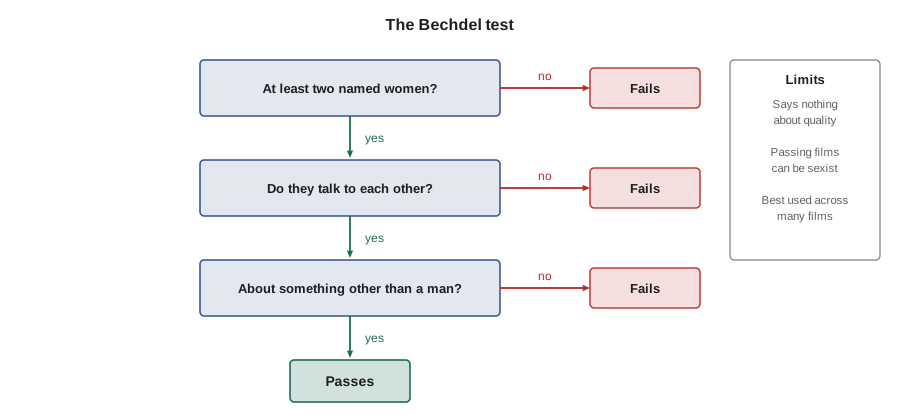
Quantitative research tracks who appears on screen and who works behind the camera. The simplest tool is the Bechdel test, which originated in a 1985 comic strip by the cartoonist Alison Bechdel, crediting her friend Liz Wallace. A film passes if it has at least two named women who talk to each other about something other than a man. The test does not measure quality or feminism; a film can pass and still be sexist, or fail and still be thoughtful. Its value is as a rough indicator across many films, revealing how often women exist only in relation to men.
import random
random.seed(9)
rates = {"1980s": 0.38, "1990s": 0.45, "2000s": 0.52, "2010s": 0.60, "2020s": 0.66}
for decade, p in rates.items():
    results = [random.random() < p for _ in range(50)]
    passed = sum(results)
print(f"{decade}: {passed} of 50 films pass ({passed / 50:.0%})")1980s: 23 of 50 films pass (46%) 1990s: 25 of 50 films pass (50%) 2000s: 27 of 50 films pass (54%) 2010s: 30 of 50 films pass (60%) 2020s: 36 of 50 films pass (72%)
Real datasets, such as volunteer-run sites that track thousands of films, have shown rising pass rates over time, although many popular films still fail. Researchers have proposed other tests: the GLAAD Vito Russo test for LGBTQ characters who are more than a punchline, and tests focusing on whether characters of color have their own narrative purpose.
Industry studies give more precise figures. The USC Annenberg Inclusion Initiative tracks the top-grossing films in the United States each year. Its study of 2025 found that women directed only 8.1 percent of the top 100 films, down from 13.4 percent in 2024, and reported that women held only about a third of speaking roles in 2025's top films. Directors from underrepresented racial and ethnic groups made up about a quarter of directors.
In the United States, there is no national public funder with comparable reporting, so research relies on studies of box office rankings, streaming releases and guild data. Year-to-year figures fluctuate, which is why researchers look at trends over a decade or more rather than a single year.
Queer theory and the history of the closet
Queer film criticism began by documenting how LGBTQ people were represented, or erased. Vito Russo's The Celluloid Closet (1981) traced a history of Hollywood depictions from coded sissies and predatory villains to tragic victims. Under the Production Code, enforced from 1934 to the late 1960s, homosexuality could not be shown openly, so it appeared through coding: costume, gesture, dialogue and narrative punishment. Critics learned to read these codes, and queer audiences developed their own pleasures in stars, camp and subtext.
In the 1990s, queer theory moved beyond counting images. Drawing on post-structuralism (Lesson 7), the philosopher Judith Butler argued in Gender Trouble (1990) that gender is performative: not an inner essence but an identity produced through repeated acts. Queer theory questioned fixed categories of gender and sexuality and the assumption that heterosexuality is natural. Alexander Doty argued that queerness is not only in films made by or about queer people; mainstream films offer queer readings that are as valid as straight ones.
Worked problem
A queer reading of a classic film
In Hitchcock's Rebecca (1940), a young second wife arrives at a grand estate haunted by the memory of the first wife, Rebecca, and is tormented by the housekeeper, Mrs Danvers, who is devoted to Rebecca's memory. How might a queer reading approach the film?
Show solution
- Identify the Production Code context: same-sex desire could not be depicted openly in 1940, so critics look for coded signs.
- Analyze the evidence: Mrs Danvers caresses Rebecca's clothes and lingerie, preserves her bedroom like a shrine and speaks of her with intense, possessive admiration.
- Interpret: many critics read Mrs Danvers's devotion as coded lesbian desire, and the film's narrative ends by destroying her, an instance of the punishment pattern Russo identified.
- Evaluate: the reading draws on the film's own images and on historical context; it does not claim to know the filmmakers' intentions, which Doty argues are not required.
Answer: A queer reading shows how the film encodes and then punishes desire it cannot name, illuminating both the film and the censorship that shaped it.
New Queer Cinema and beyond
In 1992, the critic B. Ruby Rich named a wave of independent films New Queer Cinema: works such as Jennie Livingston's documentary Paris Is Burning (1990), about Black and Latino ballroom culture in New York, Todd Haynes's Poison (1991) and Tom Kalin's Swoon (1992). These films were formally adventurous, unapologetic, often angry in response to the AIDS crisis, and uninterested in positive images designed for straight audiences. Since then, queer cinema has moved into the mainstream, from Brokeback Mountain (2005) to Moonlight (2016), the first film with an all-Black cast and an LGBTQ story to win the Academy Award for Best Picture.
American queer cinema grew from independent and festival circuits, supported by festivals such as Frameline in San Francisco and Outfest in Los Angeles, and by distributors willing to take risks. Mainstream studios moved more slowly, and debates continue about how LGBTQ characters are represented in franchise films and in international releases edited for different markets.
Trans perspectives and intersectionality
Trans film criticism examines how transgender people have been depicted, often as deceivers, punchlines or victims, and how trans filmmakers and performers are changing those images. The documentary Disclosure (2020) surveyed this history through the voices of trans actors and critics. Trans theory also questions how cinema uses reveals, makeup and casting, and asks who gets to play trans roles.
Intersectionality, a term introduced by the legal scholar Kimberlé Crenshaw in 1989, describes how race, gender, sexuality, class and other identities combine to shape experiences of discrimination and privilege. In film criticism, it warns against treating women or queer people as a single group. bell hooks's oppositional gaze (Lesson 8) is intersectional, and Lesson 10 develops theories of race and nation that interact with gender and sexuality.
Applying feminist and queer theory in an essay
A strong feminist or queer reading usually combines several of the tools in this lesson. Start with representation: who appears, who speaks, who has goals and who survives. Then move to form: whose point of view organizes scenes, how bodies are framed and lit, and how the narrative rewards or punishes characters. Finally, consider context and reception: the censorship rules, industry conditions and audiences that shaped the film and its meanings. Quantitative evidence, such as speaking time or point-of-view shots, can support a claim, but it should be connected to close analysis of key scenes.
Be specific about which theory you are using. Images of women criticism, Mulvey's psychoanalytic account, Butler's performativity and an intersectional analysis lead to different questions, and naming the framework helps readers follow and test your argument.
Common mistakes
MistakeTreating the Bechdel test as a measure of a film's feminism
InsteadUse it as a rough indicator across many films, not a verdict on one film.
MistakeAssuming queer readings require the filmmaker's intention
InsteadGround queer readings in on-screen evidence and historical context, as Doty argued.
MistakeComparing funder statistics directly with box office studies
InsteadNote that funder data cover only funded projects while box office studies cover top-grossing films.
MistakeTreating gender and sexuality as the same thing
InsteadDistinguish gender identity and expression from sexual orientation, and consider how they interact.
MistakeDiscussing women as a single group
InsteadApply intersectionality, considering how race, class and sexuality shape experiences.
Summary and key terms
- Early feminist criticism cataloged images of women; Johnston and Mulvey moved the focus to cinematic form.
- Feminist scholars revalued melodrama and women's genres, and Williams described body genres.
- Historians recovered women filmmakers, and public institutions such as Canada's Studio D supported feminist filmmaking.
- The Bechdel test and industry studies measure representation, and recent studies show uneven progress.
- Queer criticism traced coding under the Production Code and the punishment of queer characters.
- Butler's performativity and Doty's queer readings broadened queer theory, and New Queer Cinema reshaped independent film.
- Trans criticism and intersectionality show how identities combine and why no group is uniform.
- Images of women criticism
- Early feminist criticism cataloging stereotypes of women in films.
- Women's cinema as counter-cinema
- Johnston's call for feminist films that challenge cinematic conventions.
- Body genres
- Williams's term for genres producing bodily responses, such as horror and melodrama.
- Bechdel test
- A test asking whether two named women talk about something other than a man.
- Production Code
- Hollywood's self-censorship rules enforced from 1934 to the late 1960s.
- Coding
- Indirect signals of identity or desire used when explicit depiction was forbidden.
- Performativity
- Butler's idea that gender is produced through repeated acts rather than an inner essence.
- Queer reading
- An interpretation that uncovers queer meanings in a text, regardless of intention.
- New Queer Cinema
- A wave of bold independent queer films around 1990 named by B. Ruby Rich.
- Intersectionality
- Crenshaw's concept of how combined identities shape discrimination and privilege.
Practice problems
Work each problem on paper first, then reveal the answer to check.
What did images of women criticism do?
Show answer
It cataloged stereotypes of women across many films and argued for more varied portrayals.
Why did Claire Johnston think realism was not enough?
Show answer
Realist conventions were themselves ideological and turned woman into a sign of male fantasy.
Name the three body genres Williams identified.
Show answer
Horror, melodrama and pornography.
What was Studio D?
Show answer
The National Film Board's feminist studio, founded in 1974 and closed in 1996.
State the three conditions of the Bechdel test.
Show answer
Two named women, who talk to each other, about something other than a man.
Give one limitation of the Bechdel test.
Show answer
A film can pass and still be sexist, or fail and still be thoughtful.
What did the USC Annenberg study find about women directors of top films in 2025?
Show answer
They directed 8.1 percent of the top 100 films, down from 13.4 percent in 2024.
How did the Production Code affect queer representation?
Show answer
It forbade open depiction, so queerness appeared through coding and narrative punishment.
Explain Butler's performativity in one sentence.
Show answer
Gender is an identity produced through repeated acts rather than an inner essence.
Name two films associated with New Queer Cinema.
Show answer
Paris Is Burning, Poison, Swoon.
Lesson quiz · 5 questions
Score 60% or more to complete this lesson.
Create a free account to save your progress, take quizzes and earn a certificate.