
FILM-430 · Lesson 2 of 12 · 26 min
Formalism and montage
The first serious theories of film set out to prove that cinema was an art and not merely a mechanical recording. Their answer was that film becomes art precisely where it departs from reality: through framing, editing, rhythm and the deliberate shaping of what the camera captures. This lesson covers that formalist tradition, from early psychological and aesthetic theories to the Soviet montage theorists of the 1920s, whose ideas still shape editing, advertising and music video today.
FILM-101 Lesson 7 introduced montage as a style and FILM-220 Lesson 2 showed how editors use editing theory in practice. This lesson goes into the theories themselves: what the formalists claimed, why they claimed it, and how their arguments hold up.
The problem classical theorists faced
In the 1910s and 1920s, many educated critics dismissed film as a cheap amusement or a mechanical copy of the world. A painting or a poem required an artist's transformation; a camera, they argued, simply recorded whatever was in front of it. Early theorists responded in two ways. Some, the formalists, argued that film is art because it can transform reality, just as painting does. Others, the realists covered in Lesson 3, argued that film's unique power lies in its relationship to reality itself. The debate between these positions organized film theory for half a century.
The German-American psychologist Hugo Münsterberg offered one of the first answers in 1916. He argued that film reproduces the workings of the mind rather than the external world. The close-up resembles attention, the flashback resembles memory, and editing resembles the way thought jumps between ideas. Film, in this view, is art because it frees images from the constraints of physical space and time and arranges them according to the logic of consciousness.
Arnheim and the virtues of limitation
Rudolf Arnheim, a German psychologist of perception, published Film as Art in 1932. His argument was counterintuitive: film is an art because of its limitations as a recording medium. The early film image was flat, framed, black and white, silent and cut into pieces. Each of these differences from real perception gave the filmmaker a means of expression. Because the image is framed, the filmmaker chooses what to show and what to exclude. Because it is flat, depth must be suggested, and objects can be arranged for graphic effect. Because it lacks color, light and shadow carry meaning.
Arnheim therefore viewed the arrival of synchronized sound, color and widescreen with suspicion. Each technical improvement brought film closer to a complete reproduction of reality and, he feared, reduced the filmmaker's room for art. Few critics share that fear today, but Arnheim's central idea remains useful: expression comes from the gap between the image and the world. When a contemporary director shoots in black and white or a square frame, they are using a limitation in exactly the way Arnheim described.
- The frame: choosing and excluding, and creating tension at the edges of the image.
- Flatness: arranging objects graphically, making size and position expressive.
- Absence of color and sound: using light, gesture and rhythm to carry what color and sound would carry.
- Editing: breaking continuous space and time and rebuilding them for expressive ends.
Russian formalism and making the familiar strange
Alongside the film theorists, a group of Russian literary critics developed ideas that would deeply influence film. Viktor Shklovsky argued that the purpose of art is defamiliarization, or making strange: everyday perception becomes automatic, and art disrupts that automatism so that we see things freshly. The Russian formalists also distinguished between the fabula, the chronological story events, and the syuzhet, the order and manner in which a work presents them. These terms entered film theory directly; Bordwell later built his theory of narration on the fabula and syuzhet distinction, as Lesson 11 shows.
For a filmmaker, defamiliarization means using unusual angles, editing or sound to break habitual perception. A low angle on an ordinary staircase, a sudden cut to an extreme close-up of a hand, or a long silence where music would normally swell can all make a familiar situation strange and therefore noticeable.
Kuleshov and the effect of juxtaposition
In the early 1920s, the Soviet filmmaker and teacher Lev Kuleshov ran experiments at the Moscow film school. The best known, now called the Kuleshov effect, reportedly intercut the same neutral close-up of an actor's face with different images, such as a bowl of soup, a child in a coffin and a woman on a couch. Viewers were said to praise the actor's subtle expressions of hunger, grief and desire, although the face never changed. The original footage has not survived, and later attempts to replicate the experiment have produced mixed results, but the principle became foundational: the meaning of a shot depends on the shots around it.
Kuleshov also demonstrated creative geography, in which shots filmed in different places are edited together to create a continuous space that never existed. Both ideas show that editing is not a neutral joining of pieces; it constructs meaning, emotion and even space.
Pudovkin and linkage
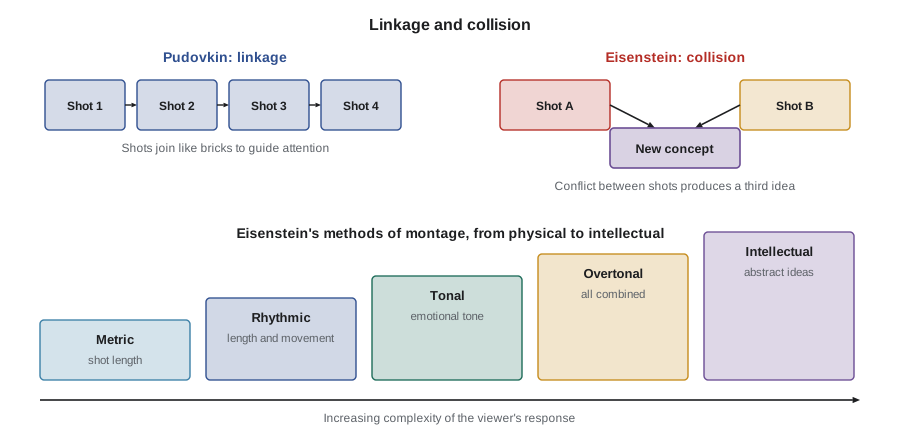
Vsevolod Pudovkin, a student of Kuleshov and director of Mother (1926), developed a theory of editing as linkage. For Pudovkin, shots are like bricks, and the editor builds a scene by joining them so that each guides the spectator's attention to the next significant detail. His approach emphasized clarity, emotional build-up and the guidance of the viewer's attention. It is close in spirit to the continuity editing of Hollywood, although Pudovkin placed more weight on the expressive power of editing to shape emotion and argument.
Eisenstein and montage as collision
Sergei Eisenstein, director of Strike (1925), Battleship Potemkin (1925) and October (1928), rejected the brick metaphor. For him, montage was collision: two shots in conflict produce a concept that neither contains alone, much as two characters combine in some written languages to form a new meaning. Eisenstein drew on Marxist dialectics, in which a thesis and antithesis produce a synthesis, and on Japanese writing, theater and poetry. His aim was not only to guide attention but to shock the spectator into new thoughts and feelings and, ultimately, to support revolutionary consciousness.
Eisenstein described several methods of montage, which he saw as a hierarchy from simple physical effects to intellectual concepts.
| Method | Basis of the cut | Effect on the viewer | Simple example |
|---|---|---|---|
| Metric | Length of shots, regardless of content | Physical tension or excitement as cuts accelerate | Shots shortening by a fixed ratio during a march |
| Rhythmic | Length combined with movement inside the frame | Momentum created by movement across cuts | Marching feet that cut on the beat of the step |
| Tonal | Emotional tone of the shots, such as light or texture | Mood | Misty harbor shots that create mourning |
| Overtonal | Combination of the previous levels | Complex, layered response | A sequence where pace, movement and tone build together |
| Intellectual | Abstract ideas created by juxtaposition | A concept the viewer must infer | A politician intercut with a mechanical peacock to suggest vanity |
The famous Odessa Steps sequence in Battleship Potemkin shows these methods working together. Soldiers descend a long flight of stairs, firing on unarmed civilians. Eisenstein cuts between the regular, mechanical rhythm of the soldiers' boots and the chaotic, individual movements of the crowd, and he stretches the time of the massacre far beyond its real duration by repeating and overlapping actions. A mother carrying her wounded son climbs against the descending soldiers; a baby carriage rolls down the steps. The sequence produces physical tension through metric and rhythmic cutting, mourning and horror through tonal contrast, and a political argument about state violence through collision.
Worked problem
Calculating metric montage
A filmmaker wants a sequence of eight shots that accelerates in metric montage, with each shot two-thirds the length of the previous one, starting with a 6-second shot. Calculate the shot lengths and total duration, and explain the intended effect.
Show solution
- The shot lengths form a geometric sequence: 6, 4, 2.67, 1.78, 1.19, 0.79, 0.53 and 0.35 seconds.
- The total is the sum of a geometric series: 6 multiplied by (1 minus (2/3) to the eighth power), divided by (1 minus 2/3), which is about 17.3 seconds.
- At 24 frames per second, the last shot lasts only about 8 frames, close to the threshold where viewers register a shot as a flash.
- Eisenstein would expect the shortening rhythm to raise physical tension regardless of content, which is why metric montage is common in trailers and action climaxes.
Answer: About 17.3 seconds in total; the accelerating cuts create tension through pace alone, which is the essence of metric montage.
fps = 24
first, ratio, n = 6.0, 2 / 3, 8
lengths = [first * ratio ** k for k in range(n)]
for i, L in enumerate(lengths, 1):
    print(f"Shot {i}: {L:5.2f} s = {round(L * fps):3d} frames")
print(f"Total: {sum(lengths):.1f} s")Shot 1: 6.00 s = 144 frames Shot 2: 4.00 s = 96 frames Shot 3: 2.67 s = 64 frames Shot 4: 1.78 s = 43 frames Shot 5: 1.19 s = 28 frames Shot 6: 0.79 s = 19 frames Shot 7: 0.53 s = 13 frames Shot 8: 0.35 s = 8 frames Total: 17.3 s
Vertov and the Kino-Eye
Dziga Vertov, another Soviet filmmaker, rejected fiction altogether. He argued that the camera, the Kino-Eye, could see more than the human eye: it could slow down and speed up motion, view the world from impossible angles and assemble a truer picture of social life than staged drama. His Man with a Movie Camera (1929) shows a day in the life of Soviet cities and constantly reveals its own making: we see the cameraman filming, the editor cutting the film, and the audience watching it in a cinema. Vertov's work is formalist in its celebration of editing and camera technique, yet documentary in its commitment to filming actual life. It anticipates later reflexive documentary and the essay film.
What happened to the formalists
Soviet montage cinema flourished for less than a decade. By the early 1930s, the Soviet state imposed socialist realism, which demanded clear narratives, positive heroes and accessible style. Eisenstein, Vertov and others were criticized for formalism, a term that became an accusation of elitism and political unreliability. Eisenstein continued to work and write, and his later theory explored sound, color and the unity of the arts, but the radical experiments of the 1920s were curtailed.
The formalists' influence outside the Soviet Union was enormous. Film societies across Europe and North America studied their films; documentary filmmakers, including John Grierson, who later founded Canada's National Film Board, admired their editing; and Hollywood absorbed montage sequences as a compact way to show the passage of time. In later decades, music videos, advertising and action films made rapid, collision-based editing part of everyday visual culture.
In the United States, formalist principles of rhythm and juxtaposition shaped avant-garde work from Maya Deren's Meshes of the Afternoon (1943) to Bruce Conner's found-footage collage A Movie (1958), and later entered mainstream editing through music video and advertising.
Strengths and limits of formalism
Formalist theories are excellent at explaining how film techniques produce effects. They encourage close attention to rhythm, composition and juxtaposition, and they give filmmakers deliberate tools. Their weaknesses are equally clear. They tend to treat the spectator as a passive recipient of effects, assuming that a given cut will produce a given response. They can undervalue the long take, the performance and the ambiguity of reality, which the realists defended. And Eisenstein's own aim of political persuasion raises questions about manipulation that later ideological critics would turn back on Hollywood.
Common mistakes
MistakeTreating the Kuleshov effect as a proven scientific law
InsteadDescribe it as an influential principle whose original evidence is lost and whose replications are mixed.
MistakeUsing montage to mean any editing
InsteadUse montage for editing that creates meaning through juxtaposition, and distinguish linkage from collision.
MistakeAssuming formalism means style without content
InsteadRecognize that the Soviet formalists used form to argue politically and to change perception.
MistakeThinking Arnheim welcomed sound and color
InsteadArnheim feared they would reduce film's expressive limits and push it toward mere reproduction.
MistakeDescribing the Odessa Steps only as a plot event
InsteadAnalyze how metric, rhythmic, tonal and intellectual montage work together in the sequence.
Summary and key terms
- Classical theorists argued over whether film is art because it transforms reality or because it records it.
- Münsterberg saw film as reproducing the mind; Arnheim argued that film's limitations as a recording medium create its art.
- Russian formalists contributed defamiliarization and the fabula and syuzhet distinction.
- Kuleshov showed that the meaning of a shot depends on its neighbors and that editing can construct space.
- Pudovkin saw editing as linkage; Eisenstein saw it as collision producing new concepts.
- Eisenstein's methods range from metric and rhythmic to tonal, overtonal and intellectual montage.
- Vertov's Kino-Eye combined formalist technique with documentary, and Soviet montage was curtailed by socialist realism.
- Formalism
- The view that film becomes art through techniques that transform and shape reality.
- Defamiliarization
- Shklovsky's term for art that makes familiar things strange so they are seen anew.
- Fabula
- The chronological sequence of story events that the viewer infers.
- Syuzhet
- The order and manner in which a work actually presents story events.
- Kuleshov effect
- The principle that viewers read a shot's meaning from the shots around it.
- Creative geography
- Editing shots from different places to create an imagined continuous space.
- Linkage
- Pudovkin's model of editing as joining shots like bricks to guide attention.
- Collision
- Eisenstein's model of editing in which conflicting shots produce a new concept.
- Intellectual montage
- Juxtaposition that creates an abstract idea the viewer must infer.
- Kino-Eye
- Vertov's concept of the camera as a perceptual instrument superior to the human eye.
Practice problems
Work each problem on paper first, then reveal the answer to check.
State Arnheim's main argument about why film is an art.
Show answer
Its differences from real perception, such as framing and flatness, give filmmakers expressive means.
What is the difference between fabula and syuzhet?
Show answer
Fabula is the chronological story; syuzhet is how the film arranges and presents it.
Describe the Kuleshov effect and one caution about it.
Show answer
A face reads differently depending on adjacent shots; the original footage is lost and replications are mixed.
Contrast Pudovkin's and Eisenstein's views of editing.
Show answer
Pudovkin linked shots to build a scene; Eisenstein collided shots to produce new ideas.
Give an example of intellectual montage.
Show answer
Cutting from a politician to a preening peacock to suggest vanity.
Shot lengths fall from 4 s by a ratio of 0.5 over five shots. List them.
Show answer
4, 2, 1, 0.5 and 0.25 seconds.
Why was formalism criticized in the Soviet Union in the 1930s?
Show answer
The state imposed socialist realism and called experimental work elitist formalism.
Name one way Vertov's film reveals its own making.
Show answer
It shows the cameraman filming, the editor cutting and audiences watching.
Give one limitation of formalist theory.
Show answer
It treats spectators as passive and can undervalue long takes and ambiguity.
How might a contemporary director use an Arnheim-style limitation?
Show answer
By shooting in black and white or a square frame to make light and composition expressive.
Lesson quiz · 5 questions
Score 60% or more to complete this lesson.
Create a free account to save your progress, take quizzes and earn a certificate.