
FILM-320 · Lesson 5 of 12 · 27 min
Working with actors I: the language of direction
Actors are the part of a film the audience watches most closely, and they are also the part a director influences mainly through words. A cinematographer can be shown a reference image; a production designer can be given a color swatch. An actor's performance comes from inside them, and the director's main tool for shaping it is language: what you say, when you say it and how. This lesson is about that language. It covers the main traditions of actor training, the difference between directions that actors can play and directions that block them, a working vocabulary of action verbs and images, and how to give notes that help.
Many first-time directors find this the most intimidating part of the job. They know how to frame a shot but feel unsure what to say to an actor who is not getting a scene right. The good news is that directing actors is a learnable craft built on a few principles, and that actors generally want to be directed. What they do not want is direction that asks them to do the impossible, such as feeling an emotion on command, or that leaves them guessing.
What actors do
Acting on film is the art of behaving truthfully in imaginary circumstances, with a camera close enough to see thought. An actor builds a character from the script and their own imagination, then on each take tries to pursue the character's objectives as if for the first time, responding to what the other actors actually give them. Good film acting often looks like no acting at all, because the camera magnifies anything false.
Film acting has particular demands. Scenes are shot out of order, sometimes the ending before the beginning. The same moment is repeated many times from different angles, and the actor must match physical actions while keeping the emotional life fresh. Actors often play to a mark on the floor, a piece of tape beside the lens or an empty space where another actor will be added later. They wait for hours and then must be ready instantly. Understanding these conditions helps a director give direction that actors can use.
Traditions of actor training
Actors come from many training backgrounds, and knowing the main traditions helps a director speak their language. Most modern approaches descend from the work of Konstantin Stanislavski at the Moscow Art Theater in the early twentieth century. His system asked actors to work from given circumstances, objectives and the imagination, and later from physical actions, rather than from external display.
| Tradition | Key figures | Emphasis | Useful language for directors |
|---|---|---|---|
| Stanislavski's system | Konstantin Stanislavski | Given circumstances, objectives, units, imagination, physical actions | What do you want? What are the circumstances? |
| The Method | Lee Strasberg | Affective or emotional memory, relaxation, sensory work | What does this remind you of? (used carefully) |
| Meisner technique | Sanford Meisner | Truthful listening and responding moment to moment | Listen and let her change you |
| Adler's approach | Stella Adler | Imagination and the actions of the play, rather than personal memory | Imagine the place; what are you doing? |
| Physical and movement-based | Michael Chekhov, Jacques Lecoq and others | The body, gesture, rhythm and imagination | Find the gesture; change the tempo |
| Technical or classical | British and Canadian stage traditions | Text, voice, clarity and craft | Where is the emphasis? What is the thought? |
Directors do not need to master every tradition, and should avoid trying to teach actors their own craft on set. The practical lesson is that most trained actors understand the language of objectives, circumstances, actions and listening. Some techniques, particularly those that draw on personal emotional memory, can be powerful but carry risks; directors should never push an actor to relive personal trauma, and should leave decisions about personal material entirely to the actor.
Result direction and playable direction
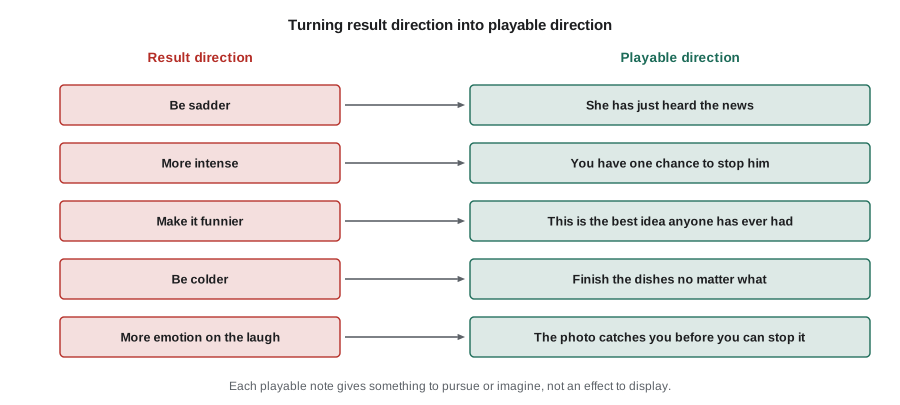
The single most important distinction in directing actors is between result direction and playable direction. Result direction describes the effect you want: "be sadder", "more intense", "make it funny", "I want to feel her pain". It tells the actor what you want the audience to see, but not how to get there, and it pushes the actor to show emotion rather than experience it. The usual consequence is indicated or pushed acting: the actor displays sadness, intensity or humor, and the camera sees the effort.
Playable direction gives the actor something to do or think that is likely to produce the result. It might be an objective, a change in circumstances, an action verb, an image, a physical task or a fact about the relationship. Because it engages the actor's imagination rather than their self-monitoring, it tends to produce behavior that feels real.
Worked problem
Converting result notes into playable notes
After a take of the kitchen scene, a director's instinct is to give these notes: to Dana, "be colder"; to Maya, "I need more emotion on the laugh"; to both, "the ending should feel sadder". Rewrite each as playable direction.
Show solution
- To Dana, instead of "be colder": "Your objective is to get through these dishes without letting her see she can hurt you. Every time she speaks, scrub harder."
- To Maya, instead of "more emotion on the laugh": "You didn't expect this photo. It's the haircut from the summer before you left. Let it catch you before you can stop it."
- To both, instead of "sadder ending": "Each of you is trying to give the other something. When the box comes back, it's a refusal. Take a moment to decide whether to try again."
Answer: Each note now gives an action, a specific memory or a new understanding of the situation. The feeling the director wanted is likely to emerge without being performed.
A vocabulary of action verbs
Action verbs, sometimes called actions or actioning, are transitive verbs that describe what one character is doing to another: to charm, to provoke, to soothe, to warn, to belittle, to plead with, to test. Because they are directed at the other person and can be pursued, they are naturally playable. A director can suggest an action for a line or a beat: "On 'You weren't here to ask', try to wound her." The actor then plays the action and lets the other actor's reaction shape the next moment.
| Intention | Verbs |
|---|---|
| To bring closer | to welcome, to comfort, to charm, to reassure, to tempt, to flatter |
| To push away | to dismiss, to reject, to warn, to threaten, to belittle, to shut out |
| To get information | to probe, to test, to interrogate, to coax, to trap |
| To change their mind | to persuade, to plead with, to bargain with, to shame, to inspire |
| To hurt | to wound, to punish, to mock, to accuse, to expose |
| To protect oneself | to deflect, to stall, to placate, to distract, to hide from |
Action verbs are a tool, not a rule. Some actors love them; others find line-by-line actioning mechanical. Use them when an actor is stuck or when a moment needs a specific change, and adapt to each actor's preferences.
Other playable tools
Besides objectives and actions, directors use several other kinds of playable direction. An "as if" gives an actor a comparison from their own experience or imagination: "Play it as if you're telling her about a car accident you caused." An image gives a picture to hold: "The kitchen is the last place your mother stood." A fact changes the circumstances: "You've already booked a flight home for tomorrow morning." A physical task gives the body something to do that shapes the scene: "Keep drying the same plate the whole time." A tempo note changes rhythm: "Pick up the cues; don't let any silence settle until the album."
Facts and circumstances are especially powerful because they change everything at once without telling the actor how to play it. If Maya knows she has a flight booked tomorrow, her offer to "take copies" becomes a goodbye. If Dana has found a letter from their mother that mentions Maya, her line "She was still here" might come from a different place. The director can introduce such facts privately to one actor, which can create genuine surprise for the other, though this should be used with care and never to embarrass or deceive an actor in ways that damage trust.
Giving notes
How a director gives notes matters as much as what the notes say. Several habits help. Go to the actor and speak quietly, rather than shouting across the set. Begin with what is working, honestly and specifically, so the actor knows what to keep. Give one or two notes at a time, not ten. Make the note specific to a moment. Keep notes to each actor private when they concern that actor's performance. Then let them try it.
Timing matters too. Between takes, actors are trying to hold on to their concentration; a long conversation can break it. Some actors like to talk through a scene; others prefer a single word and then silence. Learning each actor's preferences in rehearsal pays off on set. When a take is good, say so clearly, and when you move on, explain why: "We have it, I want to protect your energy for the close-up."
| Habit | Why it helps |
|---|---|
| Speak to the actor privately and quietly | Protects concentration and dignity |
| Start with what is working | Tells the actor what to keep |
| One or two notes at a time | Actors can absorb only so much between takes |
| Be specific to a moment | Avoids vague, general adjustments |
| Give playable direction | Engages imagination rather than self-monitoring |
| Say clearly when a take is good | Builds trust and confidence |
Things directors should avoid saying
Some common directions reliably make performances worse. Line readings, where the director speaks the line the way they want it said, usually produce imitation rather than performance, and many actors find them insulting. There are occasional exceptions, such as clarifying an emphasis the actor has misunderstood, or when an experienced actor asks for one, but they should be rare. Directions such as "be natural", "just be yourself" or "relax" tend to make actors more self-conscious. "Bigger" or "smaller" without context gives no idea of what should change.
Directors should also avoid criticizing an actor in front of others, comparing them unfavourably with other actors, or revealing frustration with sighs and silence. Actors are working with their own bodies, voices and emotions, and feel criticism personally. A director who is honest and specific but always respectful usually gets more from actors than one who is harsh.
Listening as direction
Much of directing actors is listening. Watch takes with full attention, ideally near the camera rather than only on a distant monitor, because you will see more and actors will feel your presence. Listen for the moments that feel true and those that feel performed. Listen to the actors' questions, which often reveal what is unclear in the scene or the script. When an actor offers an idea, take it seriously, try it if time allows and explain your reasoning if you decide against it.
The Meisner tradition places listening at the center of acting: a scene is alive when each actor truly responds to what the other gives them. Directors can encourage this by keeping actors' attention on each other rather than on results. A useful note when a scene feels mechanical is simply: "Forget the lines for a moment. Watch her. Let what she does change what you do."
Respect, consent and boundaries
Directing actors involves asking people to make themselves vulnerable. Respecting that vulnerability is both an ethical duty and a practical necessity, because actors who feel safe take more creative risks. Directors should discuss any physical contact, emotional extremes or personal material in advance, accept an actor's boundaries without argument, and never surprise an actor with intimate or violent contact that was not agreed. Intimacy coordinators, fight coordinators and union guidance exist precisely to support this work, as lessons 8 and 9 discuss.
Power imbalances on set are real. The director usually has more power than any actor, especially a young or emerging one. Good directors are aware of this and work to make it easy for actors to say no, ask questions and raise concerns. That awareness is part of what makes collaborative, truthful work possible.
Common mistakes
MistakeGiving result direction such as be sadder
InsteadGive playable direction: an objective, action, fact, image or task.
MistakeGiving line readings
InsteadExplain the thought or the situation behind the line instead.
MistakeTelling actors to be natural or relax
InsteadGive them something specific to pursue so self-consciousness falls away.
MistakeDelivering a long list of notes between takes
InsteadGive one or two specific notes and let the actor try them.
MistakePushing an actor to use personal trauma
InsteadLeave personal material to the actor and work through imagination and circumstances.
Summary and key terms
- Directing actors relies mainly on language: what you say, when and how.
- Most acting traditions share the language of circumstances, objectives, actions and listening.
- Result direction asks for an effect; playable direction gives something to do or imagine.
- Action verbs, as-ifs, images, facts, tasks and tempo notes are all playable tools.
- Give notes quietly, specifically, one or two at a time, starting with what works.
- Avoid line readings, "be natural" and public criticism.
- Listening, respect and clear boundaries make truthful, risk-taking performances possible.
- Result direction
- A note describing the effect wanted rather than how to achieve it.
- Playable direction
- A note giving the actor something to do, pursue or imagine.
- Indicating
- Showing an emotion to the audience rather than experiencing it.
- Action verb
- A transitive verb describing what a character does to another, such as to charm.
- As if
- A comparison that helps an actor connect to a situation.
- Line reading
- Speaking a line for an actor the way the director wants it said.
- Side-coaching
- Brief directions given during a rehearsal or take without stopping.
- Meisner technique
- An acting approach centered on truthful listening and responding.
- Affective memory
- The use of personal emotional memories in acting, associated with the Method.
- Tempo
- The pace and rhythm of a scene or performance.
Practice problems
Work each problem on paper first, then reveal the answer to check.
Why does result direction often produce pushed acting?
Show answer
It asks the actor to display an effect rather than pursue something that produces it.
Rewrite "be more intense" as playable direction.
Show answer
For example: you have one chance to stop him before he walks out.
Name four kinds of playable direction.
Show answer
Objective, action verb, as-if, image, fact, physical task or tempo note (any four).
Give an action verb to push someone away.
Show answer
For example: to dismiss, to reject or to warn.
Why should notes usually be given quietly and privately?
Show answer
To protect the actor's concentration and dignity.
When might a line reading be acceptable?
Show answer
Rarely, to clarify a misunderstood emphasis or when an experienced actor asks.
What does the Meisner tradition place at the center of acting?
Show answer
Truthful listening and responding moment to moment.
Why should directors avoid pushing actors to relive personal trauma?
Show answer
It can cause real harm; decisions about personal material belong to the actor.
Why watch takes near the camera when possible?
Show answer
You see more detail and the actors feel your presence.
How can a fact given to one actor change a scene?
Show answer
It changes the circumstances and therefore everything the character does, without dictating a result.
Lesson quiz · 5 questions
Score 60% or more to complete this lesson.
Create a free account to save your progress, take quizzes and earn a certificate.