
FILM-320 · Lesson 3 of 12 · 27 min
Visual storytelling and the director's plan
Script analysis tells a director what each scene is about. The director's plan turns that understanding into images, sounds and a schedule that a crew can execute. This lesson covers the director's side of prep: deciding how each scene will be told visually, working with the cinematographer and production designer, building a shot list and shooting plan, and working with the first assistant director to fit the film into the days available.
Much of the technical detail lives in other courses. CINE-301 covers shot sizes, angles, depth staging, coverage strategies, screen direction and eyelines from the camera department's point of view, and its lesson 11 covers scheduling coverage and the director and cinematographer partnership. FILM-210 lessons 10 and 11 cover breakdowns, shot lists, storyboards, animatics and previs from the writer's side. CINE-401 describes how the cinematographer prepares a look and lighting plan. This lesson focuses on the decisions only the director can make and on how to make them efficiently.
The visual idea of a film
Before thinking about individual shots, a director needs a few governing ideas about how the film will look and move. These ideas come from the spine and the vision document described in lesson 1. A film about a character trapped by circumstance might use static, symmetrical frames that hold the character in place, gradually loosening as she finds freedom. A film about chaos might start controlled and become increasingly handheld. A story told from one character's point of view might keep the camera close to that character and never show scenes they are not part of.
Governing ideas are valuable because they make hundreds of later decisions easier. When the cinematographer asks whether a scene should be handheld or on a dolly, or the production designer asks how cluttered a room should be, the answer can be traced back to the idea. They also protect the film from a common weakness of inexperienced directors: shots chosen because they look impressive in isolation rather than because they serve the story.
| Governing idea | Camera | Framing and lenses | Design and light |
|---|---|---|---|
| Character trapped, slowly freed | Locked off early, gradually more movement | Symmetrical, tight headroom, then wider frames | Confined spaces, then open exteriors |
| Story seen through one person | Stays with that character | Close sizes on the character, others often off-center | Light and color follow the character's mood |
| Order collapsing into chaos | Smooth dolly early, handheld later | Formal compositions break down | Clean, ordered spaces become cluttered |
| Observational realism | Responsive handheld, long takes | Moderate focal lengths, few inserts | Practical light, real locations |
Working with the cinematographer
The relationship between director and cinematographer is one of the most important on any film. CINE-401 describes it from the cinematographer's side. From the director's side, the key is to share intentions rather than dictate technical solutions. A director who says "I want to feel Dana's isolation in this kitchen, even when her sister is in the room" invites the cinematographer to propose framing, lensing and light. A director who says "use a 24 mm lens from this corner" may get exactly that, but loses the cinematographer's expertise.
The partnership usually develops through conversation about the script, shared reference films and images, location scouts, camera tests and a scene-by-scene discussion of coverage. Many directors and cinematographers go through the script together, scene by scene, deciding the purpose of each scene, its key moments, the approach to coverage and any special requirements. The result is a shared understanding that lets them work quickly on set.
Directors new to the partnership sometimes worry about losing control. In practice the strongest collaborations combine a director who is clear about what the audience must see and feel with a cinematographer who is trusted to find the best way to show it. Disagreements should be settled in prep, where there is time to talk, rather than on set with the crew waiting.
From beats to shots
The bridge between analysis and the shot list is the question: what must the audience see, and when? In the kitchen scene from lesson 2, the audience must see Maya arrive with the box, Dana's refusal to turn, the moment Dana stops scrubbing, the album and the laugh, Dana crossing to the table, the line "She was still here" and the box pushed back and forth. Each key moment suggests a shot size and angle.
Worked problem
Turning the kitchen scene's beats into a shot list
Using the six beats from lesson 2, draft a shot list for the kitchen scene that protects every key moment while keeping the number of set-ups manageable for a half day of shooting.
Show solution
- Master: a wide shot from the table end of the kitchen, holding the sink and the doorway, covering the whole scene. It establishes geography and plays Dana's back to Maya.
- Dana at the sink: a medium shot over the sink from the window side, catching her face as she refuses to turn and as she stops scrubbing.
- Maya: a medium close-up from near the sink, covering her entrance and claim, and her side of the argument.
- The album: an insert of the photograph and the turning page, which the audience must see to share the laugh.
- Two-shot at the table: both sisters looking at the album, covering beats 4 to 6, including the box pushed back and forth.
- Close singles at the table for "She was still here" and Maya's response, held for the final silence.
Answer: Six set-ups cover all key moments. The master and two-shot carry geography and the physical action; the singles protect performance at the turning points.
A shot list like this is a plan, not a contract. In rehearsal the actors may find blocking that suggests a different approach, such as Dana staying at the sink until the end. A good plan is detailed enough to schedule and flexible enough to change.
Storyboards, floor plans and previs
Directors use different tools to communicate their visual plan. Storyboards show the framing of each shot and are especially useful for action, effects and complex sequences. Floor plans, also called overheads, show the positions and movements of actors and camera from above and are often more useful than storyboards for dialogue scenes, because they show how coverage relates to blocking. Previs, short computer animations of sequences, is used for complex action and visual effects. FILM-210 lesson 11 and CINE-301 lesson 10 describe these tools in detail.
Directors should choose the tool that fits the scene and the team. A two-person dialogue scene rarely needs a full storyboard; a floor plan and shot list are faster and allow flexibility. A car chase or stunt usually needs boards or previs, because every department must understand exactly what will be seen. Some directors draw their own rough boards, which is often enough; others work with a storyboard artist.
Locations and the tech scout
Locations shape the film as much as any other choice. A director looks at a location not just for how it looks but for how scenes will play in it: where actors can move, where the camera can go, how much space there is behind the camera, what the light does through the day, what noise there is, and whether the location tells the story. The kitchen in our scene needs a sink with a window, a table that both sisters can reach, a doorway for Maya's entrance and enough clutter to suggest the funeral.
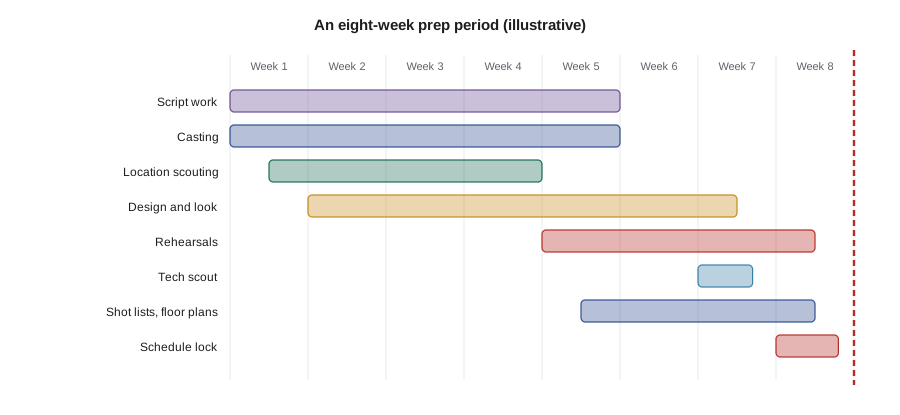
Once locations are chosen, the director, first assistant director, cinematographer, gaffer, key grip, production designer, sound mixer and location manager visit each one together on a tech scout. The director walks through each scene, explaining the blocking and shot plan so that each department can plan its work. Problems found on the tech scout, such as a wall that blocks the planned master shot or a noisy refrigerator, can be solved in prep rather than on the day.
The schedule and the first assistant director
The first assistant director (first AD) breaks down the script and builds the shooting schedule. The director's job is to give the first AD a realistic picture of what each scene needs, so the schedule reflects the creative plan. Scenes are rarely shot in story order. They are grouped by location, cast availability, time of day and other practical factors, which means a director must keep each scene's place in the story firmly in mind.
Scripts are measured in pages and eighths of a page. A common rule of thumb is that one page of a properly formatted screenplay runs about one minute on screen, though dialogue-heavy scenes run faster and action scenes slower. Schedules are often described in pages per day: a low-budget feature might aim for four to five pages a day, while a larger production might shoot two or three, and a television drama five to eight. These are illustrative ranges; the real figure depends on the complexity of each scene.
import random
random.seed(320)

# scenes as (name, pages in eighths, complexity 1-3)
scenes = [("Kitchen, night", 13, 2), ("Funeral home", 10, 2), ("Car, day", 6, 1),
          ("Garden, dusk", 9, 3), ("Attic", 7, 1), ("Bus station", 12, 3),
          ("Dana's bedroom", 5, 1), ("Lawyer's office", 8, 1)]
# rough pages per hour by complexity, with some day-to-day variation
rate = {1: 0.75, 2: 0.55, 3: 0.35}
hours_per_day = 10
total_pages = sum(p for _, p, _ in scenes) / 8
total_hours = 0
for name, eighths, c in scenes:
    pages = eighths / 8
    hours = pages / (rate[c] * random.uniform(0.9, 1.1))
    total_hours += hours
    print(f"{name:16s} {eighths:2d}/8 pages  complexity {c}  about {hours:4.1f} h")
print(f"Total pages: {total_pages:.2f}")
print(f"Estimated shooting hours: {total_hours:.1f}")
print(f"Days at {hours_per_day} shooting hours per day: {total_hours / hours_per_day:.1f}")
print(f"Average pages per day: {total_pages / (total_hours / hours_per_day):.2f}")Kitchen, night 13/8 pages complexity 2 about 3.0 h Funeral home 10/8 pages complexity 2 about 2.2 h Car, day 6/8 pages complexity 1 about 1.0 h Garden, dusk 9/8 pages complexity 3 about 3.3 h Attic 7/8 pages complexity 1 about 1.2 h Bus station 12/8 pages complexity 3 about 4.7 h Dana's bedroom 5/8 pages complexity 1 about 0.8 h Lawyer's office 8/8 pages complexity 1 about 1.3 h Total pages: 8.75 Estimated shooting hours: 17.5 Days at 10 shooting hours per day: 1.7 Average pages per day: 5.00
The estimate is crude, but it shows why the director's plan matters to the schedule. A scene the director imagines as a single long take might shoot quickly or might take all day to rehearse. A scene planned with many set-ups will take longer than its page count suggests. When the director and first AD disagree about how long something will take, the honest answer is usually to simplify the plan or to find more time, not to hope.
Prioritizing shots
No production has unlimited time. Directors protect themselves by ranking their shots before the day begins. The first priority is the shots without which the scene does not work: usually the master or main two-shot and the singles that carry the key moments. The second priority is shots that improve the scene: an insert, a reaction, a second angle on an important line. The third priority is shots that would be nice to have if time allows.
| Priority | Shot | Reason |
|---|---|---|
| A | Master from the table end | Geography and the physical story of the scene |
| A | Close singles at the table | Carry the turning point and the final silence |
| A | Two-shot at the table | Covers the shared memory and the pushed box |
| B | Dana at the sink | Shows her refusal and the moment she stops |
| B | Maya medium close-up | Her claim and defense |
| C | Insert of the photograph | Helps the laugh, but could be picked up later |
Sharing this list with the first AD and cinematographer lets the team make good decisions when time runs short. If the day falls behind, everyone knows which shot to drop. Experienced directors also look for ways to combine shots, such as a moving master that becomes the two-shot, so that fewer set-ups cover more of the scene.
The director's prep book
By the end of prep, most directors have a working book or digital folder containing the script with notes, beat breakdowns, character notes, the shot list and priorities for each scene, floor plans, storyboards for complex scenes, location photos and the schedule. This book is the director's map on set. It allows quick answers to questions, helps when scenes are shot out of order and provides a record when reshoots or pickups are needed.
The book is also a discipline. Writing down the purpose and key moments of each scene forces the director to make decisions in advance, while there is time to think. On set there will be enough surprises without discovering that a scene's purpose was never clear.
Common mistakes
MistakeChoosing shots because they look impressive alone
InsteadDerive shots from governing visual ideas and key moments.
MistakeDictating lenses and positions to the cinematographer
InsteadShare intentions and let the cinematographer propose technical solutions.
MistakeStoryboarding every dialogue scene in detail
InsteadUse floor plans and shot lists for dialogue; save boards for action and effects.
MistakeHoping a complex plan will fit the schedule
InsteadEstimate honestly with the first AD and simplify or find more time.
MistakeArriving on set without shot priorities
InsteadRank shots A, B and C and share the list with the AD and cinematographer.
Summary and key terms
- Governing visual ideas, drawn from the spine, guide hundreds of later choices.
- Share intentions with the cinematographer and let them propose technical solutions.
- Key moments from script analysis become the backbone of the shot list.
- Choose storyboards, floor plans or previs according to the scene's complexity.
- The tech scout lets every department plan around the director's blocking and shots.
- One page is roughly one minute; pages per day depend on complexity and resources.
- Rank shots by priority so the team can make good choices when time runs short.
- Governing visual idea
- An overall principle for how a film looks and moves, derived from its meaning.
- Shot list
- A list of planned shots for a scene, with size, angle and content.
- Floor plan
- An overhead diagram showing actor and camera positions and movements.
- Previs
- A rough computer animation used to plan complex sequences.
- Tech scout
- A visit to locations by the director and heads of department to plan the shoot.
- First assistant director
- The crew member who schedules the shoot and runs the set.
- Eighth of a page
- The unit used to measure scene length in a script breakdown.
- Pages per day
- The amount of script a production plans to shoot in one day.
- Master shot
- A wide shot that covers an entire scene from one angle.
- Set-up
- A camera position and lighting arrangement for one or more shots.
Practice problems
Work each problem on paper first, then reveal the answer to check.
Give a governing visual idea for a film about a man losing his memory.
Show answer
For example: begin with clear, stable frames and become increasingly fragmented and unstable.
Why share intentions rather than lenses with the cinematographer?
Show answer
It uses the cinematographer's expertise and often produces better solutions.
Which tool is usually most useful for a dialogue scene?
Show answer
A floor plan with a shot list.
Who attends a tech scout?
Show answer
The director, first AD, cinematographer, gaffer, key grip, designer, sound mixer and location manager, among others.
About how long does one script page run on screen?
Show answer
About one minute, as a rule of thumb.
A script is 96 pages and the plan is four pages a day. How many shooting days?
Show answer
About 24.
What is an A-priority shot?
Show answer
A shot without which the scene does not work.
Why are scenes rarely shot in story order?
Show answer
They are grouped by location, cast, time of day and other practical factors.
Name two things a director checks at a location beyond how it looks.
Show answer
Room for movement, camera space, light through the day, noise, practical access (any two).
What goes into a director's prep book?
Show answer
Annotated script, beats, character notes, shot lists and priorities, floor plans, boards, photos and schedule.
Lesson quiz · 5 questions
Score 60% or more to complete this lesson.
Create a free account to save your progress, take quizzes and earn a certificate.