
FILM-101 · Lesson 4 of 12 · 27 min
Mise-en-scène II: lighting and color as meaning
Light is the raw material of cinema: without it there is no image. But in films light is also a language. It shapes space, models faces, directs attention, creates mood and carries meaning across a story. Color, which depends on light, works the same way. This lesson introduces the basic vocabulary of film lighting, how to describe its quality, direction, source and color, and the main ways filmmakers use color as a system across a film. The cinematography courses in this program teach the technical side, such as fixtures, exposure and grading; here the goal is to see and interpret what lighting and color do on screen.
Four features of film lighting
Film scholars commonly describe lighting through four features.
- Quality: the hardness or softness of light. Hard light comes from small or distant sources, such as direct sun or a bare bulb, and casts sharp-edged shadows. Soft light comes from large or diffused sources, such as an overcast sky or light bounced off a white surface, and wraps gently around faces with gradual shadows.
- Direction: where light comes from relative to the subject. Frontal light flattens features; side light models shape and texture and can split a face into light and dark; backlight separates a figure from the background with a rim of light; underlighting from below often looks unnatural or menacing; top light can create dark eye sockets.
- Source: where light appears to come from in the story world. Motivated lighting seems to come from a visible or implied source, such as a window, lamp or fire, even though film lights are actually doing the work.
- Color: the warmth or coolness of light. Candlelight and tungsten bulbs look warm orange; daylight and moonlight effects often look cool blue. Colored light can also be expressive and unnatural, as with red neon or green fluorescent tubes.
Three-point lighting
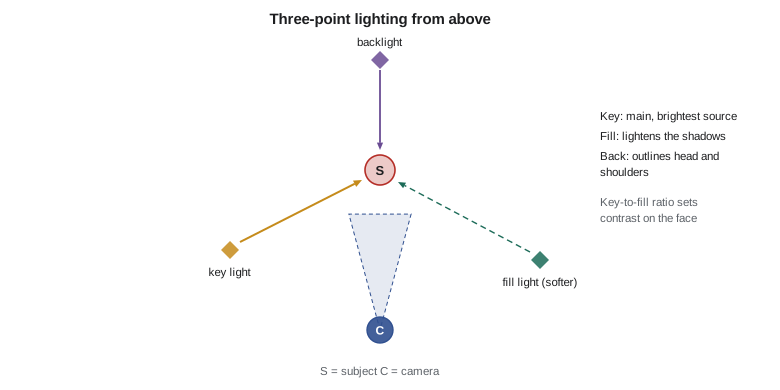
Classical Hollywood studios developed a standard approach called three-point lighting, still taught today as a starting point.
- The key light is the main, brightest source, usually placed to one side of the camera.
- The fill light is softer and placed on the other side to lighten the shadows created by the key.
- The backlight shines from behind the subject to outline the head and shoulders and separate them from the background.
The ratio between key and fill controls contrast on the face. A low ratio, with fill nearly as bright as key, produces an even, bright look. A high ratio, with little fill, produces dramatic shadow. A brighter background or extra lights on the set may complete the scheme.
Worked problem
Reading contrast from a lighting ratio
A cinematographer's notes say the key light on an actor's face is four times as bright as the fill side. Describe the likely look, and contrast it with a ratio of 1.5 to 1.
Show solution
- Interpret the 4:1 ratio: the shadow side receives a quarter of the light of the key side, so it will look noticeably darker, producing clear modeling and a moody look.
- Interpret 1.5:1: the shadow side is nearly as bright as the key side, so the face looks even and bright with soft shadows.
- Link to genre conventions: low-contrast lighting is common in comedies and romances; higher contrast suits drama, thrillers and noir.
Answer: A 4:1 key-to-fill ratio gives a dramatic face with strong shadows, suited to tension or mystery, while 1.5:1 gives a bright, even face typical of comedy or upbeat scenes.
High-key and low-key lighting
Two broad lighting styles are especially useful for analysis.
- High-key lighting uses abundant fill so that the image is bright with few deep shadows. It is typical of comedies, musicals, sitcoms and many advertisements, and suggests openness, safety or cheerfulness.
- Low-key lighting uses little fill and strong contrast, leaving large areas in shadow. It is typical of horror, thrillers and especially film noir, the American crime films of the 1940s and 1950s with their venetian-blind shadows, wet night streets and morally compromised heroes.
These are tendencies, not rules. A comedy may use low-key lighting for a parody of noir, and a horror film may unsettle us with bright, high-key daylight, as several modern folk horror films do.
| Feature | High-key | Low-key |
|---|---|---|
| Fill light | Plentiful | Little or none |
| Shadows | Soft and light | Deep and sharp |
| Typical genres | Comedy, musical, family film, advertising | Horror, thriller, crime, film noir |
| Common associations | Safety, openness, cheerfulness | Danger, mystery, moral ambiguity |
| Example described shot | A bright kitchen with even light on every face | A detective's face half in shadow under a desk lamp |
Shadows, silhouettes and what we do not see
Lighting controls what we can and cannot see. A silhouette, a figure lit from behind with no light on the front, removes facial detail and can create mystery or anonymity. Shadows on walls can foreshadow threats or suggest a character's double nature. Pools of light in darkness direct our eyes, while darkness at the edges of the frame invites the imagination to fill in danger. Many horror films rely on darkness because what is unseen is often more frightening than what is shown.
Lighting across a film
Like other techniques, lighting forms patterns. A character may be lit consistently in shadow until a moment of honesty or redemption, when light falls fully on their face. A home may move from warm lamplight early in a film to cold blue light as a marriage fails. When analyzing, note not only how a single shot is lit but how lighting changes between scenes and what those changes coincide with in the story.
Worked problem
Interpreting a lighting change
In a described drama, a man is shown in the first half almost always with his face half in shadow, lit by hard side light. After he confesses a crime in the final act, he is shown in soft, even light from a window. What might the change mean?
Show solution
- Describe the early pattern: hard side light splits the face, a common convention for divided or hidden characters.
- Describe the late pattern: soft, frontal or window light shows the whole face.
- Link to story: the change coincides with confession, the moment he stops hiding.
- Consider alternatives: the soft light might also suggest exhaustion or vulnerability; check other scenes to see which reading fits best.
Answer: The shift from hard, split lighting to soft, even light visualizes the move from concealment to openness, so lighting supports the story's moral turn; the reading is strongest if the change happens exactly at the confession and nowhere earlier.
Color in film
Color film became widespread over several decades. Early films were often tinted or toned by hand or by dyeing the film stock. Technicolor's three-strip process, used for color features from the mid-1930s, made saturated color a spectacle; a famous 1939 musical fantasy switches from sepia-toned scenes in Kansas to vivid color when its heroine arrives in a magical land. Color became standard for most features by the 1960s and 1970s. Today digital color grading lets filmmakers adjust color shot by shot in post-production, the colorist's craft covered in CINE-310.
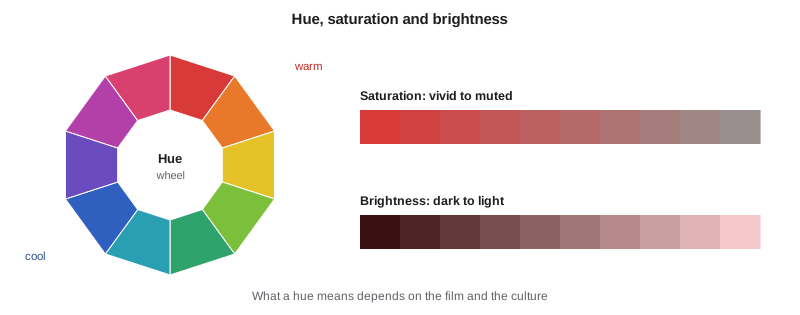
Analysts describe color using three properties.
- Hue: the color family, such as red, blue or green.
- Saturation: how intense or pure the color is, from vivid to muted or gray.
- Brightness (value): how light or dark the color is.
Color schemes and color as meaning
Filmmakers often design a restricted palette for a film or for parts of it.
- Complementary contrast: colors opposite each other on the wheel, such as orange and teal or red and green, create vivid contrast. Many modern blockbusters use warm skin tones against cool teal backgrounds.
- Analogous palettes: neighboring hues, such as yellows and oranges, create harmony.
- Monochromatic schemes: variations of one hue can create a strong, unified mood.
- Desaturation: muted color can suggest gloom, memory, war or exhaustion; saturated color can suggest fantasy, joy or heightened emotion.
- Color coding: assigning colors to characters, places or time periods helps viewers follow complex stories, for example warm colors for the past and cool colors for the present.
Color meanings are not fixed. Red can signal passion, danger, anger, love or celebration depending on the film and the culture. White is associated with weddings in many Western traditions and with mourning in several East Asian traditions. Strong analysis shows how a particular film builds the meaning of its colors through repetition and context rather than assuming universal symbolism.
American musicals and melodramas of the 1950s, such as those directed by Douglas Sirk, used saturated Technicolor so expressively that later critics read the colors as commentary on the characters' repressed emotions. In many contemporary American blockbusters, the widespread orange-and-teal grade has become so common that critics debate whether it still carries meaning or has become a default look.
Black and white
Black-and-white films are not simply color films minus color. They rely on tonal contrast, texture and lighting to separate subjects and create mood. Since color became standard, filmmakers have chosen black and white deliberately to evoke the past, create documentary austerity, emphasize graphic composition or set a work apart. When analyzing a modern black-and-white film, ask why the filmmakers made that choice and what it adds.
Practicing lighting analysis
Lighting is easiest to learn by comparison. Choose two scenes from the same film, one early and one late, and describe each using the four features: quality, direction, source and color. Then sketch a simple overhead diagram showing where the main light seems to come from. Many students are surprised to discover how consistently filmmakers motivate light from windows, lamps and screens, and how precisely they change it when the story turns. You can practice outside the cinema as well: notice how a single window lights a room on an overcast day, how a desk lamp creates hard shadows, and how streetlights tint faces at night. The more you observe real light, the more clearly you will see how films imitate, heighten or contradict it.
When describing color, try to name the overall palette of a scene in a few words, such as warm and saturated, cool and muted, or a single dominant hue with one contrasting accent. Then ask where the accent falls. Filmmakers often reserve a contrasting color for the most important object or character, so the accent can tell you where the scene wants your eye to go.
Common mistakes
MistakeAssuming lighting is only technical, not expressive
InsteadDescribe its quality, direction, source and color and ask what each does in the scene
MistakeCalling every dark scene "low-key" without checking contrast
InsteadLow-key means little fill and strong contrast, not simply a dark image
MistakeAssigning fixed symbolic meanings to colors
InsteadShow how the film builds color meaning through repetition and context
MistakeIgnoring changes in lighting across a film
InsteadTrack lighting patterns and link changes to turning points in the story
MistakeTreating black and white as merely old-fashioned
InsteadAsk why a filmmaker chose black and white and what tonal contrast and texture contribute
Summary and key terms
- Film lighting can be described by quality, direction, source and color.
- Three-point lighting uses a key, a fill and a backlight; the key-to-fill ratio controls contrast.
- High-key lighting is bright with soft shadows; low-key lighting is high in contrast with deep shadows.
- Shadows, silhouettes and darkness control what we see and can create mystery or fear.
- Color is described by hue, saturation and brightness.
- Palettes, contrast, desaturation and color coding build meaning across a film.
- Color meanings depend on context and culture, and black and white is a deliberate expressive choice.
- Hard light
- Light from a small or distant source that casts sharp-edged shadows
- Soft light
- Diffused light from a large source that creates gradual shadows
- Motivated lighting
- Lighting that appears to come from a source in the story world, such as a window or lamp
- Key light
- The main and brightest light on a subject
- Fill light
- A softer light that lightens the shadows created by the key
- Backlight
- Light from behind a subject that outlines it and separates it from the background
- High-key lighting
- Bright, low-contrast lighting with abundant fill
- Low-key lighting
- High-contrast lighting with little fill and deep shadows
- Saturation
- The intensity or purity of a color, from vivid to muted
- Film noir
- American crime films of the 1940s and 1950s known for low-key lighting and moral ambiguity
Practice problems
Work each problem on paper first, then reveal the answer to check.
Name the four features used to describe film lighting.
Show answer
Quality, direction, source and color.
What kind of shadows does hard light cast?
Show answer
Sharp-edged shadows.
Which light in three-point lighting separates the subject from the background?
Show answer
The backlight.
What does a high key-to-fill ratio produce?
Show answer
Strong contrast with dark shadows on the face.
Give two genres associated with low-key lighting.
Show answer
Horror and film noir, also thrillers.
What is motivated lighting?
Show answer
Lighting that seems to come from a source within the story world.
Name the three properties used to describe color.
Show answer
Hue, saturation and brightness.
What effect does desaturated color often create?
Show answer
Gloom, memory, exhaustion or austerity, depending on context.
Why are color meanings not universal?
Show answer
Their meaning depends on the film's patterns and on cultural associations.
What can a silhouette remove from a figure, and what effect can that have?
Show answer
Facial detail, which can create mystery or anonymity.
Lesson quiz · 5 questions
Score 60% or more to complete this lesson.
Create a free account to save your progress, take quizzes and earn a certificate.