
FILM-101 · Lesson 1 of 12 · 25 min
What film studies is and how to watch actively
Most people watch films the way they listen to music in a café: the experience washes over them, and afterwards they can say whether they liked it but not much about why. Film studies is the discipline that asks the why. It treats a film as something made, a series of decisions about what to show, how to show it, in what order and with what sound, and it asks how those decisions shape what we understand and feel. This first lesson explains what the field covers, why it matters even for people who never plan to make a film, and how to move from passive viewing to the active, note-taking kind of watching that every later lesson depends on. By the end you should be able to watch a short scene twice, take useful notes, and describe at least three formal choices and what they do.
What film studies covers
Film studies grew up in universities in the 1960s and 1970s, drawing on literature, art history, philosophy and sociology, but its object is distinct: moving images combined with sound, arranged in time. Scholars and critics usually work along several overlapping lines.
- Film form and style: how mise-en-scène, cinematography, editing and sound create meaning. This is the core of this course.
- Narrative: how films tell stories, organize time and give us access to characters' knowledge and feelings.
- Genre and authorship: the patterns films share with others of their type, and the recurring signatures of particular directors.
- Film history: how technologies, industries, movements and audiences changed over more than a century.
- Film theory: big questions about realism, spectatorship, ideology, representation and what cinema is.
- Industry and culture: how films are financed, made, distributed, rated, watched and argued about, and how they represent people and communities.
Film studies is not the same as film production, although the two feed each other. Production courses, such as the CINE and FILM production courses in this program, teach how to make the choices; film studies teaches how to notice, name and interpret them. Many great filmmakers began as critics, and many critics understand production in detail.
Why study film at all
Moving images are now the dominant way most people receive stories, news, advertising and arguments. Learning to read them carefully is a form of literacy. Three practical benefits stand out.
- You become harder to manipulate. A viewer who notices that a political advertisement uses low angles, swelling music and slow motion on one candidate and grainy, desaturated footage of the other can evaluate the message rather than simply absorb the mood.
- You enjoy films more, not less. Some students worry that analysis spoils the magic. In practice, noticing how a scene achieves its effect usually deepens appreciation, the way knowing harmony deepens listening.
- You communicate better. The vocabulary of shot scale, cutting and sound gives you precise language for talking with collaborators, writing reviews, making presentations or producing your own video.
Form and content
A basic idea in film studies is that form and content cannot be cleanly separated. Content is what the film is about: its story, characters and themes. Form is the overall system of relationships among the parts: how the story is organized and how the techniques work together. The same content told with different form becomes a different experience. A scene of two people arguing can be filmed in one unbroken wide shot that lets us watch both reactions at once, or in rapid close-ups that cut back and forth on every line. The words may be identical, but the first feels observed and tense; the second feels confrontational and claustrophobic.
Critics sometimes describe four large systems of technique, which give this course its structure.
| System | What it includes | Lessons |
|---|---|---|
| Mise-en-scène | setting, costume, makeup, staging, performance, lighting, color | 3 and 4 |
| Cinematography | framing, shot scale, angle, lens, focus, camera movement | 5 |
| Editing | how shots are joined: continuity, montage, rhythm, duration | 6 and 7 |
| Sound | dialogue, music, effects, silence, mixing | 8 |
These systems never work alone. A frightening moment in a horror film may combine a dark setting, a slow push-in, a long delay before the cut, and a low drone on the soundtrack that suddenly stops. Analysis means pulling those threads apart to see what each contributes, then putting them back together to explain the whole effect.
Active watching: a method
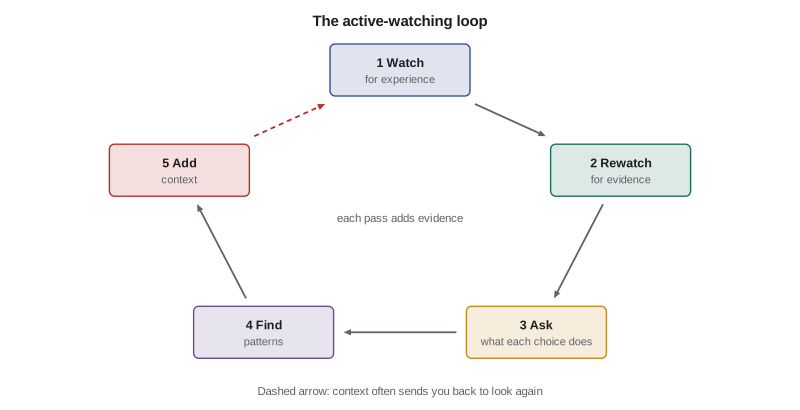
Active watching is a skill that improves with practice. The method below works for a full feature or a single scene.
- First viewing for experience. Watch without stopping. Note your reactions: where you were confused, surprised, moved, bored or tense. Those reactions are data; they tell you where the film is working hardest.
- Second viewing for evidence. Rewatch the sequence you want to discuss, pausing often. Note the shots: what is in the frame, how big, from what angle, how long each shot lasts, how one shot leads to the next, what you hear.
- Questions, not just descriptions. For each observation ask what it does. Why this framing here? Why does the music enter now? Why is this shot held so long?
- Patterns. Look for repetition and variation: a color that returns, a framing used at the start and again at the end, a sound motif linked to a character.
- Context. Only after close observation, bring in what you know about the genre, director, period or production circumstances.
Taking useful notes
In a cinema you cannot pause, so critics develop shorthand. With streaming you usually can pause, which makes careful notes much easier. A simple shot log is the most valuable tool for a beginner. For each shot, record the time it begins, a short description, the shot scale and angle, any camera movement, the main sound, and how it is joined to the next shot. Abbreviations save time: ECU, CU, MCU, MS, MLS, LS and ELS for shot scales (Lesson 5 defines them), and simple symbols for cuts, dissolves and fades.
| Shot | Start | Description | Scale and angle | Movement | Sound | Transition |
|---|---|---|---|---|---|---|
| 1 | 0:00 | Empty kitchen at dawn, rain on window | LS, eye level | static | rain, distant traffic | cut |
| 2 | 0:06 | Woman enters, puts kettle on | MLS, eye level | slow pan right | footsteps, rain | cut |
| 3 | 0:14 | Her hands, a letter left on the table | CU, high angle | static | kettle starting to hiss | cut |
| 4 | 0:17 | Her face as she reads | MCU, eye level | slow push-in | kettle rising, rain fades | cut |
| 5 | 0:26 | Kettle boils, she does not move | MS, slightly low | static | kettle whistles loudly | cut |
Even five lines reveal a design. The scene moves from wide to close, from environment to emotion; the sound shifts from the outside world to a single rising tension; and the final shot uses the whistling kettle to express what she cannot say.
Worked problem
Turning a shot log into analysis
Using the five-shot log above, write two sentences of analysis that link form to meaning.
Show solution
- Identify the pattern in shot scale: long shot to medium long to close-ups, a steady narrowing of the frame.
- Identify the pattern in sound: ambient rain gives way to the kettle, which rises to a whistle.
- Ask what the patterns do: the narrowing frame moves us from the woman's world into her private reaction; the rising kettle externalizes building emotion.
- Note the final contrast: the loud whistle against her stillness suggests shock that she cannot yet act on.
Answer: The scene narrows from the rainy kitchen to a close view of the woman's face, drawing us from her ordinary routine into a private moment of reading. As she freezes, the kettle's rising whistle stands in for the emotion she suppresses, so sound rather than performance tells us that the letter has shaken her.
Interpretation and evidence
Film analysis is interpretation, but not every interpretation is equally good. A strong reading is supported by specific, checkable evidence from the film: shots, sounds, lines, cuts, patterns. A weak reading relies on personal association ("this color reminds me of my grandmother's house") or on information outside the film used as if it were inside it. Interpretations can differ and still be strong; two careful viewers may emphasize different patterns. What matters is that the claim fits the evidence and accounts for as much of the film as possible.
Critics also distinguish several kinds of meaning, which helps keep arguments clear.
- Referential meaning: the concrete places, events and things the film refers to, such as a city, a war or a sport.
- Explicit meaning: what the film states openly, often through dialogue or a character's lesson.
- Implicit meaning: what the film suggests without stating, which the viewer must infer from patterns and contrasts. Most analysis works here.
- Symptomatic meaning: what the film reveals about the values, anxieties or assumptions of the society that produced it, sometimes without the makers intending it.
Watching across cultures and formats
This course draws examples from Canadian, American and world cinema, from fiction, documentary, animation and experimental work. Watching widely matters because the conventions of mainstream Hollywood are only one way of making films. A Quebec drama, a Japanese animation, an Iranian art film or an Indigenous documentary may handle time, performance or editing differently. Rather than judging these as strange, active viewers ask what system the film sets up and how it works within it.
American viewers can draw on large public and academic collections: many public libraries provide free access to streaming services that specialize in classic, independent and international films, and the Library of Congress National Film Registry lists culturally significant American films selected each year. Watching short films from these collections is an efficient way to practice active viewing, because a complete work may last ten minutes.
How this course is organized
Lessons 2 to 8 build the analytical toolkit: narrative, mise-en-scène, cinematography, editing and sound. Lessons 9 and 10 widen the view to genre, authorship, documentary, animation and experimental film. Lesson 11 places films in their industries and cultures, and Lesson 12 brings everything together in the most important practical skill in film studies: writing a clear, evidence-based analysis of a film. Throughout, worked examples use described scenes rather than reproduced images, and diagrams illustrate techniques without copying any film's frames.
Common mistakes
MistakeTreating analysis as a list of observations with no claim
InsteadLink each observation to what it does and build toward an argument about meaning or effect
MistakeRelying on memory of a single viewing for detailed points
InsteadRewatch the sequence and take timed notes before making claims about specific shots
MistakeUsing personal associations as evidence
InsteadBase interpretations on patterns and details that other viewers can check in the film
MistakeAssuming the Hollywood style is the only correct way to make films
InsteadIdentify the system each film sets up and judge how it works on its own terms
MistakeBringing in background information before looking closely
InsteadObserve the film carefully first, then use context to deepen or test the reading
Summary and key terms
- Film studies examines how films are made to mean, combining form, narrative, history, theory and industry.
- Form and content are inseparable: the same story told with different techniques becomes a different experience.
- Four systems of technique organize analysis: mise-en-scène, cinematography, editing and sound.
- Active watching moves from a first viewing for experience to repeated viewings for evidence, patterns and context.
- A shot log records time, description, scale, angle, movement, sound and transition for each shot.
- Strong interpretations rest on specific, checkable evidence and account for as much of the film as possible.
- Meaning can be referential, explicit, implicit or symptomatic, and most analysis works with implicit meaning.
- Film form
- The overall system of relationships among a film's parts, including narrative and style
- Style
- The patterned use of film techniques characteristic of a film, director or period
- Mise-en-scène
- Everything placed in front of the camera and staged for it, including setting, costume, lighting and performance
- Shot
- An uninterrupted run of the camera, or in the finished film, a continuous image between two edits
- Shot log
- A timed record of the shots in a sequence with their key formal features
- Active watching
- Viewing with attention to technique, usually involving repeated viewing and notes
- Implicit meaning
- Meaning suggested by patterns and contrasts rather than stated outright
- Symptomatic meaning
- What a film reveals about the values or assumptions of the society that produced it
- Interpretation
- An argued account of a film's meaning supported by evidence
- Motif
- A repeated element such as an image, color, sound or line that gains meaning through repetition
Practice problems
Work each problem on paper first, then reveal the answer to check.
Name the four systems of film technique used to organize this course.
Show answer
Mise-en-scène, cinematography, editing and sound.
What is the purpose of a first viewing without pausing?
Show answer
To register your reactions, which show where the film is working hardest.
List six things a shot log records for each shot.
Show answer
Start time, description, shot scale and angle, camera movement, sound and transition.
Give an example of explicit meaning.
Show answer
A character directly states the lesson of the story in dialogue.
Why is a personal association weak evidence?
Show answer
Other viewers cannot check it in the film, so it does not support a shared interpretation.
What does the narrowing from long shot to close-up often do in a scene?
Show answer
It moves the viewer from a character's environment into their private reaction.
What is a motif?
Show answer
A repeated element that gains meaning through repetition and variation.
How is film studies different from film production?
Show answer
Production teaches how to make choices; film studies teaches how to notice, name and interpret them.
What should you do after observing a scene closely?
Show answer
Bring in context such as genre, director or period to deepen or test the reading.
Why watch films from many cultures?
Show answer
Mainstream Hollywood conventions are only one system, and other films may handle time, performance and editing differently.
Lesson quiz · 5 questions
Score 60% or more to complete this lesson.
Create a free account to save your progress, take quizzes and earn a certificate.