
FAT-320 · Lesson 9 of 12 · 20 min
Door releases, hold-open devices and access control unlocking
Willowbank School has installed a new access control system. The security contractor's technician, Ama Boateng, has put card readers and electric locks on the main entrances, the gym and the stair doors, and she needs the fire alarm to unlock some of them and leave others locked. 'The school wants lockdown,' she says, 'and the fire code wants people out. My system has to do both, and your system tells it which one is happening.' The low-voltage program covers the access control system itself. This lesson covers the fire alarm side of door control: releasing fire doors held open, unlocking doors in the path of exit, and the interface with access control systems.
Two different jobs
Fire alarm systems control doors in two ways that are easy to confuse:
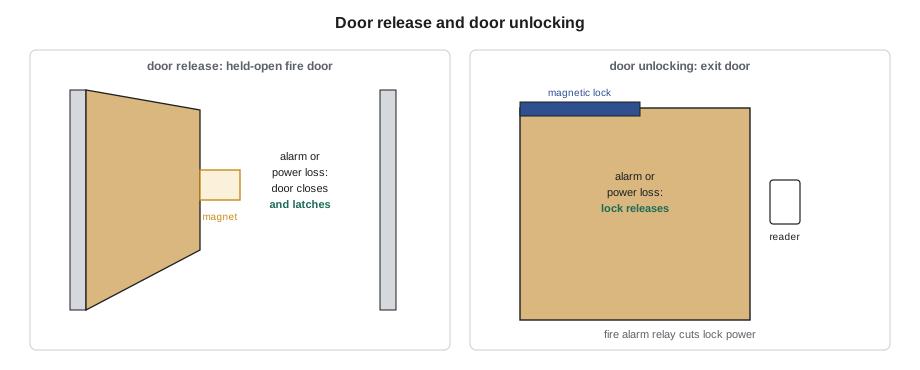
- Door release: fire doors and smoke doors that are normally held open, usually by magnetic hold-open devices, are released so that their closers shut them. The door then stops smoke and fire passing through a separation. Here the fire alarm makes the doors close.
- Door unlocking: doors that are electrically locked for security, such as stair doors, exit doors and doors with delayed egress locks, are unlocked so that people can get out, or back into a floor from a stair. Here the fire alarm makes it easier to pass through the door.
Some doors need both: a stair door may be held open in the daytime, close on alarm, and also unlock so that people in the stair can re-enter the floor. The sequence of operation says which doors do what.
Hold-open devices
A hold-open device is usually an electromagnet on the wall or floor that holds a steel plate on the door. While it is powered, the door stays open; when power is removed, the door's closer shuts it. This is called fail-safe: a power failure, a cut wire or a fire alarm signal all release the door. The fire alarm controls the magnets through relays that interrupt their power, often by zone, or through power supplies that drop out on alarm.
NFPA 72 section 21.8 covers door and shutter release, and NFPA 80 and NFPA 101 set when fire doors may be held open: the hold-open must release on smoke detection and on loss of power, and the door must then close and latch. The release devices are listed, and the release must not depend on power that the fire alarm doesn't control.
Where magnets are powered from a fire alarm power supply, their current is part of that supply's load and is cut off on alarm, so it doesn't count against standby battery capacity once the doors are released. Where they are powered from a separate supply, the fire alarm relay that interrupts it must be close to the supply or the magnets, and its wiring supervised.
# Door holder supply: load in normal condition and after release (illustrative)
holders = {"corridor 2 east": 2, "corridor 2 west": 2, "gym lobby": 4, "library": 2}
amps_each = 0.035      # holder current at 24 V (illustrative)
total = sum(holders.values()) * amps_each
print(f"{sum(holders.values())} holders draw {total:.2f} A normally")
print("on alarm the relay drops all holders: load after release 0.00 A")10 holders draw 0.35 A normally on alarm the relay drops all holders: load after release 0.00 A
Unlocking doors in the path of exit
Electrically locked doors in the path of egress must let people out. The building code and NFPA 101 allow electrically controlled egress locks, sensor release locks and delayed egress locks only under conditions, which typically include unlocking on activation of the fire alarm system or sprinkler system and on loss of power, and, for delayed egress, release after a fixed delay, commonly 15 seconds, once someone pushes on the door. NFPA 72 section 21.9 covers how the fire alarm system unlocks such doors. Stair doors locked from the stair side must unlock on alarm in many buildings so that people in the stair can re-enter a floor.
The fire alarm's job is to send the unlock signal reliably and promptly, and to make sure a fault in its own wiring causes the locks to release rather than stay locked. For that reason, unlocking is usually done by interrupting power to fail-safe locks, not by sending a 'please unlock' message that might be lost.
# Door test record: release, latch and unlock times (illustrative)
doors = [("stair A floor 2 re-entry", "unlock", 1.2, True), ("main entrance", "unlock", 0.8, True),
         ("gym lobby holder", "release", 0.5, True), ("library holder", "release", 0.6, False),
         ("east exit delayed egress", "unlock", 1.0, True)]
limit = 10.0     # design limit for release or unlock after alarm, seconds (illustrative)
for name, kind, t, ok in doors:
    status = "ok" if ok and t <= limit else ("door did not latch" if kind == "release" else "did not unlock")
print(f"{name:26s} {kind:7s} {t:4.1f} s {status}")stair A floor 2 re-entry unlock 1.2 s ok main entrance unlock 0.8 s ok gym lobby holder release 0.5 s ok library holder release 0.6 s door did not latch east exit delayed egress unlock 1.0 s ok
The library door released on time but didn't latch: its closer was set too weak after a hinge repair. That is a door hardware deficiency for the school, not a fire alarm fault, but it is found and reported during the fire alarm test.
The access control interface
Access control systems decide who may open which door and when. When they share doors with the fire alarm, the two systems must agree on what happens in an alarm. Good practice is for the fire alarm to control fire-related door functions directly, by cutting power to locks and holders through its own relays, with the access control system told about the alarm so that it can record events and show door states. The access control system must not be able to keep a door locked against the fire alarm's unlock signal.
Lockdown, used in schools and some other buildings, is the opposite of evacuation: doors are locked to keep a threat out. Lockdown and fire alarm signals can conflict. The building's emergency plan, the authority and the codes decide which takes priority for each door, and the sequence must make sure that a fire alarm during a lockdown doesn't leave people trapped behind locked exits. At Willowbank, the board's plan keeps classroom doors lockable from inside at all times, and requires the fire alarm to unlock the exits and stair doors whatever state the access control system is in.
# Which wins for each door: lockdown or fire alarm? (Willowbank plan, illustrative)
plan = {"main entrance": "fire alarm unlocks", "stair A doors": "fire alarm unlocks",
        "gym exit": "fire alarm unlocks", "classroom doors": "stay lockable from inside"}
state = {"lockdown": True, "fire alarm": True}
for door, rule in plan.items():
    result = "unlocked for exit" if rule == "fire alarm unlocks" and state["fire alarm"] else "locked from outside, free from inside"
print(f"{door:16s} {result}")main entrance unlocked for exit stair A doors unlocked for exit gym exit unlocked for exit classroom doors locked from outside, free from inside
Wiring and supervision
Door control relays follow the same rules as other emergency control functions. They are listed, located close to the equipment they control, and the fire alarm wiring to them is supervised. The relay contacts are rated for the lock or holder power they interrupt; a large magnetic lock or a bank of holders may draw more current than a small relay can safely switch. Power supplies for locks and holders are labeled with what they serve and which fire alarm relay controls them.
Testing door functions
Each door function is tested from the fire alarm inputs that are supposed to operate it. For held-open doors, the test confirms the door releases, closes and latches. For locked doors, it confirms the door unlocks on alarm and also on loss of power, which is tested by removing power from the lock or its supply. Where a door relocks after the alarm is reset, the test confirms it relocks only after reset and not before. The access control contractor watches their system's response, and the school or building staff confirm the doors are back to normal at the end.
Worked problem
Willowbank's new doors
At Willowbank, the access control contractor has wired the stair doors' magnetic locks so that the access control panel releases them when it receives a fire alarm signal over a data connection. The fire alarm sends that signal through a gateway. During the test, the stair doors unlock, but when Sasha disconnects the gateway, the doors stay locked and the fire alarm shows no trouble. What is wrong, and how is it fixed?
Show solution
- The unlocking depends on a data message through a gateway the fire alarm doesn't supervise, so a failure leaves the doors locked with no warning.
- The fix is for the fire alarm to interrupt the lock power directly, through a listed relay at the lock power supply, with the relay's control wiring supervised.
- The access control panel still receives an alarm input so it can record events and show door states.
- The test is repeated: alarm unlocks every stair door, loss of power unlocks them, and a fault in the relay wiring causes a trouble.
Answer: Doors in the path of exit must unlock on alarm and on failure, without depending on another system.
Overhead doors and shutters
Some buildings have rolling fire shutters or fire-rated overhead doors that close automatically in a fire, such as shutters over a service counter or doors between a warehouse and an office. These are released by fusible links, by the fire alarm system, or both, and many close under gravity when released, with a governor to control their speed. The fire alarm interface sends the release signal; the door's own installer maintains the mechanism. Where people may stand under a closing shutter, the design may include warning signals before it closes. The test confirms that the right fire alarm zones release each door, that it closes fully, and that the door's own trouble or position signals reach the fire alarm where provided.
# Release and close times for fire shutters (illustrative test at Cartwright)
shutters = {"dock office shutter": (0.8, 14.0), "parts counter shutter": (0.9, 9.5), "warehouse door FD-3": (1.0, None)}
for name, (release, closed) in shutters.items():
print(f"{name:22s} released {release:.1f} s {'closed at ' + str(closed) + ' s' if closed else 'DID NOT CLOSE FULLY - door installer to repair'}")dock office shutter released 0.8 s closed at 14.0 s parts counter shutter released 0.9 s closed at 9.5 s warehouse door FD-3 released 1.0 s DID NOT CLOSE FULLY - door installer to repair
Records for door functions
Door functions change often. Tenants move, security needs change and doors are rehung, and each change can break the link between the fire alarm and a door. The record drawings show each held-open door, each electrically locked door, the relay or power supply that controls it, and the fire alarm inputs that operate it. The sequence of operation lists them in the same terms, and every change to a door's hardware or the access control system is checked against those documents. At Willowbank, Sasha adds a door schedule to the fire alarm documents listing all 38 controlled doors, their hardware, their power supply and the test result from the commissioning.
During each annual inspection, the door schedule becomes the checklist. Doors that have been changed without the records being updated are found that way, and so are doors that were added to the access control system without anyone telling the fire alarm company.
Door hardware problems found during fire alarm tests are common and worth reporting clearly, with the door's location and what was observed, because the owner may need a separate contractor to fix them and the authority may want to see that they were corrected.
Common mistakes
MistakeConfusing door release with door unlocking.
InsteadRelease closes fire doors; unlocking frees exit doors.
MistakeAccepting a door that closes but doesn't latch.
InsteadA fire door must latch to hold back smoke.
MistakeRelying on another system's data link to unlock exits.
InsteadInterrupt lock power directly with a supervised relay.
MistakeTesting unlock on alarm only.
InsteadAlso test that locks release on loss of power.
MistakeLetting lockdown override exit unlocking without a plan.
InsteadFollow the emergency plan, codes and authority for each door.
Summary and key terms
- Door release closes held-open fire doors; unlocking frees locked doors in the path of exit.
- Hold-open devices and exit locks are fail-safe: alarm or power loss releases them.
- The fire alarm should control fire-related door functions directly.
- Lockdown and fire alarm priorities are set by the emergency plan and the codes.
- Tests confirm release, latching, unlocking on alarm and on loss of power, and restoration.
- Hold-open device
- A magnet that holds a fire door open and releases it on alarm or power loss.
- Fail-safe lock
- A lock that unlocks when power is removed.
- Delayed egress
- A lock that releases a short fixed time after someone pushes on the door.
- Stair re-entry
- Unlocking stair doors so people can return to a floor from the stair.
- Lockdown
- Locking doors to keep a threat out of occupied rooms.
Practice problems
Work each problem on paper first, then reveal the answer to check.
Does door release open or close doors?
Show answer
It closes held-open fire doors.
A fire door releases but doesn't latch. Is that acceptable?
Show answer
No; it must close and latch.
How should the fire alarm unlock exit doors?
Show answer
By interrupting lock power through its own supervised relay.
Besides an alarm, what else must unlock a fail-safe exit lock?
Show answer
Loss of power.
Who decides whether lockdown or fire alarm wins at each door?
Show answer
The emergency plan, the codes and the authority.
Lesson quiz · 5 questions
Score 60% or more to complete this lesson.
Create a free account to save your progress, take quizzes and earn a certificate.