
FAT-320 · Lesson 2 of 12 · 20 min
Supervising stations: central, proprietary and remote
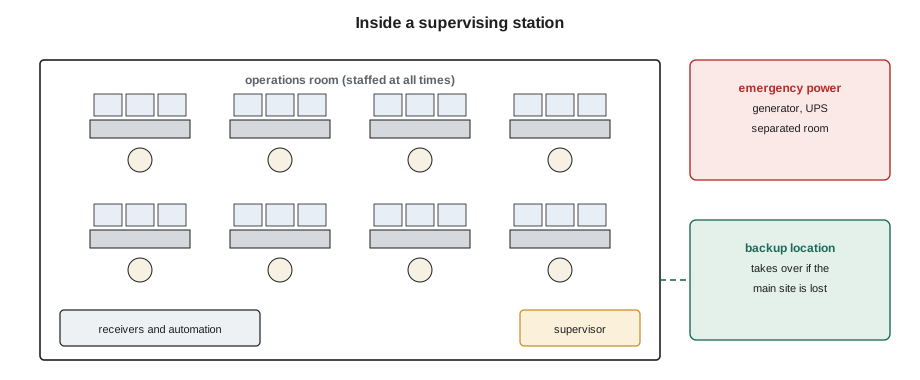
On Tuesday, Ravi takes Sasha to Piedmont Signal Monitoring's operations floor, on the second story of an unmarked building near the airport. Behind two locked doors, eight operators sit at consoles with three screens each, headsets on, in a room that never closes. Marguerite Doucet, the operations manager, shows them around. 'Everything your communicators send ends up on one of these screens,' she says. 'If the account information is wrong, or the zone list is old, the operator is the one who has to make sense of it at three in the morning.' This lesson describes the facility that receives fire alarm signals, the rules it works under, and what the technician needs to know about it.
The facility at the other end
A supervising station is a facility that receives signals from protected premises and acts on them. It has receivers that accept signals from many kinds of communicators, an automation system that decodes them and matches them to customer accounts, and operators who follow written procedures for each type of signal. It runs every hour of every day, with emergency power, backup equipment and, in modern standards, a second location that can take over if the first is lost.
In the United States, NFPA 72 Chapter 26 sets the rules for supervising station alarm systems: the station itself, its equipment, its operators, the communication methods and the signals. The receiving equipment is listed under UL standards, and the stations themselves are often listed by UL under UL 827, the standard for central station alarm services. The authority having jurisdiction decides which type of supervising station service a building needs.
Types of service
NFPA 72 describes three types of supervising station service. Central station service is provided by a listed company that receives the signals, retransmits alarms to the fire department, dispatches a runner or technician when required, and keeps records, all under a contract that the authority can verify. Proprietary supervising station service is run by the owner of the protected property, such as a university or hospital campus, from its own staffed station on the property. Remote supervising station service sends signals to a remote location, often the fire department's own communications center or an answering service, where central station service isn't required or available.
Most of Bramwell's Charlotte customers have central station service from a listed company. Eastview General Hospital also runs a proprietary station in its security office, staffed by trained security officers, and forwards fire alarms to the fire department's communications center.
What the center does with a signal
When a signal arrives, the center's automation system decodes it, identifies the account and the point, and places it in a queue by priority. Fire alarm signals go to the top. The operator follows the account's written instructions, which describe whom to call, in what order, for each kind of signal. In general:
- Fire alarm signals are passed to the fire department's dispatch center at once. Where the authority allows a short verification call to the premises before dispatch, the call must be quick, and it must never delay the fire department beyond the limit the standard sets.
- Supervisory signals are reported to the owner's contacts, and to the service company if the owner's instructions say so. Some authorities want supervisory signals reported to the fire department as well.
- Trouble signals are reported to the owner or the service company. A trouble that doesn't clear within the time set in the instructions is escalated.
- Restoral signals, which say a condition has cleared, close out the event in the center's records.
Every signal, every call and every action is recorded with the time. Those records are what show, after an incident, whether the system and the center did what they should.
# A center's queue: highest priority first, oldest first within a priority
signals = [
    ("09:14:02", "Tamarind House", "trouble", "AC power loss"),
    ("09:14:05", "Willowbank School", "supervisory", "valve VS-1 closed"),
    ("09:14:07", "Cartwright DC", "fire alarm", "waterflow riser 2"),
    ("09:14:09", "Riverlight Tower", "trouble", "path 1 failure"),
]
rank = {"fire alarm": 0, "supervisory": 1, "trouble": 2}
for t, site, kind, text in sorted(signals, key=lambda s: (rank[s[2]], s[0])):
    action = {"fire alarm": "call fire dispatch now", "supervisory": "call owner contacts",
              "trouble": "call owner or service company"}[kind]
print(f"{t} {kind:11s} {site:18s} {text:20s} -> {action}")09:14:07 fire alarm Cartwright DC waterflow riser 2 -> call fire dispatch now 09:14:05 supervisory Willowbank School valve VS-1 closed -> call owner contacts 09:14:02 trouble Tamarind House AC power loss -> call owner or service company 09:14:09 trouble Riverlight Tower path 1 failure -> call owner or service company
Timing
NFPA 72 sets several 90-second limits. For performance-based technologies, such as IP and cellular communicators, the time from the alarm at the premises to its display and recording at the station must not exceed 90 seconds. Where the authority allows an operator to verify an alarm before calling the fire department, the verification must not delay retransmission by more than 90 seconds from receipt. A digital alarm communicator's attempt to transmit must also be completed within 90 seconds. In periodic testing, the technician confirms that each test signal reaches the station within 90 seconds.
Timing matters because a fire grows quickly. A minute lost between the detector and the dispatcher is a minute added before the first truck arrives, in a fire that may double in size every couple of minutes.
# Check signal delivery times from a test against the limit
limit_s = 90
tests = [("smoke, floor 3", 7), ("waterflow riser 1", 12), ("valve VS-2", 9), ("trouble, AC loss", 41), ("pull station lobby", 118)]
for name, seconds in tests:
print(f"{name:20s} {seconds:4d} s {'within limit' if seconds <= limit_s else 'TOO SLOW - investigate path'}")smoke, floor 3 7 s within limit waterflow riser 1 12 s within limit valve VS-2 9 s within limit trouble, AC loss 41 s within limit pull station lobby 118 s TOO SLOW - investigate path
In Sasha's test, the pull station signal took nearly two minutes. The panel had sent it on the cellular path after the first path failed to answer, and the communicator's retry timing had been left at a slow default. The fix is in the communicator's programming, covered in the next lesson.
The account record and the zone list
The center can only act on what its account record says. Each account lists the address, the contacts and their order, the authority to call, and the meaning of every zone or point the communicator can send. When a building is altered, the zone list must be updated at the center as well as in the panel. Marguerite shows Sasha a recent example: a waterflow switch at a school had been reported as 'zone 4, gym smoke' for two years, because the zone numbers changed during a renovation and nobody told the center.
For the technician, keeping the account in step with the system is part of every job that changes the system. The usual practice is to send the center a written point list after any change, and then to test every changed point to the center and confirm, by reading back the operator's screen or the center's event report, that each one is described correctly.
# Compare the panel's point list with the center's account record
panel = {1: "pull station, lobby", 2: "smoke, floors 1-3", 3: "smoke, floors 4-6",
         4: "waterflow, riser 1", 5: "valve supervisory", 6: "AC power"}
center = {1: "pull station, lobby", 2: "smoke, floors 1-3", 3: "smoke, floors 4-6",
          4: "gym smoke", 5: "valve supervisory"}
for point in sorted(set(panel) | set(center)):
    a, b = panel.get(point, "-"), center.get(point, "-")
print(f"point {point}: panel '{a}' / account '{b}' {'ok' if a == b else 'UPDATE ACCOUNT'}")point 1: panel 'pull station, lobby' / account 'pull station, lobby' ok point 2: panel 'smoke, floors 1-3' / account 'smoke, floors 1-3' ok point 3: panel 'smoke, floors 4-6' / account 'smoke, floors 4-6' ok point 4: panel 'waterflow, riser 1' / account 'gym smoke' UPDATE ACCOUNT point 5: panel 'valve supervisory' / account 'valve supervisory' ok point 6: panel 'AC power' / account '-' UPDATE ACCOUNT
Certificates and contracts
For central station service, NFPA 72 requires the arrangement to be documented, and listed companies typically issue a certificate, such as a UL certificate, that the authority can verify. The certificate shows the property, the systems covered and the type of service, and it is valid only while the service continues to meet the requirements.
A monitoring contract that lapses because a bill went unpaid is one of the commonest ways a building loses monitoring without anyone noticing. Many authorities now require the center to tell them when service to a building is canceled.
Worked problem
A visit to the center
During the visit, Marguerite shows Sasha three accounts that Bramwell services. One lists the owner's contact as a manager who left last year. One has a zone list with seven points, but the communicator now sends twelve. One has no record of a test signal in nine days, though the building's communicator is set to test daily. What should Sasha do about each?
Show solution
- The contact list belongs to the owner; Sasha tells the owner, who updates it with the center.
- The zone list is Bramwell's job: send the center the current point list and test the five new points to confirm they are described correctly.
- The missing test signals mean the center has lost contact or the communicator has stopped testing. That needs a service call now, and the center should already have reported it as a failure.
- Each item is recorded in the service report.
Answer: The account record is part of the system; when it is wrong, the operator acts on the wrong information.
Inside the center's procedures
Marguerite shows Sasha the written procedures the operators follow. Each procedure is a short checklist for one kind of signal, and the automation system brings it up on the operator's screen with the account details. For a fire alarm, the operator confirms the address and the zone, calls the fire department's dispatch line, gives the address, the cross street and the type and location of the alarm, and records the dispatcher's name and the time. Only then does the operator call the premises or the owner's contacts. For a supervisory signal, the operator works down the owner's contact list until someone accepts responsibility, and records who it was.
Operators are trained and their work is reviewed. Calls are recorded so that supervisors can check them, and the center measures how long each kind of signal takes to handle. When a building's account produces confusing or repeated signals, the center asks the service company to investigate, because confusing signals slow the operators down for every other building as well.
# Handling times for a month of signals at the center (illustrative, seconds from receipt to first call)
times = {"fire alarm": [11, 14, 9, 22, 13, 10], "supervisory": [48, 63, 55, 71], "trouble": [130, 95, 210, 160, 120]}
for kind, t in times.items():
print(f"{kind:12s} signals {len(t):2d} average {sum(t) / len(t):5.0f} s slowest {max(t):4d} s")fire alarm signals 6 average 13 s slowest 22 s supervisory signals 4 average 59 s slowest 71 s trouble signals 5 average 143 s slowest 210 s
What the technician tells the center
Good monitoring depends on good information from the service company. Bramwell sends the center, for every new account or change: the building's address and any second address used by the fire department; the point list with plain descriptions that an operator can read aloud to a dispatcher; the communicator's paths, formats and test interval; the owner's contacts as the owner provides them; and any special instructions, such as a hospital's on-site security office or a building where certain signals are handled differently. Descriptions are written for the operator and the firefighter, not for the technician: 'smoke detector, third floor east corridor' is useful, 'SD-3E-14' is not.
When a center changes its receivers, telephone numbers or addresses, it tells the service companies, which must reprogram every affected communicator before the old receivers are switched off. A center migration is one of the few times many buildings' communicators must be changed at once, and Bramwell schedules those visits carefully.
Common mistakes
MistakeAssuming the center knows what each point means.
InsteadSend the current point list after every change and test it.
MistakeChanging zone numbers without telling the center.
InsteadUpdate the account at the same time as the panel.
MistakeTesting only that a signal arrives.
InsteadConfirm it arrives on time and is described correctly.
MistakeIgnoring missing test signals.
InsteadA center that stops hearing a building has a failure to chase.
MistakeTreating the certificate as permanent.
InsteadIt is valid only while the service continues to the standard.
Summary and key terms
- A supervising station receives signals, decodes them and acts on them by written procedures.
- NFPA 72 Chapter 26 sets the rules; service may be central, proprietary or remote.
- Fire alarm signals go to the fire department at once; supervisory and trouble signals go to the owner and service company.
- Signals must arrive quickly and be described correctly.
- The account record and the zone list must match the system.
- Supervising station
- The staffed facility that receives and acts on fire alarm signals.
- Automation system
- The software that decodes signals and matches them to accounts.
- Account record
- The center's information about a building: contacts, instructions and points.
- Certificate
- A document showing a building is monitored to the standard by a listed company.
- Restoral
- A signal that a condition has cleared.
Practice problems
Work each problem on paper first, then reveal the answer to check.
Which signal type goes to the top of the operator's queue?
Show answer
Fire alarm.
Who updates the owner's contact list with the center?
Show answer
The owner.
After a renovation changes zone numbers, what must happen at the center?
Show answer
The account's point list is updated and the points are tested.
What does a certificate tell the authority?
Show answer
That the building is monitored to the standard by a listed company.
Why does the center record every signal and call with the time?
Show answer
To show afterwards what happened and when.
Lesson quiz · 5 questions
Score 60% or more to complete this lesson.
Create a free account to save your progress, take quizzes and earn a certificate.