
ENGG-160 · Lesson 5 of 5 · 43 min
Working in design teams
Almost no engineering work is done alone. Even a modest project like our community center entrance involves a civil engineer, an architect, a structural engineer for the canopy, an electrical designer for lighting and the door operator, a cost estimator, a contractor and the client. Large projects involve hundreds of people in several companies and time zones. How well those people work together often matters as much as how well any of them calculates.
Teamwork can be learned like any other engineering skill. This chapter covers how teams develop, how to set one up with a charter and clear roles, how to run meetings that produce decisions, and how to plan and schedule work using a work breakdown structure, the critical path method and a Gantt chart. It then turns to the human side: responsibility, risk, feedback, conflict and psychological safety, and finishes with design reviews.
How teams develop
In 1965, psychologist Bruce Tuckman described four stages that small groups tend to pass through; with Mary Ann Jensen, he added a fifth in 1977.
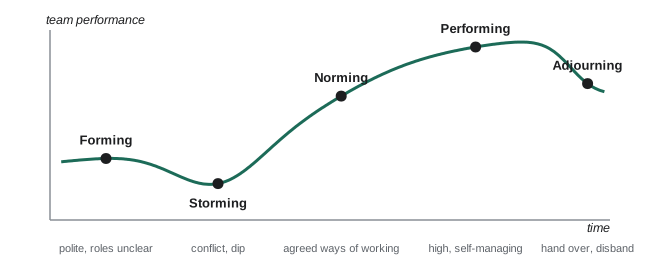
- Forming: members are polite and cautious; roles and goals are unclear.
- Storming: disagreements surface over goals, approach and who does what. Performance often dips.
- Norming: the team agrees how it works, and trust grows.
- Performing: the team works smoothly, handles problems itself, and produces its best work.
- Adjourning: the work ends, and the team hands over and disbands.
The model is a simplification, and teams can slip back a stage when membership or goals change. Its practical lesson is that storming is normal, not a sign of a bad team. Teams that set up clear expectations early (the charter, below) tend to get through it faster.
Setting up a team
The team charter
A team charter is a short document, written and agreed in the first meeting, that records how the team will work. It typically covers:
- Purpose and deliverables: what the team must produce, for whom, and by when.
- Roles: who leads, who manages the schedule, who is the main contact with the client, who owns which technical areas.
- Communication: which channels are used for what, and expected response times.
- Decision-making: consensus, majority, or the lead decides after consultation? What happens when the team cannot agree?
- Meetings: when, how long, and how minutes and action items are recorded.
- Expectations and accountability: what happens if someone misses a deadline or does not contribute.
It feels bureaucratic for a four-person student team, but most team conflicts come from unspoken assumptions that differ ("I thought we'd all edit the report together on Sunday"). Writing them down is cheap insurance.
Roles and responsibility: RACI
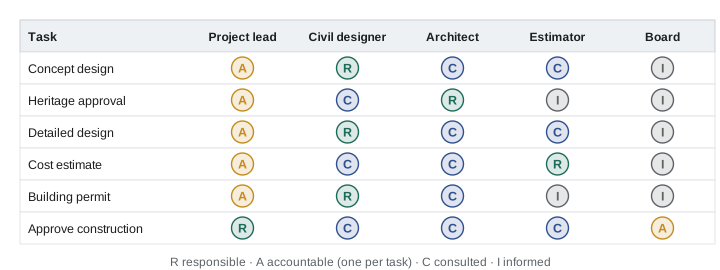
Confusion about who is responsible for what is one of the most common causes of dropped work. A RACI matrix assigns each task to people in four ways:
- R (Responsible): does the work.
- A (Accountable): owns the result and signs off; exactly one person per task.
- C (Consulted): gives input before decisions; two-way communication.
- I (Informed): kept up to date; one-way communication.
Worked problem
Checking a RACI matrix
A team's draft RACI shows the cost estimate with the estimator as R, the project lead as A, and the board also as A. Detailed design has the civil designer as R and no A. What is wrong, and how should it be fixed?
Show solution
- Cost estimate: two A's. When two people are accountable, neither is. Keep the project lead as A; make the board I (informed of the result) or C if they set the cost assumptions.
- Detailed design: no A. Nobody owns the result, so nobody signs off. Make the project lead (or the engineer of record) A.
Answer: Each task needs exactly one A. Fix the cost estimate to one accountable person and give detailed design an owner
Meetings that produce decisions
Engineers spend a lot of time in meetings, and badly run ones waste it. A few habits help.
- Every meeting has a purpose and an agenda, circulated beforehand, with a time for each item and the decision needed.
- Start and end on time. Keep design discussions that involve only two people for after the meeting.
- Record decisions and action items, not a transcript. Each action has an owner and a due date.
- Circulate the minutes within a day, and start the next meeting by reviewing the open actions.
Worked problem
Writing action items
Convert these notes into proper action items: "Talk to heritage people about the canopy. Somebody should check the drain. Cost estimate needs updating."
Show solution
- "A1. Present canopy options to the heritage advisory committee and report its feedback. Owner: Priya. Due: Nov. 12."
- "A2. Confirm the storm sewer connection point and depth for canopy drainage. Owner: Marc. Due: Nov. 8."
- "A3. Update the cost estimate with the revised walkway length and canopy. Owner: Jin. Due: Nov. 10."
Answer: Each action has a number, a specific verb and result, one named owner and a date. "Somebody should" means nobody will
Planning the work
Work breakdown structure
A work breakdown structure (WBS) divides the project into smaller and smaller pieces until each piece is a work package small enough to estimate, assign and track, typically a few days to a few weeks of effort. The top level might be design, approvals, procurement, construction and handover; design then breaks into survey, concept, detailed design and so on. A good WBS covers 100% of the work, including easily forgotten items such as reviews, permits and documentation.
The critical path method
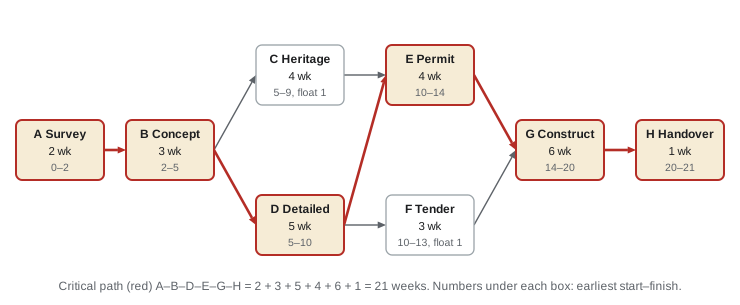
Once the activities, their durations and their dependencies are known, the critical path method (CPM) finds the shortest possible project duration and the activities that control it.
- Forward pass: each activity's earliest start (ES) is the latest earliest finish (EF) of its predecessors; EF = ES + duration.
- Backward pass: starting from the project end, each activity's latest finish (LF) is the earliest latest start (LS) of its successors; LS = LF − duration.
- Total float = LS − ES: how much the activity can slip without delaying the project.
- The critical path is the chain of activities with zero float. Any delay on it delays the whole project.
Worked problem
Finding the critical path
Activities (weeks): A survey 2; B concept design 3 (after A); C heritage review 4 (after B); D detailed design 5 (after B); E building permit 4 (after C and D); F tender and award 3 (after D); G construction 6 (after E and F); H handover 1 (after G). Find the project duration, the critical path and the float of each activity.
Show solution
- Forward pass: A 0–2; B 2–5; C 5–9; D 5–10; E starts at max(9, 10) = 10, finishes 14; F 10–13; G starts at max(14, 13) = 14, finishes 20; H 20–21.
- Duration: 21 weeks.
- Backward pass from 21: H 20–21; G 14–20; E LF = 14, LS = 10; F LF = 14, LS = 11; D LF = min(10, 11) = 10, LS = 5; C LF = 10, LS = 6; B LF = min(6, 5) = 5, LS = 2; A 0–2.
- Float: C = 6 − 5 = 1 week; F = 11 − 10 = 1 week; all others 0.
Answer: 21 weeks. Critical path A–B–D–E–G–H. The heritage review and the tender each have 1 week of float
Worked problem
What if the heritage review runs long?
The heritage committee meets monthly, and the review now looks like 6 weeks instead of 4. What happens to the project?
Show solution
- C now finishes at \(5 + 6 = 11\) instead of 9. It had 1 week of float, so it overruns by 1 week net.
- E now starts at max(11, 10) = 11, finishes 15; G 15–21; H 21–22.
- New duration 22 weeks. The critical path is now A–B–C–E–G–H; D has gained 1 week of float.
Answer: The project slips one week to 22 weeks, and the heritage review becomes critical. The project lead should get the canopy options to the committee early, or ask for a special meeting, since it now controls the schedule
Shortening the project means shortening critical activities, a process called crashing. Adding a second crew might cut construction from 6 to 4 weeks, bringing the project back to 19 weeks (on the original durations), at extra cost. Shortening a non-critical activity achieves nothing. And there are limits: adding people to an activity also adds coordination, and in software development Fred Brooks famously observed that "adding manpower to a late software project makes it later" (Brooks's law, 1975).
The Gantt chart
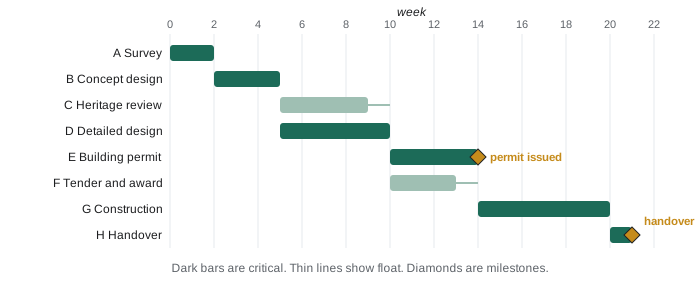
A Gantt chart draws the schedule as horizontal bars on a timeline, one row per activity. It is the most common way to communicate a schedule, because anyone can read it. Critical activities are usually highlighted, float is shown as a thin extension, and milestones (zero-duration events such as "permit issued") are diamonds.
Risk
Every schedule and budget rests on assumptions that may turn out wrong. A risk register lists each identified risk with its likelihood, its impact, an owner, and a response: avoid it, reduce it, transfer it (for example to an insurer or contractor), or accept it with a contingency. ENGG-100 used a risk matrix for safety; the same tool works for project risks. A simple way to size a contingency is the expected cost: probability times impact.
Worked problem
Expected cost of a risk
The team estimates a 20% chance of finding buried utilities that must be relocated, at a cost of about $30,000, and a 10% chance that frost in late fall delays paving into spring, costing $12,000. What is the expected cost, and how does it compare with the $25,800 contingency?
Show solution
- Utilities: \(0.20 \times 30\,000 = \$6\,000\).
- Frost delay: \(0.10 \times 12\,000 = \$1\,200\).
- Total expected cost: $7,200.
Answer: $7,200, comfortably inside the contingency on average. But if the utilities risk does occur, it alone uses $30,000, more than the whole contingency. Expected values guide budgets; the worst credible case guides decisions. A utility locate and test pits early in design would reduce the biggest risk cheaply
The human side
Psychological safety
Research by Amy Edmondson (1999) introduced the idea of psychological safety: a shared belief that the team is safe for interpersonal risk-taking, such as admitting a mistake, asking a "stupid" question or challenging a senior person's idea. Google's Project Aristotle study of its own teams (published in 2015) found it to be the most important factor distinguishing effective teams. In engineering, it is a safety issue as well as a performance one: many of the disasters studied in ENGG-100 involved someone who saw the problem but did not feel able to press it.
Leaders build psychological safety by inviting dissent ("What am I missing?"), responding to bad news with thanks rather than blame, admitting their own mistakes, and separating the person from the problem.
Giving and receiving feedback
Feedback should be specific and about behavior and its effect, not about personality. One widely taught structure, from the Center for Creative Leadership, is Situation–Behavior–Impact (SBI).
Worked problem
Feedback with SBI
A teammate has submitted their report section late twice, and the team stayed up late to integrate it. Rewrite "You're unreliable and you're dragging the team down" using SBI.
Show solution
- Situation: "For the last two report deadlines, on Oct. 3 and Oct. 17…"
- Behavior: "…your section arrived after the 6 p.m. internal deadline we agreed in the charter…"
- Impact: "…so Jin and I spent until 2 a.m. integrating and checking it, and we had no time to review the conclusions."
- Then invite their view and agree a fix: "Is something getting in the way? Could we split your section or move your internal deadline earlier?"
Answer: SBI describes facts and effects the person can recognize and change, rather than a judgment they will defend against. Ending with a question turns criticism into problem-solving
Receiving feedback is a skill too: listen fully, ask for examples, thank the person, and decide what to act on. Defending yourself in the moment rarely helps.
Handling conflict
Conflict about ideas (task conflict) can improve designs. Conflict about people (relationship conflict) almost always hurts. The Thomas–Kilmann model describes five ways people handle conflict, arranged by how assertive (pursuing their own concerns) and how cooperative (attending to others' concerns) they are.
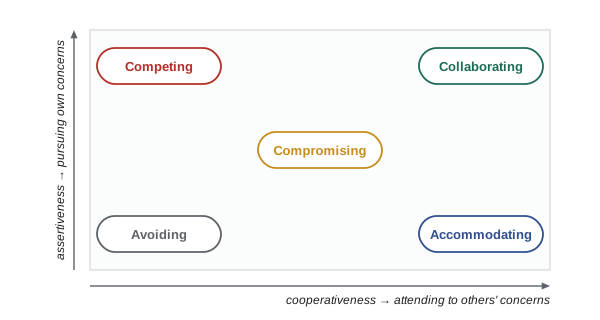
- Competing: firm on your position. Right for safety-critical issues and code compliance, where you must not give way.
- Collaborating: working to find a solution that fully satisfies both. Best for important design decisions when there is time.
- Compromising: each side gives up something. Useful under time pressure when goals are moderately important.
- Avoiding: postponing. Reasonable for trivial issues or when tempers need to cool; harmful if it becomes a habit.
- Accommodating: giving way. Appropriate when the issue matters more to the other person, or when you realize you were wrong.
Worked problem
Choosing a conflict mode
For each situation, suggest a suitable mode. (a) The architect wants a slimmer canopy beam; your calculation shows it would be overstressed. (b) Two teammates disagree on the report's font. (c) The heritage committee wants stone cladding, the board wants low cost.
Show solution
- (a) Competing on the safety requirement (the beam must work), while collaborating on how: perhaps a deeper but narrower section, or a different material, can meet both goals.
- (b) Avoiding or accommodating: it is trivial; pick one and move on.
- (c) Collaborating: look for an option that meets both interests, such as stone cladding only on the visible face, or a cast-stone product. Compromise if collaboration fails.
Answer: Hold firm on safety and codes; let go of trivia; collaborate on real trade-offs between legitimate interests
Design reviews
A design review is a planned, structured examination of a design by people who did not create it, held at defined stages: typically a concept or preliminary design review (PDR) before detailed design begins, and a critical design review (CDR) before construction or manufacture. Reviews catch errors while they are still cheap to fix, and they are the gates of the stage-gate process from Lesson 1.
A good review has a clear scope and checklist, materials sent in advance, reviewers with the right expertise and independence, and a written list of findings, each with an owner and a resolution. The designers' job during a review is to explain and listen, not to defend. In professional practice, independent checking of calculations and drawings is routine, and some jurisdictions require it for higher-risk work (New York City, for example, requires structural peer review for certain large or unusual buildings). Even so, the engineer who seals the work is responsible for it whether or not a reviewer missed something.
Inclusive and distributed teams
Teams that bring together different disciplines, backgrounds and experiences consider a wider range of users and failure modes, which is exactly what design needs. Getting that benefit takes deliberate effort: making sure quieter members are heard (silent brainstorming, round-robin input), rotating less visible tasks like taking minutes, and checking that decisions do not rest on assumptions only some members share. Distributed teams add the challenges of time zones and text-based communication: write things down, keep a single source of truth for documents (with version control), and make decisions visible to everyone, not just those on a particular call.
Common mistakes
MistakeSkipping the team charter because "we all get along".
InsteadAgree roles, communication, decision-making and deadlines in writing at the start; most conflicts come from unspoken assumptions.
MistakeAssigning two accountable people, or none, to a task.
InsteadEvery task has exactly one A in the RACI matrix.
MistakeMeetings with no agenda and minutes that record discussion but not decisions.
InsteadAgenda in advance; minutes list decisions and numbered actions with one owner and a date.
MistakeTrying to recover a late schedule by speeding up non-critical work.
InsteadOnly shortening critical-path activities shortens the project; recheck the critical path after any change.
MistakeFeedback about personality ("you're lazy").
InsteadDescribe the situation, behavior and impact, then ask and agree a fix.
MistakeTreating a design review as an attack to be defended against.
InsteadExplain, listen and record findings; reviews find problems while they are cheap to fix.
Summary and key terms
- Teams develop through forming, storming, norming, performing and adjourning; storming is normal.
- A team charter sets purpose, roles, communication, decision-making and accountability; a RACI matrix gives every task one accountable owner.
- Effective meetings have an agenda and produce decisions and action items with owners and dates.
- A work breakdown structure divides the project into work packages; the critical path method finds the duration, the critical path and each activity's float.
- Gantt charts communicate schedules; risk registers and expected costs inform contingencies, while worst credible cases inform decisions.
- Psychological safety lets people raise problems; SBI feedback and deliberate choice of conflict mode keep conflict productive.
- Independent design reviews at defined stages catch errors early; inclusive and well-documented teamwork considers more users and failure modes.
- Team charter
- A written agreement on a team's purpose, roles and ways of working.
- RACI matrix
- A table assigning tasks as Responsible, Accountable, Consulted or Informed.
- Action item
- A specific task with one owner and a due date, recorded in meeting minutes.
- Work breakdown structure
- A hierarchical division of a project into manageable work packages.
- Critical path
- The longest chain of dependent activities, which sets the project duration.
- Float
- How long an activity can be delayed without delaying the project.
- Gantt chart
- A bar chart of activities against time.
- Crashing
- Shortening critical activities, usually at extra cost.
- Risk register
- A list of risks with likelihood, impact, owner and response.
- Psychological safety
- A shared belief that a team is safe for interpersonal risk-taking.
- Design review
- A structured examination of a design by people independent of its creation.
Practice problems
Work each problem on paper first, then reveal the answer to check.
A team is three weeks into a project and arguing about scope and who does what. Which Tuckman stage is this, and what would help?
Show answer
Storming. Revisit or write the team charter: confirm the deliverables, roles and how decisions are made, and record the agreement.
Write a proper action item for: "Someone needs to get quotes for handrails."
Show answer
Example: "A7. Obtain three written quotes for aluminum handrails to drawing E-301 rev. B. Owner: Sam. Due: Nov. 15."
In the original schedule, by how much can the tender (F) slip before the project is delayed? What if it slips 3 weeks?
Show answer
F has 1 week of float. A 3-week slip finishes F at week 16 instead of 13, so G starts at 16 (not 14) and the project finishes at week 23, a 2-week delay.
Activities: P 4 days; Q 6 days after P; R 3 days after P; S 5 days after Q and R. Find the duration, critical path and the float of R.
Show answer
P 0–4; Q 4–10; R 4–7; S 10–15. Duration 15 days. Critical path P–Q–S. R float = 10 − 7 = 3 days.
In the original entrance schedule, which single change would shorten the project more: cutting the heritage review from 4 to 2 weeks, or cutting detailed design from 5 to 4 weeks?
Show answer
Heritage review is not critical, so cutting it gains nothing. Cutting detailed design (critical) to 4 weeks makes D finish at 9; E then starts at max(9, 9) = 9, giving a 20-week project. Detailed design.
A risk has a 5% chance of costing $200,000 and another a 40% chance of costing $10,000. Compare their expected costs and say which deserves more attention.
Show answer
$10,000 and $4,000. The first also has a much worse worst case ($200,000), so it deserves more attention: reduce its likelihood or transfer it if possible.
Rewrite with SBI: "Your drawings are sloppy."
Show answer
Example: "On the bracket drawing issued Tuesday (situation), three dimensions were missing and the title block showed rev. A (behavior), so the shop called twice and fabrication was held for a day (impact). Can we add a checklist step before issue?"
Which conflict mode suits: (a) a teammate wants to use a non-code-compliant handrail height to save money; (b) choosing a team name?
Show answer
(a) Competing on the code requirement, then collaborating on other savings. (b) Avoiding or accommodating; it is trivial.
Give two practices that build psychological safety.
Show answer
Examples: leaders asking "What am I missing?"; thanking people who raise bad news; admitting their own mistakes; blameless reviews of errors focused on the system.
What is the difference between a PDR and a CDR?
Show answer
A preliminary design review checks the concept and approach before detailed design starts. A critical design review checks the completed detailed design before construction or manufacture.
Lesson quiz · 5 questions
Score 60% or more to complete this lesson.
Create a free account to save your progress, take quizzes and earn a certificate.