
ENGG-130 · Lesson 1 of 5 · 45 min
Forces and vectors
Statics is the study of bodies that are not accelerating. That sounds narrow, but it covers nearly everything engineers build to stand still: bridges, buildings, towers, cranes holding a load, pipe supports, machine frames, dams and retaining walls. Before you can size a beam or pick a bolt, you need to know the forces acting on it, and statics is how you find them.
Every statics problem is built from the same raw material: forces, which are vectors. This chapter sets up the tools you will use for the rest of the course. You will learn how to describe a force, add forces graphically and with trigonometry, break forces into components in two and three dimensions, write a force that acts along a cable, and use the dot product to find angles and projections.
What statics assumes
Engineering mechanics rests on a few idealizations. They are approximations, but very good ones for the problems in this course.
- A particle has mass but negligible size. We can treat a body as a particle when all the forces on it act through one point, such as a ring where several cables meet.
- A rigid body does not deform. Real steel beams bend a few millimeters under load, but that change in geometry is too small to affect the equilibrium calculation. (How much they bend is the subject of mechanics of materials, the course that follows this one.)
- A concentrated force acts at a single point. Real loads are always spread over some area, but if the area is small compared with the body, a point load is accurate.
Newton's laws are the foundation. The first law says that a body with no net force stays at rest or moves at constant velocity. Statics is the case where the net force and the net moment are both zero, so the body stays where it is. The third law says forces come in equal and opposite pairs, and you will use it every time you take a structure apart to analyze the pieces.
Units
This course uses SI units. Force is measured in newtons (N), where 1 N is the force that accelerates 1 kg at 1 m/s². Structural loads are usually quoted in kilonewtons (1 kN = 1000 N) and moments in newton-meters (N·m) or kilonewton-meters (kN·m). Distances are in meters or millimeters. Stress, which you will meet next year, is in pascals (1 Pa = 1 N/m²) and in practice megapascals (1 MPa = 1 N/mm²).
Mass and weight are different things. Mass, in kilograms, is a property of the object. Weight is the force gravity exerts on it, \(W = mg\), with \(g = 9.81\) m/s² near the Earth's surface. A 2000 kg steel beam weighs \(2000 \times 9.81 = 19\,620\) N, or 19.6 kN. When a drawing says a load is "2 tonnes", convert it to a force before using it in an equilibrium equation.
Describing a force
A force is fully described by four things: its magnitude (how large, in newtons), its direction (an angle, a slope, or a unit vector), its sense (which way along that direction it points), and its point of application. The straight line through the point of application in the direction of the force is its line of action.
For a rigid body, the principle of transmissibility says a force can slide anywhere along its line of action without changing its external effect. Pushing a stalled car from behind and pulling it with a rope from the front, along the same line, produce the same motion. This is only true for the body as a whole: the internal forces in the car are different in the two cases, and that matters when you design the bumper.
On diagrams, directions are given in one of three ways. An angle measured from a stated axis, such as "30° above the positive x-axis". A slope triangle, such as a small 3-4-5 triangle drawn beside the force: the force has the same direction as the hypotenuse, so its components are \(\tfrac{3}{5}\) and \(\tfrac{4}{5}\) of its magnitude. Or, in three dimensions, the coordinates of two points on the line of action. All three are common on engineering drawings, and you should be comfortable with each.
Adding forces: the parallelogram law
Forces add as vectors. Two forces acting at a point can be replaced by a single resultant force, found with the parallelogram law: draw the two forces tail to tail, complete the parallelogram, and the diagonal from the common tail is the resultant. The equivalent triangle rule places the forces tip to tail; the resultant runs from the first tail to the last tip.
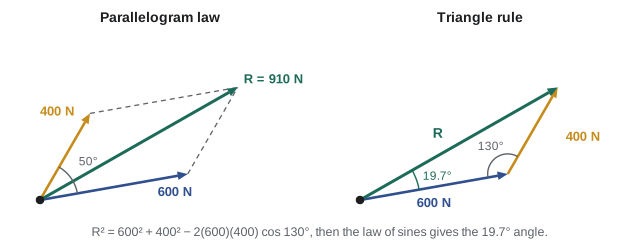
The triangle gives you a way to calculate the resultant with two results from trigonometry. For a triangle with sides \(a, b, c\) and opposite angles \(A, B, C\):
The law of cosines gives the size of the resultant; the law of sines then gives its direction.
Worked problem
Two cables on an eye bolt
An eye bolt is pulled by two cables: 600 N and 400 N, with 50° between them. Find the resultant and its angle from the 600 N cable.
Show solution
- Place the forces tip to tail. The interior angle between them in the triangle is \(180^\circ - 50^\circ = 130^\circ\).
- \[R^2 = 600^2 + 400^2 - 2(600)(400)\cos 130^\circ = 828\,538 \;\Rightarrow\; R = 910.2 \text{ N}\]
- Law of sines for the angle \(\phi\) between \(R\) and the 600 N force, which sits opposite the 400 N side:
- \[\frac{400}{\sin\phi} = \frac{910.2}{\sin 130^\circ} \;\Rightarrow\; \sin\phi = 0.3366, \quad \phi = 19.7^\circ\]
Answer: R = 910 N, at 19.7° from the 600 N cable, toward the 400 N cable. Check: the resultant is closer to the larger force, as it should be
Graphical methods are still useful for checking. A scaled sketch on squared paper will catch a resultant that points the wrong way or is wildly too large. But for more than two forces, the component method below is faster and less error-prone.
Rectangular components in two dimensions
Any force in a plane can be replaced by two perpendicular components, one along each axis. If a force \(F\) makes an angle \(\theta\) with the positive x-axis:
With a slope triangle instead of an angle, use the ratios of its sides directly. A force of 500 N along a 3-4-5 slope pointing up and to the left has components \(F_x = -\tfrac{3}{5}(500) = -300\) N and \(F_y = +\tfrac{4}{5}(500) = 400\) N. Assign the signs from the sketch, not from the calculator.
In vector notation, using unit vectors \(\mathbf{i}\) and \(\mathbf{j}\) along x and y, a force is written \(\mathbf{F} = F_x\mathbf{i} + F_y\mathbf{j}\). To add any number of forces, add their components:
The inverse tangent on a calculator only returns angles between −90° and +90°. If \(R_x\) is negative, the resultant is in the second or third quadrant and you must add 180°. Sketch the components and look.
Worked problem
Resultant of three forces on a bracket
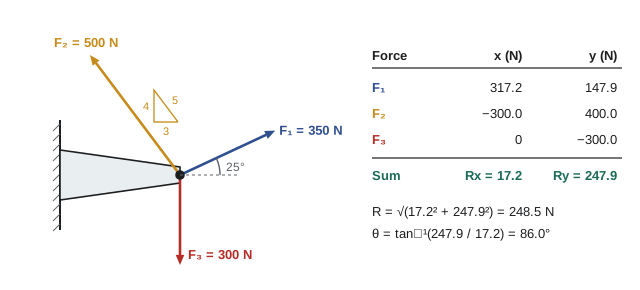
A bracket carries three forces at one point: \(F_1 = 350\) N at 25° above the positive x-axis, \(F_2 = 500\) N up and to the left along a 3-4-5 slope (3 horizontal, 4 vertical), and \(F_3 = 300\) N straight down. Find the resultant.
Show solution
- \(F_1\): \(350\cos 25^\circ = 317.2\) N, \(350\sin 25^\circ = 147.9\) N.
- \(F_2\): \(-\tfrac{3}{5}(500) = -300.0\) N, \(+\tfrac{4}{5}(500) = 400.0\) N.
- \(F_3\): 0, \(-300.0\) N.
- Sums: \(R_x = 317.2 - 300.0 + 0 = 17.2\) N and \(R_y = 147.9 + 400.0 - 300.0 = 247.9\) N.
- \[R = \sqrt{17.2^2 + 247.9^2} = 248.5 \text{ N}, \qquad \theta = \tan^{-1}\frac{247.9}{17.2} = 86.0^\circ\]
Answer: R = 249 N at 86.0° above the positive x-axis, almost straight up
Setting the work out as a table (one row per force, columns for x and y) is the habit that separates clean solutions from messy ones. It makes a sign error easy to spot and easy for a reviewer to check.
Working backwards: finding an unknown force
Often the resultant is what you need, and one of the forces is unknown. The same component equations work in reverse.
Worked problem
Two tugs on a barge
Two tugboats tow a barge. The combined pull must be 5000 N straight ahead (along +x). Tug A pulls with 3000 N at 30° to the left of ahead (above the x-axis). (a) What force must tug B provide? (b) If tug A can adjust its pull but must stay at 30°, what is the smallest force tug B could provide?
Show solution
- Tug A: \((3000\cos 30^\circ,\; 3000\sin 30^\circ) = (2598,\; 1500)\) N.
- (a) Tug B must supply the rest: \(B_x = 5000 - 2598 = 2402\) N and \(B_y = 0 - 1500 = -1500\) N.
- \[B = \sqrt{2402^2 + 1500^2} = 2832 \text{ N}, \qquad \tan^{-1}\frac{1500}{2402} = 32.0^\circ \text{ to the right}\]
- (b) On the triangle rule, A's line is fixed and B closes the triangle from A's tip to the tip of R. The shortest closing side is perpendicular to A's line, so B acts at 90° to A (60° to the right of ahead).
- \[B_{\min} = 5000\sin 30^\circ = 2500 \text{ N}, \qquad A = 5000\cos 30^\circ = 4330 \text{ N}\]
Answer: (a) 2830 N at 32.0° to the right of ahead; (b) 2500 N at 60° to the right, with tug A pulling 4330 N
Components along non-perpendicular directions
Sometimes a force must be split into parts along two given directions that are not at right angles, for example into the two members of a bracket that meet at a joint. You can do this with the law of sines on the force triangle, or by writing the two unknown parts as components and solving two equations.
Worked problem
Splitting a load into two struts
A 1000 N hanging load is supported by two members meeting at a joint. Member 1 rises to the left at 30° above horizontal; member 2 rises to the right at 60° above horizontal. Find the force each member must supply.
Show solution
- Write each member's force as a magnitude times its direction: \(P_1(-\cos 30^\circ, \sin 30^\circ)\) and \(P_2(\cos 60^\circ, \sin 60^\circ)\).
- Their sum must balance the load, giving \((0, 1000)\) N upward.
- x: \(-0.866P_1 + 0.500P_2 = 0\), so \(P_2 = 1.732P_1\).
- y: \(0.500P_1 + 0.866(1.732P_1) = 1000\), so \(2.000P_1 = 1000\).
Answer: P₁ = 500 N and P₂ = 866 N. The members are at right angles to each other here, so the answers are simply 1000 sin 30° and 1000 cos 30°. The steeper member carries more of the load
That pattern is worth remembering: the member closest to the line of the load does most of the work. The same idea explains why nearly flat cables develop enormous tension, which you will see in the next lesson.
Forces in three dimensions
Many real structures are three-dimensional: guyed towers, tripods, crane booms held by cables, pipe hangers. A force in space has three rectangular components:
Its direction can be described by the three direction angles \(\alpha, \beta, \gamma\) that the force makes with the positive x, y and z axes. Their cosines, the direction cosines, are the components of the unit vector along the force:
Because the squares must add to one, only two of the angles are independent. Given two, the third is fixed (up to the sign of its cosine, which you choose from the sketch).
Worked problem
Force from direction angles
A 500 N force has \(\alpha = 60^\circ\) and \(\beta = 45^\circ\), and points upward (positive z). Find \(\gamma\) and the components.
Show solution
- \[\cos^2\gamma = 1 - \cos^2 60^\circ - \cos^2 45^\circ = 1 - 0.25 - 0.50 = 0.25\]
- \(\cos\gamma = +0.5\) because the force points up, so \(\gamma = 60^\circ\).
- Components: \(500(0.5,\; 0.7071,\; 0.5) = (250,\; 353.6,\; 250)\) N.
Answer: γ = 60°; F = 250i + 354j + 250k N
A force directed along a line
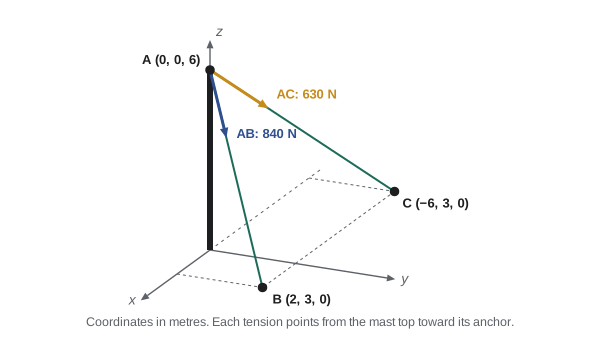
The most useful 3D form comes from geometry. A cable's tension acts along the cable, so if you know the coordinates of its two ends you know its direction. The position vector from point A to point B is
Divide by its length to get a unit vector, and multiply by the tension:
Always run the position vector from the body toward the point the cable pulls it to. A cable pulls the body toward the far anchor, never away from it.
Worked problem
Tension along a guy cable
A guy cable runs from the top of a mast, A(0, 0, 6) m, to a ground anchor B(2, 3, 0) m. Its tension is 840 N. Write the force the cable exerts on the mast top.
Show solution
- \(\mathbf{r}_{AB} = (2 - 0)\mathbf{i} + (3 - 0)\mathbf{j} + (0 - 6)\mathbf{k} = 2\mathbf{i} + 3\mathbf{j} - 6\mathbf{k}\) m.
- Length: \(\sqrt{4 + 9 + 36} = 7\) m.
- \[\mathbf{F}_{AB} = 840\,\frac{2\mathbf{i} + 3\mathbf{j} - 6\mathbf{k}}{7} = 240\mathbf{i} + 360\mathbf{j} - 720\mathbf{k} \text{ N}\]
Answer: F = 240i + 360j − 720k N. Check: √(240² + 360² + 720²) = 840 N
Worked problem
Resultant of two guy cables
A second cable runs from A(0, 0, 6) to C(−6, 3, 0) with a tension of 630 N. Find the resultant of the two cable forces on the mast top, and its direction angles.
Show solution
- \(\mathbf{r}_{AC} = -6\mathbf{i} + 3\mathbf{j} - 6\mathbf{k}\) m, length \(\sqrt{36 + 9 + 36} = 9\) m.
- \(\mathbf{F}_{AC} = 630(-6, 3, -6)/9 = (-420,\; 210,\; -420)\) N.
- Add: \(\mathbf{R} = (240 - 420,\; 360 + 210,\; -720 - 420) = (-180,\; 570,\; -1140)\) N.
- \[R = \sqrt{180^2 + 570^2 + 1140^2} = 1287 \text{ N}\]
- Direction cosines: \(-180/1287 = -0.1398\), \(570/1287 = 0.4428\), \(-1140/1287 = -0.8856\).
Answer: R = −180i + 570j − 1140k N, magnitude 1290 N, with α = 98.0°, β = 63.7°, γ = 152.3°. The large downward part compresses the mast; the sideways part (600 N in the y direction) must be balanced by a third cable
That last observation is the whole point of the calculation. A mast with two guys on one side would be pulled over. Designers place a third cable so the horizontal parts cancel, a problem you will solve in the next lesson.
The dot product
The dot (scalar) product of two vectors is
where \(\theta\) is the angle between them. It answers two questions that come up constantly in statics:
- The angle between two lines: \(\cos\theta = \mathbf{u}_1 \cdot \mathbf{u}_2\), using unit vectors along each line.
- The component of a force along a line, called its projection: \(F_\parallel = \mathbf{F}\cdot\mathbf{u}\). The perpendicular part is then \(F_\perp = \sqrt{F^2 - F_\parallel^2}\).
Projections matter whenever a member can only resist force along its own axis, like a strut, or when you need the part of a load that acts along a slope or a shaft.
Worked problem
Angle between two cables and a projection
For the mast above, find the angle between cables AB and AC, and the component of the 630 N force in AC along the line AB.
Show solution
- \(\mathbf{u}_{AB} = (2, 3, -6)/7\) and \(\mathbf{u}_{AC} = (-6, 3, -6)/9\).
- \[\cos\theta = \frac{(2)(-6) + (3)(3) + (-6)(-6)}{7 \times 9} = \frac{33}{63} = 0.5238\]
- \(\theta = 58.4^\circ\).
- Projection: \(F_\parallel = 630 \times 0.5238 = 330\) N.
Answer: The cables are 58.4° apart, and 330 N of the AC tension acts along AB
Common mistakes
MistakeUsing the 50° between two forces directly in the law of cosines.
InsteadThe law of cosines uses the angle inside the force triangle, opposite the resultant: 180° minus the angle between the forces when they are drawn tail to tail.
MistakeTrusting the calculator's inverse tangent for the direction of a resultant.
Insteadtan⁻¹ only returns −90° to 90°. If Rx is negative, add 180°. Always check the quadrant against a sketch.
MistakeTaking components with sin and cos the wrong way round when the angle is measured from the y-axis or from a slope.
InsteadThe component adjacent to the angle gets cos. Redraw the right triangle for each force rather than memorizing "x is cos".
MistakeWriting a cable force from the anchor toward the body.
InsteadA cable pulls the body toward the anchor. Run the position vector from the body's attachment point to the far end.
MistakeForgetting to divide by the length when building a force from a position vector.
InsteadF = F(r/r). Check that the magnitude of your result equals the given tension.
MistakeUsing mass in kilograms as if it were a force.
InsteadConvert to weight with W = mg before writing any force equation: a 50 kg load is 490.5 N.
Summary and key terms
- Statics finds the forces on bodies that are not accelerating, using idealizations of particles, rigid bodies and concentrated forces.
- A force has magnitude, direction, sense and point of application. On a rigid body it can slide along its line of action (transmissibility).
- Two forces combine by the parallelogram law or triangle rule; the law of cosines and law of sines give the resultant.
- For several forces, resolve each into components, add each axis separately, then rebuild R and its angle, checking the quadrant.
- In 3D, F = Fx i + Fy j + Fz k. Direction cosines are the components of the unit vector and their squares add to one.
- A force along a line from A to B is F times r_AB divided by its length.
- The dot product gives the angle between lines and the projection of a force onto a direction.
- Scalar
- A quantity with magnitude only, such as mass or length.
- Vector
- A quantity with magnitude and direction, such as force.
- Resultant
- The single force equivalent to a set of concurrent forces.
- Line of action
- The line through a force's point of application along its direction.
- Principle of transmissibility
- A force on a rigid body may move along its line of action without changing the external effect.
- Rectangular components
- Perpendicular parts of a vector along the coordinate axes.
- Unit vector
- A vector of length one that indicates direction.
- Direction cosines
- The cosines of the angles a vector makes with the x, y and z axes.
- Position vector
- A vector from one point to another, built from their coordinate differences.
- Dot product
- A·B = AB cos θ; used for angles and projections.
Practice problems
Work each problem on paper first, then reveal the answer to check.
A 750 N force acts at 220° from the positive x-axis (measured counterclockwise). Find its components.
Show answer
Fx = 750 cos 220° = −574.5 N; Fy = 750 sin 220° = −482.1 N. Both negative: third quadrant.
A 1.30 kN force acts along a 5-12-13 slope, pointing down and to the right (12 horizontal, 5 vertical). Find its components.
Show answer
Fx = +(12/13)(1300) = 1200 N; Fy = −(5/13)(1300) = −500 N.
Two forces of 8 kN and 5 kN act on a gusset plate with 70° between them. Find the resultant and its angle from the 8 kN force.
Show answer
R² = 64 + 25 + 2(8)(5)cos 70° = 116.4, R = 10.79 kN. sin φ = 5 sin 110°/10.79 = 0.4355, φ = 25.8°.
Find the resultant of 200 N at 0°, 300 N at 90° and 250 N at 225°.
Show answer
Rx = 200 − 176.8 = 23.2 N; Ry = 300 − 176.8 = 123.2 N. R = 125.4 N at 79.3°.
The resultant of two forces must be 1200 N vertically upward. One force is 800 N at 60° above the positive x-axis. Find the other.
Show answer
First force: (400, 692.8). Other: (−400, 507.2) N, magnitude 646 N at 128.3° from +x (51.7° above the negative x-axis).
A force has α = 45°, γ = 60°, and a positive y-component. Find β.
Show answer
cos²β = 1 − 0.5 − 0.25 = 0.25, cos β = +0.5, β = 60°.
A cable runs from A(1, 0, 4) m to B(4, 4, 4) m with tension 2.5 kN. Write the force on A as a vector.
Show answer
r = (3, 4, 0), length 5. F = 2.5(0.6, 0.8, 0) = 1.5i + 2.0j kN. The cable is horizontal.
F = 300i − 200j + 600k N. Find its magnitude and direction angles.
Show answer
F = √(90 000 + 40 000 + 360 000) = 700 N. cos α = 3/7, α = 64.6°; cos β = −2/7, β = 106.6°; cos γ = 6/7, γ = 31.0°.
Find the angle between r₁ = (2, 2, 1) and r₂ = (4, −4, 2).
Show answer
Dot product 8 − 8 + 2 = 2. Lengths 3 and 6. cos θ = 2/18, θ = 83.6°.
F = 400i + 300j N acts on a pipe whose axis has unit vector u = (0.8, 0, 0.6). Find the components of F along and perpendicular to the pipe.
Show answer
F∥ = 400(0.8) + 0 + 0 = 320 N. F = 500 N, so F⊥ = √(500² − 320²) = 384 N.
Lesson quiz · 5 questions
Score 60% or more to complete this lesson.
Create a free account to save your progress, take quizzes and earn a certificate.