
ELV-430 · Lesson 7 of 12 · 21 min
Hydraulic modernization and cylinder replacement
In the spring audit in ELV-420, Hugh Mbeki had spotted that Birchwood Apartments car 2 was using more oil every year with no leak anyone could see. The early cylinder test passed and a weeping valve fitting was replaced, but the trend did not stop, and a buried cylinder with no protective casing that slowly loses oil is the hydraulic version of a rope wearing faster than the others: it might be nothing, and it might be oil going into the ground. Birchwood's owners asked Northcrest to price a hydraulic modernization of car 2 that would replace the cylinder with a new one in a sealed liner, along with the power unit, the valve and the controller. Tamsin was released from Tillicum for two weeks in the middle of the outage to join the Birchwood crew, which is how this lesson came to be in her last term. It covers modernizing hydraulic elevators: the power unit and valve, the controller and starter, the choice between replacing a buried cylinder and converting to a holeless design, and the drilling, removal, installation and environmental work a cylinder replacement involves.
What a hydraulic modernization includes
ELV-220 covered how hydraulic elevators work. A typical hydraulic modernization replaces the power unit, which is the tank, pump, motor and control valve, with a new one; replaces the controller and starter; adds or replaces the rupture valve at the cylinder; replaces the oil, often with a fire-resistant or biodegradable fluid where the owner or the environment calls for it; and replaces the door equipment and fixtures as lesson 6 described. The cylinder is the expensive question. It is either kept, when it is in a protective casing or above ground and tested sound, or replaced, which for a buried cylinder means drilling.
Each part brings its own improvements. A new submersible power unit runs its pump and motor inside the oil tank, which is quieter and cools the motor in the oil. A modern control valve with electronic adjustment gives smoother starts, stops and leveling than an old mechanical valve and holds its settings better as the oil warms. A soft starter or a variable-frequency drive on the pump motor reduces the starting current, which ELV-220 showed can be several times running current on an across-the-line start, and with a variable-frequency drive the valve's job becomes simpler because the pump flow itself is controlled. Oil heaters or coolers keep the oil in the temperature range where its viscosity, and therefore the car's ride, stay steady.
# Sizing the new power unit for Birchwood car 2 (direct-acting, single-stage plunger)
import math
rated = 3500          # lb
car_wt = 4000           # car and plunger weight on the cylinder, lb
plunger_d = 5.5         # in
speed = 80              # rated up speed, ft/min
eff = 0.60
area = math.pi * plunger_d ** 2 / 4
p_work = (rated + car_wt) / area
flow = area * speed * 12 / 231
power = p_work * flow / 1714 / eff
print(f"plunger area {area:.2f} in2; working pressure {p_work:,.0f} psi with rated load")
print(f"pump flow for rated speed {flow:.0f} gal/min")
print(f"motor power about {power:.1f} hp at {eff:.0%} overall pump and motor efficiency")plunger area 23.76 in2; working pressure 316 psi with rated load pump flow for rated speed 99 gal/min motor power about 30.3 hp at 60% overall pump and motor efficiency
The new power unit was a submersible unit with a 40 hp motor, a little larger than the calculation's figure to allow for the friction of the piping and the valve and for the oil's viscosity on cold mornings, and the starting current was cut with a soft starter. The power unit's tank had to hold enough oil to fill the cylinder with the car at the top, plus the reserve the maker specifies above the pump inlet, plus the piping, which was checked against the cylinder volume calculated from the plunger diameter and stroke.
Replacing or converting the cylinder
A buried cylinder that is not protected against corrosion can leak oil into the soil and, if its bottom fails, let the car descend. ELV-220 described how the code and the authorities responded: new buried cylinders must be inside a protective liner or casing that keeps them away from the soil and lets leaks be detected, and older single-bottom cylinders have been the subject of upgrade orders. Birchwood's cylinders had safety bulkheads, which met the usual upgrade rules, but without a casing nobody could say where the missing oil had gone.
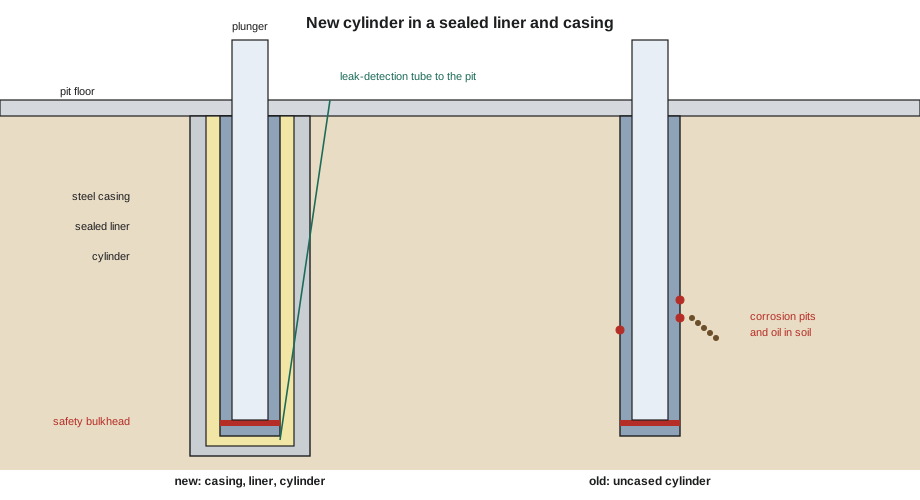
There were two ways to remove the risk. One was to drill out the old cylinder and install a new one in a sealed liner, with its own casing and leak detection; the car would keep its original layout and capacity. The other was to convert car 2 to a holeless design, with one or two telescopic cylinders standing in the pit beside the car, as at Ashgrove Clinic, removing the buried cylinder and filling its hole. Holeless conversions avoid drilling but limit travel, often need the rails and the car frame altered, and take pit space. Birchwood's car 2 traveled four floors with a heavy freight duty, beyond what a holeless arrangement could comfortably carry in its pit, so the owners chose a new in-ground cylinder.
Pulling the old cylinder
Cylinder replacement is done with a specialist drilling contractor working with the elevator crew. The car is landed on cribbing at the bottom of the hoistway or lifted and held at the top with a chain hoist from the overhead beam, depending on the method; the oil is pumped out of the cylinder and the power unit into drums for disposal or recycling; and the plunger is disconnected from the platen and pulled out through the car, then the cylinder itself is pulled. At Birchwood, the old cylinder was 40 ft long, and pulling it meant lifting it up through the hoistway and out through the top of the building's hoistway into the drilling contractor's crane, in sections, with the hoistway protected and the area below the lift kept clear. Lesson 2's planning applied here as much as anywhere: the crane, the drilling rig and the environmental contractor all had to be booked together.
The old cylinder is examined as soon as it is out. Corrosion pits, holes and staining on the outside, and the condition of the soil around the hole, tell the owner whether oil has been leaking and how much. Birchwood's cylinder had a cluster of corrosion pits about two-thirds of the way down, one of them through the wall, and the soil in the hole near it smelled of oil. That made the job an environmental cleanup as well as a cylinder replacement.
Oil in the ground
Hydraulic oil in soil is a spill, and spills have reporting rules. In Washington, the state's Department of Ecology must be notified of oil spills to soil or water, and the person responsible must contain and clean them up. The owner, not the elevator contractor, is usually responsible for the cleanup, but the contractor's crew is often the first to see the evidence and must tell the owner at once and in writing. At Birchwood, the environmental consultant took soil samples from the hole as it was drilled out, the contaminated soil was removed in drums by a licensed carrier, and the hole was cleared before the new casing went in. The owner's report to the authority recorded the estimated quantity from the oil usage records, which were suddenly the most useful document on the job.
# Estimating oil lost to the ground from Birchwood car 2's oil records
added = [5.3, 7.4, 9.2, 11.9, 13.7, 15.9]            # oil added each year for the last six years, gal
normal = 3.2            # allowance for normal losses (packing seepage collected in the drip ring, sampling), gal a year
cyl_volume = 50           # cylinder full of oil, gal
lost = sum(max(a - normal, 0) for a in added)
print(f"oil added over {len(added)} years: {sum(added):.0f} gal; unexplained: {lost:.0f} gal")
print(f"that is {100 * lost / cyl_volume:.0f} % of the cylinder volume")
print("report the estimate with the records it came from; the soil samples will confirm or correct it")oil added over 6 years: 63 gal; unexplained: 44 gal that is 88 % of the cylinder volume report the estimate with the records it came from; the soil samples will confirm or correct it
Installing the new cylinder
The drilling contractor drilled the old hole out to the larger diameter the new casing needed and to the depth the new cylinder and its bottom clearance required, set the steel casing, and checked the hole's verticality. The new cylinder came already sealed in its liner, a heavy plastic tube closed at the bottom, with a leak-detection tube running from the bottom of the liner to the pit, where any oil that escaped from the cylinder would collect and could be checked with a dipstick. The assembly was lowered into the casing with the crane, plumbed with a long level against the rails, and its head set to the elevation the drawings showed. The space between the liner and the casing was filled as the maker specified, and the pit floor was rebuilt around the cylinder head.
Then the crew took over. The plunger was installed and connected to the platen, the rupture valve was mounted at the cylinder head, the new oil line was run from the power unit to the cylinder with as few joints as possible and none buried, the power unit was set and filled, the controller and soft starter were wired, and the system was bled of air by running the car slowly up and down as the valve maker described. With the car running, the valve was adjusted: up acceleration, up speed, up slowdown and leveling, down start, down speed, down slowdown and leveling, and the relief setting. The adjustments were made with the oil at its normal running temperature, after an hour of runs, because a valve adjusted with cold oil runs too fast and lands short once the oil warms.
# Rupture valve trip setting check (illustrative; the maker's chart sets the actual setting)
rated_down = 80               # rated down speed, ft/min
plunger_area = 23.76              # in2
trip_factor = 1.4              # trips at this multiple of rated down speed (maker's guidance, illustrative)
q_rated = plunger_area * rated_down * 12 / 231
q_trip = q_rated * trip_factor
print(f"rated down flow {q_rated:.0f} gal/min; valve set to trip at about {q_trip:.0f} gal/min ({trip_factor:.0%} of rated speed)")
print("tested by opening the down valve fully with rated load and confirming the car stops within the allowed distance")rated down flow 99 gal/min; valve set to trip at about 138 gal/min (140% of rated speed) tested by opening the down valve fully with rated load and confirming the car stops within the allowed distance
Tests and acceptance
The acceptance tests for a hydraulic modernization follow the same pattern as lesson 8's for an electric car, with the hydraulic items ELV-220 and ELV-420 described: the relief valve set and sealed, the system held at pressure to check for leaks, the rupture valve tripped with rated load, the car held at a landing to check for drift, the low oil protection, the pump motor's starting and running currents, the controller's safety functions and the door and fixture tests. The new cylinder's leak-detection tube was dipped and recorded as dry, which became the first entry in its new record in the maintenance control program. Camille Draper, who had done the Larchmont East acceptance in ELV-420, inspected Birchwood car 2, and it returned to service at the end of the third week.
Worked problem
Holeless or a new in-ground cylinder?
A two-stop hydraulic car in a small clinic has a buried, uncased cylinder that has failed its leakage test. The car carries light loads, the pit is wide, and the building sits on a site with groundwater close to the surface. What should the survey report recommend?
Show solution
- Drilling near groundwater adds environmental risk and cost to an in-ground replacement.
- A two-stop car with light loads is well within what a holeless telescopic arrangement can carry.
- A wide pit gives room for one or two holeless cylinders beside the car.
- Recommend a holeless conversion, removing the old cylinder and filling the hole, subject to checking the rails and car frame for the new support points.
Answer: Recommend a holeless conversion: the travel and load suit it, the pit allows it and it avoids drilling near groundwater.
Common mistakes
MistakeTreating oil usage records as a formality.
InsteadThey are the evidence of leaks and the basis of any spill estimate.
MistakeAdjusting a hydraulic valve with cold oil.
InsteadRun the car until the oil reaches its working temperature, then adjust.
MistakeBurying oil line joints.
InsteadKeep joints accessible and the run as short and simple as possible.
MistakeLeaving the environmental question to the end.
InsteadBook the environmental consultant with the drilling contractor and tell the owner at once if oil is found.
MistakeChoosing holeless without checking travel, load and pit space.
InsteadHoleless designs have limits; check them before recommending one.
Summary and key terms
- Hydraulic modernizations replace the power unit, valve, controller and starter, add a rupture valve and often replace the oil.
- Buried cylinders without casing can leak into the soil; new buried cylinders go in sealed liners with leak detection.
- The choice is a new in-ground cylinder or a holeless conversion, decided by travel, load, pit and site.
- Pulling a cylinder needs a drilling contractor, a crane, oil handling and an environmental plan booked together.
- Oil found in the ground is a spill with reporting duties; the oil records support the estimate.
- Valves are adjusted with warm oil; acceptance includes relief, pressure, rupture valve, drift and low oil tests.
- Power unit
- The tank, pump, motor and control valve of a hydraulic elevator.
- Submersible power unit
- A power unit with its pump and motor inside the oil tank.
- Liner
- A sealed plastic tube around a buried cylinder that keeps it from the soil and collects leaks.
- Leak-detection tube
- A tube from the bottom of the liner to the pit for checking for escaped oil.
- Holeless hydraulic
- A hydraulic elevator with cylinders standing in the pit instead of buried below it.
- Rupture valve
- A valve at the cylinder that stops the car if the oil flow out of the cylinder exceeds a set rate.
Practice problems
Work each problem on paper first, then reveal the answer to check.
Why does a soft starter help a hydraulic modernization?
Show answer
It reduces the pump motor's high starting current.
What does the leak-detection tube show?
Show answer
Whether oil has escaped from the cylinder into the liner.
Why was a holeless conversion not chosen for Birchwood car 2?
Show answer
Its travel and heavy duty were beyond what a holeless arrangement in its pit could comfortably carry.
Who is usually responsible for cleaning up oil found in the soil?
Show answer
The owner, with the contractor reporting what it finds at once.
Why adjust the valve with the oil warm?
Show answer
Valve settings made with cold oil run fast and land short once it warms.
Lesson quiz · 5 questions
Score 60% or more to complete this lesson.
Create a free account to save your progress, take quizzes and earn a certificate.