
ELV-430 · Lesson 1 of 12 · 22 min
Why and when elevators are modernized
Tamsin Iwasaki started the last term of her apprenticeship in the autumn, with the five-year test of Tillicum car 1 behind her and the car's modernization permit issued. ELV-410 had ended with Moira Kessler's review of the alteration package and its eleven findings; ELV-420 had put car 1 through its last full-load test as the old car. Now the crew would take the 1962 car apart and put a modern one together inside the same hoistway, on the same rails and the same worm geared machine. Lena Ostrander had put Priya Sandhu in charge of the job, with Ray Abernethy and Tamsin on the crew and Jonah Sweeney as the helper. Lena also gave Tamsin a second task for the term: by the spring, she would sit the certification exam that turns an apprentice into a mechanic. This course follows both. The first eight lessons cover modernization, from the first survey to the acceptance test; lessons 9 to 11 cover troubleshooting; and the capstone brings Tillicum car 1 back into service and prepares Tamsin for the exam.
What modernization means
An elevator is never finished. The building around it changes, the code changes, parts wear out and the companies that made the original equipment stop supporting it. Maintenance keeps a unit safe and working as it was built; modernization changes what it is. In the trade, modernization means replacing major components or systems with new ones of a different design, usually the controller, the drive, the door equipment and the fixtures, and often the machine on older cars. The code does not use the word. It speaks of repairs, which put the existing equipment back in its original condition; replacements, which substitute a new part of the same kind and rating; and alterations, which are any changes other than repairs and replacements. A modernization is a set of alterations, and every alteration it includes brings code requirements with it, which is why a modernization needs a permit and an acceptance inspection while a repair usually does not.
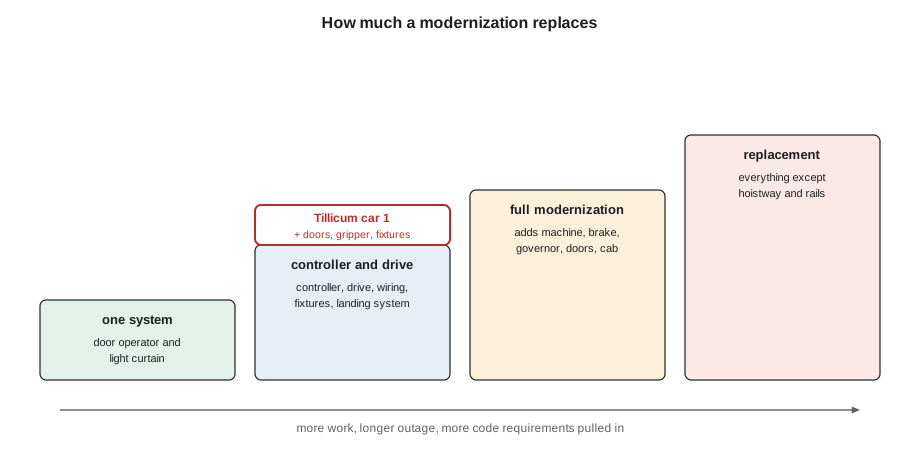
Modernizations come in sizes. The smallest replace one system, for example a door operator with a modern closed-loop operator and a light curtain, which is the job Northcrest did at Ashgrove Clinic in ELV-420. A controller modernization replaces the controller, the drive and usually the wiring, fixtures and landing system, keeping the machine, ropes, rails and safeties. A full modernization adds the machine and brake, the governor, the doors and the cab. At the far end, a replacement removes everything except the hoistway and rails and installs a new elevator, which in practice is treated as a new installation. Tillicum car 1 sat in the middle: a controller and drive modernization with door, fixture, safety and machine room work, keeping the geared machine, the DC hoist motor, the five ropes put on in the rope job two years earlier, the rails, the governor and the safeties.
Why owners modernize
Owners spend money on elevators for a handful of reasons, and a mechanic who understands them can give better advice and better survey information. The first is reliability. An old controller with worn relays, a door operator that drifts out of adjustment and a landing system with dirty contacts all cause callbacks and entrapments, and the callback log tells the story in numbers. Tillicum car 1 had averaged nine callbacks a year for the last three years against two or three for car 2, which had been modernized, and more than half of car 1's were door and relay faults.
The second is parts. Equipment from the 1960s to the 1990s was made by companies that have since merged, closed or stopped making spares, and many of their circuit boards, relays and door parts can only be found secondhand or rebuilt. A unit whose next failure may take weeks to fix because a part has to be made by hand is a unit the owner cannot rely on. The third is safety and code. New editions have added protection that old cars lack, including ascending car overspeed and unintended movement protection, door reopening devices that detect a passenger without touching them, car top guardrails, firefighter service, emergency communication with two-way voice and, in newer editions, text and visual signals. An owner does not usually have to add these to an old car that is left alone, but an alteration can require them, and some authorities have ordered upgrades of particular hazards, such as single-bottom hydraulic cylinders.
The fourth is accessibility: braille and tactile markings, audible signals, hall lanterns, larger and better-placed buttons and a car large enough for a wheelchair. The fifth is energy and performance. A Ward-Leonard car like Tillicum car 1 runs a motor-generator set, which spins whenever the car is in service, wasting power between runs and turning braking energy into heat. A modern drive draws power only when the car moves and can return braking energy to the building. Modern motion control gives smoother starts and stops, more accurate leveling and shorter flight times. The last reason is the building itself: a change of use, a renovation, a new tenant with different traffic or an owner who wants the lobby to look new.
| Reason | What the mechanic sees | What the owner sees |
|---|---|---|
| Reliability | Repeat callbacks on the same parts | Complaints and entrapments |
| Parts | Rebuilt or secondhand spares, long lead times | Long outages |
| Safety and code | Missing devices compared with current editions | Orders, insurance questions, risk |
| Accessibility | Old fixtures, no audible signals | Tenant and visitor complaints |
| Energy and ride | M-G set running, rough stops, poor leveling | Power bills, ride complaints |
| Building change | New traffic, new loads | Renovation plans |
How long equipment lasts
No component has a fixed life, but the industry has rough expectations that help when an owner asks what to plan for. Rails, machine beams and hoistway structure last as long as the building if they are kept dry and aligned. Well-maintained geared machines and their DC motors often run fifty years or more; the worm and gear wear slowly and can be measured, as ELV-230 showed. Relay controllers were commonly in service for thirty or forty years, but microprocessor controllers have a shorter useful life, often fifteen to twenty-five years, because their boards and software become obsolete before they wear out. Door operators, door equipment and fixtures wear fastest because they move on every stop, often lasting fifteen to twenty-five years. Ropes and belts depend on use and are replaced on condition. Hydraulic power units commonly run twenty to thirty years, while the life of a buried cylinder depends on the soil, the corrosion protection and luck.
These figures are expectations, not rules. A component past its typical life is a reason to look closely, not a reason to replace it, and a component inside its life can still be worn out. The survey in lesson 2 measures and records what is actually there. The code below shows the simple scoring Priya used in the first conversation with Tillicum's property manager, before the survey, to show which parts of car 1 were at or past their expected life and how much of the car's callback history they accounted for.
# First look at Tillicum car 1: component age against typical expected life (illustrative ranges)
age = 65                      # years since installation
parts = [  # (component, typical life low, high, years since last replaced, share of last 3 years' callbacks %)
    ("relay controller", 30, 40, age, 38),
    ("motor-generator set", 40, 60, age, 6),
    ("door operator and car door", 15, 25, age, 31),
    ("hall and car fixtures", 20, 30, age, 9),
    ("landing system (floor selector)", 30, 40, age, 11),
    ("geared machine and DC motor", 50, 70, age, 3),
    ("suspension ropes", 8, 20, 2, 0),
    ("governor and safeties", 40, 60, age, 2),
]
print(f"{'component':34s}{'age':>5s}{'life':>9s}{'used':>7s}{'callbacks':>11s}  flag")
for name, lo, hi, yrs, cb in parts:
    used = 100 * yrs / ((lo + hi) / 2)
    flag = "past life" if yrs > hi else ("in range" if yrs >= lo else "")
    if cb >= 25:
        flag += (" + " if flag else "") + "callback driver"
    print(f"{name:34s}{yrs:5d}{lo:4d}-{hi:<4d}{used:6.0f}%{cb:9d} %  {flag}")
print("past life and driving callbacks: replace in the modernization; past life but quiet: survey closely")component age life used callbacks flag relay controller 65 30-40 186% 38 % past life + callback driver motor-generator set 65 40-60 130% 6 % past life door operator and car door 65 15-25 325% 31 % past life + callback driver hall and car fixtures 65 20-30 260% 9 % past life landing system (floor selector) 65 30-40 186% 11 % past life geared machine and DC motor 65 50-70 108% 3 % in range suspension ropes 2 8-20 14% 0 % governor and safeties 65 40-60 130% 2 % past life past life and driving callbacks: replace in the modernization; past life but quiet: survey closely
The table made Priya's point without a sales pitch: the controller, the door equipment and the landing system were past their expected life and produced four-fifths of the callbacks, while the machine, the motor, the governor and the safeties were old but quiet, and the ropes were nearly new. That pattern is what makes a controller and drive modernization the right size for car 1. Replacing the machine would have added months of outage and a crane lift for little reliability gain, as long as the survey confirmed that the gear, bearings and brake were sound.
Signs that a unit is due
Mechanics see the signs before anyone else. A rising callback rate on a unit whose maintenance has not changed is the clearest. So are repeated adjustments that do not hold: a door operator that needs resetting every month, a leveling error that comes back a week after it is corrected, a relay contact that is filed and replaced and burns again. Parts that are rebuilt rather than bought new, a controller whose wiring diagrams are faded and marked up by four generations of mechanics, insulation that cracks when a wire is moved, a motor-generator set whose brushes and commutator need constant attention and a machine room that has to be kept cold for the controller all point the same way. So do ride complaints, longer waiting times as a building fills, and the building's own changes.
The mechanic's job is not to sell modernizations; that is for the owner, the contractor's sales staff and often an independent consultant. The mechanic's job is to keep accurate records, to report condition honestly in the maintenance control program and the annual reports, and to answer the survey questions in lesson 2 with facts. An owner who has been told for five years, in writing and with numbers, that the controller is failing will plan for it; an owner who hears about it for the first time when the car is out of service for three weeks waiting for a part will not trust the next recommendation.
At Tillicum, the property manager, Grace Holm, had been receiving Ray's annual condition notes for six years. When the building's owners decided to renovate the lobby and asked what the elevators needed, she already had a list. The decision to modernize car 1 took one meeting, because the information had been building up in Northcrest's records all along. The permit followed the code review in ELV-410, and the work was scheduled for the autumn, when the building's tenants could most easily live with one car for ten weeks.
What changes for the mechanic
A modernization is construction work inside a working building. The car being modernized is out of service for weeks, and the other car carries the whole building, so its maintenance and reliability matter more than ever; Ray scheduled an extra visit to car 2 before the outage and kept it on a short callback response for the whole job. The hoistway becomes a construction site with its own hazards: open hoistway doors behind barricades, work on the car top with a new controller not yet connected, temporary run boxes, test wiring and jumpers that must be controlled and counted, and new equipment that does not yet have its safety circuits proven. The crew works to the contractor's modernization safety procedures and the elevator industry's field safety handbook, which ELV-110 introduced; lesson 4 returns to temporary operation and jumper control.
The mechanic also changes roles. On a maintenance route, the mechanic keeps old equipment working; on a modernization, the mechanic builds new equipment, wires it from drawings, sets it up with a laptop or a service tool, tunes the drive and the motion, and proves every safety function before the inspector sees it. Many apprentices find modernization the most demanding work in the trade, because it combines installation, adjusting, troubleshooting and code knowledge on one job. It is also the work that prepares them best for the certification exam, which tests all four.
Worked problem
Modernize, repair or wait?
A seven-stop geared car in a medical building has had six callbacks this year, four of them for a relay that fails to drop out in the door circuit. The relay is a type no longer made. The owner asks whether the car needs modernizing.
Show solution
- Look at the whole pattern, not one fault: one relay causing four callbacks is a repair problem first.
- Find a replacement or an approved equivalent relay and fix the immediate cause; record the part's availability problem.
- Report to the owner that the controller uses parts no longer made, list them, and estimate how long the stock of spares will last.
- Recommend a survey to scope a controller modernization in the next two or three years, with the callback and parts data as evidence.
Answer: Repair the fault now, report the parts risk in writing and recommend a planned survey; do not let a single failing part drive a rushed modernization or be ignored.
Common mistakes
MistakeCalling every repair a modernization, or every modernization a repair.
InsteadUse the code's terms: repair, replacement and alteration, and know which needs a permit.
MistakeRecommending replacement only because a part is old.
InsteadAge is a reason to look; condition, callbacks and parts support decide.
MistakeForgetting the other car during a modernization.
InsteadThe car left in service carries the whole building; give it extra attention.
MistakeTelling the owner about failing equipment only when it fails.
InsteadReport condition honestly and in writing every year.
MistakeTreating a modernization as maintenance work.
InsteadIt is construction under a permit, with its own safety procedures.
Summary and key terms
- Modernization replaces major components with new designs; in code terms it is a set of alterations, each bringing requirements and needing a permit and acceptance.
- Scopes range from one system through controller and drive, full modernization and complete replacement.
- Owners modernize for reliability, parts, safety and code, accessibility, energy and ride, and building changes.
- Expected component lives are rough guides; condition, callbacks and parts support decide what is replaced.
- Mechanics spot the signs first and report them in writing; owners decide.
- During a modernization, the remaining car carries the building and the hoistway is a construction site.
- Modernization
- Replacing major elevator components or systems with new ones of a different design.
- Alteration
- Any change to equipment other than a repair or a replacement; it needs a permit and acceptance.
- Replacement
- Substituting a new part of the same kind and rating for an existing one.
- Controller modernization
- Replacing the controller, drive, wiring, fixtures and landing system while keeping the machine and hoistway equipment.
- Motor-generator set
- A motor driving a DC generator that powers a DC hoist motor in a Ward-Leonard system.
- Obsolescence
- The point at which a component can no longer be supported with new parts.
Practice problems
Work each problem on paper first, then reveal the answer to check.
What is the difference between a replacement and an alteration?
Show answer
A replacement substitutes a new part of the same kind and rating; an alteration is any other change and needs a permit.
Name four reasons owners modernize.
Show answer
Reliability, parts availability, safety and code, accessibility, energy and ride quality, building changes.
Why were the machine and motor kept at Tillicum car 1?
Show answer
They were old but sound and quiet in the callback record, and replacing them would add outage time and cost for little gain.
Why does a modernization change the maintenance of the other car?
Show answer
It carries the whole building during the outage, so a failure would leave no service.
Who decides whether to modernize?
Show answer
The owner, advised by the contractor and often a consultant; the mechanic supplies accurate condition information.
Lesson quiz · 5 questions
Score 60% or more to complete this lesson.
Create a free account to save your progress, take quizzes and earn a certificate.