
ELV-430 · Lesson 5 of 12 · 22 min
Machine, rope and brake upgrades
Tillicum car 1 kept its 1962 worm geared machine, but keeping a machine does not mean leaving it alone. In the third week of the outage, while the electricians were running the new car lighting circuit and the controller wiring was going in, Ray and Tamsin worked on the machine itself: the brake was relined and readjusted, the commutator was skimmed, the gear oil was changed, the sheave grooves were measured, and the rope gripper was mounted on the machine beams under the drive sheave. This lesson covers the machine, rope and brake work that goes with a modernization, the checks that decide whether old components can be reused, and the larger upgrades, from regrooving a sheave to replacing a geared machine with a gearless one, that other jobs need.
Deciding whether to reuse the machine
Lesson 2's survey measured the machine; now the crew confirms the readings with the machine opened up. The gear case cover comes off and the worm and wheel are examined for pitting, scoring and the wear pattern along the teeth, which should be even across the face. Backlash and end play are measured again with dial indicators. Bearings are listened to with the machine running on inspection and felt for heat after a series of runs. The sheave grooves are gauged on every rope, because a groove worn deeper than the others makes its rope carry more of the load and wear faster, as ELV-230 showed. Any reading that has changed since the survey, or that falls outside the maker's guidance, goes to Priya before the work goes on.
Tillicum's readings matched the survey. The gear had the even, polished wear pattern of a well-lubricated worm; the backlash was unchanged; the bearings were quiet; and the grooves, regrooved in the rope job two years earlier, were within 0.008 in of each other. The only refurbishment the machine needed was the work already in the scope: new brake linings, a skim of the brake drum, new gear oil and attention to the commutator and brushes of the DC motor.
Refurbishing a DC motor
A DC motor's weak points are the commutator and brushes, which carry the armature current through sliding contact. A healthy commutator has an even, brown-to-gray surface film and no deep grooving or raised bars; the mica insulation between bars is cut slightly below the copper so that the brushes ride on copper. Over decades, brushes wear grooves into the commutator, and high mica or burnt bars cause sparking. Tillicum's commutator was skimmed true in place with a commutator turning tool driven by the motor itself at low speed, the mica was undercut, the brush holders were set to the correct clearance from the commutator, the brushes were replaced with the grade the motor maker specified, and the brushes were bedded in with fine abrasive so they contacted the full width of the bar. The new drive's lower ripple and smoother acceleration would be easier on the commutator than the old generator had been.
The motor's insulation was tested again after the work, with a megohmmeter at the voltage the procedure set, between the armature circuit and the frame and between the field and the frame, and the readings recorded with the winding temperature. A high reading is good, but a reading much lower than the survey reading would have meant moisture or contamination from the skimming dust, which is why the dust is vacuumed out before the test.
Brakes
The machine brake holds the car at the landing and stops it in an emergency stop. Its lining wears with every application on older cars, which set the brake at speed during a normal stop, and less on modern cars, where the drive brings the car to rest and the brake sets only when it has stopped. Tillicum's controller would change car 1 from the first kind to the second, so the new linings would last far longer than the old ones. Relining a drum brake means removing the shoes, riveting or bonding the new linings, fitting the shoes, setting the spring to the force the maker specifies, setting the shoe clearance at the drum evenly on both sides when the brake is lifted, and checking that the plunger has the travel the brake needs to lift fully. The drum was skimmed lightly to remove the scoring and its diameter recorded, because a drum skimmed too many times becomes too thin.
The brake must hold the car with 125 % of rated load at the landing, and on a modernization the crew checks that the existing brake, with its new linings, can still do that with the new car weight and balance. The check compares the torque the load imposes on the brake drum with the torque the brake can develop.
# Brake holding check for reuse, Tillicum car 1 (geared, 1:1 roping, brake on the motor side of the worm)
g = 9.81
rated = 1135                 # kg
balance = 0.45                 # counterweight balance, fraction of rated load
sheave_d = 0.64                 # drive sheave diameter, m
ratio = 40                 # worm gear reduction
reverse_eff = 0.45            # worm gear efficiency when driven from the sheave (low for worm gears; illustrative)
drum_d = 0.33                   # brake drum diameter, m
spring = 900               # spring force at each shoe, N
mu = 0.35                       # lining friction coefficient (illustrative)
load = 1.25 * rated
unbalance = (load - balance * rated) * g          # N at the ropes, car side heavy
t_sheave = unbalance * sheave_d / 2               # N m at the sheave
t_brake_needed = t_sheave / ratio * reverse_eff   # N m at the brake drum (worm helps hold)
t_brake = 2 * spring * mu * drum_d / 2            # two shoes
print(f"torque at the drum with 125 % load: {t_brake_needed:.0f} N m")
print(f"brake torque from the spring setting: {t_brake:.0f} N m")
print(f"margin {t_brake / t_brake_needed:.2f} x;", "reuse ok" if t_brake >= 1.5 * t_brake_needed else "check with the maker")torque at the drum with 125 % load: 32 N m brake torque from the spring setting: 104 N m margin 3.24 x; reuse ok
The calculation works in newton meters on both sites because it uses the maker's data sheet, which is metric. It showed a comfortable margin, helped by the worm gear itself, which resists being driven backwards from the sheave. A margin on paper is not a test: the brake was proven with 125 % load during the pretests in lesson 8. Gearless machines have no worm to help, so their brakes are sized for the full torque at the sheave and are tested half by half where they have two independent halves, as ELV-420 described.
Protection the old machine lacks
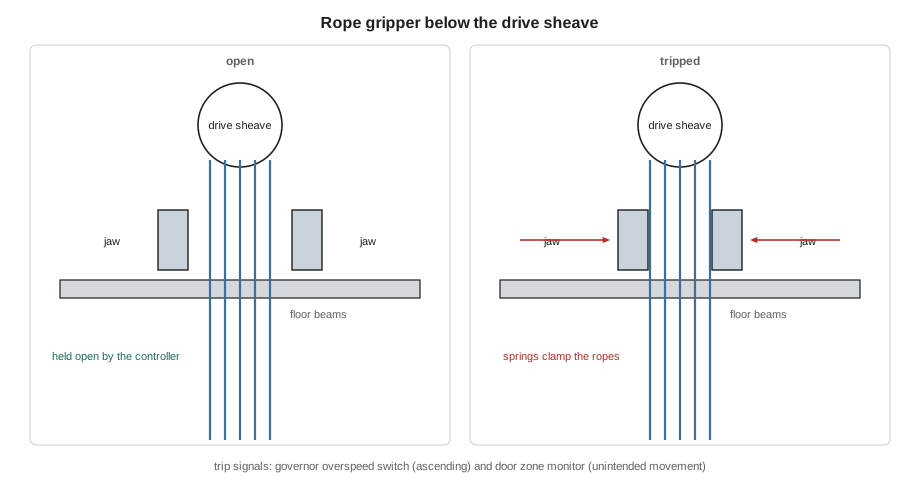
A 1962 machine with a single brake cannot by itself protect against two hazards the current code addresses: a car that rises too fast because the brake or the drive has failed with the counterweight heavier than the car, and a car that moves away from a landing with its doors open. Lesson 3 showed that a controller alteration pulls these requirements in. On a geared car with a single brake, the usual answer is an emergency brake that acts independently of the machine brake, either on the drive sheave, on the ropes, or on the rails. Tillicum's package used a rope gripper: a pair of jaws mounted on the machine beams below the drive sheave, through which the five suspension ropes pass, held open by the controller and released by springs to clamp the ropes when the controller detects ascending overspeed from the governor switch or unintended movement from the door zone sensors.
Mounting a rope gripper is a structural job. It applies its full stopping force to the beams it sits on, so the beams and the gripper's mounting must be checked for that force by the maker's instructions and, where needed, by an engineer. The gripper must suit the number, diameter and construction of the ropes, which was the subject of ELV-410's second finding: the first gripper proposed for Tillicum had been rated for a different rope size range, and the replacement was chosen against the ropes actually on the car. The jaws are aligned so that the ropes pass through them without touching when open, the hydraulic or electrical hold-open circuit is wired to the controller, and the gripper's own test procedure, which trips it with the car moving at slow speed and measures the stopping distance, goes into the pretest plan.
Ropes: reuse or replace?
Tillicum car 1's ropes were two years old, but on most modernizations the ropes are older, and the decision to reuse them is made from wear data, not from age. The code's replacement criteria, which ELV-230 described, depend on broken wires per lay length, the pattern of breaks, the reduction in diameter and corrosion. Repeat measurements from the maintenance records show how fast each rope is wearing and whether it will reach a limit within the period before the next planned rope job. A modernization is often the best time to replace ropes that will be due within a few years, because the car is already out of service and the crew is already there.
# Rope reuse decision from wear records (Pemberton Block car 1, five ropes)
nominal = 0.5                # in
limit = 0.031                  # diameter reduction limit used in the program, in below nominal
readings = {                   # rope: diameters at the worst section, over four annual examinations
    1: [0.500, 0.498, 0.497, 0.495],
    2: [0.501, 0.500, 0.499, 0.497],
    3: [0.484, 0.481, 0.478, 0.475],
    4: [0.500, 0.499, 0.498, 0.497],
    5: [0.499, 0.498, 0.496, 0.495],
}
breaks = {1: 2, 2: 1, 3: 6, 4: 1, 5: 2}       # broken wires in the worst lay at the last examination
BREAK_LIMIT = 8                               # illustrative limit for this rope construction
years_to_next_rope_job = 5
worst = None
for r, d in readings.items():
    rate = (d[0] - d[-1]) / (len(d) - 1)      # loss per year
    left = d[-1] - (nominal - limit)
    yrs = left / rate if rate > 0 else 99
    print(f"rope {r}: {d[-1]:.3f} in, losing {rate:.3f} a year, limit in {yrs:4.1f} years, {breaks[r]} breaks")
    worst = min(worst, yrs) if worst is not None else yrs
reuse = worst > years_to_next_rope_job and max(breaks.values()) < BREAK_LIMIT * 0.6
print(f"first rope reaches its limit in {worst:.1f} years")
print("decision:", "reuse and keep measuring" if reuse else "replace all ropes during the modernization")rope 1: 0.495 in, losing 0.002 a year, limit in 15.6 years, 2 breaks rope 2: 0.497 in, losing 0.001 a year, limit in 21.0 years, 1 breaks rope 3: 0.475 in, losing 0.003 a year, limit in 2.0 years, 6 breaks rope 4: 0.497 in, losing 0.001 a year, limit in 28.0 years, 1 breaks rope 5: 0.495 in, losing 0.001 a year, limit in 19.5 years, 2 breaks first rope reaches its limit in 2.0 years decision: replace all ropes during the modernization
Pemberton Block's rope 3, the one that ELV-420 found riding in the deepest groove, was wearing twice as fast as the others and had the most broken wires. On its own, it would reach the limit within about two years, long before the next planned rope job. Pemberton's controller modernization was due the following year, so Priya added a full set of new ropes and a regroove of the sheave to that scope, rather than replacing rope 3 alone, because a new rope next to four worn ones carries more than its share of the load. The same reasoning applies to belts on machine-room-less cars, whose monitoring devices give the wear data.
Larger machine work
Some modernizations go further. A sheave that cannot be regrooved again is replaced, which on a geared machine means pressing the sheave off its shaft or replacing the shaft assembly. A worn gear set can be replaced by the machine maker or a specialist rebuilder, or the whole machine replaced. The most common machine upgrade today replaces a geared machine with a permanent-magnet gearless machine, as Northcrest did on Tillicum car 2: the new machine is lighter and more efficient, needs no gear oil, runs quietly and has a dual brake that can meet the unintended movement requirement on its own. It needs new beams or an adapter frame, careful checking of the rope angles and wrap on the sheave, a rope replacement because the sheave diameter and groove profile change, and usually a crane or a rigging plan through the building, which ELV-130's capstone covered. Each of these is an alteration with its own code items, and each changes the car's maintenance for the next twenty years.
Worked problem
Is a skimmed drum still usable?
During relining, the brake drum of a geared machine is found scored. It has been skimmed twice before. The maker gives a minimum drum diameter. What should the mechanic check before skimming again?
Show solution
- Measure the drum diameter at several points and compare it with the maker's minimum.
- Work out how much material the skim will remove to clean up the scoring.
- If the drum after skimming would be below the minimum, or the scoring is deeper than a skim can remove, the drum must be replaced.
- Record the drum diameter after the work, so the next mechanic knows how much life is left.
Answer: Measure first: skim only if the finished diameter stays above the maker's minimum, otherwise replace the drum, and record the result.
Common mistakes
MistakeReusing a machine on the strength of the survey alone.
InsteadConfirm the readings with the machine opened up before refurbishing it.
MistakeSkimming a commutator and testing the insulation with the dust still in the motor.
InsteadVacuum out the dust, then test.
MistakeSetting a brake by feel.
InsteadSet the spring force, shoe clearance and plunger travel to the maker's figures, then prove it with load.
MistakeChoosing an emergency brake without checking the ropes it must grip.
InsteadMatch the gripper to the rope number, diameter and construction.
MistakeReplacing one worn rope in a set.
InsteadReplace the set, and regroove if the grooves are uneven.
Summary and key terms
- A kept machine is confirmed with the gear case open: gear wear pattern, backlash, end play, bearings and groove depths.
- DC motors are refurbished at the commutator and brushes and retested for insulation.
- Brakes are relined and set to the maker's figures; the brake must hold 125 % of rated load, checked by calculation and proven by test.
- A single-brake geared car needs an independent emergency brake for ascending overspeed and unintended movement, often a rope gripper.
- Rope reuse is decided from wear rates and broken wires; ropes due within a few years are best replaced during the modernization.
- Larger work, such as sheave or gearless machine replacement, is an alteration in its own right.
- Backlash
- The free movement between the worm and the gear teeth.
- Commutator
- The ring of copper bars on a DC motor armature through which the brushes carry current.
- Undercutting
- Cutting the mica between commutator bars below the copper.
- Rope gripper
- An emergency brake that clamps the suspension ropes, independent of the machine brake.
- Brake drum
- The drum on the motor shaft that the brake shoes grip.
- Regrooving
- Recutting worn sheave grooves to a uniform profile.
Practice problems
Work each problem on paper first, then reveal the answer to check.
Why gauge every sheave groove before reusing a machine?
Show answer
A deeper groove makes its rope carry more load and wear faster.
Why will Tillicum's new brake linings last longer than the old ones?
Show answer
The new drive stops the car before the brake sets, instead of the brake stopping it at speed.
What load must the brake hold at the landing?
Show answer
125 % of rated load.
What two hazards does an emergency brake on a single-brake car protect against?
Show answer
Ascending car overspeed and unintended car movement with the doors open.
Why replace all the ropes instead of the one worn rope?
Show answer
A new rope beside worn ones carries more than its share of the load.
Lesson quiz · 5 questions
Score 60% or more to complete this lesson.
Create a free account to save your progress, take quizzes and earn a certificate.