
ELV-430 · Lesson 2 of 12 · 23 min
Modernization planning, surveys and scope
Two years before the crew arrived with the new controller, Priya and Ray spent a long Saturday surveying Tillicum car 1. A survey is a measured, written inspection of what is actually there, done to decide what a modernization must include, what can be kept and what will surprise the crew if nobody looks. It is the most important document in a modernization, because every later decision rests on it: the scope, the price, the schedule, the code review in ELV-410 and the parts ordered from the controller maker. This lesson covers the survey, the scope and specification that come out of it, and the planning that turns a scope into ten weeks of work in an occupied building.
Who is involved
Large modernizations usually involve four parties. The owner pays and decides. An elevator consultant, hired by the owner, often writes the specification, reviews the contractor's submittals and inspects the work; Tillicum's owners hired Arjun Mehta, a consultant who had once been a mechanic himself. The elevator contractor surveys, prices, designs the details, gets the permit and does the work. The authority, SDCI, the city's building department, reviews the permit application, which ELV-410 followed, and inspects the result. On smaller jobs there is no consultant and the contractor's survey and proposal are the specification. Either way, the survey belongs to everyone: the consultant uses it to write the specification, the contractor to price and plan, the owner to decide, and the crew to know what they will find.
Surveying the machine room
The machine room survey starts with the power: the feeder size and its protection, the mainline disconnect and whether it can be locked, the separate car lighting supply, the condition of the conduit and the arc flash labeling, which Tillicum did not have. Ray measured the supply voltage at the disconnect with the car idle and running, because a weak feeder that is acceptable for a motor-generator set, which starts once and then runs, may sag when a new drive draws its current at every start. The room itself is surveyed for size, headroom, lighting, ventilation, the door and its closer, the access route, storage that does not belong and anything that passes through, such as Tillicum's roof drain, which ELV-410 found.
The machine is surveyed in more detail than any other part, because its condition decides whether a controller modernization is enough. Priya and Ray measured the worm and gear backlash at four positions around the gear, checked the end play of the worm shaft, listened to and felt the bearings, took oil samples from the gear case for analysis, measured the brake drum for wear and scoring and the linings for thickness, and recorded the brake's coil voltage, resistance and plunger travel. The DC hoist motor's insulation resistance was measured with a megohmmeter, its commutator examined for wear, grooving and discoloration, and its brush gear and field windings checked. The motor-generator set was recorded too, even though it would be scrapped, because its nameplate gave the generator voltage and the motor current the new drive had to match.
| Item | Survey reading | Decision |
|---|---|---|
| Worm and gear backlash | 0.015 to 0.017 in at four points | Keep; within the maker's guide |
| Worm shaft end play | 0.004 in | Keep |
| Gear oil sample | Normal wear metals, no water | Keep; change oil during the job |
| Brake drum | Light scoring, no cracks | Keep; skim if needed |
| Brake linings | 0.18 in left | Replace during the job |
| Motor insulation | 180 MΩ at 500 V | Keep |
| Commutator | Slight grooving, good film | Keep; skim and undercut |
| Ropes | Installed two years ago, diameter at baseline | Keep |
Surveying the hoistway, pit and car
In the hoistway, the survey records the rails and their brackets, the counterweight and its guides, the governor rope, the traveling cable, the hoistway doors with their hangers, tracks, closers, interlocks and sills, the hoistway wiring, and anything in the hoistway that does not belong, such as the abandoned steam pipe ELV-410 found. Each hoistway door is checked on every floor, because one bad door can be enough to make the scope include all of them. The pit is surveyed for depth, water, the buffers, the stop switch, the light and the receptacle, the ladder and the refuge space. On the car, the survey records the frame, the platform and its isolation, the guide shoes, the safety and its linkage, the car door, the operator, the car top, the cab and its weight, and the car station and fixtures.
Measurements that seem unnecessary at the time often turn out to matter. Priya measured the car's actual weight by recording the motor current balance with known loads, because the cab had been made heavier in a renovation (as ELV-230 found), and a new drive is set up for the real car weight and counterweight balance, not the nameplate. She photographed every hoistway door, every controller cabinet, the traveling cable at its anchors and every fixture, and she measured the hall fixture openings in the walls, because new fixtures that do not cover the old holes mean wall repairs the owner must arrange. The survey took nine hours and produced forty pages.
Scoring the survey
A survey produces hundreds of observations; the owner needs a short list of what must be done and in what order. Northcrest scored each item on two scales. Condition ran from 1 (new or as new) to 5 (failed or unsafe). Consequence, the effect if the item failed in service, ran from 1 (cosmetic) to 5 (a safety hazard or a long outage). The product of the two gave a priority, and any item that the code would require as part of the planned alterations was flagged as mandatory whatever its score. The scoring is a tool for discussion, not a formula that replaces judgment; Priya changed two scores after talking them through with Ray.
# Survey scoring for Tillicum car 1: condition (1 good .. 5 failed) x consequence (1 cosmetic .. 5 hazard or long outage)
items = [  # (item, condition, consequence, required by the alteration?)
    ("relay controller", 4, 5, True),
    ("motor-generator set", 3, 4, True),
    ("floor selector and landing system", 4, 4, True),
    ("car door operator", 4, 4, False),
    ("hoistway door closers (3 weak)", 3, 3, False),
    ("hoistway door interlocks", 3, 5, False),
    ("brake linings", 3, 5, False),
    ("hall and car fixtures", 3, 2, True),
    ("emergency phone", 4, 4, True),
    ("pit stop switch location", 3, 4, True),
    ("cab finishes", 2, 1, False),
    ("worm and gear", 2, 5, False),
]
rows = sorted(((c * q, n, c, q, m) for n, c, q, m in items), reverse=True)
print(f"{'item':36s}{'cond':>5s}{'cons':>5s}{'score':>7s}  action")
for score, n, c, q, m in rows:
    action = "mandatory" if m else ("include" if score >= 12 else ("consider" if score >= 8 else "defer"))
    print(f"{n:36s}{c:5d}{q:5d}{score:7d}  {action}")
inc = [r for r in rows if r[4] or r[0] >= 12]
print(f"{len(inc)} of {len(rows)} items in the base scope")item cond cons score action relay controller 4 5 20 mandatory floor selector and landing system 4 4 16 mandatory emergency phone 4 4 16 mandatory car door operator 4 4 16 include hoistway door interlocks 3 5 15 include brake linings 3 5 15 include pit stop switch location 3 4 12 mandatory motor-generator set 3 4 12 mandatory worm and gear 2 5 10 consider hoistway door closers (3 weak) 3 3 9 consider hall and car fixtures 3 2 6 mandatory cab finishes 2 1 2 defer 9 of 12 items in the base scope
The scoring put the interlocks, the door operator and the brake linings into the base scope alongside the items the alteration made mandatory, and left the cab finishes and the worm and gear out. The weak door closers scored nine, in the 'consider' band, and Arjun added them because the hoistway doors would be off their tracks anyway when the new door equipment went in, so the closers would cost little extra then and much more later.
From survey to scope and specification
The scope is the list of what will be replaced, what will be kept and what will be refurbished, written so that two contractors pricing it would include the same work. The specification adds how: the equipment's performance (speed, acceleration, leveling accuracy, door times, noise limits), its standards (the code edition in force, the electrical code, accessibility requirements), the submittals the contractor must provide, the testing and acceptance, the warranty, the maintenance period after completion, and the conditions of the work such as working hours, protection of finishes and keeping one car in service. A good specification also says what the contractor must not do, for example use proprietary equipment that only the installing company can service. Tillicum's specification required a non-proprietary controller with diagnostic tools available to any licensed contractor, which matters for the owner's choice of maintenance company for the next twenty years.
The scope for car 1 kept the machine, motor, governor, safeties, ropes, rails, counterweight, buffers and car frame. It replaced the relay controller and motor-generator set with a microprocessor controller and a static DC drive, the floor selector with an absolute landing system, the door operator and car door equipment with a closed-loop operator and a full-height light curtain, the hoistway door equipment and closers, the traveling cable and hoistway wiring, and all fixtures. It added a rope gripper for ascending car overspeed and unintended movement protection, a one-button emergency phone, a car top inspection station with a guardrail, pit equipment, machine room ventilation and a separate car lighting circuit, as ELV-410's package set out.
Planning the work
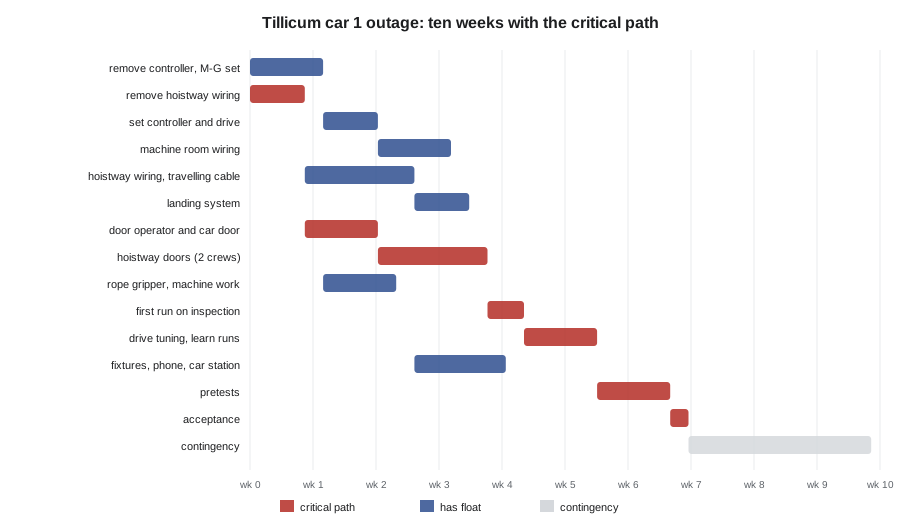
A modernization in an occupied building is planned backward from the owner's limits: how long the building can manage with one car, when deliveries can come in, when noisy work is allowed, and when the inspector can be booked. Long-lead items are ordered first; the controller, drive and landing system for Tillicum had a fourteen-week lead time from approved drawings, so the drawings had to be approved and the order placed four months before the outage began. The outage itself is planned as a sequence of tasks with durations and dependencies, and the longest chain of dependent tasks, the critical path, sets the outage length. Tasks off the critical path have float: they can slip without delaying the finish. Tasks on it cannot.
# Critical path for the Tillicum car 1 outage (crew working days)
tasks = {  # name: (duration in working days, prerequisites)
    "remove old controller and M-G set": (4, []),
    "remove hoistway wiring and selector": (3, []),
    "set controller and drive": (3, ["remove old controller and M-G set"]),
    "run machine room wiring": (4, ["set controller and drive"]),
    "install hoistway wiring and traveling cable": (6, ["remove hoistway wiring and selector"]),
    "install landing system": (3, ["install hoistway wiring and traveling cable"]),
    "door operator and car door": (4, ["remove hoistway wiring and selector"]),
    "hoistway doors and closers (9 floors)": (9, ["door operator and car door"]),
    "rope gripper and machine work": (4, ["remove old controller and M-G set"]),
    "first run on inspection": (2, ["run machine room wiring", "install landing system", "rope gripper and machine work"]),
    "drive tuning and learn runs": (4, ["first run on inspection"]),
    "fixtures, phone and car station": (5, ["install hoistway wiring and traveling cable"]),
    "pretests": (4, ["drive tuning and learn runs", "hoistway doors and closers (9 floors)", "fixtures, phone and car station"]),
    "acceptance inspection": (1, ["pretests"]),
}
early = {}
def finish(t):
    if t not in early:
        d, pre = tasks[t]
        early[t] = max((finish(p) for p in pre), default=0) + d
    return early[t]
end = max(finish(t) for t in tasks)
late = {t: end for t in tasks}
for t in sorted(tasks, key=finish, reverse=True):
    for p in tasks[t][1]:
        late[p] = min(late[p], late[t] - tasks[t][0])
print(f"outage: {end} working days = about {end / 5:.1f} weeks")
for t in sorted(tasks, key=finish):
    fl = late[t] - early[t]
print(f"{t:44s} finishes day {early[t]:2d} float {fl:2d}" + (" CRITICAL" if fl == 0 else ""))outage: 23 working days = about 4.6 weeks remove hoistway wiring and selector finishes day 3 float 0 CRITICAL remove old controller and M-G set finishes day 4 float 1 set controller and drive finishes day 7 float 1 door operator and car door finishes day 7 float 2 rope gripper and machine work finishes day 8 float 4 install hoistway wiring and traveling cable finishes day 9 float 0 CRITICAL run machine room wiring finishes day 11 float 1 install landing system finishes day 12 float 0 CRITICAL first run on inspection finishes day 14 float 0 CRITICAL fixtures, phone and car station finishes day 14 float 4 hoistway doors and closers (9 floors) finishes day 16 float 2 drive tuning and learn runs finishes day 18 float 0 CRITICAL pretests finishes day 22 float 0 CRITICAL acceptance inspection finishes day 23 float 0 CRITICAL
The calculation showed a critical path of about seven weeks of crew time running through the door work: the car door, then the hoistway doors floor by floor, then the pretests. The controller and wiring had float, so a late delivery of a cabinet would not delay the job as long as the door crew stayed on schedule. Lena added a second crew for the hoistway doors in weeks three and four, which shortened the critical path, and then added two weeks of contingency for the inspector's calendar, a held part and the unknowns of a 1962 building, which gave the ten-week outage the owner was told to expect.
Living with the building
The owner, the tenants and the people who use the building every day are part of the plan. Tenants were told the dates in writing six weeks ahead, with a phone number to call; the one remaining car was put on a short callback response; the lobby floor was protected where the crew carried equipment; noisy work such as drilling for fixture boxes was kept to agreed hours; and every evening the hoistway openings on car 1 were barricaded and locked. Tillicum had no generator, so the plan also covered what would happen to the remaining car in a power failure and who would be called. The best measure of a well-planned modernization is that the building's occupants remember it as an inconvenience, not a crisis.
Worked problem
A survey finding that changes the scope
On a survey of a hydraulic car, the mechanic finds that the oil usage log shows a slow, steady loss of oil over four years, with no visible leaks in the machine room or pit. The cylinder is buried and has no casing. The planned scope is a controller and door modernization only. What should the survey report say?
Show solution
- Unexplained oil loss from a buried, uncased cylinder can mean a leak into the ground.
- Recommend a cylinder leakage test (Category 3 style) before the scope is settled.
- If the loss is confirmed, the scope should include cylinder replacement with a lined or cased cylinder, which is lesson 7's subject.
- Report the finding to the owner in writing now, because a leak may also be an environmental reporting matter.
Answer: Report the loss, recommend a test before finalizing the scope and flag a possible cylinder replacement; the survey exists to catch exactly this.
Common mistakes
MistakeSurveying only what will be replaced.
InsteadSurvey what will be kept too; its condition decides whether the scope is right.
MistakeUsing nameplate data for car weight and balance.
InsteadMeasure the actual car and counterweight balance; renovations change them.
MistakeLeaving long-lead items until the outage starts.
InsteadOrder them from approved drawings months ahead.
MistakePlanning the outage without a critical path.
InsteadFind the longest chain of dependent tasks and manage it.
MistakeSpecifying proprietary equipment by accident.
InsteadRequire diagnostic tools available to any licensed contractor if the owner wants a choice.
Summary and key terms
- A survey is a measured, written inspection that every later decision rests on.
- The machine room survey covers power, the room, and the machine, brake, motor and M-G set in detail; the hoistway, pit and car are surveyed item by item.
- Scoring condition and consequence turns hundreds of observations into a priority list, with code-required items flagged as mandatory.
- The scope lists what is replaced, kept and refurbished; the specification adds performance, standards, submittals, testing and conditions.
- The critical path sets the outage length; long-lead items are ordered months ahead; contingency covers the unknowns.
- Occupants are part of the plan: notice, protection, quiet hours and the remaining car's reliability.
- Survey
- A measured, written inspection of existing equipment done to decide the scope of a modernization.
- Scope
- The list of what will be replaced, kept and refurbished in a modernization.
- Specification
- The document that sets the performance, standards, submittals, testing and conditions of the work.
- Critical path
- The longest chain of dependent tasks in a schedule, which sets the finish date.
- Float
- The time a task can slip without delaying the finish.
- Long-lead item
- Equipment that must be ordered well ahead because it takes weeks or months to make.
Practice problems
Work each problem on paper first, then reveal the answer to check.
Why measure the supply voltage with the car running?
Show answer
A feeder adequate for an M-G set may sag when a new drive starts the motor at every run.
Why survey the machine in detail on a controller modernization?
Show answer
Its condition decides whether keeping it is safe and sensible.
What does the consequence score in a survey mean?
Show answer
The effect if the item failed in service, from cosmetic to a hazard or long outage.
What is float?
Show answer
The time a task can slip without delaying the finish of the job.
Why did the Tillicum specification require a non-proprietary controller?
Show answer
So that any licensed contractor can maintain the car with available diagnostic tools.
Lesson quiz · 5 questions
Score 60% or more to complete this lesson.
Create a free account to save your progress, take quizzes and earn a certificate.