
ELV-430 · Lesson 10 of 12 · 20 min
Troubleshooting electrical and control faults
Most elevator callbacks are electrical or control faults, or look like them: the car shuts down, the controller shows a fault, and the mechanic has to decide whether the fault is real, where it is and what caused it. ELV-210 taught the electrical theory, ELV-310 the controllers and their diagnostics, and lesson 9 the method. This lesson applies them to the faults Tamsin met during her two weeks on Route 7 and the weeks after: a drive that tripped on hot afternoons at Seaview Medical, a hydraulic pump motor that kept tripping its overload at Holloway Memorial Hospital, and a ground fault on Pemberton Block's traveling cable. Each shows a different tool: correlating fault records with conditions, measuring the supply, and testing insulation.
Measuring safely
Electrical troubleshooting means measuring live circuits, and the meter is the mechanic's main protection as well as their main tool. The meter and its leads must be rated for the measurement category of the circuit: a controller's line side, a drive's DC bus and a motor's terminals are high-energy circuits where an under-rated meter can fail violently in a transient. The arc flash and shock protection rules from ELV-210 apply: work dead where possible, wear the protective equipment the hazard assessment requires where it is not, test the meter on a known source before and after proving a circuit dead, and remember that a drive's DC bus can stay charged for minutes after the supply is off, until its indicator and a measurement both show it discharged.
Most control faults are found with voltage readings across contacts and from points to a common reference. A closed contact carrying current has almost no voltage across it; an open one has the full circuit voltage across it, as ELV-210's safety string example showed. A contact that is closed but dirty or burnt has a small voltage across it that rises with the current and with heat, which is often how intermittent faults start. Resistance readings are taken only with the circuit dead and isolated, and are useful for coils, windings and suspected high-resistance connections.
A drive that trips on hot afternoons
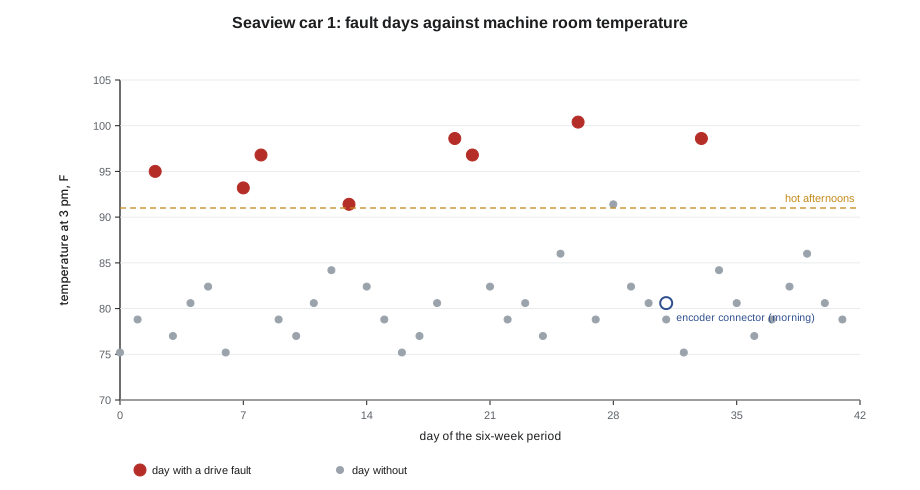
Seaview Medical car 1, a gearless car with a regenerative drive, had tripped on drive faults nine times in six weeks. The fault codes varied, which made the first mechanic suspect a failing drive, and a replacement control board was already on order. Tamsin pulled the drive's fault history with the service tool and matched each fault with the machine room temperature, which the new building management system logged every fifteen minutes. The faults clustered in the afternoon, on the hottest days.
# Correlating drive faults with machine room temperature, Seaview car 1
faults = [  # (date, time, fault, machine room temperature at the time, F)
    ("06-02", "14:20", "heatsink temperature", 95),
    ("06-09", "15:05", "DC bus overvoltage", 93),
    ("06-10", "16:40", "heatsink temperature", 97),
    ("06-17", "13:55", "overcurrent", 91),
    ("06-23", "15:30", "heatsink temperature", 99),
    ("06-24", "14:10", "DC bus overvoltage", 97),
    ("07-01", "16:15", "heatsink temperature", 100),
    ("07-03", "11:20", "encoder", 81),
    ("07-08", "15:45", "heatsink temperature", 99),
]
all_hours = [75, 79, 95, 77, 81, 82, 75, 93, 97, 79, 77, 81, 84, 91, 82, 79, 75, 77, 81, 99, 97, 82, 79, 81, 77, 86, 100, 79, 91, 82, 81, 79, 75, 99, 84, 81, 77, 79, 82, 86, 81, 79]      # temperatures logged at 15:00 every day over the same six weeks, F
mean_all = sum(all_hours) / len(all_hours)
mean_f = sum(f[3] for f in faults) / len(faults)
hot = 91
n_hot_days = sum(1 for t in all_hours if t >= hot)
n_hot_faults = sum(1 for f in faults if f[3] >= hot)
print(f"{len(faults)} faults; average room temperature at a fault {mean_f:.1f} F against {mean_all:.1f} F on an ordinary afternoon")
print(f"{n_hot_faults} of {len(faults)} faults happened at {hot} F or more, a temperature reached on {n_hot_days} of {len(all_hours)} afternoons")
afternoon = sum(1 for f in faults if 12 <= int(f[1][:2]) < 18)
print(f"{afternoon} of {len(faults)} faults between 12:00 and 18:00")
print("conclusion: faults follow the room temperature, not the drive's age; check the cooling first")9 faults; average room temperature at a fault 94.7 F against 83.2 F on an ordinary afternoon 8 of 9 faults happened at 91 F or more, a temperature reached on 9 of 42 afternoons 8 of 9 faults between 12:00 and 18:00 conclusion: faults follow the room temperature, not the drive's age; check the cooling first
The pattern pointed away from the drive board and toward cooling. The machine room's ventilation fan, which should have started at a set temperature, was running, but its thermostat had been moved during a roofing repair and now sat in the cool air stream by the intake louver, so the fan ran at its low speed while the room heated up. Inside the drive, the heatsink fan's filter was clogged with dust. Hot heatsinks reduce the drive's current capacity, and the drive's protection tripped at the first demanding run: a heavy start gave an overcurrent fault, a hard regenerative stop with the braking circuit running hot gave a DC bus overvoltage. The one fault that did not fit, an encoder fault on a cool morning, turned out to be unrelated: a loose encoder connector, found and secured on the same visit. The order for the control board was canceled, the thermostat moved back to the room's warmest point, the filter cleaned and added to the maintenance control program, and the faults stopped.
A pump motor that trips its overload
Holloway Memorial Hospital car 1, a hydraulic bed car, tripped its pump motor overload two or three times a week, always on up runs with a bed and staff aboard. The overload had been reset each time and once replaced, and the motor's nameplate current was not far below the overload setting. Tamsin measured the supply at the starter with the car running up with a test load: the three line voltages and the three line currents. The voltages were close, but not equal, and the currents much less so.
# Voltage and current unbalance at the pump motor starter, Holloway car 1
volts = (478, 467, 482)          # line-to-line, V
amps = (64, 75, 60)           # line currents on an up run with load, A
fla = 69                          # motor full-load current from the nameplate, A
def unbalance(x):
    avg = sum(x) / 3
    return 100 * max(abs(v - avg) for v in x) / avg, avg
vu, vavg = unbalance(volts)
iu, iavg = unbalance(amps)
print(f"voltage: average {vavg:.0f} V, unbalance {vu:.1f} %")
print(f"current: average {iavg:.0f} A, unbalance {iu:.1f} %, highest line {max(amps)} A against {fla} A full load")
# a rule of thumb: motor heating rises by about twice the square of the voltage unbalance in percent
print(f"extra heating from voltage unbalance about {2 * vu ** 2:.0f} %")
print("check:", "supply problem - find the cause before resetting the overload again" if vu > 1 or iu > 10 else "supply acceptable")voltage: average 476 V, unbalance 1.8 % current: average 66 A, unbalance 13.1 %, highest line 75 A against 69 A full load extra heating from voltage unbalance about 7 % check: supply problem - find the cause before resetting the overload again
A voltage unbalance of under 2 % produced a current unbalance of more than 10 %, which is typical, because a motor's negative-sequence current from even a small voltage unbalance is large. One line was carrying more than the motor's full-load current while the average was below it, so the overload, which senses the highest line, tripped. The cause was in the supply, not the elevator: following the low line back, Tamsin and the hospital's electrician found a loose, discolored connection on one phase of the feeder at the building's distribution panel. Once it was remade, the unbalance fell well under 1 % and the trips stopped. The overload had been doing its job all along, and resetting it repeatedly without measuring had let the connection get worse.
A ground fault in the traveling cable
Pemberton Block car 1's controller reported a ground fault on its 120 V control circuit, briefly, a few times a month. A ground fault is a connection, through damaged insulation, between a conductor and grounded metal. On a grounded system it can blow a fuse or trip a protective device; on the isolated or ground-detected control circuits many controllers use, it is reported by a ground detector before it causes harm, which gives the mechanic a chance to find it. The fault was intermittent, so Tamsin used insulation resistance tests on each part of the circuit with the circuit dead and isolated, comparing the results with the last recorded readings, and then repeated the traveling cable tests with the car at the top, the middle and the bottom of the hoistway.
# Insulation resistance of control circuit sections to ground, Pemberton car 1 (500 V test); TC = traveling cable
readings = {  # section: megohms now, megohms at the last annual test
    "machine room wiring": (250, 300),
    "hoistway riser": (180, 200),
    "TC, car at top": (95, 120),
    "TC, car at middle": (40, 120),
    "TC, car at bottom": (0.6, 120),
    "car wiring": (150, 160),
}
for sec, (now, last) in readings.items():
    flag = "LOW" if now < 2 else ("falling" if now < last / 5 else "")
    print(f"{sec:34s}{now:8.1f} MΩ   last {last:6.1f} MΩ  {flag}")
print("the TC reading changes with car position: look where the cable bends at the bottom of its loop")machine room wiring 250.0 MΩ last 300.0 MΩ hoistway riser 180.0 MΩ last 200.0 MΩ TC, car at top 95.0 MΩ last 120.0 MΩ TC, car at middle 40.0 MΩ last 120.0 MΩ TC, car at bottom 0.6 MΩ last 120.0 MΩ LOW car wiring 150.0 MΩ last 160.0 MΩ the TC reading changes with car position: look where the cable bends at the bottom of its loop
The traveling cable's insulation was good with the car at the top, worse at the middle, and nearly a short with the car at the bottom, where the cable's loop rests lowest in the pit. In the pit, Tamsin found the reason: the cable's loop had been brushing against a sharp edge of a new pit ladder bracket, installed during a code upgrade, and had worn through its jacket and one conductor's insulation. The worn conductor touched the bracket only when the car was low. The bracket was moved and guarded, and the cable, which had a spare conductor of the same size, was repaired by moving the circuit to the spare and recording the change on the drawings; Priya noted that the damaged section would be replaced at Pemberton's coming modernization.
Communication and sensor faults
Modern controllers depend on serial links: between the controller and the car, the hall fixtures, the group dispatcher and the drive. A failing link shows as lost calls, fixtures that stop working, cars dropping out of the group or controller faults reporting a lost node. The service tool's diagnostics show which nodes are reporting and how many messages are lost, and the usual causes are mechanical: a connector worked loose, a termination resistor missing after a fixture change, a shield grounded at the wrong end, a cable run beside a motor lead, or water. Encoders and landing system sensors fail in the same mechanical ways, plus dirt on optical tapes and vanes. The rule is the same as for relays: look for the change that coincides with the fault.
Worked problem
A fault code that names the wrong part
A car's controller reports an encoder fault several times a day, always just after the car starts. The encoder has been replaced and the faults continue. What should be checked next?
Show solution
- A fault code names the signal that went wrong, not always the part that caused it.
- Faults just after starting point to the moment of highest current and vibration.
- Check the encoder cable and its shield grounding, its routing near the motor leads, the connectors at both ends and the encoder's coupling to the motor shaft.
- Watch the encoder signal with the service tool or a scope during starts to see whether the signal drops or is noisy.
Answer: Look beyond the named part: check the encoder's cable, shield, routing, connectors and coupling, and watch the signal during starts.
Common mistakes
MistakeUsing a meter rated below the circuit's measurement category.
InsteadUse meters and leads rated for the circuit, and check the meter before and after.
MistakeReplacing parts because of a fault code.
InsteadUse the code to find the signal, then find what disturbed it.
MistakeResetting an overload repeatedly.
InsteadMeasure voltage and current on all three lines and find why it trips.
MistakeIgnoring building and environment data.
InsteadTemperature, power and building logs often explain a pattern.
MistakeTesting insulation with the circuit live or connected to electronics.
InsteadIsolate the section and disconnect sensitive equipment first.
Summary and key terms
- Measure safely: rated meters, protective equipment, proven dead, and the drive's DC bus discharged.
- Voltage across a contact shows its state; small, rising voltage drops reveal dirty or burnt contacts.
- Correlate fault records with conditions such as temperature, time and load to find patterns.
- Small voltage unbalance causes large current unbalance and overload trips; the cause is often in the supply.
- Insulation resistance tests by section, and with the car at different positions, find intermittent ground faults.
- Serial link, encoder and sensor faults are usually mechanical: connectors, shields, routing, terminations, dirt and water.
- Measurement category
- The rating of a meter for the transient energy of the circuit being measured.
- Voltage unbalance
- The largest difference of a line voltage from the average, as a percentage of the average.
- Ground fault
- An unintended connection through damaged insulation between a conductor and grounded metal.
- Insulation resistance
- The resistance between a conductor and ground, measured with a high test voltage.
- Heatsink
- The metal part that carries heat away from a drive’s power electronics.
- Termination resistor
- A resistor at the end of a serial link that prevents signal reflections.
Practice problems
Work each problem on paper first, then reveal the answer to check.
What voltage appears across an open contact in a live series circuit?
Show answer
The full circuit voltage.
Why did the Seaview drive trip with different fault codes?
Show answer
Heat reduced its capacity, so whatever run was most demanding tripped a different protection.
Why does a small voltage unbalance cause a large current unbalance?
Show answer
The motor's negative-sequence current from the unbalance is large.
Why test the traveling cable with the car at different positions?
Show answer
The cable bends at different points, so a damaged spot may touch ground only in some positions.
Name three common causes of serial link faults.
Show answer
Loose connectors, missing termination resistors, wrong shield grounding, routing beside motor leads, water.
Lesson quiz · 5 questions
Score 60% or more to complete this lesson.
Create a free account to save your progress, take quizzes and earn a certificate.