
ELV-420 · Lesson 8 of 12 · 20 min
Buffer, brake and unintended movement tests
The second half of Tillicum car 1's test day was the brake, and the next week brought Larchmont's annual tests and Seaview car 1's five-year tests, which included its rope gripper. Between them Tamsin saw every kind of device that protects the ends of the hoistway and the car at a landing: spring and oil buffers, an old drum brake and a modern disc brake, an emergency brake that grips the ropes and a car that must not creep away from a floor with its doors open. Larchmont also gave her the answer to the blank page she had found in its program in lesson 2: the oil usage record for its buffers. This lesson covers the tests of buffers, brakes, ascending car overspeed protection and unintended movement protection, how they are done and what the results mean.
Buffers
Buffers are the last protection at the bottom of the hoistway. If a car or counterweight runs past its terminal stopping devices, the buffer absorbs its energy and brings it to rest within a limited deceleration. Spring buffers, used on slower cars such as Tillicum car 1, are essentially stops with a spring; they are examined for damage, corrosion, secure mounting and correct height and are not load-tested in service beyond what the inspection guide calls for. Oil buffers, used on faster cars and on Larchmont, force oil through orifices as the plunger is compressed, and their performance depends on the oil level and the condition of the orifices and seals. After compression, an oil buffer's plunger must return to its fully extended position, pushed by its return spring, within the time the code allows, commonly 90 seconds; a buffer that returns slowly or not at all has a problem with its spring, its oil or its plunger.
Annually, the oil level is checked with the buffer's dipstick or sight gauge, the buffer is examined for leaks and the plunger is compressed and its return watched and timed. Every five years the buffer is tested as the inspection guide describes, which commonly means striking it with the car or counterweight at a set speed and load and measuring its return. Where reduced-stroke buffers are used together with emergency terminal speed limiting devices, as at Quayside, those devices are tested at the same time, because the shorter buffer stroke relies on them to keep the striking speed down.
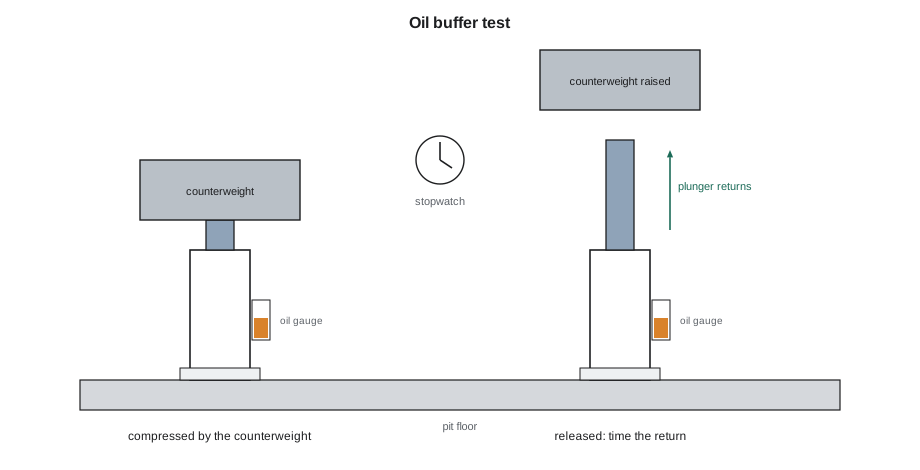
Larchmont's annual test found the counterweight buffer's oil just below the minimum mark and a damp ring of oil around the plunger seal. Tamsin topped it up with the oil the maker specified, wrote the amount on the buffer oil page that had been blank, and timed the return: well inside the limit. Ray put a new seal on the repair list. When she checked the history, she found the same buffer had been topped up twice in two years with nothing recorded, which explained why nobody had noticed the trend. That is the purpose of the oil usage record, and the reason the code asks for one.
Brakes
The brake on a traction machine holds the car at a landing, stops it when power is removed in an emergency, and on many modern machines also acts as the emergency brake for unintended movement and ascending car overspeed. Brakes are examined and measured on routine visits, as lesson 4 described. Their tests check that they can do their job with load. The code requires a brake to hold the car with a specified overload at rest, commonly 125 % of rated load for passenger elevators, and to stop the car within limits when power is removed while it is running. The acceptance test for a new or altered installation, and the periodic brake test in the edition that applies, check these with weights in the car or by an alternative method the maker specifies. Freight elevators of some loading classes have their own load figures.
Tillicum car 1's brake test followed its safety test. The extra weights were added to bring the load to 125 % of rated. Ray first parked the car at the bottom landing with the brake set and watched a mark on the brake drum and another on the ropes for several minutes: no creep. Then he ran the car down at rated speed and, as it passed a marked point, Jonah opened the machine's main line contactor from the controller as the procedure described. The brake set, the car stopped, and Tamsin measured the slide distance from the mark to where the car stopped. With that distance and the speed, the average deceleration could be worked out and compared with what the program expected for this car.
# Brake tests, Tillicum car 1: hold at rest and stop from rated speed with 125 % load
v = 200                     # car speed when power was removed, ft/min
slide = 16.5                 # distance from the mark to the stop, in
creep = 0                 # car movement while parked for 5 min with 125 % load, in
EXPECTED_MAX = 24.0       # longest stop expected for this car from its acceptance record (illustrative), in
G = 9.81
v_ms = v * 0.00508
s_m = slide * 0.0254
decel = v_ms ** 2 / (2 * s_m)
print(f"stop from {v} ft/min in {slide} in: average deceleration {decel:.2f} m/s2 ({decel / G:.2f} g)")
print(f"creep while holding: {creep} in")
hold_ok = creep == 0
stop_ok = slide <= EXPECTED_MAX and decel / G <= 1.0
print("hold at rest:", "pass" if hold_ok else "fail - brake slipping under load")
print("stop from speed:", "pass" if stop_ok else "fail - investigate lining, spring force and adjustment")stop from 200 ft/min in 16.5 in: average deceleration 1.23 m/s2 (0.13 g) creep while holding: 0 in hold at rest: pass stop from speed: pass
The brake held and stopped the car comfortably inside the distance on its acceptance record from 1962, which Ray had dug out of the building's files. Moira noted that a brake stopping much more sharply than expected is also worth investigating: a brake adjusted too hard gives passengers a violent stop and loads the ropes, the machine and the car. On geared machines like Tillicum's, the brake test is also a test of the worm and gear, which carry the braking torque from the drum to the sheave, so the machine was examined for any sign of movement or damage afterwards.
On machines whose brake has two independent sets of springs and linings, such as Seaview's gearless disc brakes, the code and maker require each half to be tested on its own for its ability to hold or stop the car, because the second half is what keeps the car safe if the first fails. The maker's procedure explains how to release one half at a time, and the brake monitoring system's own checks are confirmed at the same time.
Ascending car overspeed and unintended movement protection
Two hazards were not covered by the older codes Tillicum car 1 was built to. An empty car is lighter than its counterweight, so if the brake or the machine fails, the car can accelerate upward and strike the top of the hoistway. And a car stopped at a landing with its doors open can move away from the floor if the brake fails or the drive drives it, shearing anyone stepping in or out. Editions of the code from around 2000 onward require both ascending car overspeed protection and unintended movement protection on new traction elevators, and alterations such as Tillicum car 1's modernization bring them in on older ones. These functions are provided by an emergency brake, which may be a rope gripper acting on the suspension ropes, a brake acting on the sheave or the machine's own brake if it meets the code's requirements, together with a detection means.
The tests show that the detection works and that the emergency brake stops the car within the code's limits. For ascending car overspeed, the usual test runs the empty car upward and causes the detection means to act, often by the maker's method of lowering the trip setting or simulating an overspeed, and then measures the stop. For unintended movement, the car is stopped at a landing with its doors open and made to move away, typically on inspection operation with the brake held open or with the maker's test function, and the distance the car travels before the emergency brake stops it is measured. The code limits that distance; the figure commonly quoted is 48 in from the landing, and the maker's design is usually much shorter. At Seaview, the rope gripper was tested both ways, following the maker's procedure on the controller's service tool, with Tamsin measuring the travel from a tape mark on the hoistway door frame.
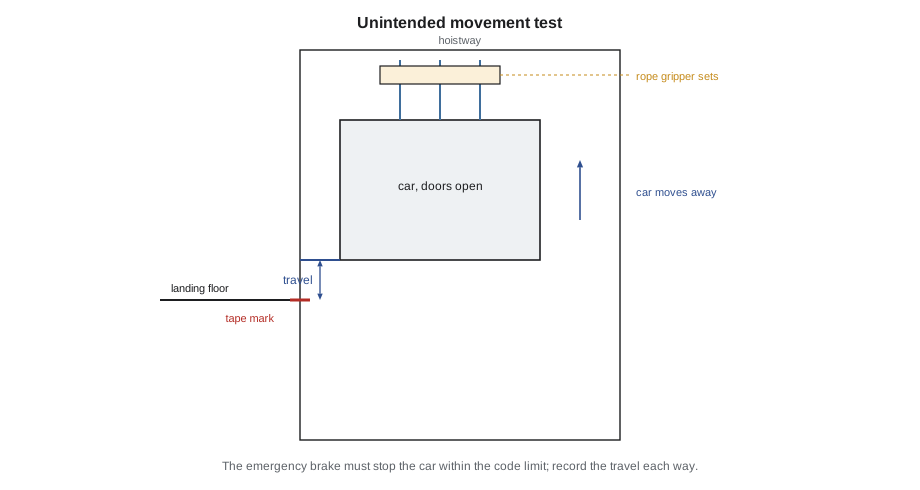
# Unintended movement and ascending overspeed results, Seaview car 1 (rope gripper)
LIMIT = 48             # code limit on travel away from the landing, in
ucm = {"up, empty car": 12.2, "down, rated load": 10.6}       # travel before the stop, in
for case, d in ucm.items():
    print(f"unintended movement {case}: {d} in ({100 * d / LIMIT:.0f} % of limit) -> {'pass' if d <= LIMIT else 'fail'}")
trip_speed = 443        # car speed when the ascending overspeed detection acted, ft/min
rated = 350             # rated speed, ft/min
print(f"ascending overspeed detection acted at {trip_speed} ft/min = {100 * trip_speed / rated:.0f} % of rated speed")
print("check this against the maker's setting and the code's limit for the detection means")unintended movement up, empty car: 12.2 in (25 % of limit) -> pass unintended movement down, rated load: 10.6 in (22 % of limit) -> pass ascending overspeed detection acted at 443 ft/min = 127 % of rated speed check this against the maker's setting and the code's limit for the detection means
Both unintended movement results were a fraction of the limit. Tamsin noticed that the upward test with the empty car traveled further than the downward test with rated load, and Ray asked her to explain it: with the car empty the counterweight is heavier, so the car accelerates upward faster before the gripper sets, and goes further. The test that matters most for each car is the direction in which the unbalanced load drives it.
Terminal stopping devices
Normal terminal stopping devices slow and stop the car at the top and bottom landings if the regular stopping means fails; final terminal stopping devices, the final limits, open the safety circuit and stop the car if it runs past the terminal landing. Emergency terminal speed limiting and stopping devices, where fitted, check the car's speed as it approaches the terminals. Each is tested on its own interval by running the car into it on inspection or at the speed the procedure requires, with the normal stopping means disabled for the test as the maker describes, and each test is followed by restoring and checking the normal means. The final limit test at Tillicum was the last test of the day, and Ray had Tamsin count every jumper back into the box before the car went back on normal service.
Worked problem
A buffer that will not return
During Seaview car 2's annual tests, the counterweight oil buffer is compressed and takes 4 minutes to return, and the last few centimeters take longest. The oil level is at the mark. What could cause this and what should be done?
Show solution
- Slow return with correct oil level points to the return spring or to the plunger binding in its cylinder.
- Examine the plunger for corrosion, scoring or dirt and the spring for breakage or fatigue.
- The buffer has failed its test: the car is not returned to normal service until the buffer is repaired or replaced and retested.
- Record the result, the cause found and the repair, with the retest time.
Answer: Suspect a weak or broken spring or a binding plunger; repair or replace, retest, and keep the car out of normal service until the buffer passes.
Common mistakes
MistakeTopping up buffer oil without recording it.
InsteadRecord every addition; repeated top-ups reveal a leaking seal.
MistakeTesting only one half of a dual brake.
InsteadTest each independent half for its ability to hold or stop the car.
MistakeJudging a brake only by whether it stops the car.
InsteadCompare the stop with the expected distance; too sharp a stop is also a problem.
MistakeRunning unintended movement tests only downward.
InsteadTest in the direction the unbalanced load drives the car, often upward with the car empty.
MistakeLeaving the normal terminal means disabled after a final limit test.
InsteadRestore and check the normal means and count every jumper back.
Summary and key terms
- Oil buffers are checked annually for oil level, leaks and return time, and tested every five years as the inspection guide describes; their oil additions are recorded.
- Brakes must hold a specified overload at rest, commonly 125 % of rated load for passenger elevators, and stop the car within limits when power is removed.
- Dual brakes have each half tested on its own; brake tests on geared machines also load the worm and gear.
- Ascending car overspeed and unintended movement protection are tested by causing the detection to act and measuring the emergency brake's stop.
- Unintended movement travel is limited by the code, commonly 48 in; the worst case is usually the direction the unbalanced load drives the car.
- Terminal devices are tested by running the car into them, then the normal means is restored and checked.
- Oil buffer
- A buffer that absorbs energy by forcing oil through orifices as its plunger is compressed.
- Return time
- The time for a compressed oil buffer plunger to return to full extension.
- Brake hold test
- A test that the brake holds the car at rest with a specified overload.
- Emergency brake
- A device such as a rope gripper or sheave brake that stops the car for ascending overspeed or unintended movement.
- Unintended movement
- Movement of a car away from a landing with its doors not closed and locked.
- Final terminal stopping device
- A switch that stops the car if it runs past a terminal landing.
Practice problems
Work each problem on paper first, then reveal the answer to check.
Why does an oil buffer's return time matter?
Show answer
A slow return shows a weak spring, binding plunger or oil problem, and the buffer must be extended to protect the next strike.
What overload must a passenger elevator brake commonly hold at rest?
Show answer
125 % of rated load.
Why is each half of a dual brake tested on its own?
Show answer
The second half must keep the car safe if the first fails.
Why does the empty car often travel furthest in an upward unintended movement test?
Show answer
The counterweight is heavier than the empty car, so the car accelerates upward faster.
What follows a final limit test?
Show answer
Restoring and checking the normal stopping means and removing all jumpers.
Lesson quiz · 5 questions
Score 60% or more to complete this lesson.
Create a free account to save your progress, take quizzes and earn a certificate.